



Journalists should, by the very nature of their profession, stand on the side of freedoms, but unfortunately, the pro-government media has positioned itself as a supporter of bans and pressures in the fields of art and culture. Sometimes, the wave of lynching against artists even starts with journalists before it hits social media. Then come the concert bans, access restrictions, investigations, detentions, and arrests…
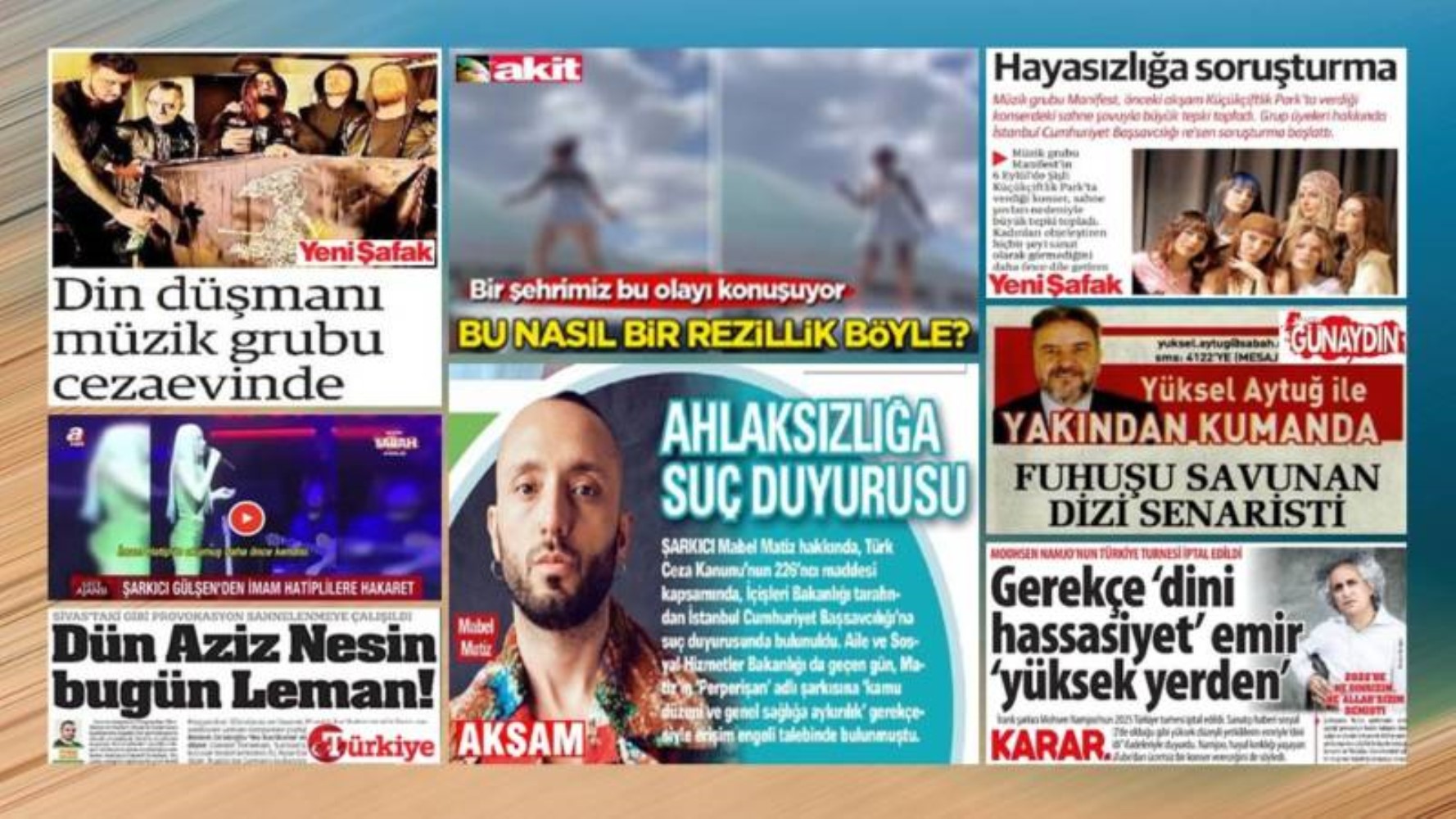
You may recall that the artist Gülşen was constantly targeted by the pro-government media due to her revealing stage outfits. Eventually, her remarks about imam hatip high school students at a concert in Istanbul in 2023 became an opportunity. As a result of a campaign by trolls and the pro-government media, Gülşen was arrested and spent four days in jail; she was also sentenced to 10 months in prison on charges of “inciting the public to hatred and hostility.” They are still obsessing over Gülşen’s clothes.
The magazine LeMan was also targeted, first on social media and then in the pro-government media, because of an anti-war cartoon. While reports of “vile cartoon from LeMan” followed one another, even the Anadolu Agency wrote about an “anti-Muslim cartoon from LeMan magazine.” In the end, the magazine’s office was raided, an investigation was launched, and four people from the magazine were arrested on charges of “insulting religious values”; despite the prosecutor’s request for their release, they have been in prison for 2.5 months.
As in the cases of LeMan and Gülşen, there are four pretexts fabricated for the pressures on artists and art: “obscenity,” “inciting the public to hatred and hostility,” “insulting religious values,” and “harming the institution of the family.” Since the scope and boundaries of all four are unclear, the understanding of morality, religion, and values held by one segment of society is being imposed on the entire public with the support of the media.
It is possible to list the contribution and support of the pro-government media to the pressures directed at artists and cultural and artistic products this month as follows:
Yeni Akit published a report titled “Stop the exhibitionist indecency” before the Manifest band’s +18 concert; it claimed that the band performed an obscene show in semi-naked outfits. Yeni Şafak also supported the detention of the Manifest band after the concert with a report titled “Investigation into indecency.” Not only was the band’s Turkey tour canceled, but access to the concert footage was also blocked.
Five members of the music band Sarinvomit were arrested on charges of “inciting the public to hatred and hostility by sharing song lyrics containing insults to religious values on social media.” Yeni Şafak published a report titled “Anti-religion music band in prison.”
An interview from four years ago in which Merve Göntem, the screenwriter of the TV series “Kızılcık Şerbeti,” described a character from a previous show, resurfaced on social media. The media, which had been reacting to the “Kızılcık Şerbeti” series for some time, did not miss this opportunity; Aydınlık reported on the interview with “She legitimized prostitution,” and Takvim with “She normalized prostitution, praised escorting.” In Sabah, Yüksel Aytuğ wrote, “The TV series screenwriter who defends prostitution.” Türkiye newspaper legitimized the screenwriter’s detention with a report titled “Judicial control for the screenwriter who encourages prostitution.”
At the Automobile Sports Fair held in Isparta, footage of a woman dancing on top of a minibus was first published on social media and local media; then Yeni Akit reported, “A city is talking about this incident! What kind of disgrace is this?” Subsequently, the Isparta Governor’s Office announced that an investigation had been launched into the incident.
Following the Ministry of Family and Social Services’ claim that it could “harm the institution of the family and cause public outrage,” access to Mabel Matiz’s song “Perperişan” was blocked on YouTube, Spotify, and Apple Music. Then, the Ministry of Interior filed a criminal complaint. While Akşam called it “immorality,” İhsan Karahasanoğlu in Yeni Akit claimed that Mabel Matiz “wanted to provoke religious values.”
Even a compilation of just 20 days proves with striking examples the function that the pro-government media sees for itself as the “moral guardian” of a prohibitive and impositionist mentality. There is no other way; exposing this prohibitionism and defending freedoms in the field of art and culture is once again the duty of us journalists.
They headlined a statement Erdoğan never made
The speech delivered by President Tayyip Erdoğan at the Extraordinary Summit of the Organization of Islamic Cooperation and the Arab League was published on Milliyet’s TV page with the headline “Historic call from Erdoğan in Qatar: We have the power to stop Israel.” However, in the report on the Milliyet website, the headline was changed to “We have the means to stop Israel.”
The next day, the newspapers Akşam, Sabah, Takvim, Türkgün, and Yeni Şafak came out with the headline “We have the power to stop Israel.” Türkiye also used the headline on an inside page. Naturally, this statement attributed to Erdoğan caused a great stir. It was discussed on Habertürk’s “Son Durum” program; Nedret Ersanel wrote in Yeni Şafak, “Do we have the power to stop Israel?” BirGün evaluated this approach in its report “Islamist demagoguery is not working.”
I looked at the reports to understand in what context Erdoğan used this sentence; there was no such sentence. I listened to the speech, and then I examined the transcript of the speech on the Presidential website. In the text published under the headline “The Islamic world has the fortitude to thwart Israel’s expansionist ambitions,” Erdoğan said, “We know that Israel will not stop in the short term without being subjected to a strong reaction and sanctions, and that it will accelerate its policies of occupation and instability. We are aware that we have the means to prevent this.”
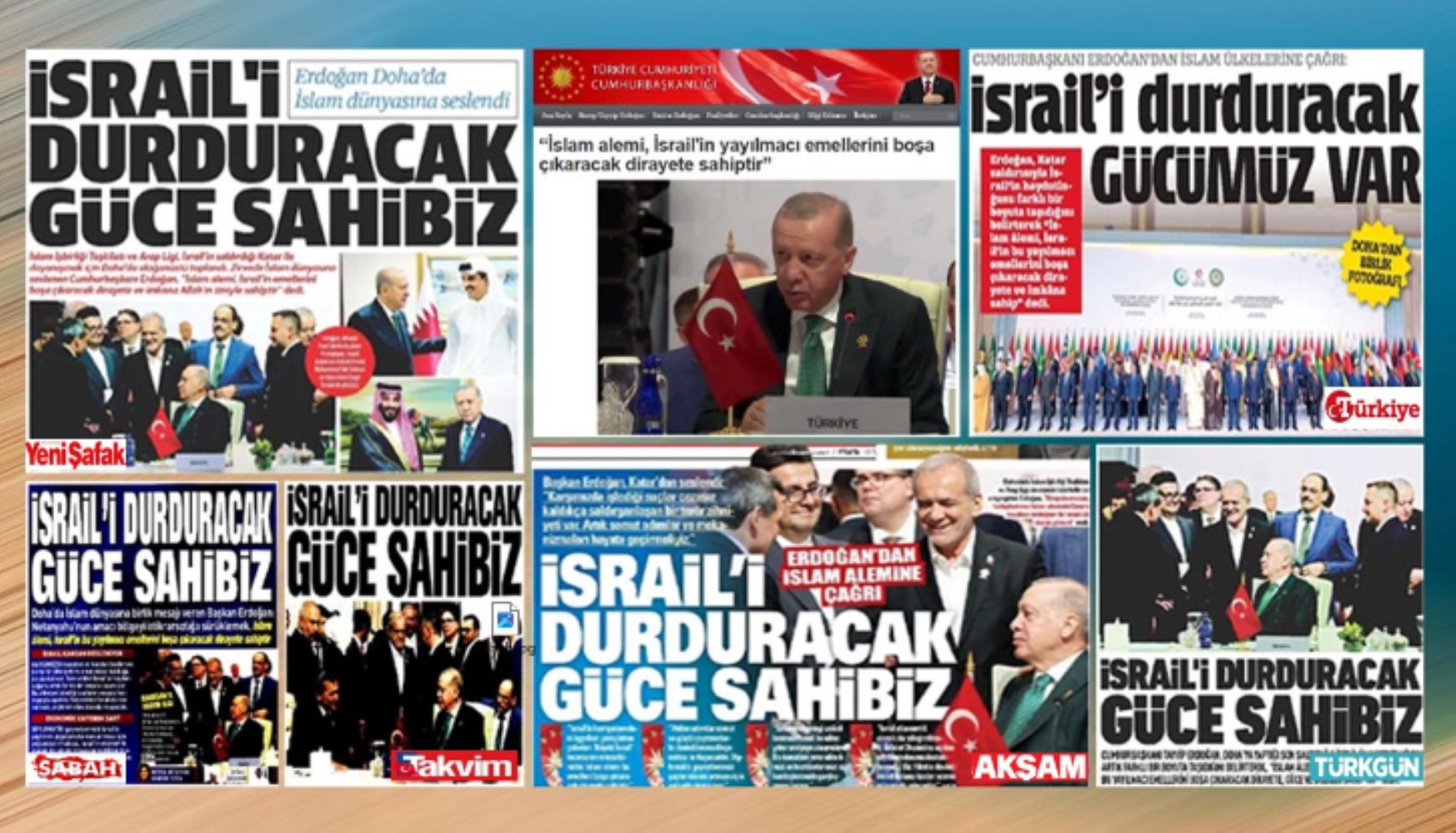
Erdoğan was talking about “means to prevent,” but he did not have a sentence saying “We have the power to stop Israel.” It seems this sentence belongs to the managers of the five newspapers; it is their interpretation.
While Erdoğan said “means to prevent,” they changed it to “power to stop.” However, the two do not mean the same thing; they are very different. The words of a figure at the top of the state, such as the President, can of course be interpreted, but they cannot be changed and presented differently than they were.
Furthermore, how is it that six newspapers headline a sentence that Erdoğan did not say? I don’t think it is possible for them to do this without a whisper from someone or a collaboration.
A journalist does not make people wait, does not whitewash, does not get things banned
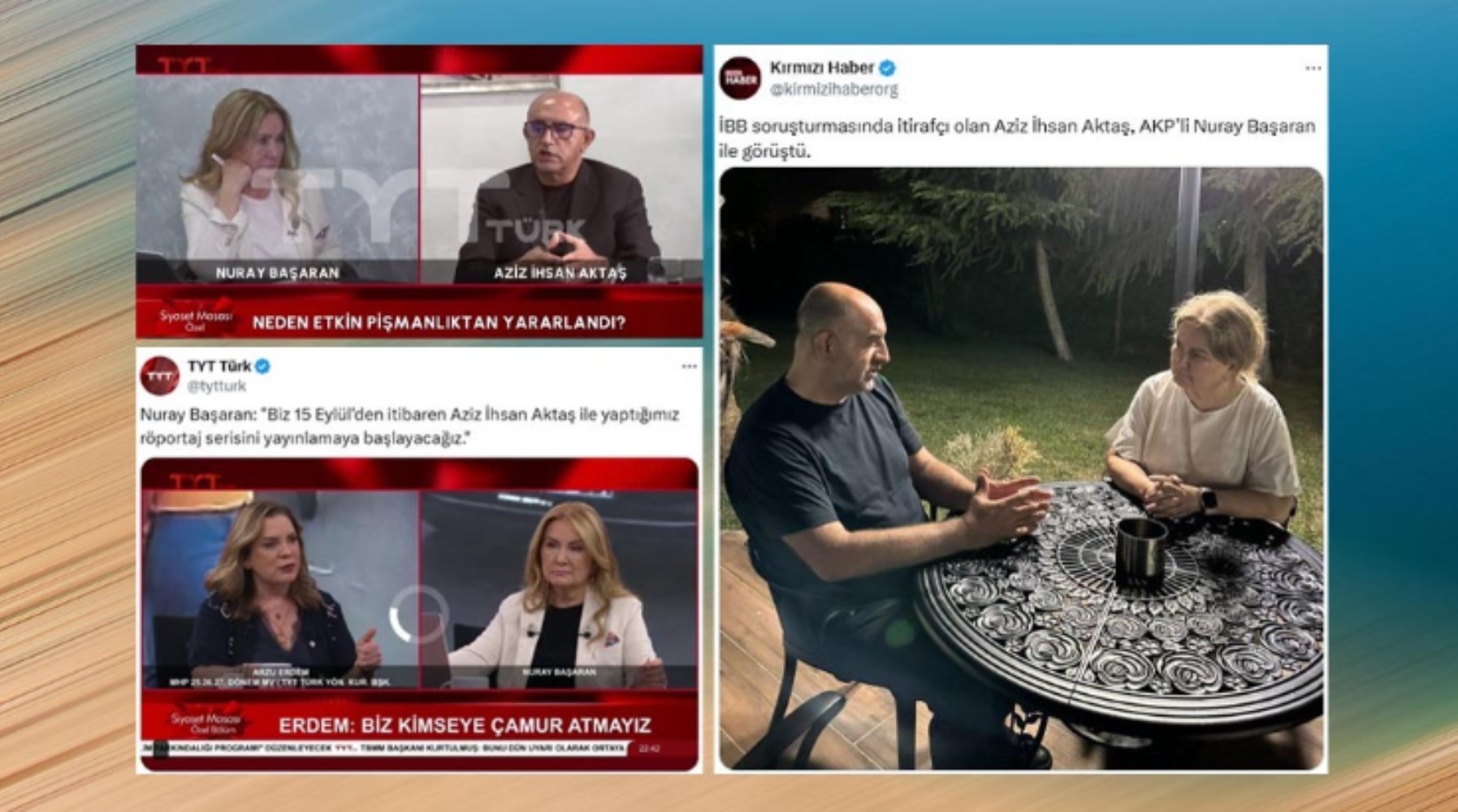
When a photograph of Nuray Başaran taken while she was talking at the same table with “organized crime leader” and “confessor” Aziz İhsan Aktaş surfaced on social media, the date was July 31.
Exactly 20 days later, Başaran appeared on screen with Arzu Erdem, who appears to be the owner of the TYT Türk channel where she is the Editor-in-Chief, and announced that she had conducted an interview with Aziz İhsan Aktaş and that they would start broadcasting it on September 15. Why hadn’t she broadcast it until that day, why would she wait for September 15? She did not explain the answers to these questions.
Then, without waiting for September 15, she published a short segment of the interview on August 27. Her justification was also interesting: “We have published a part of the interview we conducted as a right of reply against the allegations of fleeing abroad just today. We will publish the rest in the coming days.”
The “right of reply and correction” is a valuable concept in journalism. It is mandatory to grant everyone the right of reply. However, whose right of reply is the priority here: Aktaş’s, or that of Ekrem İmamoğlu and the dozens of CHP members who are defendants and the subjects of the “confessions” that Aktaş is accused of and which are also the basis for their arrests? This question also remained unanswered.
Başaran published the interview on September 18, that is, at least 1.5 months after it was conducted.
Of course, a journalist can interview someone associated with a crime, but the goal should not be to enable them to explain themselves and be whitewashed, but to clarify the issue. This can only be done by questioning, digging, and pushing the interviewee. There was no such approach in Başaran’s interview.
Moreover, Nuray Başaran and Arzu Erdem had an access ban placed on Medyaradar due to the article titled “Can Holding and TYT Türk: The enigma of clean capital in the media,” which also mentioned the interview with Aktaş. Instead of getting the article and the site banned, they could have used their right of reply; they did not. Fortunately, the higher court accepted the objection and the site was opened, but the article had been removed.
Just as a journalist resorting to a ban instead of a reply and correction is contrary to the spirit of journalism, so is keeping an interview waiting for days. “Actuality,” which is one of the elements of the concept we call “news value,” is damaged when it is kept waiting. The suspicion arises, rightly so, that the interview passed through someone’s control and that the timing was intended to influence the case for which an indictment is expected...
Transparency is easier than denying
Former CHP Chairman Kemal Kılıçdaroğlu is complaining about what is written about him as “inner circle” and “backstage” information.
Most recently, he denied Sözcü’s headline “I am coming with my bed, Kemal.” In his post regarding the report, which claimed that “if a ‘nullity’ decision is issued, he will set up headquarters at the general headquarters for a week,” he says, “I do not have a single relative I have spoken to in order to give a political message to be conveyed to members of the press,” and criticized “news being made without asking him and without obtaining confirmation.”
Kılıçdaroğlu is very right. Of course, when making a news report, especially if it concerns the attitude and thoughts that person will take regarding an event, it is necessary to ask, talk, and confirm. However, Kılıçdaroğlu, who complains about news being made without asking him, has acted as if he has taken a vow of silence since the lawsuits regarding the cancellation of the CHP congress two years ago began.
The Kılıçdaroğlu who once chatted with journalists and answered their questions every time he encountered them is no longer there. Not only does he not answer phones and questions, but he does not even talk to journalists waiting for him at the Grand National Assembly of Turkey, where he went for a funeral ceremony, or in front of his office. It is contradictory for him to both say “It was written without asking me” and to be determined not to talk when called.
However, it is natural for people to wonder what he will do if the entire CHP congress is deemed invalid and a “trustee” is appointed to the chairmanship. In that case, I do not say it is correct from a journalistic perspective; but it is a natural result that reports based on backstage information and his inner circle attributed to him are written and discussed.
If Kılıçdaroğlu appeared before journalists and answered questions, he would not have to deal with denying “inner circle” and “backstage” reports; journalists would have received information from the source. Moreover, Kılıçdaroğlu must know that as long as he does not explain his stance regarding the “trustee” and the judicial process, his denials cannot eliminate the credibility of those “inner circle” and “backstage” reports.
The political consequences of Kılıçdaroğlu’s stance bind him, but it is clear that it makes the work of our journalist colleagues difficult. Our journalist colleagues are still trying to satisfy the public’s curiosity and inform them in an environment where there is no transparency and the interlocutor does not answer questions.
In a single sentence:
Hürriyet supported President Ali Koç by publishing a full-page interview before the Fenerbahçe congress, and Sözcü supported his rival Sadettin Saran by conducting an extensive interview.
Ersin Düzen on Now TV also provided support by bringing Ali Koç on screen on the first day of the congress; an advertisement for one of Koç Holding’s companies was broadcast during the program.
In Nefes’s headline “Greek Foreign Minister made a scandalous post,” it said “Foreign Minister,” but the report mentioned Defense Minister Nikos Dendias.
In the headline of the Halktv website’s report on the bus accident in Nigeria, “entered the fray” was written instead of “rolled into the ditch”; the photo in the report was also an old photo that has been used by news sites such as AA, TRT Haber, and 12Punto since 2013.
While Sabah wrote in its report “Deadly mistake at private hospital” that the incident occurred at the Private Polatlı Can Hospital, İHA, Karar, Sözcü, and Türkiye hid the name of the accused hospital.
Hürriyet used the headline “He was about to lose his life while trying to save the cat,” but the real fault was not with that woman, but with the driver of the vehicle speeding along the emergency lane.
In Sözcü’s report titled “Expectation of a new hike in gasoline has arisen,” demands for increases regarding raw milk prices, not fuel, were conveyed.
Sabah, Türkiye, and Milliyet published a full-page advertisement for an e-commerce firm as if it were a page containing news without putting a “This is an advertisement” warning.
FOR YOUR CRITICISMS, COMPLAINTS, AND SUGGESTIONS: [email protected]
Most Read

Striking picture for Özgür Özel's 'New Party'

Özgür Özel gives a dated response regarding the number of resignations

Forest fire in Antalya brought under control
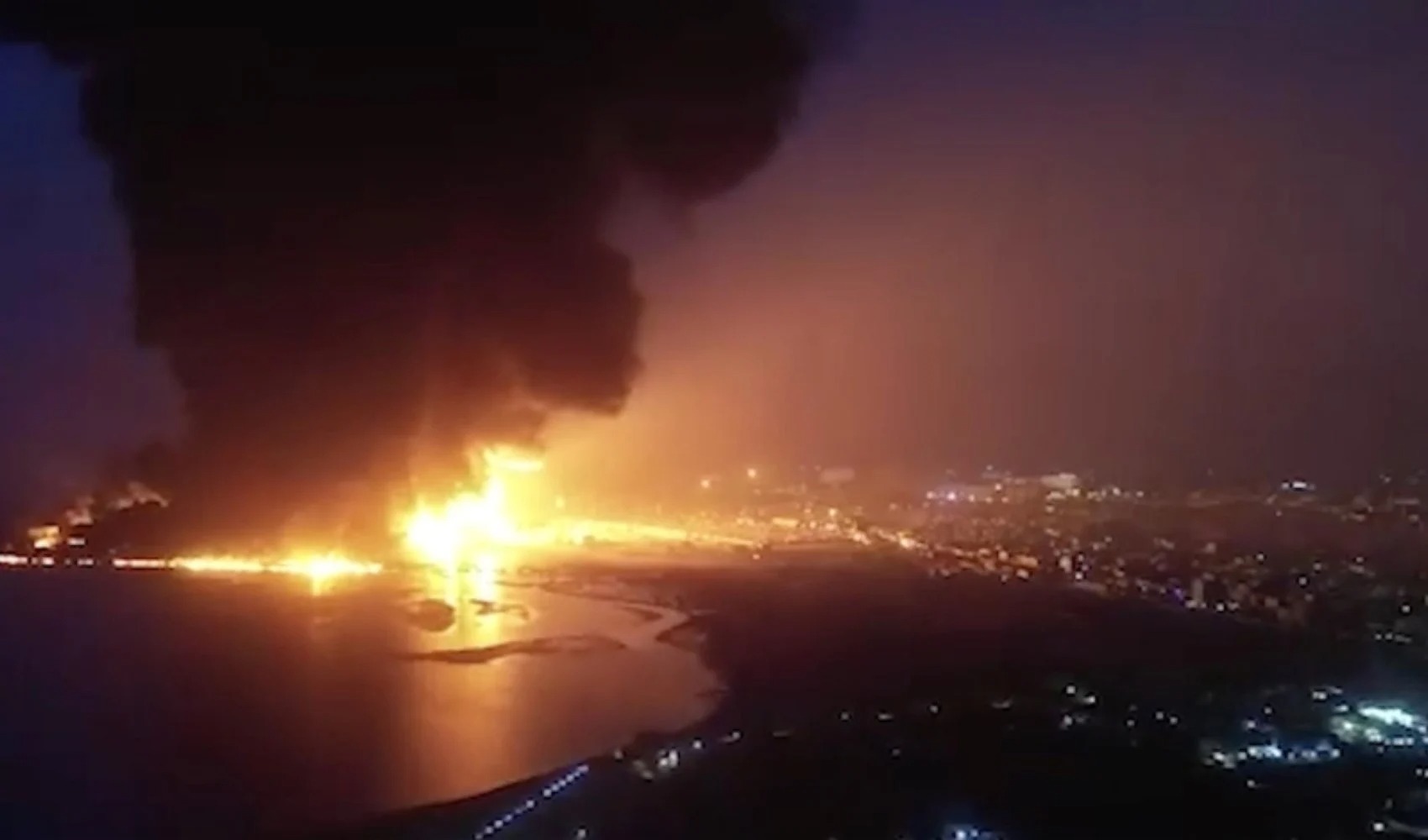
Houthis strike Saudi-owned tanker
4 drones shot down near US Consulate General in Erbil

Özel’s new party move in the world press
Famous director Ezel Akay and his brother have been detained
The new rule of the field: Attrition
'Papers with spells and curses' operation: 'Master, my spouse filed for divorce'
Key figure in Epstein files found dead at home