



What is the point of talking for hours about the most absurd theories regarding the Narin murder, only to conclude by saying, “We are just discussing scenarios here, they may not be entirely true”? You are not sure of their reality, yet you will harvest ratings by speculating on unverified rumors and trampling over grief. Where is the journalism in this?
This is what has been happening on screens for days. Publications are being made about the murder of a sweet, innocent little girl while ignoring journalistic codes and principles, and without caring about the traumatic effects on society. People are not allowed to live through their grief; the lives of an entire village's inhabitants are being recklessly churned up. The bleeding wound is being probed and aggravated with a pornographic lust.
We already knew that some screen-addicted journalists considered themselves experts on everything you can think of—politics, education, sports, foreign policy, the judiciary, and more. While discussing the Narin murder—alongside the “media parsley” types who are experts in everything—they became police officers, detectives, prosecutors, and judges all at once. In reality, most of what they were doing was screenwriting based on assumptions.
Hürriyet’s headline “4 scenarios in the Narin murder” and Korkusuz’s “Here are those three possibilities” were striking examples of journalists’ assumptions being mistaken for news. A journalist creates a scenario to solve a knot or find answers to questions. Then, they investigate and try to find evidence. A scenario, just like allegations or rumors, does not become news on its own as long as evidence cannot be found.
From the day Narin’s body was found, and even from the first days she went missing, her mother, Yüksel Güran, was branded as a “woman having an illicit affair.” There are still those talking about an affair with her uncle, Salim Güran, who is currently in custody. For example, Sabah and AHaber published the statement of the arrested Nevzat Bahtiyar as a “confession” that confirmed an affair between the mother and the uncle. However, no data has emerged so far to confirm these affair scenarios. On the contrary, her husband, Arif Güran, denied it; Narin’s DNA tests also did not confirm the scenarios regarding her father.
Still, on Didem Arslan Yılmaz’s program, sexual insinuations were made by writing that Yüksel Güran, during the days Narin was being searched for, “had blood drawn with a syringe she brought with her, telling the nurses in the ambulance she called to her home, ‘The state wants this, a secret test will be done.’” From Cumhuriyet to Ekonomim, it became news in many places under “allegation” headlines with definitive expressions like “it has emerged.”
Emotional exploitation is also at its peak. On Star and Show TV, the news of Narin’s death and her funeral ceremony were presented with music, like the credits of a film. The main news bulletin presented by Ece Üner on Halk TV began with a lament. On Now TV and some other channels, footage of Narin dancing at a wedding was brought to the screen along with the news of her death. Unfortunately, while trying to generate ratings, circulation, and clicks over people’s sorrow, the traumatic effect is aggravated. However, in news reports, there should be “no effects or music other than natural sound,” and archival footage should be selected to be consistent with the content of the news.
TV100 reporter Canan Altıntaş crying on live broadcast saying, “I saw something, I cannot say it,” was another example of turning journalism into a visual show. A journalist says and writes whatever they know. If they cannot verify it, or if there is an ethical issue, they do not say that they cannot say it. Moreover, she explained it later; what she saw was just village women praying in front of a house before Narin’s body was found. There was actually no situation worth exaggerating that much.
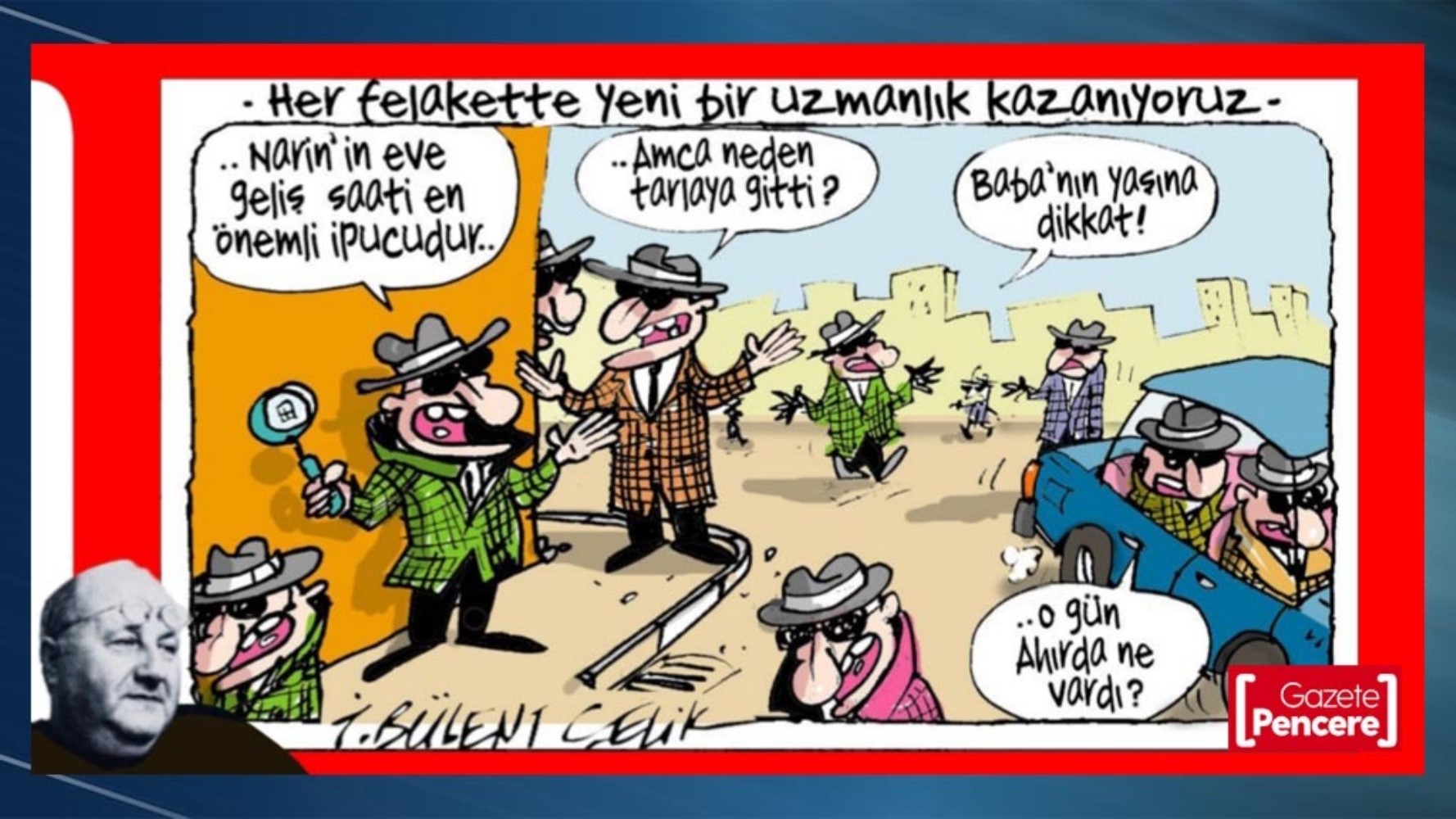
Unfortunately, the zeal shown in conveying scenarios, allegations, and possibilities was not shown in research. For example, it was written for days that “WhatsApp is not providing the messages.” That was until a reporter from DW called META officials and received the answer, “It does not record the messages, we do not have any messages to provide.” A journalist investigates first and then writes/tells, but the rule has been reversed in our media.
Of course, there were also journalists who chased the truth, presented concrete evidence, and did successful work. In fact, the real progress happened thanks to them; they informed the public.
The presumption of innocence also worked in reverse. First, everyone in the village was declared guilty in our media. Some journalists decided in advance that the murder had a political aspect and passed judgment. Evidence is only now emerging and the culprits are being identified; the produced scenarios are collapsing one by one.
The authorities are also largely to blame for the confusion of information. Even Interior Minister Ali Yerlikaya declared the entire family guilty in advance days ago by saying, “Isn’t it very clear?” The police, gendarmerie, and the prosecutor’s office did not establish a transparent channel to inform journalists from the beginning. By preferring to inform under the table and leaking the suspects’ statements, they encouraged rumor and scenario journalism.
Still, I must say that the media’s ownership of Narin in this way and making her the main agenda item had a great impact on making progress toward finding the killers. If more care had been taken and examples of investigative journalism had competed, results could have been achieved faster.
THE JOURNALIST PLAYING A ROLE
AKP Diyarbakır Deputy Galip Ensarioğlu stood out in this process as the person who said the most inappropriate things at the most inappropriate times.
His statement to Sözcü TV regarding Narin’s murder, “There are things we sometimes don’t know, and sometimes things we shouldn’t say because the family are our friends,” rightly drew backlash. While trying to correct his words by claiming he was misunderstood, he spoke to Sözcü TV again. But this time, his words were reported as “Resignation signal from AKP deputy.”
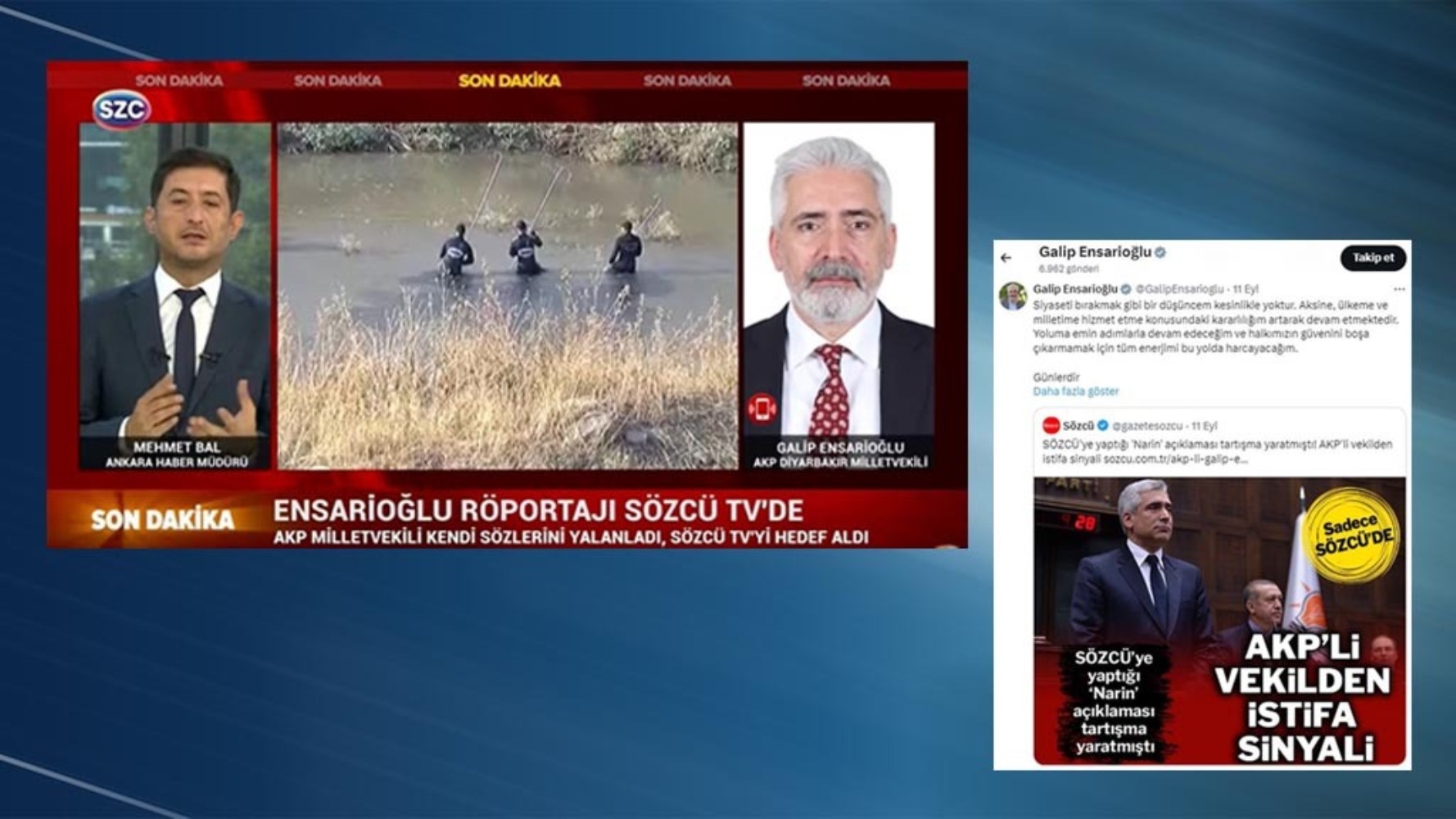
Following this, Ensarioğlu had to make another statement, stating that his words were distorted and that he was not thinking of leaving politics. The most striking aspect of these developments in terms of journalism was the broadcast Sözcü made to defend its report.
Sözcü TV Ankara Representative Mehmet Bal went on screen and broadcast the audio recording of the interview conducted with Ensarioğlu by phone. However, as if a video interview were taking place, they placed Ensarioğlu’s portrait on one side of the screen; on the other side, Mehmet Bal voiced his questions as if Ensarioğlu were in front of him at that moment and he was conducting a live interview. It is unbelievable, but he acted on screen as a journalist; he played the journalist conducting an interview! Meanwhile, “Ensarioğlu interview on Sözcü TV” was written at the bottom of the screen, and the viewer was not warned that it was a “re-enactment.”
This is a highly misleading, truth-deforming style of reporting that is incompatible with journalism. First, a journalist does not act, does not add acting to news, and there is no re-enactment in news. An interview is what it is; you present it exactly as it is; if it is audio, it is audio; if it is video, it is video.
Second, since Ensarioğlu’s words were from a recording and Mehmet Bal’s questions were conveyed through re-enactment, it is impossible to be sure how much it reflects the original state of the interview. For example, Mehmet Bal tries to make Ensarioğlu say that he does not blame Sözcü TV with a long question; he ends one of his questions with the sentence, “You are saying there is no distortion in the questions we directed, right? I understand correctly.” Ensarioğlu’s answer does not exactly correspond to this sentence.
Presenting an interview conducted by phone as if it were a video interview on television just because technology allows it cannot be an ethical behavior. There may be no limits in technology, but there are limits in journalism; journalists, editors, and presenters must internalize these limits.
A FAKE WORLD CHAMPIONSHIP
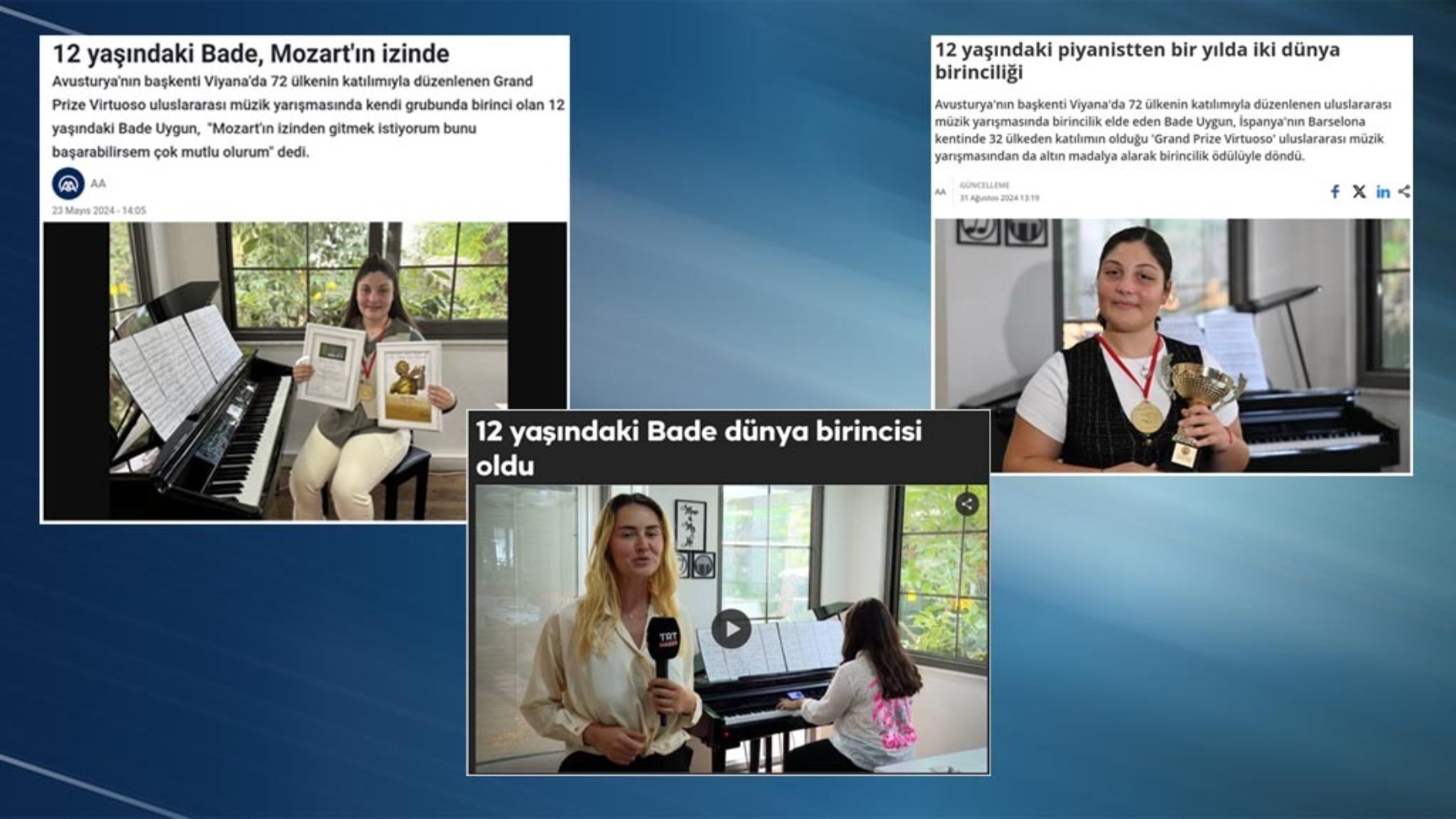
Dozens of news sites and newspapers used the Anadolu Agency report with the headline, “2 world championships in 1 year from a 12-year-old pianist.” It was told that a child named Bade Uygun, living in Antalya, returned with a first-place award after winning a gold medal at the “Grand Prize Virtuoso international music competition” in Barcelona, following Vienna.
Suspecting that there were no sources other than Bade Uygun and her teacher in the news, I looked at the website of the mentioned competition. I encountered an organization that is not a world-scale competition, but one where you apply by paying 185 Euros, and which constantly organizes music competitions and concerts with winners in different countries. It is a commercial organization, similar to which there are also ones in Turkey.
In the competition held in Vienna this year, more than 90 children under the age of 18 had entered the winners’ list according to different instruments and age groups. On the winners’ list in Barcelona, there were the names of 56 children. More interestingly, among the Vienna winners, there were 12 other children from Turkey besides Bade Uygun, and among the Barcelona winners, there were 4 more children from Turkey. In fact, 7-year-old Alp Ata Demir had entered both the Vienna and Barcelona winners’ lists.
The fact that the other children participating from Turkey, and especially Alp Ata Demir, were not written about shows that no research was done while preparing the news. At the very least, if the competition page had been looked at, it would have been understood that it was not an event to be exaggerated as a “World Championship.”
We have encountered similar news many times before. Everyone who says they have achieved international success is believed, and news is made without checking; editors publish it without questioning at all. News that dozens of such international competition winning reports were nonsense has come out before, but neither the reporters learned a lesson nor the editors.
If every piece of news is made like this, woe to journalism...
In a single sentence:
Turkuvaz Medya, which draws power from the AKP government, had the new domain name of Medyaradar—which it had previously obtained an access ban for due to the “Turkuvaz Media Group’s YouTube channels were hacked” news—blocked, shutting down the site; it prevented journalism from being practiced.
Habertürk, Hürriyet, Sözcü, Milliyet, and Yeni Şafak removed from their reports the words of İlhan Tatar, one of the complainants in the Ayhan Bora Kaplan criminal organization case, accusing former Interior Minister Süleyman Soylu and Supreme Court member Yüksel Kocaman.
In the news of Türkgün and Türkiye newspapers, “Devlet Bahçeli’s life became a book,” there was no information about who wrote the book.
The headline of Hürriyet and Türkiye, “Alper Gezeravcı became Space Commander,” was wrong; Gezeravcı did not become a commander, he was appointed to the “Space Command.”
Although Minister of Transport and Infrastructure Abdülkadir Uraloğlu confirmed that the identity data of 85 million people were stolen during the pandemic period, the Center for Combating Disinformation committed disinformation by making a statement that “there is no leaked data.”
Yeni Akit published Sezgin Baran Korkmaz’s accusations against former CHP deputy and jurist İlhan Cihaner as if they were verified; it did not include Cihaner’s response.
Gazete Pencere’s headline “The wedding dress is gone, the uniform has arrived” was wrong; instead of uniform, “jersey” or “apron” should have been used.
In Karar’s news, “Child poverty is higher than adults,” it was a deficiency that it was not stated that the data shared by analyst Hakkı Hakan Yılmaz was taken from TUIK.
In the research conducted by ASAL Araştırma by phone, only 0.9 percent of 2 thousand people over the age of 18 answered that the institution they trust the most in Turkey is the media.
FOR YOUR CRITICISMS, COMPLAINTS, AND SUGGESTIONS: [email protected]
Most Read

Striking picture for Özgür Özel's 'New Party'

The PKK opening and Özgür Özel’s path!..

How did the newspapers view Özgür Özel's farewell to the CHP?

He killed his wife by slitting her throat: Their children witnessed the moments

What did the CHP do?

Özel’s new party move in the world press

The New CHP, against CEHAPE

Fire at TUSAŞ engine factory in Eskişehir under control

From self-efficacy to despair

Kılıçdaroğlu's first message on Özgür Özel's new party announcement