



In recent months, the main agenda of the pro-government media has been the CHP and CHP-run municipalities. Naturally, at the forefront are Ekrem İmamoğlu, the Istanbul Metropolitan Municipality, and district municipalities. Since March 19, this has intensified; pro-government newspapers, television channels, and news websites are in a state of constant campaigning.
I call it a campaign because, rather than objective news, texts, articles, and speeches that judge, pass verdicts, and express opinions are being published. A form of journalism is being practiced that never gives space to opposing views, is one-sided, and aims to portray them as guilty.
I sat down and scanned the publications of pro-government newspapers for the first 15 days of April. Hürriyet, Milliyet, and Türkiye used fewer and more balanced reports. However, Akşam, Sabah, Yeni Akit, and Yeni Şafak have become the essential components of this campaign. Headlines such as Akşam's "They distributed 70 apartments to delegates," Sabah's "Great graft at Küçükçiftlik," Yeni Akit's "The bribe came to Ekrem's feet," and Yeni Şafak's "He took two apartments and changed his side" are just a few examples.
During these 15 days, news against the CHP appeared on the front page of Akşam newspaper for 10 days, seven of which were headlines. In Sabah, anti-CHP news was placed on the front page for 13 days, and all 13 were featured as headlines. In Yeni Şafak, anti-CHP news was used for 13 days, eight of which were headlines. But the record belongs to Yeni Akit. Within 15 days, news smearing and accusing the CHP was used for a full 14 days, 13 of which were headlines.
I also scanned the columnists' articles. During these 15 days, 41 columns in Akşam, 34 in Yeni Şafak, 32 in Yeni Akit, 29 in Hürriyet, 18 in Türkiye, and 11 in Milliyet were published against the CHP, İmamoğlu, and CHP-run municipalities.
Almost all of the articles by Abdülkadir Selvi and Nedim Şener in Hürriyet, Mahmut Övür and Okan Müderrisoğlu in Sabah, Emin Pazarcı and Murat Özer in Akşam, Cem Küçük and Yücel Koç in Türkiye, İhsan Aktaş in Yeni Şafak, and Ali İhsan Karahasanoğlu in Yeni Akit are about the CHP, İmamoğlu, and the municipalities.
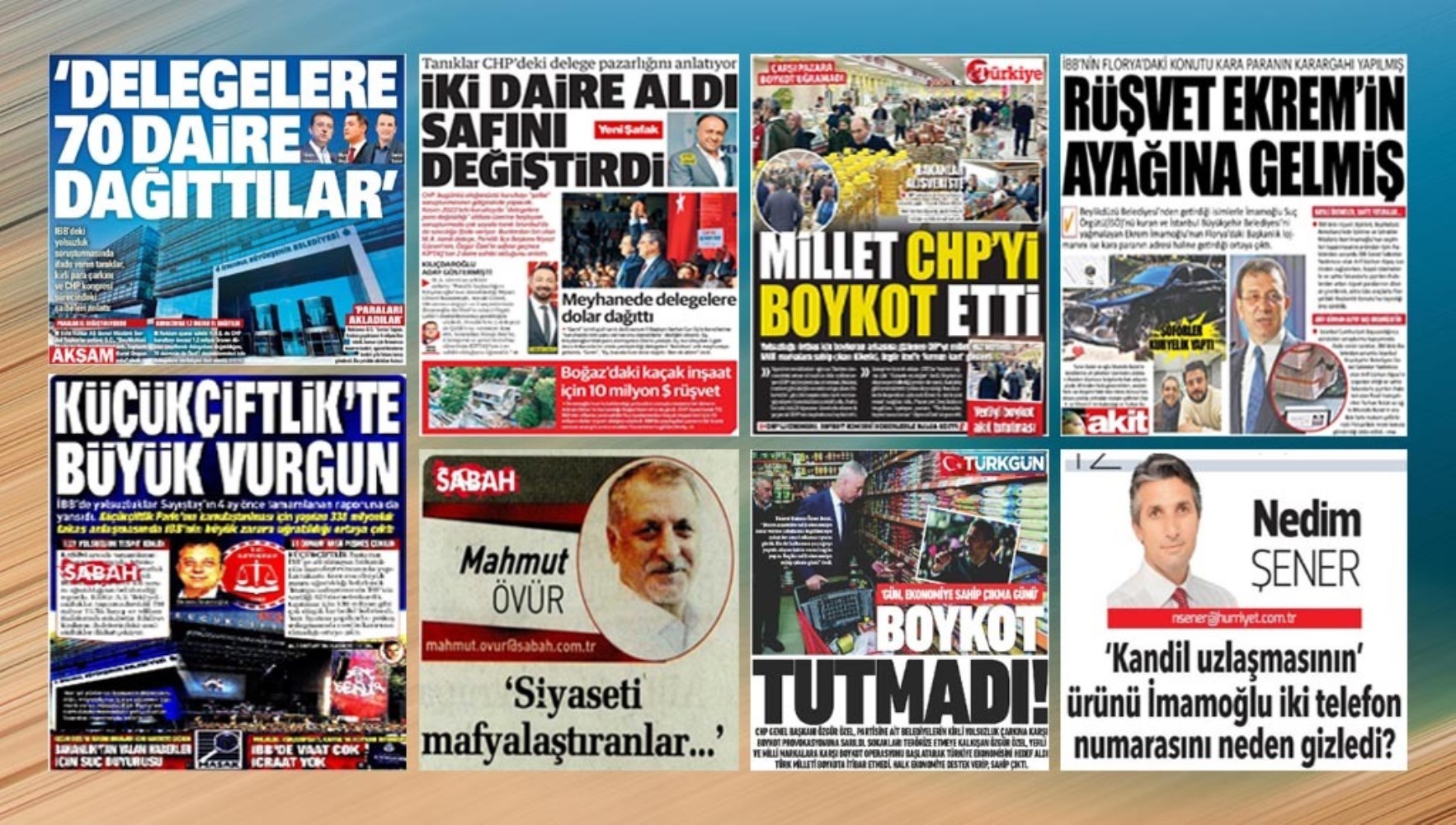
Nedim Şener wrote six articles in these 15 days, and in all six, he accuses and judges the CHP, Özgür Özel, and İmamoğlu. All six of Cem Küçük's six articles, all three of Yücel Koç's three articles, eight of Mahmut Övür's 10 articles, five of Emin Pazarcı's seven articles, six of Okan Müderrisoğlu's eight articles, and 11 of Ali İhsan Karahasanoğlu's 15 articles are about the CHP, Özgür Özel, İmamoğlu, and CHP-run municipalities. All of these texts are pieces that pass judgment and stigmatize.
Ahmet Hakan in Hürriyet and Ali Saydam in Yeni Şafak often dedicate one of their fragmented article sections to the CHP. However, their language and approach, of course, cannot be compared to that of Nedim Şener or Ali İhsan Karahasanoğlu.
Of course, the CHP, Özgür Özel, Ekrem İmamoğlu, and CHP mayors can be criticized; if there are shortcomings, mistakes, or corruption, they can be written about. The accusations against İmamoğlu and other individuals who have been arrested or are under investigation should also be written about and discussed. Instead of covering them up, it is essential that the public be informed, but informed accurately.
However, while informing the public, it is necessary to respect the "presumption of innocence," remain objective, and present both the accusations and the defense in a balanced manner. Yet, in these pro-government articles and reports, journalism is being replaced by acting as police, prosecutors, and judges; partisanship is on full display.
They act as if the country's only problem is the CHP and its municipalities. The slightest accusation or negative development regarding AKP municipalities cannot make the news. The police blocking the CHP's attempt to march on İstiklal Avenue in support of Palestine, or Chairman Özgür Özel's magnificent rally in Yozgat, can be completely ignored.
Together, they are painting a picture of journalism intertwined with partisanship.
Sözcü also distorted the denial
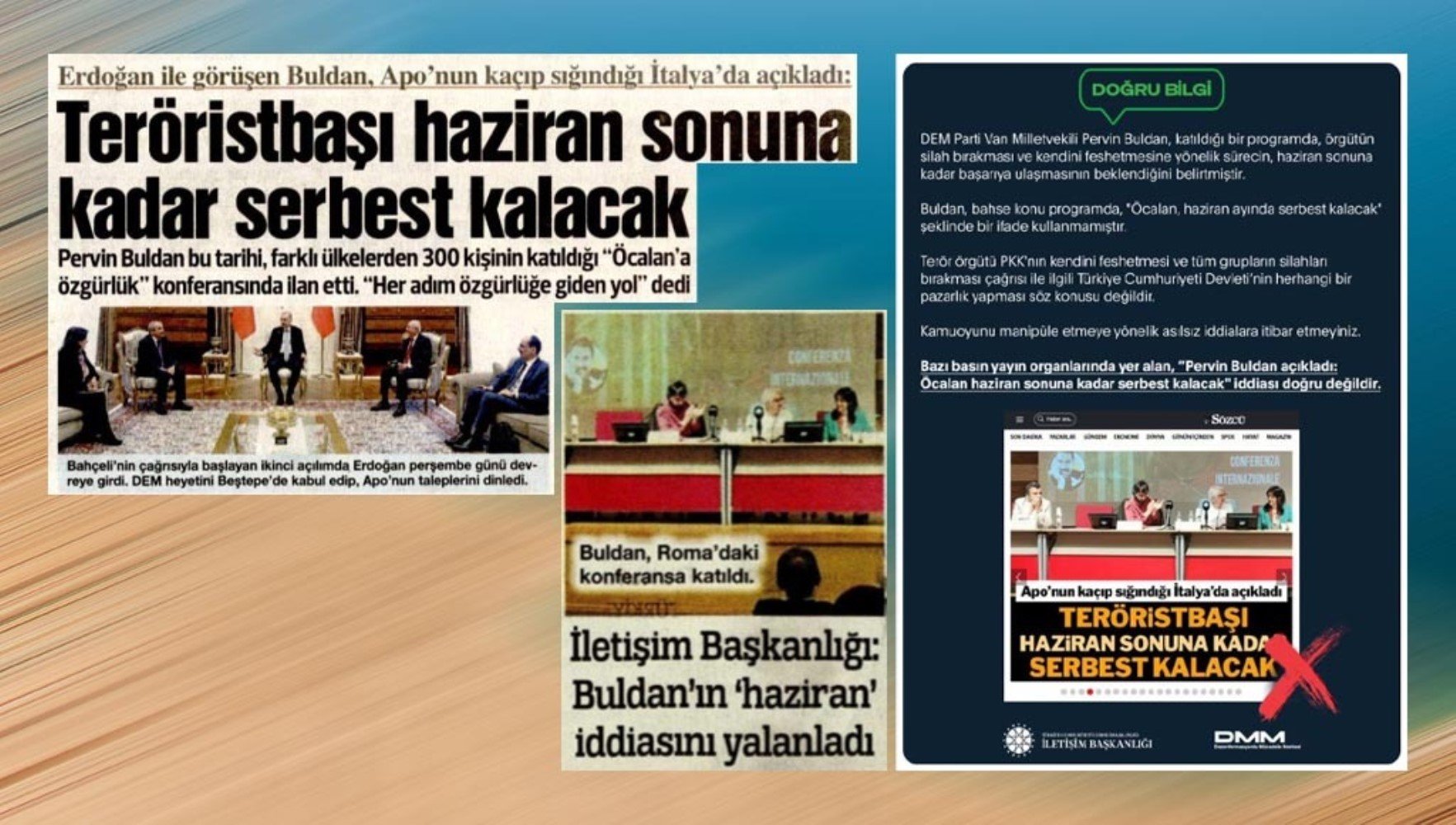
Above the headline "The terrorist leader will be released by the end of June" on the front page of Sözcü, it stated, "Buldan, who met with Erdoğan, announced it in Italy, where Apo fled and took refuge."
However, DEM Party Van MP Pervin Buldan made no such statement. She said, "The process is expected to reach full success by the end of June," and added:
"We know that every step taken is also a path leading to Mr. Öcalan's physical freedom."
Indeed, the Communications Directorate's Center for Combating Disinformation also refuted this news, stating, "Buldan did not use the expression 'Öcalan will be released in June' in the program in question." Although many of the Center's refutations turn out to be empty, its statement regarding Buldan was correct; Buldan had already spoken in front of cameras, and her words were very clear.
Despite this, Sözcü published this refutation the next day with the headline "Communications Directorate: Refuted Buldan's 'June' claim." However, the Communications Directorate was refuting Sözcü, not Buldan. Sözcü, which misquoted Buldan, also reported the refutation incorrectly.
A newspaper should never reflect anyone's words differently than they are, and when it turns out to be wrong, it should clearly correct it. Sözcü, however, misled its readers in both the news and the correction.
The twerk instructor is not African
Journalist Fuat Uğur's post about Üsküdar Mayor Sinem Dedetaş contained expressions that were truly sexist and pushed the boundaries of journalism quite far:
"Let Sinem Dedetaş, who brought a twerk dance instructor from Africa so that the women of Üsküdar could learn, perform twerk dances on stage to raise money to pay the salaries of Üsküdar Municipality employees. I am sure that the leading names of the bourgeoisie will invest good money in this show."
Fuat Uğur did not apologize after the criticisms, nor did he delete this post. Moreover, he responded to the reactions by saying, "The dilemma of recent days: Why would someone who has twerk lessons given during the month of Ramadan find this dance immoral for themselves?"
Fuat Uğur's posts were based on the reports that appeared in AHaber and Yeni Şafak on March 13, and subsequently spread throughout the pro-government media, titled "Another scandal from the CHP-run Üsküdar Municipality! It gave twerk training during the month of Ramadan."
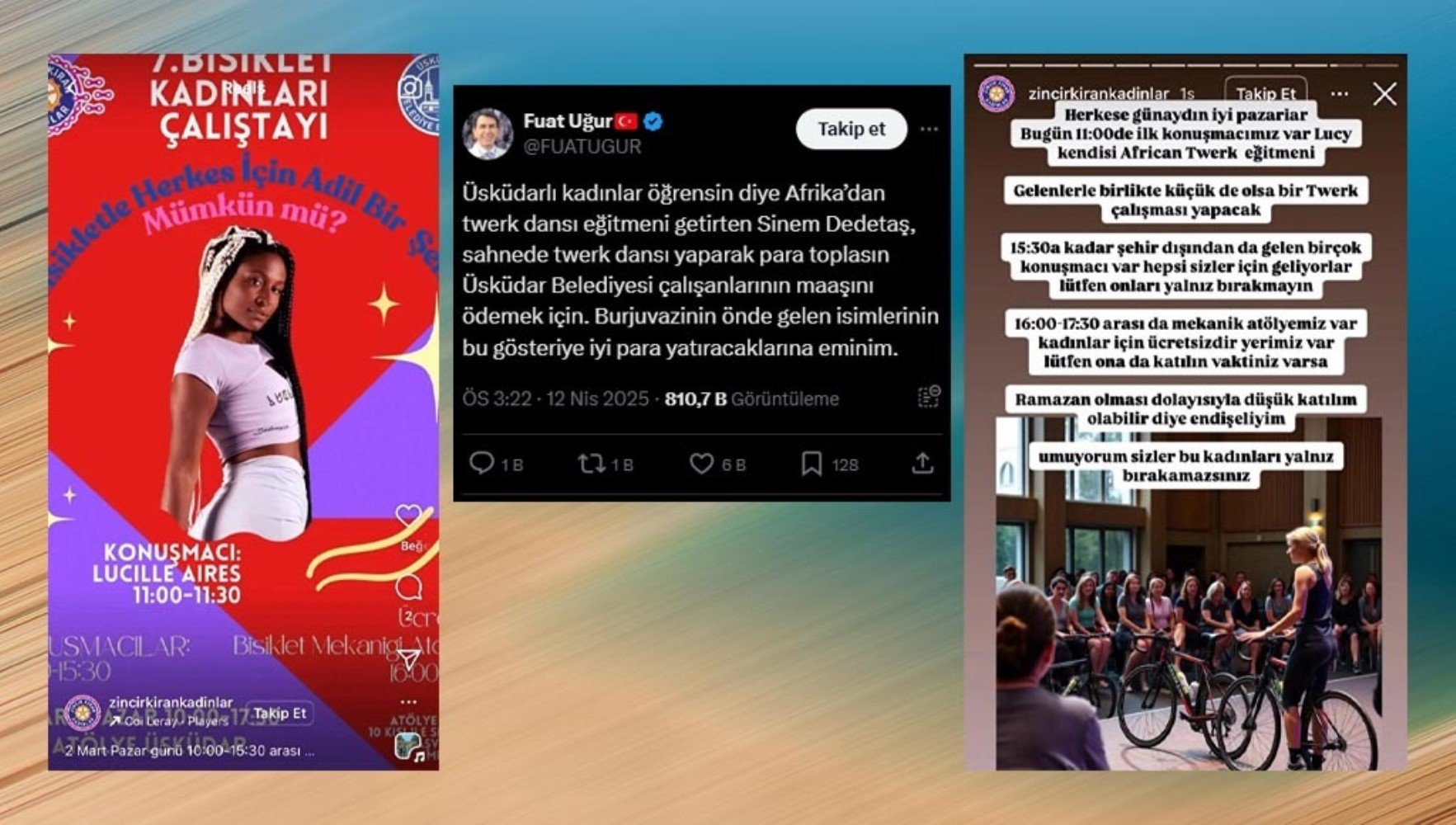
However, according to Dedetaş's statement, the organization in question was not arranged by the Municipality, but by a women's association called the "Chain-Breaking Women's Association"; Lucille Aires, a dance instructor living in Istanbul, had been invited to the event, which was organized to encourage women to use bicycles.
The posters and WhatsApp correspondence included in the news report also belonged to this association. There is no mention of a "twerk instructor from Africa"; a "bicycle mechanics workshop" was being announced. Moreover, Lucille Aires, who spoke at the workshop, was born in Ireland and has been living in Istanbul for a long time, not in Africa.
In summary, the news reports that Fuat Uğur insistently defended his post with are also incorrect. Sinem Dedetaş did not bring in a dance instructor from Africa. Furthermore, even if she had brought a dance instructor from Africa, a journalist would have no right to use such expressions toward a female mayor.
Patient privacy and Sırrı Süreyya
Show TV obtained footage of Deputy Speaker of the Grand National Assembly of Turkey Sırrı Süreyya Önder, one of the key actors in the Imralı process, taken before he suffered a heart attack.
In the footage, Önder is eating at a restaurant, then paying at the register, and after not turning down a person's request, he takes a photo with them before leaving the restaurant. That is all...
Show TV reported these images as "his last images before having a heart attack"; from there, many TV channels, from Habertürk TV to Global Haber, picked them up and broadcast them.
Önder is a political figure. His private life space is narrower than that of other people; if it were not a case of illness, there would be no objection to the publication of these images. Only the use of the restaurant's security camera for purposes other than its intended use, and the transformation of security into "surveillance," could be debated.
If Önder hadn't suffered a heart attack a few hours after leaving that restaurant, those images wouldn't have even been news. As viewers, what did we learn from these images? How Önder ate stuffed vine leaves, that he gave a tip, and so on... But what is the benefit of this to us, and what does it matter to the viewer how he eats?
What gave those images "news value" was the fact that he had a crisis afterward. Searching the footage for signs of illness and the onset of the crisis. But in that case, don't these images intrude upon the "patient's private sphere"? Even if Önder is a politician, doesn't his state of illness invoke "patient rights"?
Undoubtedly, these are debatable points. But honestly, seeing those images just because they were taken before the crisis made me uncomfortable. I felt as if I were X-raying a person struggling for their life.
In a single sentence:
• While the journalists whom Limak has taken to Barcelona and shown around to date focused on Limak's "success" in the Camp Nou stadium construction, only Melih Sadıkoğlu from Sözcü managed to report on the delay in construction and the company's initiatives regarding the penalty.
• In his article titled "The human-animal comparison of 'dog-worshippers'," Atilla Yayla from Türkiye newspaper advocated for the killing of "dogs that harm humans," stating, "In older, more normal times, such dogs would certainly have been culled."
• In Habertürk TV's report on the attack on the grave of the murdered child Ahmet Mattia Minguzzi, the fact that the perpetrator was "67 years old" was repeated exactly five times.
• The use of the term "thought-stutterer" by Başar Yaltı in his article "Protecting the judiciary from the judge" in Cumhuriyet was demeaning to people who stutter.
• In Cumhuriyet, Dikmen Gürün wrote, "Ionesco's work is on stage with the Tiyatro Oyunevi production: Thoughts on 'The Bald Soprano'," but the play was actually staged by "Oyun Atölyesi."
• Pro-government media did not report on the protest by teachers who were victims of the interview system in front of the ministry, nor on the violence perpetrated by the police.
• Türkiye published praise for the company that owns the newspaper with the headline "Full support from Kyrgyz President Japarov," while Takvim did the same with the headline "Power on the track."
• In its report "Celebrities also donated their clothes," Hürriyet used a photo of Meltem Demirören, the sister of the newspaper's owner Yıldırım Demirören, and his wife Revna Demirören taken with Emine Erdoğan as the "celebrities."
• In Sabah's report "She was the iconic child of the Soma disaster," the accused mother's name was coded as Tomurcuk S., but the report included a photo of the woman with her face clearly visible.
• Yeni Şafak targeted a journalist in its report "Now the target is school administrations" by writing "Birgün Newspaper reporter who provokes citizens with provocations."
• Hürriyet wrote "municipal personnel" (belediye personelleri) in its report on the "arrest at the Gülşen concert"; however, the word "personel" is already plural in Turkish.
FOR YOUR CRITICISMS, COMPLAINTS, AND SUGGESTIONS: [email protected]
Most Read

Striking picture for Özgür Özel's 'New Party'

The PKK opening and Özgür Özel’s path!..

How did the newspapers view Özgür Özel's farewell to the CHP?

He killed his wife by slitting her throat: Their children witnessed the moments

What did the CHP do?

Özel’s new party move in the world press

Fire at TUSAŞ engine factory in Eskişehir under control

The New CHP, against CEHAPE

From self-efficacy to despair

Kılıçdaroğlu's first message on Özgür Özel's new party announcement