



Following the death of Evre Başak Clarke, who passed away in England, the people who should feel the most guilty are the journalists who branded her a "fraudster."
I know that the fraud allegations regarding the fundraising campaign Clarke started for "treatment expenses and the future of her young son, Oscar" were first raised on social media by a person named Ahmet Sonuç, who uses the name "Jahrein." Then, others increased the intensity of the accusations, adding in Clarke’s old social media posts and hurling insults.
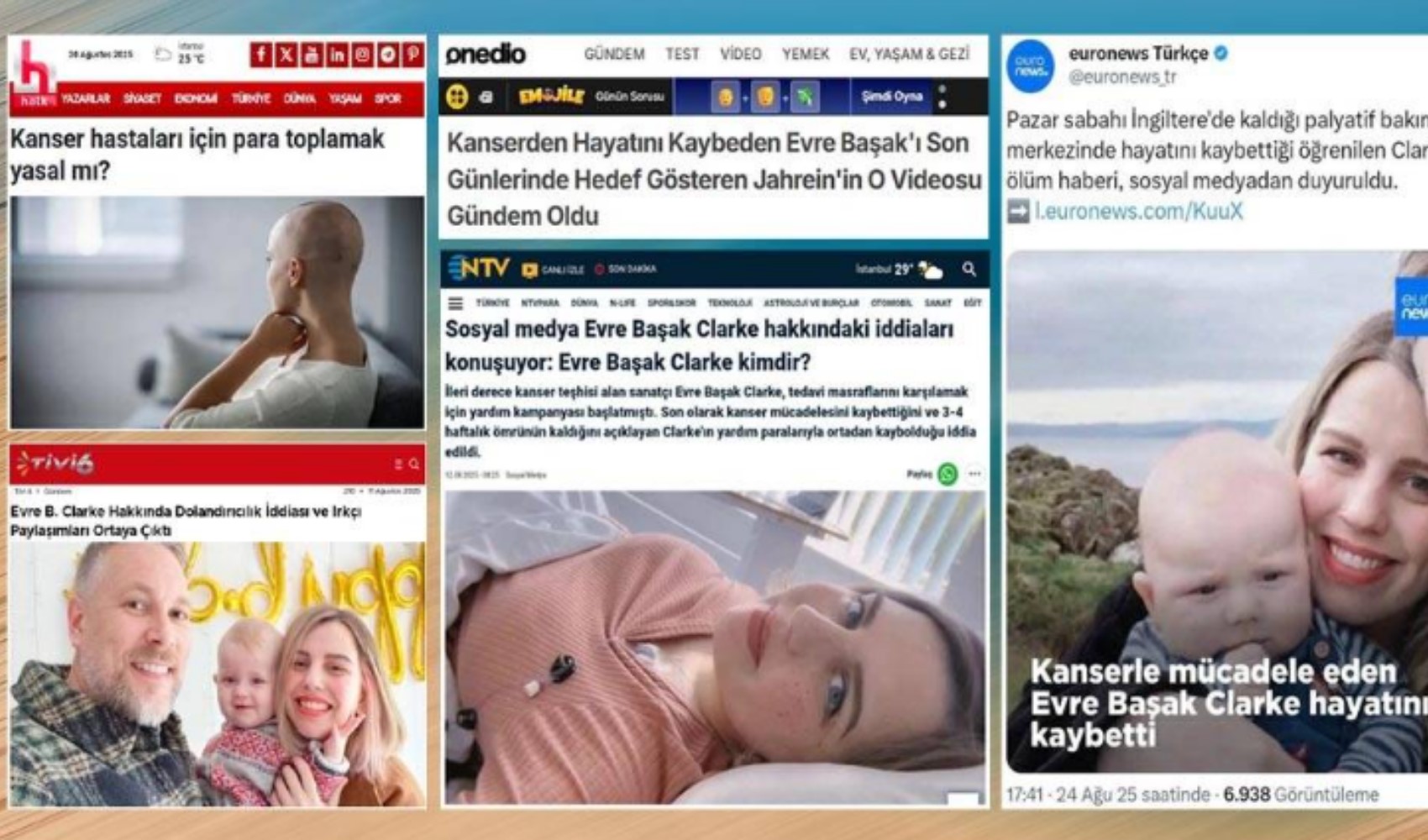
In the media, some outlets reported on Ahmet Sonuç’s words, which mocked and accused a person whom doctors had said had "only 2-3 weeks to live" due to cancer. And they did so without any verification, relying solely on this individual.
Halktv.com.tr wrote, "The Evre B. Clarke riddle: Fraud allegations regarding Evre B. Clarke, who collected aid by claiming to have cancer. After collecting the money, she deletes doctor reports and everything else. She locks her account and disappears." The NTV news site published a story titled, "Social media is talking about the allegations against Evre Başak Clarke." Sites like Sputnik, Onedio, Bundle, and İşçi Haber also featured similar reports.
Halk TV deleted its story following the backlash, but when the news of Clarke’s death arrived, the reports on most other sites were still up. Jahrein, unable to handle the reactions, also locked his account, but he will likely open it and continue again tomorrow.
The real issue lies with the media organizations that quoted his hypothetical words—which were based on no concrete documents or information—without any checking or research. For some time now, some journalists have been mistaking social media posts for "information"; they take them and publish them exactly as news.
However, posts there are only clues, allegations. They can only turn into news after being researched, verified, and having their elements completed. Evre B. Clarke should have been investigated before being accused of fraud, and at the very least, the opposing view should have been included in the reports. Unfortunately, Evre B. Clarke proved the inaccuracy and injustice of those reports with her death. The journalists who published those stories now owe Clarke an apology and a correction.
WAS 'ÜLKÜCÜ' ACTIVITY A CRIME?
National Path Party (Milli Yol Partisi) Chairman Remzi Çayır was the guest of the week in Cumhuriyet. In the interview, which was given nearly a full page, one sentence regarding Remzi Çayır’s biography caught my attention:
"He was arrested in 1979 due to his 'Ülkücü' (idealist) activities while he was a student at Ankara University Faculty of Science."
This is a very vague statement that does not explain its content. There was no crime called "Ülkücü activities" in the 1970s or afterwards. In the "MHP and Ülkücü Organizations Case" following the September 12 coup, Ülkücüs were tried on other charges. Remzi Çayır must have been facing other accusations as well.
Remzi Çayır is from Kahramanmaraş. Therefore, I first looked at the 1978 Kahramanmaraş massacre case; his name does not appear among the defendants. However, some web pages regarding the massacre state that the report prepared by the then-Minister of Interior, İrfan Özaydınlı, included information that "Remzi Çayır, along with a group of Ülkücüs including Haluk Kırcı, Ünal Osmanağaoğlu, and Ercüment Gedikli, went from Ankara to Kahramanmaraş before the events."
The late journalist Erbil Tuşalp also listed Remzi Çayır’s name in a 2006 article among the Ülkücüs who "left the city immediately after the Kahramanmaraş massacre."
Furthermore, last February, MHP Deputy Chairman Yaşar Yıldırım stated that Remzi Çayır had gone to prison due to a grocery store robbery and a coal distribution office robbery in Bahçelievler, Ankara. Remzi Çayır responded to this allegation by calling it "slander" and said he would file a lawsuit.
However, I checked, and on page 613 of the "MHP and Ülkücü Organizations Case" indictment, it is written that Remzi Çayır, whose name appears among "our imprisoned comrades" in a document found at the MHP headquarters, was being tried as a defendant for "various robberies."
The Milliyet newspaper dated March 17, 1979, also included the police statement that "Remzi Çayır and Ercüment Dağıstanlı robbed the Petrol Ofisi, the Akbank branch, and the coal distribution office in Bahçelievler and took 129 thousand liras."
This information proves how suspicious, insufficient, and incorrect the phrase "arrested in 1979 due to his Ülkücü activities" in Cumhuriyet is. In fact, during the interview or the editorial process, one should have been skeptical of this statement and clarified it.
ATTACK ON THE SACRED OF ALEVIS
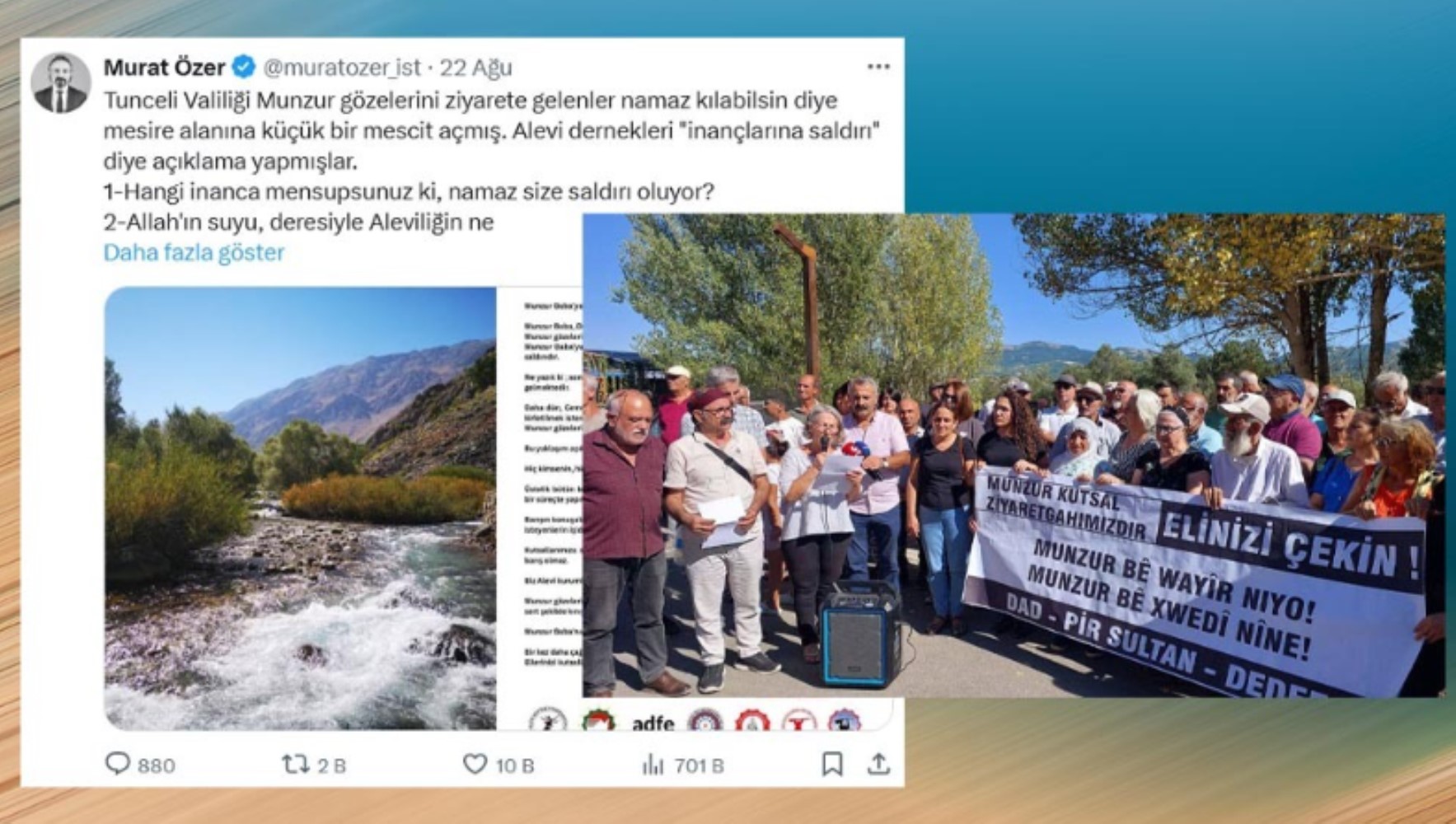
The Tunceli Governor's Office opening a prayer room (mescit) at the "Munzur Springs," which Alevis consider sacred, caused reactions from Alevi civil society organizations. Akşam newspaper columnist Murat Özer took the protest text of the Alevi organizations and shared it on social media; he wrote the following underneath:
"The Tunceli Governor's Office has opened a prayer room in the recreation area so that those visiting the Munzur Springs can pray. Alevi associations have issued a statement calling it an 'attack on their faith.' 1-Which faith do you belong to that prayer is an attack on you? 2-What does God's water and stream have to do with Alevism?"
When there was no demand from Alevis for a prayer room, why did the governor's office build one there? Or why didn't they build a Cemevi? Instead of questioning these, Özer attacks the sacred of the Alevis by saying, "What does God's stream have to do with Alevism?" He is mocking people's beliefs and discriminating.
It is not a journalist's place to question people's beliefs or sacred values; one must respect what religions consider sacred. The Turkish Declaration of Rights and Responsibilities in Journalism also advises this:
"A journalist cannot make the cultural values, beliefs, or lack of belief of individuals, communities, and nations a subject of attack, cannot belittle them, and cannot mock them."
Murat Özer should have been able to develop empathy with the Alevis instead of trying to question why they consider that place sacred.
THE WRITER WEARING THE JERSEY OF THE TEAM THEY COVER
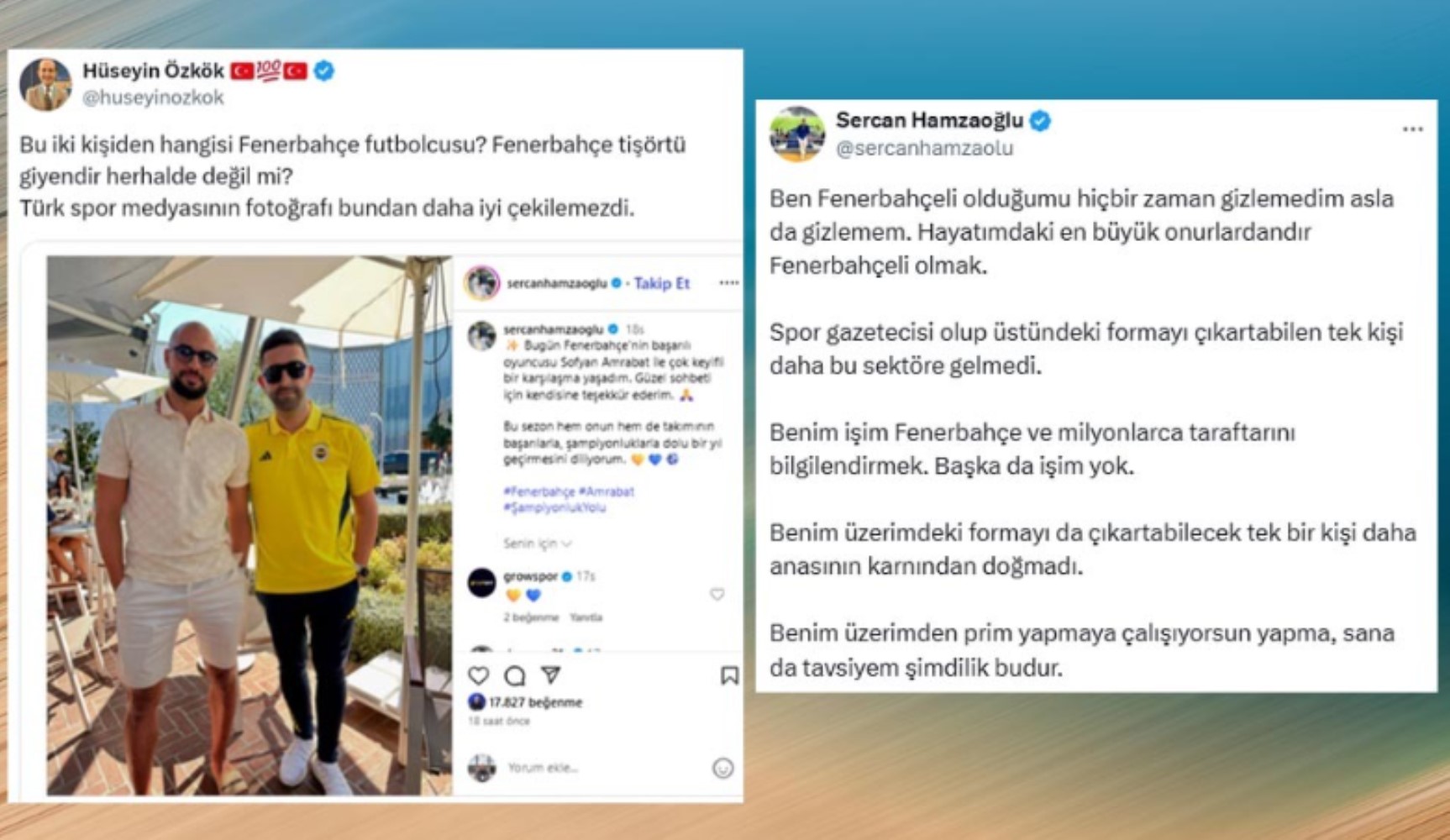
Sports journalist Hüseyin Özkök criticized his colleague Sercan Hamzaoğlu for a photo he shared on social media with Fenerbahçe footballer Sofyan Amrabat:
"Which of these two people is the Fenerbahçe footballer? It's the one wearing the Fenerbahçe jersey, right? The Turkish sports media could not have been captured better than this."
Hamzaoğlu responded to this criticism by saying, "I have never hidden that I am a Fenerbahçe fan, and I never will," and added:
"Being a Fenerbahçe fan is one of the greatest honors in my life. No other person who can take off the jersey they wear while being a sports journalist has come to this sector yet."
It could have been a useful discussion, but as I understand it, the issue has gone far beyond professional boundaries with what was written on social media and phone conversations. Özkök then tagged the Turkish Sports Writers Association, the Turkish Journalists Association, and me, asking for my opinion.
If Sercan Hamzaoğlu were a YouTuber and not a journalist, there would be no issue. But when one is a journalist, the situation changes. A journalist should not identify with the news sources in the field they cover. A journalist being a fan of a club and openly declaring it leads to identification with the club; they become no different from a fan watching a match in the stands. Being a fan prevents the journalist from looking at that team and its management critically and objectively.
The pose Sercan Hamzaoğlu gave with footballer Amrabat is also a photo that a fan, not a journalist, would take. Of course, the issue here is not Fenerbahçe; I am trying to draw attention to the drawbacks of a journalist being a fan of a club that is their news source, regardless of which team it is. Unfortunately, this mistake is not unique to Hamzaoğlu; it is quite common in our football media.
In a single sentence:
Journalists attending the Ministry of National Defense's weekly regular press conference did not ask why the report regarding the death of two soldiers in İskenderun has still not been released despite a month having passed.
Türkiye newspaper columnist Cem Küçük advertised the media group company he works for with his post, "İhlas Foundation dorms stand out with their state-supported facilities."
In the story "Salaries of millions of civil servants recalculated" on Sözcü's website, the 2026 increase was mistakenly calculated at 7 percent instead of 11 percent; moreover, it contradicted the new salary table in the printed newspaper.
Sabah, in its story "10 years in prison for the harassing manager," which was based on the court's reasoned decision, hid the identity of the person convicted by the court by giving his name as Bülent S.
Akşam published promotional texts for the AKP-run Sincan and Başakşehir municipalities under the guise of news without adding a disclaimer that they were advertisements.
Yeni Akit spewed hatred following the death of Prof. Dr. Emin Alıcı with its story, "The enemy of the headscarf Emin was sent off from the church."
Sözcü TV broadcast the English "Breaking the Chains" video by Güm Kanal, which produces videos saying "Artificial intelligence is at the service of the working class," by cutting its logo and without even mentioning the channel's name.
Hürriyet, which ignored Mourinho's words directed at Hamdi Akın while publishing an interview with Akın, wrote those words as one of the reasons for Mourinho's firing a day later.
Akşam discriminated by putting the headline "Russian wife killed" on a story, as if the woman being Russian was an important element and cause of the murder.
In the "Newborn gang" case, the second report prepared by the Council of Forensic Medicine regarding the death of 10 babies included findings of "inappropriate treatment and negligence"; outlets that did not report the first report also turned this report into news.
Sabah's use of "fake wine" and "fake whiskey" in its "No passage for illicit alcohol" story was wrong; for those, it was illicit, not fake.
Milliyet did not cite Murat Ağırel's article "Berlin Embassy fraud," which was published in Cumhuriyet a day earlier, in its story "They targeted the Chief Prosecutor."
FOR YOUR CRITICISMS, COMPLAINTS, AND SUGGESTIONS: [email protected]
Most Read

Striking picture for Özgür Özel's 'New Party'

Özgür Özel gives a dated response regarding the number of resignations

Forest fire in Antalya brought under control

The PKK opening and Özgür Özel’s path!..

How did the newspapers view Özgür Özel's farewell to the CHP?

He killed his wife by slitting her throat: Their children witnessed the moments

What did the CHP do?

Özel’s new party move in the world press

The New CHP, against CEHAPE

Fire at TUSAŞ engine factory in Eskişehir under control