



It wasn't long ago—just five months—that the murder of Narin Güran was one of the most heavily covered topics by newspapers, news websites, and television stations. It wasn't just journalists; even those speaking on daytime talk shows had turned into amateur detectives.
The village of Tavşantepe in Diyarbakır had been transformed into a TV studio; some journalists, instead of reporting on concrete findings, entered a ratings race by relaying rumors and their own judgments. The prevailing view in the media, which poisoned and influenced the judicial process, was that the mother, Yüksel, the brother, Enes, and the uncle, Salim Güran, had committed this murder.
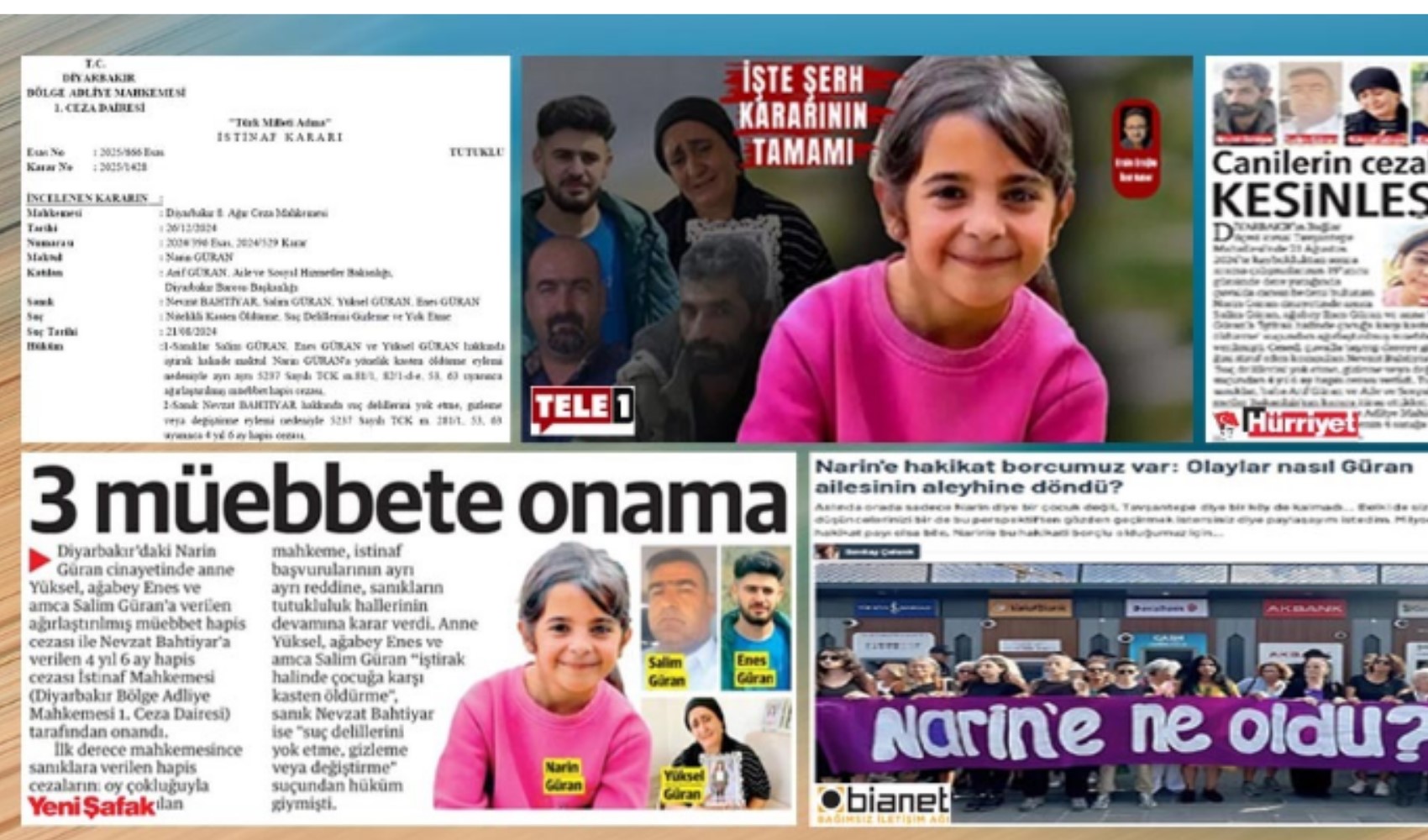
Indeed, the court reached a verdict in line with the public expectations created by the media; it sentenced family members Yüksel, Enes, and Salim Güran to aggravated life imprisonment for murder, and Nevzat Bahtiyar to 4 years and 6 months in prison for the crime of "destroying, concealing, or altering evidence of a crime."
Unfortunately, this decision by the Diyarbakır 8th High Criminal Court was not sufficiently questioned in the media, and journalists stepped aside with the comfort of having completed their duties. They showed little interest in the appellate court's confirmation decision last week, brushing it off with minor news items.
However, the 1st Criminal Chamber of the Regional Court of Justice had reached the decision by a majority vote, and the presiding judge had attached a detailed dissenting opinion. This information was buried in the fine print of most media outlets, including AA, AHaber, Akşam, Cumhuriyet, Halktv, Ekoltv, Hürriyet, CNNTürk, İHA, Sabah, Sözcü, Nefes, Türkiye, and Yeni Şafak.
Among the newspapers, only Milliyet presented the presiding judge's dissenting opinion in a separate box. As far as I can see, only the Tele1 news site published the full text of the dissenting opinion, which was reported in detail by DHA and Serbestiyet.
It is clear that the judge penned the dissenting opinion—which is longer than the verdict text itself—after seriously examining all the evidence, testimonies, and reports in the file. The first thing that caught my attention in the dissenting opinion was the emphasis on how the defendants' statements changed "according to the new situation created after the news and discussion content on social media and TV bulletins." The judge had clearly observed the media's influence on the trial in the statements.
The judge lists one by one the legal deficiencies in the investigation and trial, the contradictions between reports, the nature of the narrowed base station reports as secondary evidence, the failure to determine the motive and the manner in which the murder was committed, and the shortcomings and errors of the conviction decision.
After examining the dissenting opinion published in Tele1 under the byline of Ersin Eroğlu, I remembered the anxiety I felt during the process that began with Narin Güran's disappearance. What if all or some of the members of the Güran family are innocent? What if we journalists negatively influenced the judiciary and led to the conviction of innocent people? These questions pricked my conscience...
In fact, I had felt the same anxiety before regarding the court's decision after reading the article by DEM Party MP and communication academic Sevilay Çelenk, published in Bianet, titled "We owe a debt of truth to Narin: How did events turn against the Güran family?" and the subsequent interview she conducted with Gökçer Tahincioğlu on T24, as well as Esra Arsan's article "From earthquake reporting to the Narin Güran murder, the naked state of a journalism: The Ferit Demir legend (!)" and the interview containing Ferit Demir's response to the criticisms. These articles also contained striking findings about how the Güran family members might be innocent and about the media's mistakes.
Now, the legal objections highlighted in the dissenting opinion during the appellate process have been added to the questions in those articles. It has now become a necessity to reopen this file, examine it with the cold-bloodedness of a journalist, and pursue the evidence. If even one of those convicted with our contribution is innocent, this is a great responsibility, a heavy burden on the conscience...
"INTENT READING BASED ON ABSTRACT ASSUMPTION"
The presiding judge of the 1st Criminal Chamber of the Diyarbakır Regional Court of Justice begins the dissenting opinion by emphasizing the principles of the "presumption of innocence" and "the defendant benefits from doubt." Most importantly, regarding the court's conviction decision, the judge states that "no opinion is expressed within the scope of the evidence, and the opinion and justification reached in the form of intent reading based on abstract assumption are contrary to the law." The judge lists all the legal problems identified in the court decision one by one with careful language, without looking at whether they are in favor of or against the defendants; moreover, the appellate decision approved by the other two judges does not cover the judge's objections.
The 16-page dissenting opinion, which includes the judge's view that the court's decision should be overturned due to "incomplete investigation, legal classification of the crime, proof, and findings that the formation and acceptance are contrary to the law," will make the work of the panel that will examine the file at the Court of Cassation stage quite easy. The sections I have summarized below from the dissenting opinion reveal that the judge tried to make a cool-headed legal assessment by stepping outside the media's sphere of influence:
• It was not taken into account that there are contradictions between the narrowed base station report and the farm camera footage, which constitutes definitive material evidence, and Nevzat's defenses regarding the incident.
• I am of the opinion that it is not possible to make a decision based on these two reports (Prof. Labudde and National Criminal), as sufficient improvement could not be made in either report and there are contradictions between the two reports regarding the blur resembling Narin.
• It is contrary to the law to decide on a conviction for the crime of concealing evidence of a crime with the acceptance that the act of killing was not proven against Nevzat, by relying on the narrowed base station report, which contradicts the formation and concrete evidence and needs to be supported by other evidence, and his contradictory defenses.
• Considering the current evidence status regarding Yüksel and Enes, it is necessary to evaluate how their participation in the alleged crime occurred and what the legal classification of the crime should be.
• It is not proven that there was a criminal decision made regarding the killing of Narin before the incident.
• It is contrary to the law that no opinion is expressed within the scope of the evidence regarding what the actual purpose of killing Narin was, which is more important than the hearing of the relationship between Yüksel and Salim, and that the opinion and justification reached in the form of intent reading based on abstract assumption are contrary to the law.
• Considering Nevzat's statements that he received Narin's lifeless body from Salim, it is contrary to the law that the issue of whether Salim personally carried out the act of killing Narin was not discussed in the reasoned decision.
• It is contrary to the law to establish a verdict by accepting the acts as proven by giving the status of definitive material evidence to the narrowed base station report, which can be considered as secondary evidence that does not allow for review, as a result of an incomplete investigation regarding Yüksel and Enes.
• Except for Nevzat's allegation that "Salim Güran told me 'I killed this girl because she saw that I was with Yüksel'," no concrete evidence has been put forward regarding these claims.
• It is contrary to the law to make a decision without considering whether the crime scene was the driver's seat of the vehicle used by Salim and whether the act of killing was carried out by Salim personally and alone, within the scope of concrete material evidence.
• It is understood that during the hearings, attempts were made to consult the witness's knowledge regarding matters not acquired through his five senses, and that the court panel, defense counsel, and attorneys acted in violation of the Criminal Procedure Code (CMK) by asking questions containing interpretations that would not contribute to the emergence of the material truth, without complying with the cross-examination procedure.
THE ABUSE CASE IN BEYLİKDÜZÜ
I don't know if you remember the news about the "allegation of abuse of a 2-year-old child in Beylikdüzü"; the judicial process regarding the Narin Güran murder and finally the appellate decision reminded me of that incident.
That news, published in Bianet about three years ago, was based on a doctor's account, a hospital report, and the fact that the Büyükçekmece Chief Public Prosecutor's Office had opened an investigation. However, later, the Forensic Medicine report did not confirm the sexual abuse allegation; the investigation was closed.
While examining the news following the discussions, I had stated that the hospital report could not be ignored and that the "news value of the allegation" arose with the available data, but I had evaluated the fact that the family had not been spoken to as a deficiency. I wrote that the allegation, not the news, turned out to be wrong.
I thought about this assessment of mine a lot later. Over time, I came to the conclusion that I had not sufficiently considered the pain of the family who were subjected to a serious accusation. Until the allegation was clarified, the family members were subjected to sexual abuse accusations, and they could not even experience the pain of their deceased child. Now, whenever I think of their state, my heart aches.
The lesson I learned is this; it is important to pursue a sexual abuse allegation—especially if it is directed at a child—but it is also important to get the views of all parties, use careful language, and respect the family's pain.
In the Narin Güran murder, if even one of the family members is innocent and we, as journalists, caused that innocent person to be convicted, this would be an unforgivable journalistic crime. We are faced with a task such as finding the answers to the questions that remain in the dark, ensuring the resolution of the legal problems in the case, and ensuring that the murder is clarified in all its aspects.
In a single sentence:
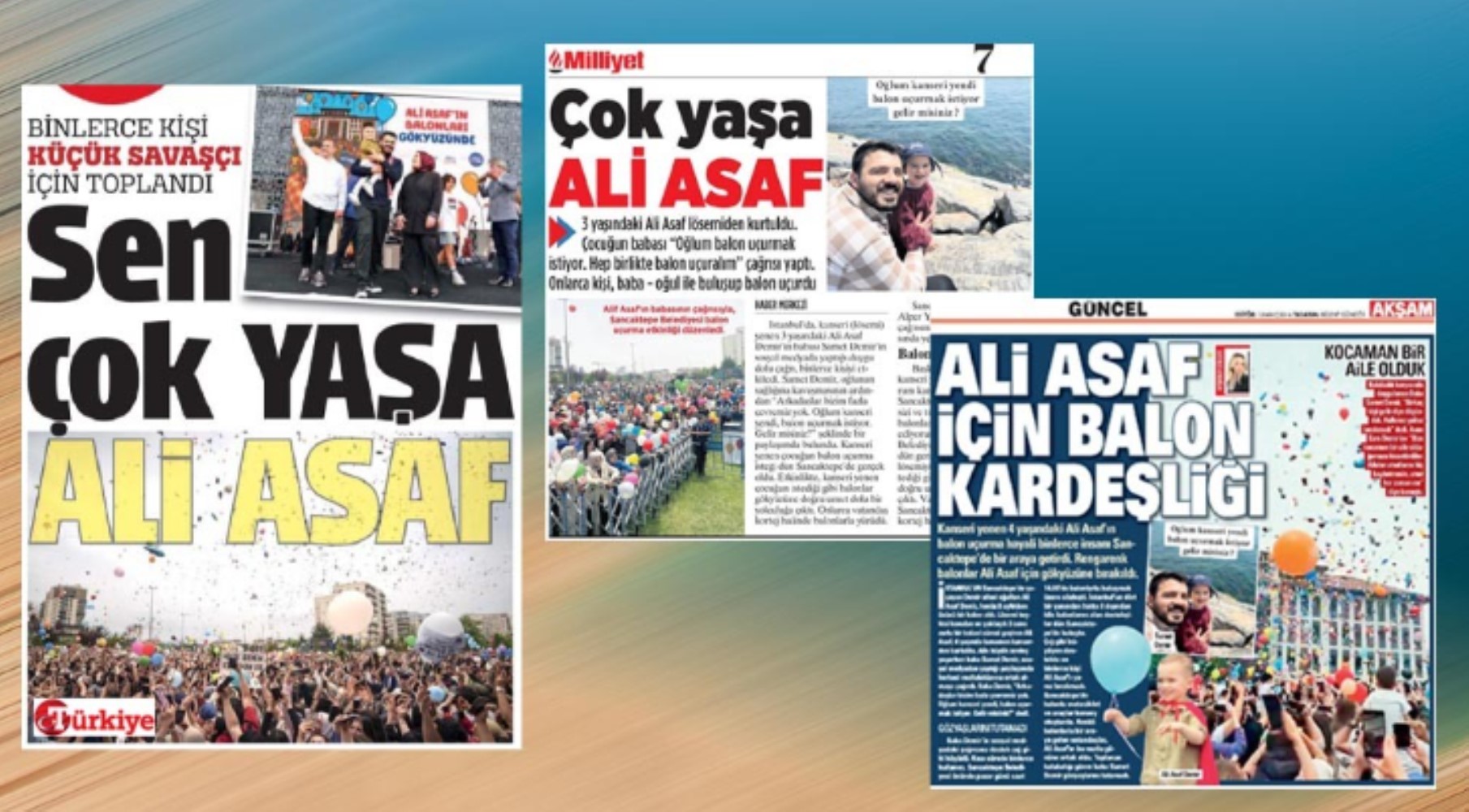
• Akşam and Türkiye did not mention that thousands of people gathered upon the call of CHP Sancaktepe Mayor Alper Yeğin in the news about balloons being released for a child named Ali Asaf who beat cancer.
• "Award-giving" organizations, which have become an industry, gave plaques to some media outlets under the names of "International Diamond Awards" in Istanbul and "Capital Value Awards" in Ankara.
• Akşam columnist Hikmet Genç responded to an opposition journalist, whose name he did not give, who criticized the questions directed at President Erdoğan on the plane returning from Budapest, at the level of "kartaloş" (old hag), "dingil" (jerk), "yüznumara ibriği" (toilet pitcher), "Ulan" (Hey you), "duayen manyak" (doyen maniac), "Where do you get these from."
• Milliyet published the AKP-controlled Konya Metropolitan Municipality's promotional text as if it were news under the headline "Four Seasons Konya" without adding the "This is an advertisement" warning.
• TV channels like BBC and SKY did not show the footage of the traumatic moment when a vehicle drove into the crowd celebrating Liverpool's championship, but ATV and CNN Türk repeated the footage of that moment over and over.
• Trendyol took journalists from Dünya, Habertürk, Hürriyet, Milliyet, Sabah, and Yeni Şafak to Dubai to watch the signing ceremony of the data center to be established in Ankara.
• CHP Chairman Özel's words, "Who does Yeni Şafak belong to? It belongs to the son-in-law," were published in the opposition media without being corrected; the information that Yeni Şafak does not belong to Berat Albayrak should have been added to the news.
• The headline "Zehra Güneş said goodbye: Surprise separation" on the Halktv site was misleading; what was called "separation pain" was her sister Mina, who is also a volleyball player like Zehra Güneş, going to the USA.
• In Hürriyet's news titled "Here is the coordinator, the bully at home," the man referred to as the "coordinator of a large holding" did not even have the name of his wife or even his lawyer; all the subjects in the news were hidden.
• Yeni Şafak censored the surname of the deceased artist Şimal, which was "Gülen," and wrote it as "Tebessüm Eden" (Smiling); it did not correct it despite the reactions and critical news on social media.
FOR YOUR CRITICISMS, COMPLAINTS, AND SUGGESTIONS: [email protected]
Most Read

Striking picture for Özgür Özel's 'New Party'

The PKK opening and Özgür Özel’s path!..

How did the newspapers view Özgür Özel's farewell to the CHP?

He killed his wife by slitting her throat: Their children witnessed the moments

What did the CHP do?

Özel’s new party move in the world press

The New CHP, against CEHAPE

Fire at TUSAŞ engine factory in Eskişehir under control

From self-efficacy to despair

Kılıçdaroğlu's first message on Özgür Özel's new party announcement