



In that cartoon, Muhammad and Musa are depicted greeting each other as they sprout wings and ascend to the heavens, having been killed by missiles raining down on both sides. It is an anti-war cartoon that emphasizes the meaninglessness of war.
Doğan Pehlevan, who drew the cartoon, also says that those depicted are not the prophets. Furthermore, even if the figure drawn were the Prophet Muhammad, there is no expression there that insults or mocks the prophet. Prophets are drawn greeting each other in a friendly manner despite the war. From an Islamic perspective, the depiction of the Prophet Muhammad may be criticized, and that is open to debate. But the drawing is a silhouette, not a portrait.
Undoubtedly, the cartoon can be criticized, and reactions can be expressed. However, the reactions shown to the cartoon in LeMan were not peaceful protests. There were those on social media screaming for death and those demanding that they be punished like the Charlie Hebdo cartoonists in France.
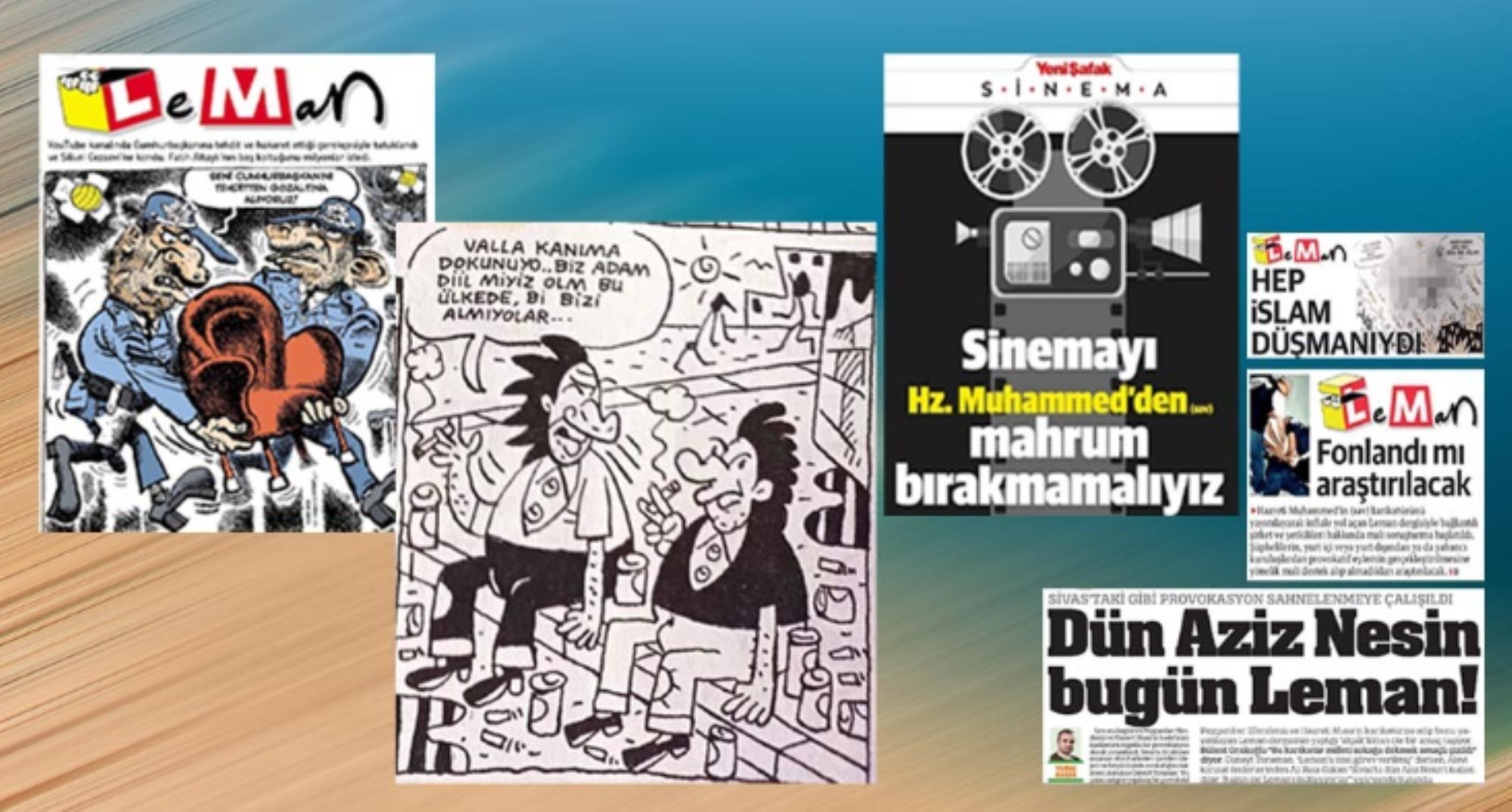
A group led by members of the Great Eastern Raiders Association (Büyük Doğu Akıncıları Derneği), an offshoot of IBDA-C, marched to the front of the magazine's building in Beyoğlu with slogans; some even climbed the building and waved banners. But the police only watched the violence and did not detain a single person.
Minister of Interior Ali Yerlikaya also displayed police violence by sharing footage of four people being detained from LeMan. The attackers were given space to act, and violence roamed the streets. Law, justice, and human rights were nowhere to be found.
Unfortunately, the pro-government media followed the same line in the LeMan cartoon incident. “A journalist cannot publish content that justifies, encourages, or incites violence and war,” and they should not. But newspapers like Akşam, Hürriyet, Milliyet, and Yeni Şafak, as well as pro-government television channels, did not mention the attack on the magazine office, the death slogans, or the aggression and violence displayed by the protesting group while reporting on the reactions to LeMan.
Yeni Şafak with headlines like “They talk about humor while spewing blood” and “LeMan has always been an enemy of Islam,” Türkiye with “Yesterday Aziz Nesin, today LeMan” and “Anger rains down on the vile attack,” and Sabah with “LeMan’s record turns out to be heavy” tried to legitimize and justify the violence and aggression. Sabah columnist Nihat Hatipoğlu also joined the chorus, writing that in the cartoon, “the prophets were shown like terrorists,” however he looked at it.
Only Abdülhamit Güler, who prepares the cinema page for Yeni Şafak, displayed a different approach from his circle in his article “We should not deprive cinema of the Prophet Muhammad,” writing that “even if it is not the Prophet Muhammad being drawn, it being open to misunderstanding is a serious problem.”
The raiding of LeMan’s office, the confiscation of the magazine, the blocking of access to its website, and even the arrest of four people were not enough for the pro-government media. They continued their broadcasts for days.
The fourth frame, right below the cartoon that caused so much noise, may have been overlooked. Two people are chatting while smoking; one complains to the other:
“Honestly, it gets to me… Aren’t we human beings in this country, they don’t even take us in”
This cartoon reflects the state of the country. Now the cartoonist of that cartoon is also under arrest. Academic Aslı Aydemir, who reacted to the jihadists who attacked the Leman office that night, is also under arrest. RTÜK has also decided to shut down the screens of opposition channels Halk TV and Sözcü TV for 10 days each.
In addition to these, our journalist friend Timur Soykan, who reacted to the operations against CHP mayors, was also detained solely because of his social media post.
We are truly in a country like the one in that last cartoon frame; at this rate, they will not leave any “dissidents” who haven't been put inside. The space for freedom of thought and expression is narrowing a little more every day.
'NEWS' PRIVILEGE FOR THE BOSS'S COMPANY
Hürriyet was the newspaper that gave the most extensive coverage to the “Gazi Race” news. Two days in advance, it put the “Record prize at Gazi” news on the front page; it allocated a large space in the back. Interviews with jockeys and live broadcast announcements followed one another. News and interviews covered the pages on the day of the race and afterwards.
Milliyet, the other newspaper of the Demirören group, also reflected the race to its readers with care. The group’s television channels, Kanal D and CNN Türk, also broadcast the race live. The only thing missing from the news in Demirören media after the race was the chanting of “We are Mustafa Kemal’s soldiers” from the stands. Milliyet also reported on an aspect of the race that was not in other media outlets with the headline “Host Oktay”:
“Demirören Holding Board Member B. Murat Oktay was also among those watching the historic Gazi Race. Hosted by Oktay, many names from the worlds of art, business, and sports spent pleasant hours at the most colorful organization of recent years in the Hipodrom.com box.”
This news also explained the reason for the extraordinary interest shown by Milliyet and, of course, the other media outlets of the Demirören Group in the “Gazi Race” this year. Because Hipodrom.com, one of Demirören Holding’s companies, was the “host”! The horse racing platform Hipodrom.com “allows betting on all domestic and international races organized by the Jockey Club of Turkey via mobile and web platforms.”
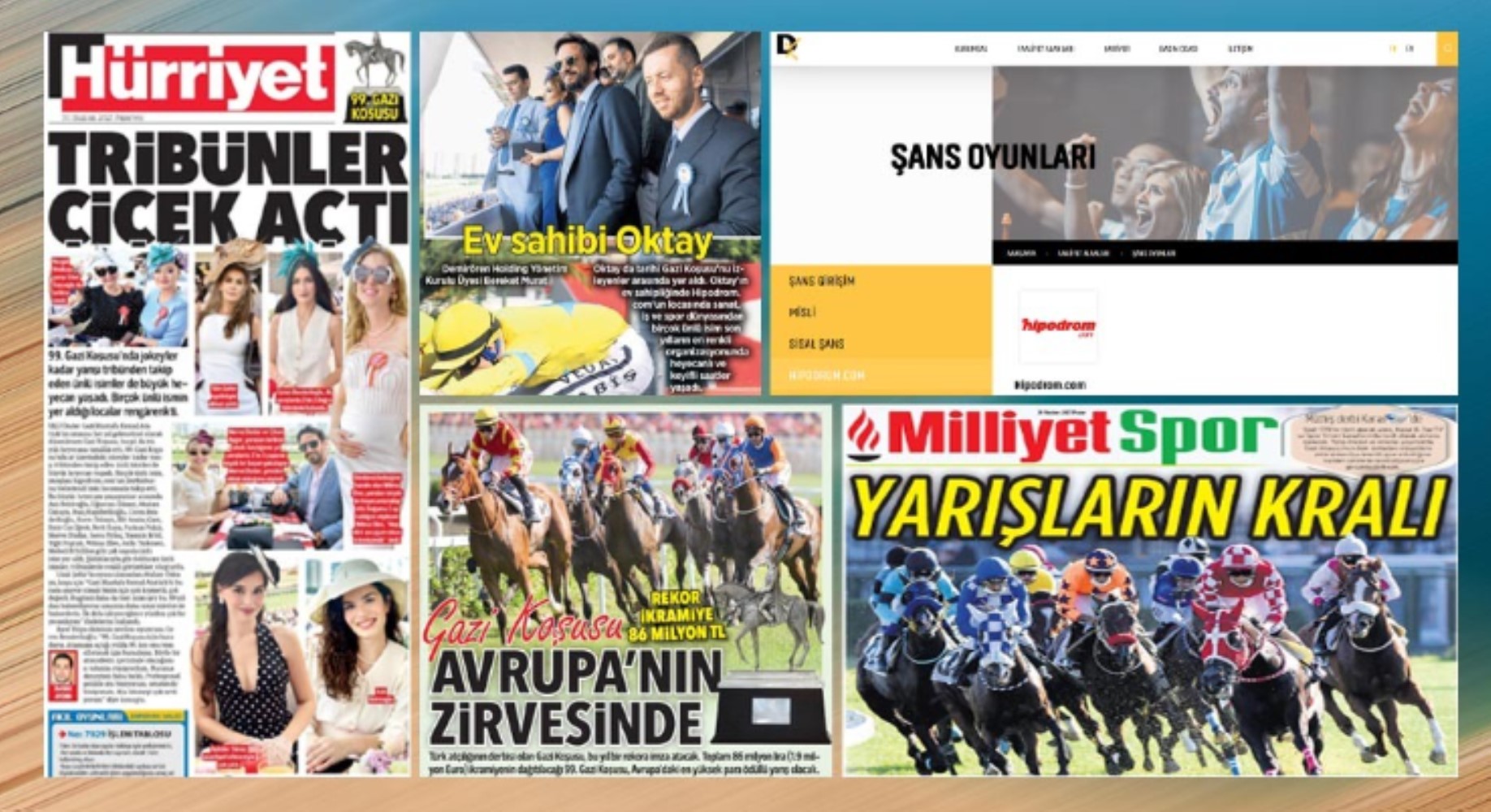
As such, the purpose of the efforts of Hürriyet, Milliyet, and others was to provide a privilege to their boss’s company! They were using journalism as a tool for their boss’s commercial interests. Indeed, Ahmet Hakan, without even feeling the need to hide that they were doing “news” for the benefit of the boss, praised the organization and thanked Demirören in his article “The most elegant tradition inherited from Atatürk.”
A media organization that tramples on journalistic principles according to the boss’s interests finds it natural to protect the interests of others in its other news as well. It conducts journalism according to the boss’s interests or his signals in political, economic, social news, and even in sports.
Unfortunately, “boss journalism” is quite common in our media. And the most terrible, most saddening part is that some of our journalist colleagues internalize and adopt this disgrace…
THE PROBLEM OF SOURCES IN PARLIAMENTARY QUESTIONS
Some opposition MPs have found the easy way out. They take the news that appears in the opposition media and turn it into a parliamentary question as it is. Let me share a few examples I have come across in recent days.
In the news “Black hole swallowed 200 billion” published in BirGün on June 15, information was given that “guarantee payments” for highway projects had reached 200 billion TL; the amounts paid since 2017 were listed. The parliamentary question submitted by CHP Deputy Chairman Ulaş Karasu on June 18 regarding these payments was based on this news, but no source was cited.
The “Here is waste for you” news was on the front page of Sözcü on September 24, 2024. It was stated that the floating natural gas platform, which exploded in 2015, was shortened by 23.5 meters and sold to Turkey after being repaired. The information in Sözcü’s news was used in the parliamentary question submitted by Good Party Group Deputy Chairman Turhan Çömez on June 2; there was no reference to the newspaper in the question.
Veryansın TV’s news about the Ministry of Labor and Social Security renting a 13-story building for 86 thousand liras per year was also turned into a parliamentary question by CHP MPs Ali Gökçek and Hasan Öztürkmen. They also did not cite a source in their questions.
It is, of course, positive that MPs bring the news that journalists produce with so much effort to the agenda of the Grand National Assembly of Turkey through parliamentary questions. It is valuable for them to follow up on the news and maintain continuity, but it is unfair to turn them into questions without citing the source. We expect respect for labor.
THE DIFFERENCE BETWEEN JOURNALISM AND PUBLIC RELATIONS
Journalist Doğu Eroğlu drew attention to the “different journalism” in two news stories published on the same day in his social media post. I immediately read the two news stories.
It was the research titled “The story of two villages in İliç: Çöpler and Sabırlı” published on T24. In the research written by Doğu Eroğlu and produced by “Ortak,” an independent news center for investigative journalists, it was explained that “the mine had disconnected the entire region from subsistence activities and proletarianized it in 15 years, and that migration became inevitable when the mine’s activities stopped.”
In the news “The common demand of the people: Let the mine be opened” published on Habertürk, it was stated that the economic wheels in İliç were not turning after the accident and that the villagers wanted the mine to be opened.
Indeed, there was a big difference between the two news stories. Ortak’s research looked at the current problem in the district from a wide window and examined the effects of both the opening and closing of the mine together. The research on Habertürk, on the other hand, emphasized that the opening of the mine and the extraction of “gold that directs the world economy from under the soil” modernized İliç and changed the fate of the region, and advocated for the reopening of the mine.
Ortak’s was a product of objective journalism, while the one on Habertürk was a public relations activity prioritizing the reopening of the mine. When journalism looks after corporate interests instead of protecting people and nature, it ceases to be journalism.
Those who want to learn what is going on in that region should read the research on T24; let the owners of Anagold, which operates the mine in İliç, and their extensions in the media content themselves with the news on Habertürk…
In a single sentence:
-While Hürriyet, Akşam, and Türkiye saw the 24.6 percent major increase in natural gas prices as small on their inner pages, Sabah published it with the headline “Price update in natural gas”; the next day, it also ran the news “44 percent subsidy continues in natural gas.”
-Access to the accounts of journalists Altan Sancar and Ali Macit was blocked.
-The presence of Öcalan’s photograph in the articles he shared on newspapers and websites was cited as the reason for the arrest warrant issued for journalist Nedim Türfent.
-Yeni Akit, which has made it a habit to insult CHP Chairman Özgür Özel, continued its insults this time with the headlines “Posta-headed” and “Harami” (Bandit).
-Akşam and Türkiye published the promotional text titled “Our youth will build our Konya” by the AKP Mayor of Konya as if it were news without putting an “advertisement” warning.
-The headline of the Halktv website “Beware! 650 million dollars worth of counterfeit money in circulation” was misleading; Akşam’s headline “35 billion dinars of counterfeit banknotes collected from the market in Libya” was more accurate.
-Cumhuriyet’s news site includes headlines that have nothing to do with journalism, such as “… which city’s area code? …whose phone code?” just to hunt for readers.
-NTV and Halktv published the news “After the hidden camera scandal, (CHP’s) Sapanca Municipality demolished that bungalow,” but pro-government local sites preferred to write “The owners demolished the facility.”
FOR YOUR CRITICISM, COMPLAINTS, AND SUGGESTIONS: [email protected]
Most Read

Striking picture for Özgür Özel's 'New Party'

The PKK opening and Özgür Özel’s path!..

How did the newspapers view Özgür Özel's farewell to the CHP?

He killed his wife by slitting her throat: Their children witnessed the moments

What did the CHP do?

Özel’s new party move in the world press

Fire at TUSAŞ engine factory in Eskişehir under control

The New CHP, against CEHAPE

From self-efficacy to despair

Kılıçdaroğlu's first message on Özgür Özel's new party announcement