



A disease dating back to the 'Televole' era has flared up again. In the case of the secret bank fund fraud, old footage of Fatih Terim and the famous footballers who lost their money is being broadcast on some TV news bulletins as if they were speaking about the current trial.
By repeatedly airing this footage, the truth is being distorted and viewers are being misled. If it were accepted that there is no absolute obligation to provide visuals in news reports, the problem would be solved. If there is no statement from the footballers, then there is none; digging into the archives to manufacture something that does not exist is contrary to the spirit of journalism.
The second problem with the reporting on this case is the hesitation to mention the bank's name. When the incident broke out last April, in Habertürk's report,in Cem Küçük's article in the Türkiye newspaper, and in most of the reports published subsequently, "a private bank" it was being said. Gazete Oksijen, which was following the incident closely, was giving the name of Denizbank.
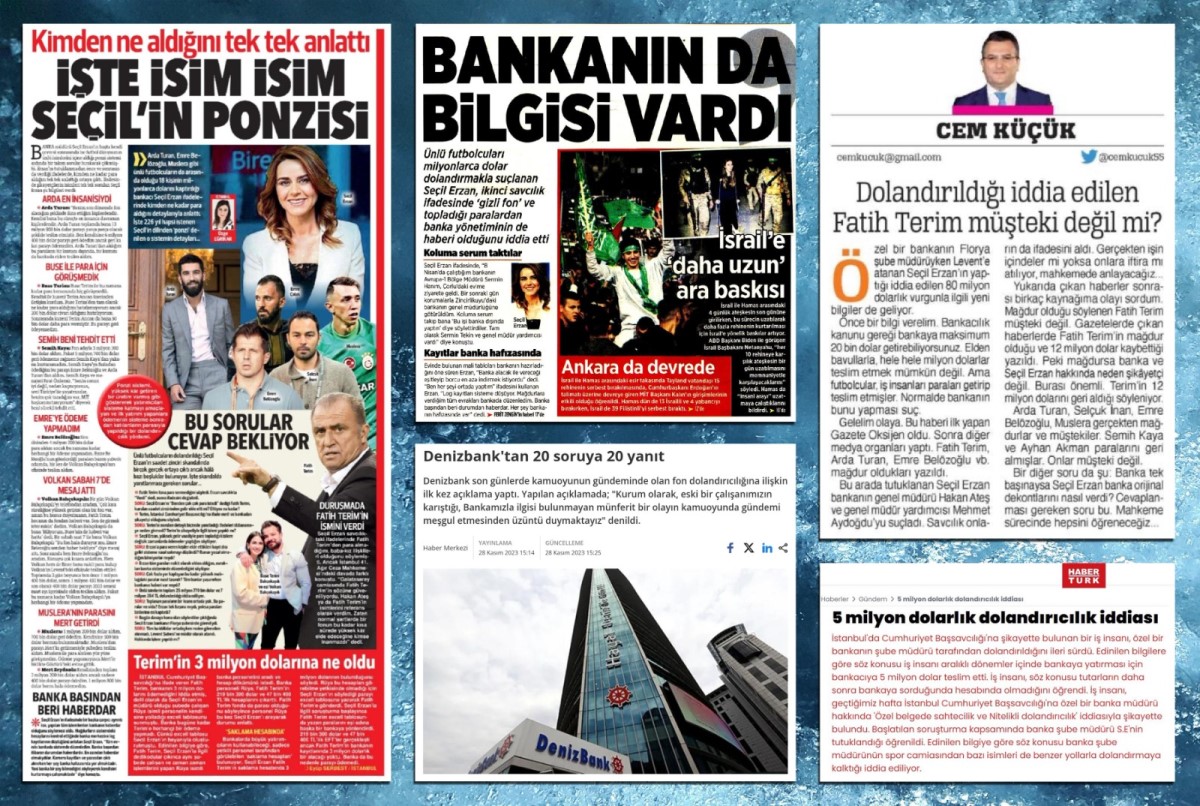
In the reports on October 26 regarding the acceptance of the indictment against Branch Manager Seçil Erzan and the other defendants, as well as in most of the reports concerning the first hearing on November 20, the bank's name was concealed. So much so that, in Hürriyet's November 25 "Seçil's questions" headline, even though one of the questions was about the bank, the bank's name was not mentioned! In Milliyet's November 27 "The bank also had knowledge" the bank's name was in the headline, while it was mentioned in passing on the inside pages.
In one of the rare examples in print media, Ismail Saymaz's articles published in Sözcü on November 23 and 24 mentioned Denizbank's name in the very first line and examined the bank's responsibility. Digital media was more active on this issue. Gazete Duvar, Gerçek Gündem, Habertürk, Odatv, T24 and other news sites were explicitly mentioning the bank's name.
Once it became so widely known, other media outlets also began including the bank's name in their reports. Indeed, Denizbank was forced to issue a statement and answer questions on November 28. The primary reason the bank felt no need to inform the public until that day was that the media had been concealing the bank's name in their coverage.
This is a disease that has become deeply entrenched in Turkey in recent years. Names are omitted in news reports containing negative information about private companies, private banks, private hospitals, and major business figures. Even without a request from the parties involved, those responsible are shielded. There is no need for anyone from Denizbank to call and ask not to mention the bank's name. This is voluntary protectionism...
THE MINE OWNER WAS ALSO PROTECTED
News reports regarding the collapse at the copper mine in the Şirvan district of Siirt on November 23, which resulted in the deaths of three people—two engineers and one worker—were also a striking example of the media's “concealing those responsible” disease.
AA and DHAreports did not mention the company's name in the headline or the lead, but it was present in the governor's statement. The name of "Eti Bakır Anonim Şirketi" was being given. İHA, however, went a step further and announced in the headline of its report that this company "is affiliated with Cengiz Holding." was being announced in the headline of the news.
However, in the majority of media reports regarding the accident, even the Eti Bakır company was not mentioned. Most of those who did name Eti Bakır concealed the fact that this company is affiliated with Cengiz Holding. Only a small number of sites, such as Evrensel, BirGün, SolHaber, and Tele1, published the name of Cengiz Holding.
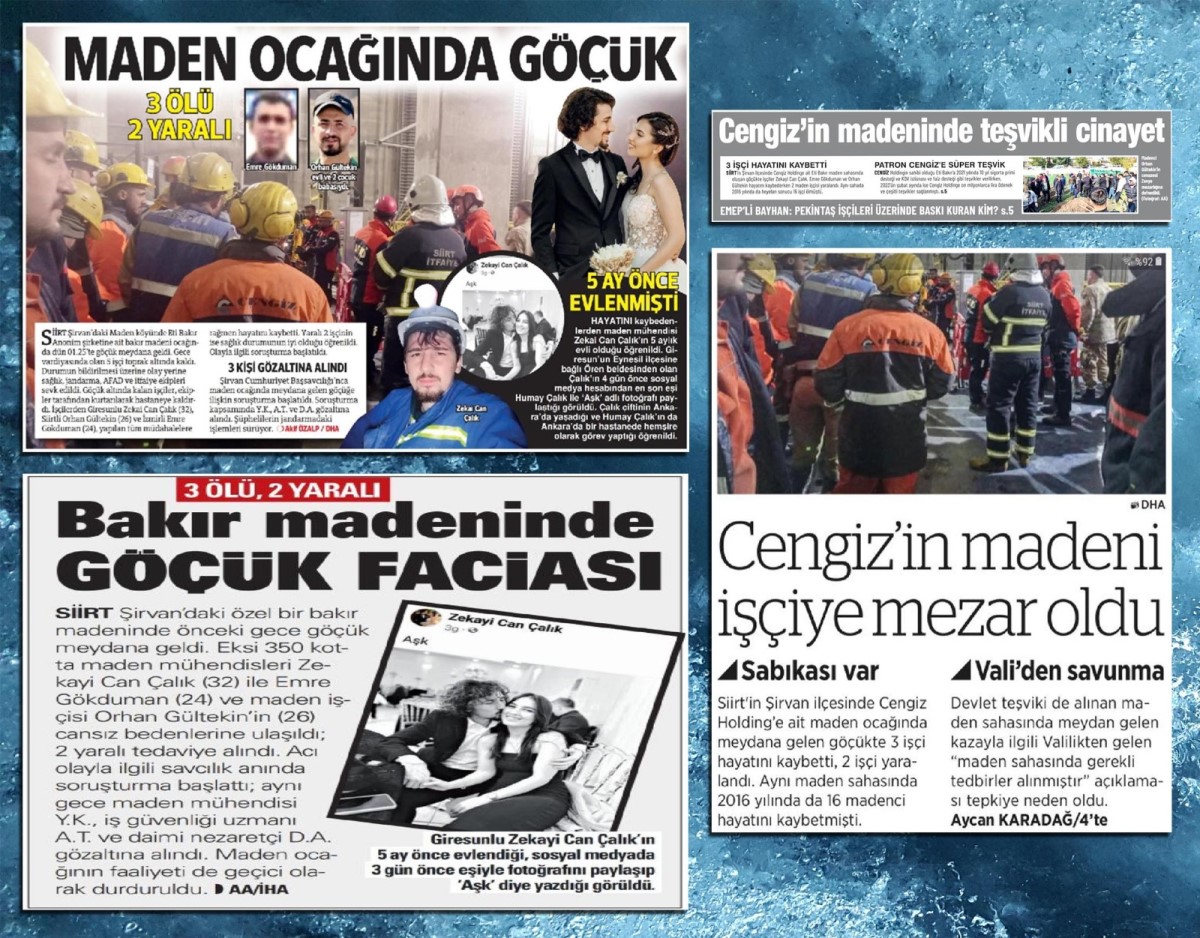
In fact, even in the reports where Cengiz Holding's name was written, there was a lack of information regarding the history of the mine. Cengiz Holding acquired this mine from the Ciner Group in 2017 had purchased. In 2016, 16 workers died in a collapse at a mine operated by the Ciner Group. In the reports regarding that accident, it was not mentioned that the mine belonged to the Ciner Group. Not only was the news of the accident censored on Habertürk, but the judicial process was also completely ignored by the corporate media.
Just as the mainstream media hid the fact that the Ciner Group was responsible for the deaths of 16 workers back then, today the responsibility of Cengiz Holding is being covered up. If those responsible for the collapse seven years ago had been clearly identified, perhaps new collapses could have been prevented. I had thought that the death of three more people in the same mine due to another collapse would stir the conscience of the media, but alas!
The protection of Cengiz Holding is also a reflection of the disease of hiding those responsible in news reports. It is also an indicator of how the media has surrendered to power centers and corporations. If that were not the case, they would not act so protectively and would not abandon the pursuit of public interest.
IS THE FOOTBALL MEDIA ASLEEP?
Murat Ağırel started with the Tuzlaspor match tickets that were sold for 5,000 liras and proceededto cover everything from match-fixing executives in the football world and money laundered through fake invoices in clubs, to players involved in illegal betting and those demanding money from rival team executives. He wrote about these in Cumhuriyet newspaper starting from the first days of November and also explained them on his program on Halk TV.
It would be expected that every one of his articles would stir up fans, club executives, prosecutors, and everyone who wants“clean football.” However, other than the Public Prosecutor's Office launching an investigation into Tuzlaspor executives, there has been no concrete development to date. Moreover, Murat Ağırel was subjected to threats and insults from ignorant individuals on social media. The threats from football commentators Nevzat Dindar and Alper Mert, who later apologized, were also inappropriate.
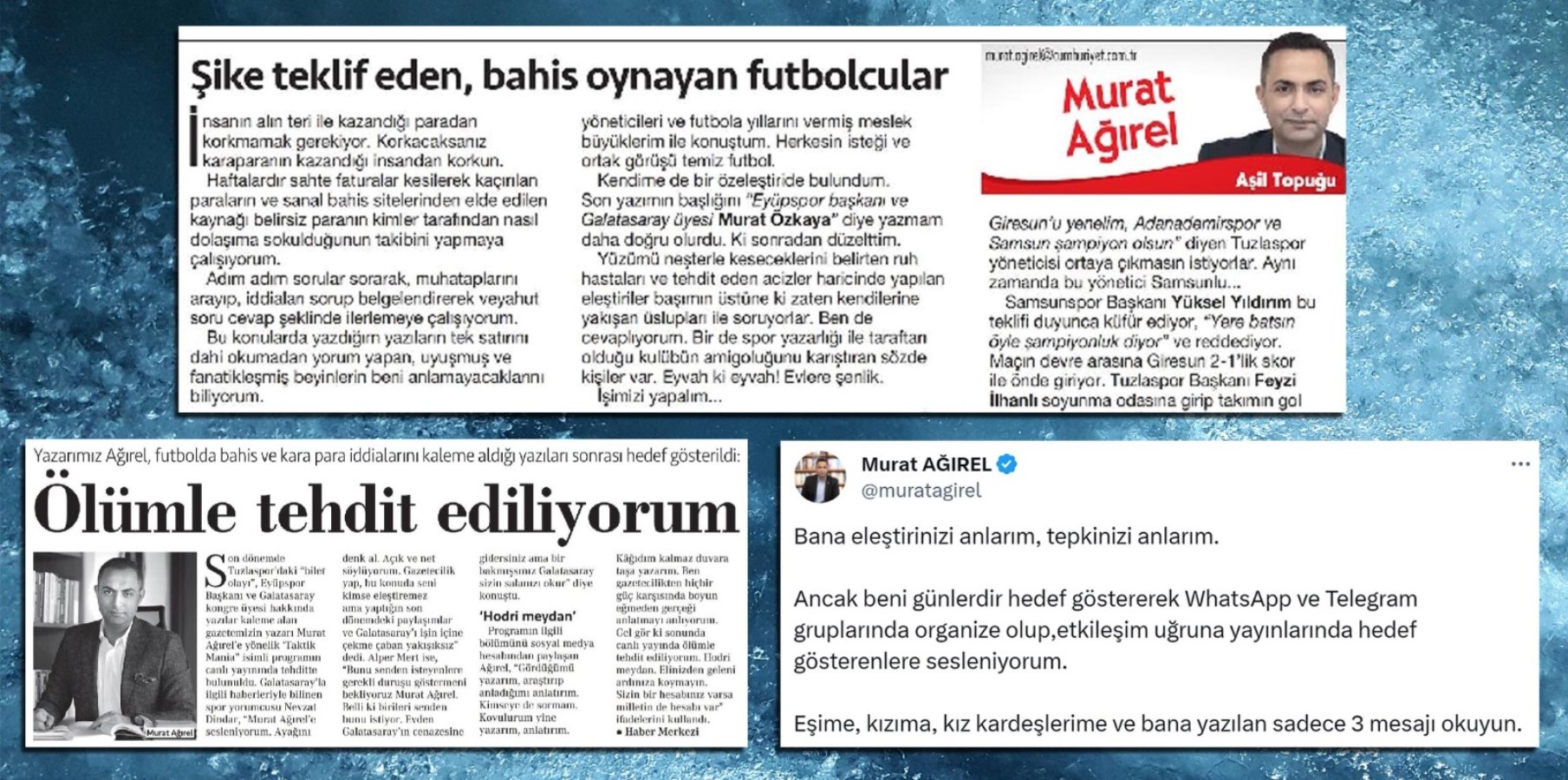
Murat Ağırel was made a target in the football community, but everything he wrote was in plain sight for those with eyes to see. For example, Tuzlaspor selling all its tickets and then playing to empty stands, or the betting scheme that turned a 475,000 lira investment into 4.75 million liras coupon, the goalkeeper who is a member of a virtual betting site, the Tuzlaspor executive who offered a bribe to Samsunspor, and the players who sent messages to the Eyüpspor president players are not exactly secret or hidden affairs.
So, why couldn't the football media bring what Murat Ağırel wrote to the agenda? How did it happen that it was Murat Ağırel, who follows political issues, and not a football writer, who wrote about all of this? Did they fail to notice, or were those who did notice unable to write about it due to their special relationships with the clubs or professional deformation? I hope a football writer will emerge to answer this question with sincerity.
While such serious allegations are being laid bare, football the media's continued indifference is also striking. On the football pages, I only saw news of the investigation and statements from the TFF and some club presidents. A couple of statements from football commentators, a few articles, and that's it.
Instead of investigating these dirty dealings, the football media continues to focus on the matches of big teams, writing success stories for coaches, and debating the same repetitive topics like allegations regarding referees. It seems they have no intention of leaving their comfort zones.
NTV'S STATEMENT
"Journalists' financial dealings and professional organizations" In my article titled, the name of Buse Yıldırım from NTV was mentioned among the journalists who attended the Brand Conference. NTV News Director Halil Demir made a brief statement on this matter:
"NTV's on-air personality Buse Yıldırım attended the Brand Conference under a corporate assignment. Therefore, she has no financial gain or interest. NTV's journalistic ethics principles are extremely clear. NTV on-air personalities or reporters cannot participate in such organizations without the institution's knowledge."
NTV's corporate sensitivity is valuable. Otherwise, for "on-air personalities" to develop personal financial relationships with such commercial platforms harms both the individual and the institution.
Furthermore, Fatih Altaylı stated that, just as with all other meetings he attends as a speaker, he did not receive any payment for his speech at Crypto Fest.
THOSE DECEIVED BY SOCIAL MEDIA
Aykırı, Odatv and the next day, the reports published by Ihlas News Agency "Starving wolves descend into Istanbul city center" under the headline were sourced from social media. The footage had been shared on the account named "Istanbul bulletin" on X before these sites.
The reports stated "that two wolves were seen in Basaksehir, citizens were shocked, and the wolves were filmed with a mobile phone camera"There was no other information. It was clear that once the footage was found, a few lines were added to it and it was released as a news story. Many sites, including AHaber, Cumhuriyet, Hürriyet, Milliyet, Sabah, Sputnik, Kanal 7, and Yeni Akit, used this story exactly as it was.
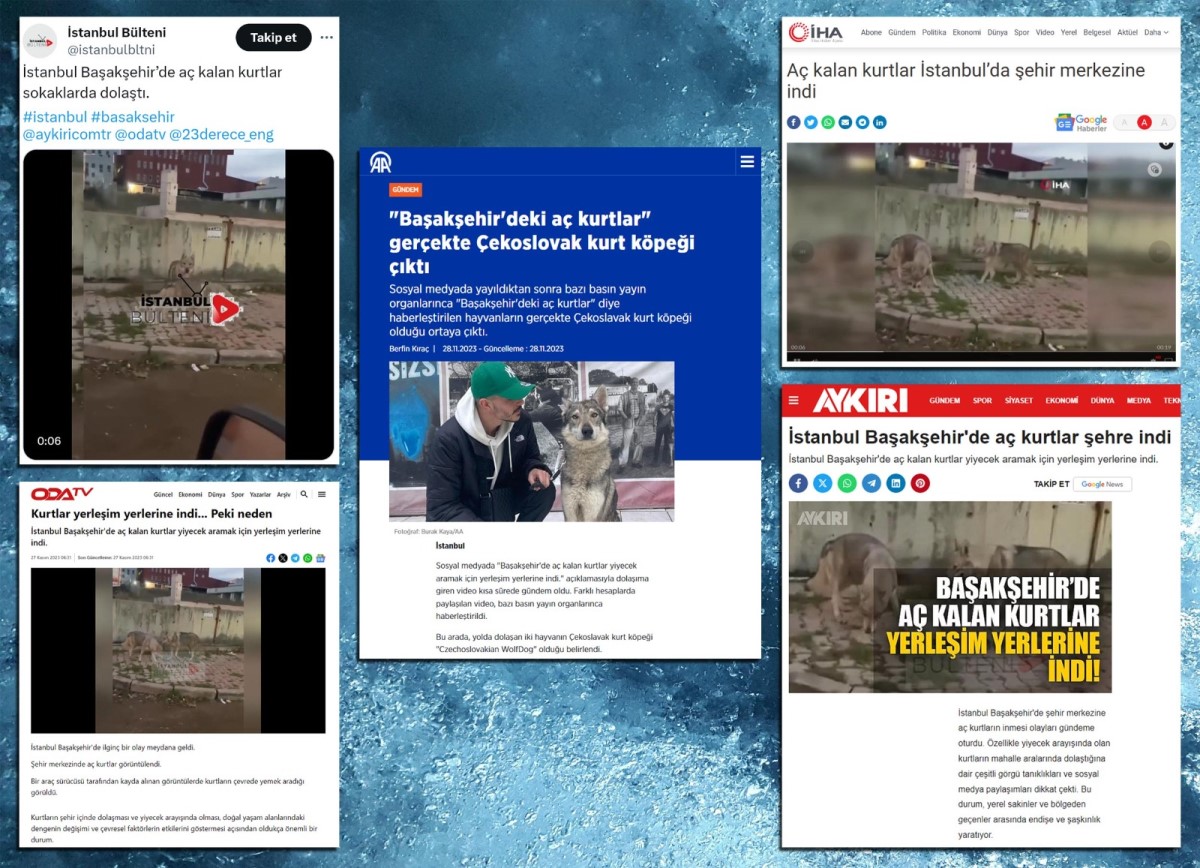
When Anadolu Agency investigated the matter the next day, the true face of the incident emerged. The animals roaming in Başakşehir were not "hungry wolves," but "Czechoslovakian wolfdogs." Burak Kaya, the owner of the two dogs, said he read the news with astonishment and added: “People are doing journalism on social media as they please without knowing what is going on.” he said.
Unfortunately, this error has increased recently. Social media posts are being published without undergoing any research or verification. Jumping on every random post or image, as in the example of "hungry wolves descending into the city", drags media organizations into error. I understand that speed is important in the digital age, but fact-checking is even more important...
In a single sentence:
In Korkusuz's, "Engin, whose feet she kissed, is beating Dilan Polat" report, the image they produced by manipulating an old photograph to make it look like Dilan Polat had been beaten publishing it as a "representative photo" is incompatible with journalism. The strike initiated by journalists who were fired from Sputnik after no agreement could be reached during collective bargaining negotiations has reached its 110th day.
In the report provided by AA and used by Akşam and Karar,
titled "Residents paying dues equal to rent demand a trustee," information regarding the actual amount of the dues was missing. Sabah,
in its report titled "Investigation into interference with judicial decision," failed to provide necessary context. in its report, it acted like a judge and declared Prof. Dr. İzzet Özgenç guilty in advance.
In Cumhuriyet's "exterior insulation" page, an advertisement for a company that produces wall panels was published, and right next to it, an interview with the company's general manager was featured.
Under the name "City Meetings," Sabah newspaper columnists, who travel to municipalities to contribute to the newspaper's advertising revenue, were in Şanlıurfa last week.
Yeni Akit, with a slang reference, "They ate the father, now it's the sister's turn" pushed the boundaries of ethics with its headline.
On the front page of Yeni Şafak, "Candidacy of 8 mayors in CHP is in danger" the word Denizli was written by mistake instead of Aydın under the headline.
While Hürriyet reported that the Turkey report prepared by the EU "included a proposal to provide visa facilitation," it ignored the fact that this proposal was tied to the Cyprus condition.
Yeni Şafak presented the public relations texts of the Ordu, Karesi, and Bursa Metropolitan Municipalities as news, and It was published as a full page without adding the “This is an advertisement” warning.
It was incorrect to refer to Hüseyin Eligül, a defendant in the Denizbank fraud case, as a “suspect” in the reports by Habertürk and Posta regarding the “courier charges against the municipal police officer” story.
Published in Artıgerçek, DHA, Habertürk, Halktv, Sabah, Sözcü, Takvim, and T24, The access ban decision for the news report titled "Operation on the sponsor of Acun Ilıcalı's team" was issued by the criminal judgeship of peace in Ürgüp.
The response to my "smart cancer drug" critique
DHA health reporter Özlem Yurtçu Karabulut, sent a statement regarding my article titled "Smart cancer drug and peddling hope." Stating that she was saddened that I wrote the piece without seeking her opinion, Karabulut responded to my critique in summary as follows:
“To judge a reporter's professional competence not by their original report, but by a version that has appeared in other outlets and undergone countless interventions—how ethical and technically correct is that? I am honestly very saddened by that part.
We used the future tense in the headline and lead of my original report distributed by our agency. In other words, we are reporting on something that will happen, not something that has already occurred. In the report distributed by DHA with my byline, the answer to why they want to conduct phase studies in Turkey rather than the US is provided in quite some detail. (It is also in the raw version of my interview; I tell the professor, 'Why do you want to do this in Turkey instead of the US? Please explain this emphatically because social media and the like are ruthless; they might say, 'Look, he couldn't do it there, so he's trying to do it here.' It is necessary to explain this correctly from a technical standpoint.') And when you read the entire report, Mr. Bülent Özpolat explains the reason quite clearly.
First of all, the 'drug mentioned in the report that appeared in DHA 3 years ago' and the drug in this report are not the same! Prof. Dr. Özpolat is conducting dozens of projects. I would have liked you to explain in your article how you reached the conclusion that the two are the same drug. I wish you had asked; we would have explained all the details. It is truly very sad that you imply that a phase study to be conducted in Turkey is 'done without being subject to rules as strict as those in the US.'
Finally, I would like to conclude by addressing your sentence, 'The reporter just held the microphone and did not ask the necessary questions.' As you should know, in agency reports, the reporter's voice and the questions they ask must be completely removed during editing. Therefore, it is very normal that you could not hear my questions and only saw me holding the microphone (!).
If you reached these judgments without watching or reading my original news text at all, that is unfortunately even worse. I can very easily prove which questions I asked during my video interview, which lasted a total of 27 minutes.
As a reporter who has dedicated years to practicing health journalism in the most accurate and ethical way, and who has read perhaps hundreds of scientific articles and followed just as many scientists and research projects for this purpose, I would also like to state that I am very saddened by this summary judgment of yours."
Because it was quite long, I had to summarize Karabulut's response. First of all, let me state that I am not judging any of my colleagues; I am only criticizing mistakes. When there is a dark point or an issue that needs to be clarified, I seek the opinions of the relevant parties before writing. In other situations, I provide space for the right of reply.
Publishing Karabulut's response is also a result of this stance. First and foremost "without reading the original news text" The response I evaluated is an unfounded approach. This is because I included links to the original DHA reports in my article. He likely failed to notice the links because he read my piece on another site, but even though I pointed this out to him, he did not feel the need to examine them.
The reason I concluded that the “smart drug” mentioned by Prof. Dr. Özpolat in the latest DHA report is the same as the drug mentioned in the report from three years ago is the phrasing used in the reports. In the previous DHA report, while describing the drug, Prof. Dr. Özpolat was saying that they were working on “non-protein coding genes.” I suggest Karabulut take another look at that report.
DHA’s removal of questions from both the text and the footage is also an incorrect method. While some questions can certainly be removed from the text for brevity, critical questions must remain. Removing questions from the video is a method that restricts, renders invisible, and devalues the reporter...
Journalism is the profession of asking questions, and filtering out questions reduces the function of reporting to merely holding a microphone. It is saddening that Karabulut tries to portray this error by the institution he works for as a “normal” journalistic activity... Moreover, what he claims to have asked Prof. Dr. Özpolat is actually not a question, but a warning...
FOR YOUR CRITICISM, COMPLAINTS, AND SUGGESTIONS: [email protected]
Most Read

Striking picture for Özgür Özel's 'New Party'

Özgür Özel gives a dated response regarding the number of resignations

Forest fire in Antalya brought under control

The PKK opening and Özgür Özel’s path!..

How did the newspapers view Özgür Özel's farewell to the CHP?

He killed his wife by slitting her throat: Their children witnessed the moments

What did the CHP do?

Özel’s new party move in the world press

The New CHP, against CEHAPE

Fire at TUSAŞ engine factory in Eskişehir under control