



In a report by the GDH Dijital website titled “Ali Mahir Başarır’s official vehicle found with hotel owner,” it was stated that CHP Group Deputy Chairman Ali Mahir Başarır’s “parliamentary luxury vehicle with flashing lights registered in his name” was being driven by a friend.
It is true that a member of parliament giving a privilege granted to them to someone else is newsworthy. However, the issue did not stop there. In subsequent reports, it was emphasized that the businessman Mehmet Hazım Giray, whom the police caught driving Başarır’s vehicle, had a “record for crimes of threats, assault, and resisting the police.” In Sabah’s report, it was alleged that Giray had “links to criminal organizations,” and an attempt was made to create the perception of a dirty relationship between Başarır and Giray.
Başarır not only denied the claim that his friend had “links” and a “criminal record,” but while he was on a live broadcast with Uğur Dündar at the CHP convention, he said of Sema Kızılarslan, the reporter who wrote the story for GDH, “The prosecutor needs to detain her immediately.” It is a major contradiction and a major mistake for Başarır, an executive of a party that opposes the detention of opposition journalists, to call for the detention of a journalist. The response to a news report cannot be the detention of a journalist.
Furthermore, Başarır, who claimed that “most government MPs give their license plates to businessmen and organized crime groups,” also alleged that journalists Ahmet Hakan, Ferhat Murat, Candaş Tolga Işık, and Hadi Özışık, as well as legal expert Serkan Toper, use “flashing light” vehicles.
The pro-government media did not even report on Başarır’s claim regarding journalists with “flashing lights.” Aside from Ferhat Murat, there was no objection from the journalists whom Başarır alleged use “flashing lights.” They may feel entitled to enjoy the benefits of power when they are pro-government, but journalism cannot be conducted with such privileges.
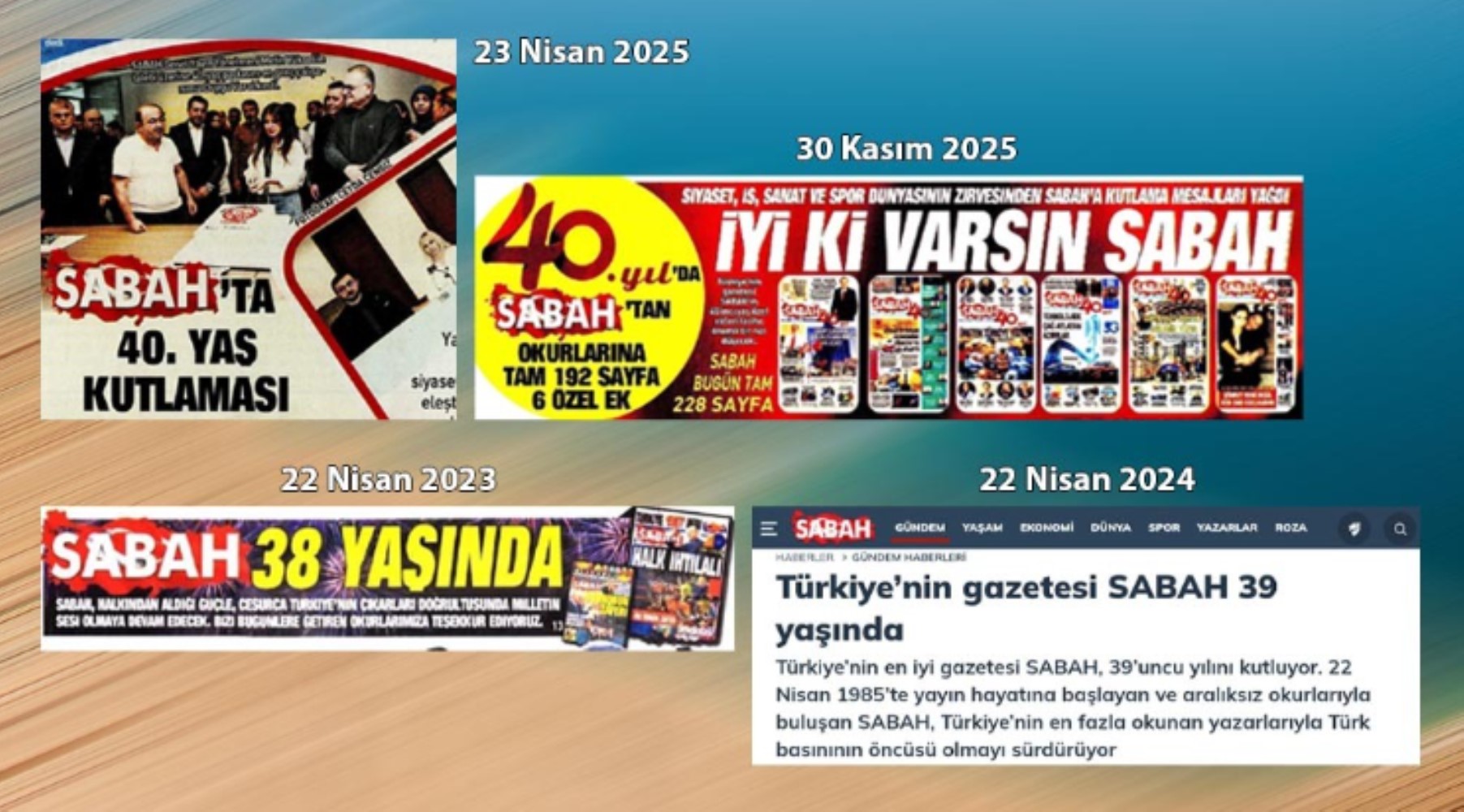
Sabah’s anniversary gimmick
Sabah newspaper was founded on April 22, 1985. Since that day, it has celebrated its anniversary every April 22.
This year, on April 22, the Editor-in-Chief and staff cut a cake; the next day, a report was published in the newspaper under the headline “40th-year celebration.” Below the report were congratulatory messages from AKP members Ömer Çelik, Hüseyin Yayman, and Şebnem Bursalı.
But somehow, they decided to celebrate the newspaper’s founding once again on November 30 this year! In a sub-headline reading “Glad you exist, Sabah,” it was announced that “congratulatory messages for Sabah were pouring in from the worlds of politics, business, art, and sports.” In fact, Turkuvaz Media Vice Chairman of the Board Serhat Albayrak wrote in one of the supplements, as if Sabah were founded on November 30 and not April 22, “As Sabah celebrates its 40th year today…”
The special supplements distributed with the newspaper that day, which were described as “40th-year special supplements that will leave an important mark on history,” were 192 pages long. In the six special supplements on economy, life-health-sports, industry-production, technology-innovation, local governments, and Sabah, advertisements and commercials occupied more space than the articles.
I didn’t find it a chore; I scanned the pages of the supplements. Dozens of companies and public institutions, including Cengiz, Tosyalı, Limak from Kalyon, Zorlu, Halkbank, Borsa İstanbul, Emlak Konut, and Ziraat Bank, celebrated Sabah’s 40th anniversary by placing full-page ads. By a rough estimate, 98 of the 192 pages were completely covered with ads and commercials.
It seems Sabah made good money with its 40th-year supplements. Turkuvaz Media, which has been generating revenue from sponsorships by organizing at least one or two “summits” every month in recent years, now appears to have turned “birthday supplements” into a new method of financing.
Otherwise, why would a newspaper celebrate its founding anniversary twice in one year? However, if they had told their readers this, at least they wouldn’t have been deceiving them. I wouldn’t be surprised at all if they apply this method of celebrating a “birthday” twice a year and collecting ads to ATV, A Haber, Takvim, and Fotomaç as well.
Sözcü’s circulation is in decline
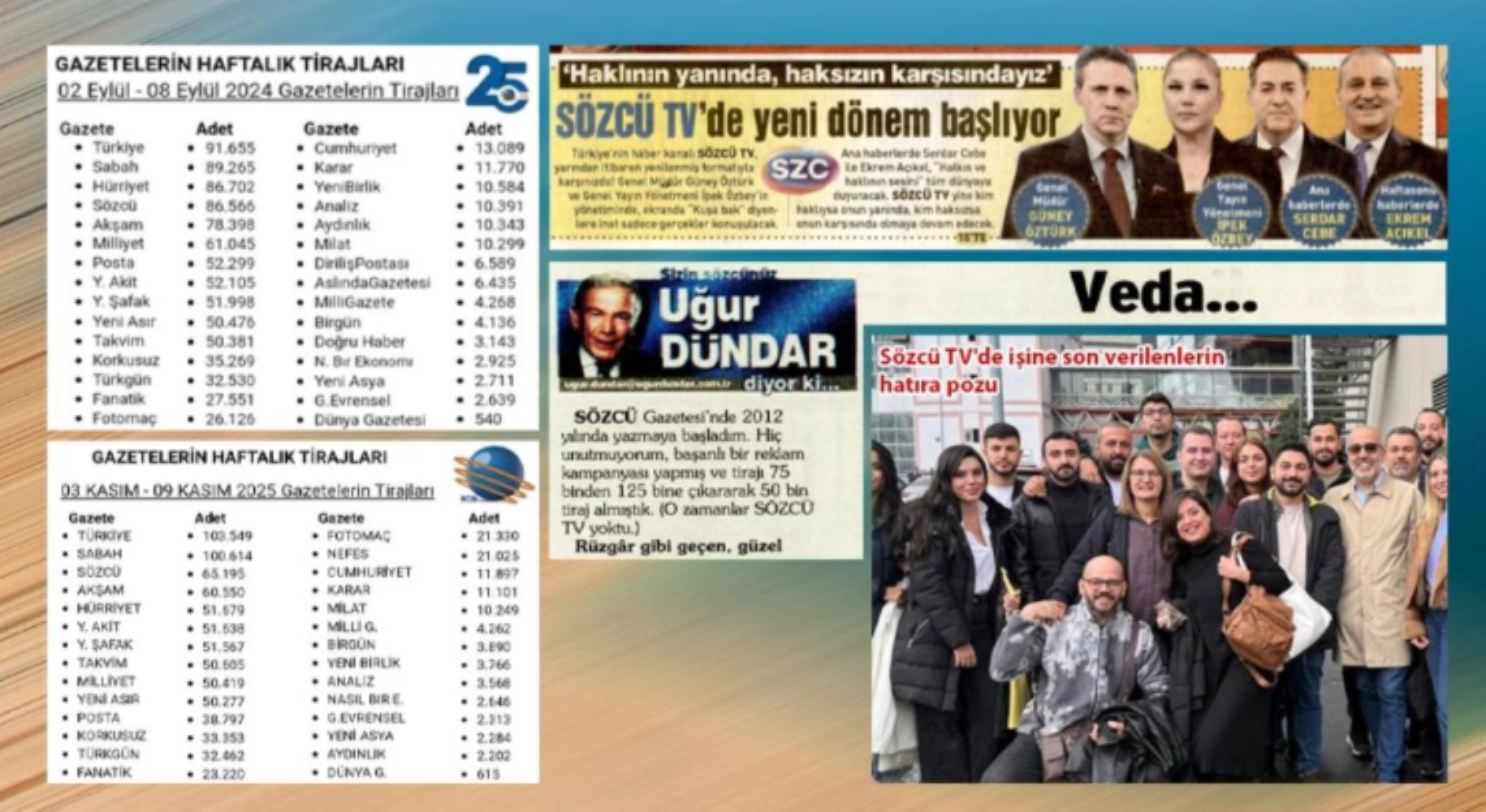
Following the purge of journalists at Sözcü TV, Uğur Dündar, who left Sözcü newspaper, explained in his farewell article that when he started writing in 2012, they had increased the newspaper’s circulation from 75 thousand to 125 thousand. Today, Sözcü’s circulation is at the 65 thousand level.
We will see what path the newspaper’s circulation will take under the management of Yılmaz Özdil. Meanwhile, according to TİAK, Sözcü TV’s all-day rating in November was 0.13, and its “share” was 0.84.
Actually, the circulation of printed newspapers is falling all over the world, but the decline is even faster in our country. Based on the data from the Media Monitoring Center (MTM), I wrote about the September 2-8 circulation figures last year. I compared those figures with the November 3-9, 2025, circulation figures.
Only the circulations of Türkiye and Sabah have increased compared to last year. Sabah’s circulation rose from 89 thousand 265 to 100 thousand 614, while Türkiye’s circulation—including subscribers—rose from 91 thousand 655 to 103 thousand 549. The losses of Yeni Akit and Yeni Şafak are very small. Yeni Akit fell from 52 thousand 998 to 51 thousand 638; Yeni Şafak fell from 51 thousand 998 to 51 thousand 567.
The newspaper that has lost the most circulation in the last year is Hürriyet. Hürriyet, which fell to fifth place, saw its circulation drop from 86 thousand 702 to 51 thousand 679. Sözcü’s circulation fell from 86 thousand 566 to 65 thousand 195, Akşam’s to 78 thousand 398, Milliyet’s from 61 thousand 45 to 50 thousand 419, and Posta’s from 52 thousand 299 to 38 thousand 797.
Karar newspaper has maintained its circulation of around 11 thousand. While Aydınlık’s circulation dropped from the 10 thousands to 2 thousands, Cumhuriyet’s circulation fell from 13 thousand to 11 thousand. There were small declines in the circulations of BirGün, which is around 4 thousand, and Evrensel, which is around 2 thousand. Nefes’s circulation is around 21 thousand…
Of course, there is also the possibility that these numbers are “inflated.” Because there is no independent organization auditing the circulations; MTM’s data consists of the circulations provided by the media organizations themselves. Furthermore, circulation means the number of newspapers printed; we do not know how many of these were actually sold.
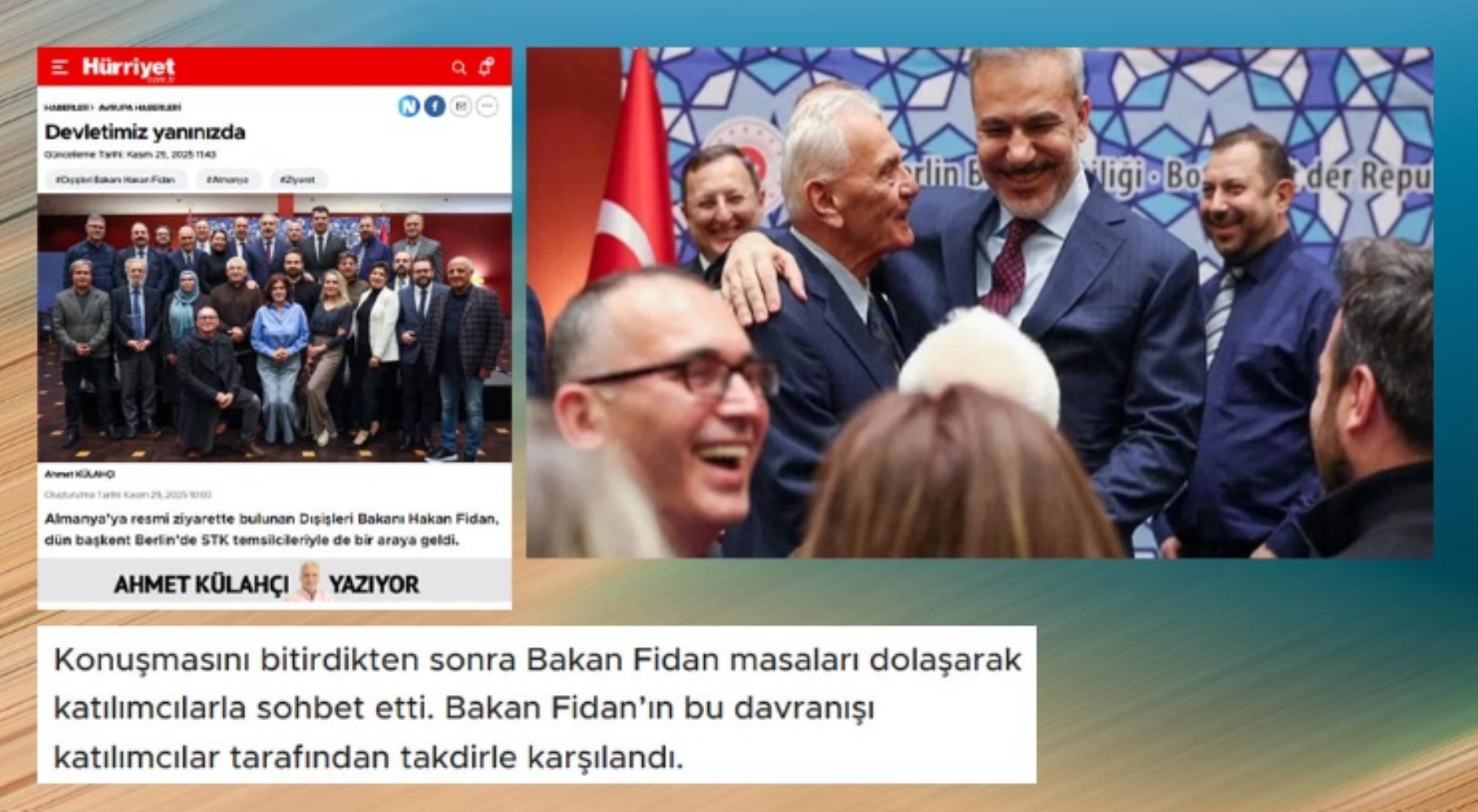
Fidan’s intimate pose with a journalist
What remains from Foreign Minister Hakan Fidan’s meeting in Berlin with the heads of Turkish non-governmental organizations and journalists are not striking news stories, but “souvenir” photos.
The journalists appear quite cozy with Minister Fidan in the photos. Especially the photo of Hürriyet Europe Coordinator Ahmet Külahçı, where there is no “distance” left; Fidan has his arm around Külahçı’s shoulder, and the other journalists are watching them with smiles.
When in such close contact with a news source, it is inevitable that the news will be affected by this closeness. I looked at the report Ahmet Külahçı wrote after the meeting. Let me quote the last sentence of the report titled “Our state is with you”:
“After finishing his speech, Minister Fidan walked around the tables and chatted with the participants. This behavior of Minister Fidan was met with appreciation by the participants.”
Incredible; only a journalist who poses so intimately with a minister could extract “appreciation” from a minister’s chat with NGO representatives and journalists. So much for journalistic objectivity…
Journalism organizations that reward politicians
As the end of the year approaches, professional journalism organizations are announcing the colleagues who have received awards.
For journalists accustomed to being punished, awards are valuable. After all, everyone wants to be applauded.
It is natural for professional journalism organizations to evaluate the work of journalists and reward them with objective and fair criteria. But it is wrong for professional organizations to give awards to individuals and institutions outside of journalism, and for other institutions to also reward journalists. It can lead to the violation of the contact-distance rule and to conflicts of interest.
It was strange that the Antalya Journalists Association gave an award to an educational institution this year in addition to journalists. There is even a financial relationship involved. A protocol had been signed with this educational institution to provide special discounts to association members.
In the awards of the Global Journalists Council (KGK), the measure was lost completely. Some of the 21 awards were given to journalists, including Palestinian journalist Sami Muhammed Shehade, who was wounded in Gaza; but names from fields such as diplomacy, science, art, literature, education, and service were also rewarded. One of the “diplomacy” awards was given to former minister and AKP MP Mevlüt Çavuşoğlu. In his speech, he praised the KGK, saying, “The Council shows the whole world how diplomacy can be conducted effectively through media.”
The Turkish Press Federation, while distributing awards to journalists, rewarded writer and politician Sadık Albayrak as the “Thinker of the Year.”
If journalists give an award to a politician who is a member of the government, then that politician will see no harm in viewing journalism and the professional organization as an extension of the Ministry of Foreign Affairs.
Journalists’ skewed view of nursing homes
Our media has suddenly remembered theater artist Zihni Göktay, and they are constantly wearing out the door of the nursing home where he lives. The subject of the interviews is always the same: “Why did he end up in a nursing home?”
The reason Zihni Göktay is receiving so much attention was a social media post by someone who saw him in the nursing home, followed by the following reports:
“Master actor Zihni Göktay’s latest state shocked everyone! What he is going through is frightening,” “Zihni Göktay’s painful story: He moved to a nursing home after losing his wife,” “His wife died, his house was demolished, he fell into a nursing home... Zihni Göktay’s latest state saddened everyone deeply,” “Legendary actor Zihni Göktay saddened his fans with his latest appearance,” “Master Actor Zihni Göktay in a nursing home.”
Dozens of reports have been published on the internet showing the artist in a sad, terrible situation. Yet Zihni Göktay is not in such a fallen, pathetic state at all. He tells the journalists who ask why he is in a nursing home that “his house is undergoing urban transformation, and he will stay there temporarily until his house is built,” adding, “This place has been good for me.” He is content with his situation, happy.
Showing artists in nursing homes as someone who has “fallen” is an old habit of the media. Whenever they see an artist or a celebrity staying in a nursing home, they always write such pity-inducing headlines.
However, times have changed; as life expectancy has increased, so have nursing homes and care facilities, as well as the people staying in them. Moreover, nursing homes are no longer places where only lonely, destitute elderly people stay; nursing homes with much more developed living conditions can be the preference of many families.
Journalism is not a profession that can be done with stereotypes; journalism that does not keep up with change and does not transform with change remains behind society.
In a single sentence:
• In Sözcü’s report on “Sirtaki in front of Hagia Sophia,” it was said that “… the dance performance was evaluated as a provocative act,” but there was no mention of who made such an evaluation.
• Adnan Şahin, a writer for the “People’s Kitchen” page of Türkiye newspaper, introduced his wife Deniz Şahin’s restaurant and praised its kitchen in an article titled “The kitchen born from the heart of the Five Seas.”
• Environment and Urbanization Minister Murat Kurum’s speech in K. Maraş was broadcast live not only by dozens of pro-government TV channels but also by KRT TV, which has been broadcasting on tape delay for months.
• Milliyet introduced a company’s new coffee machine with a report titled “It doubled the coffee pleasure.”
• Yeni Akit continued to defend its former writer Hüseyin Üzmez, who was convicted of molesting a 14-year-old girl and died in prison, by saying “Attack on the journalist in the grave.”
• In Hürriyet’s report “Weight loss drugs changed consumption,” a photo of one of these drugs was published, and brand advertising was carried out.
• Takvim made a person’s health problem a subject of mockery by writing “Cover me” (a pun on 'arm' in Turkish) in an insensitive language in a report about a person who had an arm transplant receiving a traffic ticket.
• On Habertürk TV, it was written at the bottom of the screen that “Manavgat corruption investigation has begun,” but it was the trial, not the investigation, that had begun that day.
• The pro-government media did not report on the “We are in action for defense” protests held by lawyers in front of courthouses across the country.
FOR YOUR CRITICISMS, COMPLAINTS, AND SUGGESTIONS: [email protected]
Most Read

Striking picture for Özgür Özel's 'New Party'

Özgür Özel gives a dated response regarding the number of resignations

Forest fire in Antalya brought under control

The PKK opening and Özgür Özel’s path!..

How did the newspapers view Özgür Özel's farewell to the CHP?

Houthis strike Saudi-owned tanker

What did the CHP do?

Özel’s new party move in the world press

The New CHP, against CEHAPE

From self-efficacy to despair