



A building collapsed in Gebze, and four people died. When microphones were held out to them, citizens living in surrounding buildings blamed the metro construction, saying they had "filed a complaint with CİMER 4 months ago."
In the initial reports regarding the incident on October 29, these complaints from local residents were always relegated to the sidelines. They also never mentioned that the Ministry of Transport and Infrastructure was carrying out the metro construction.
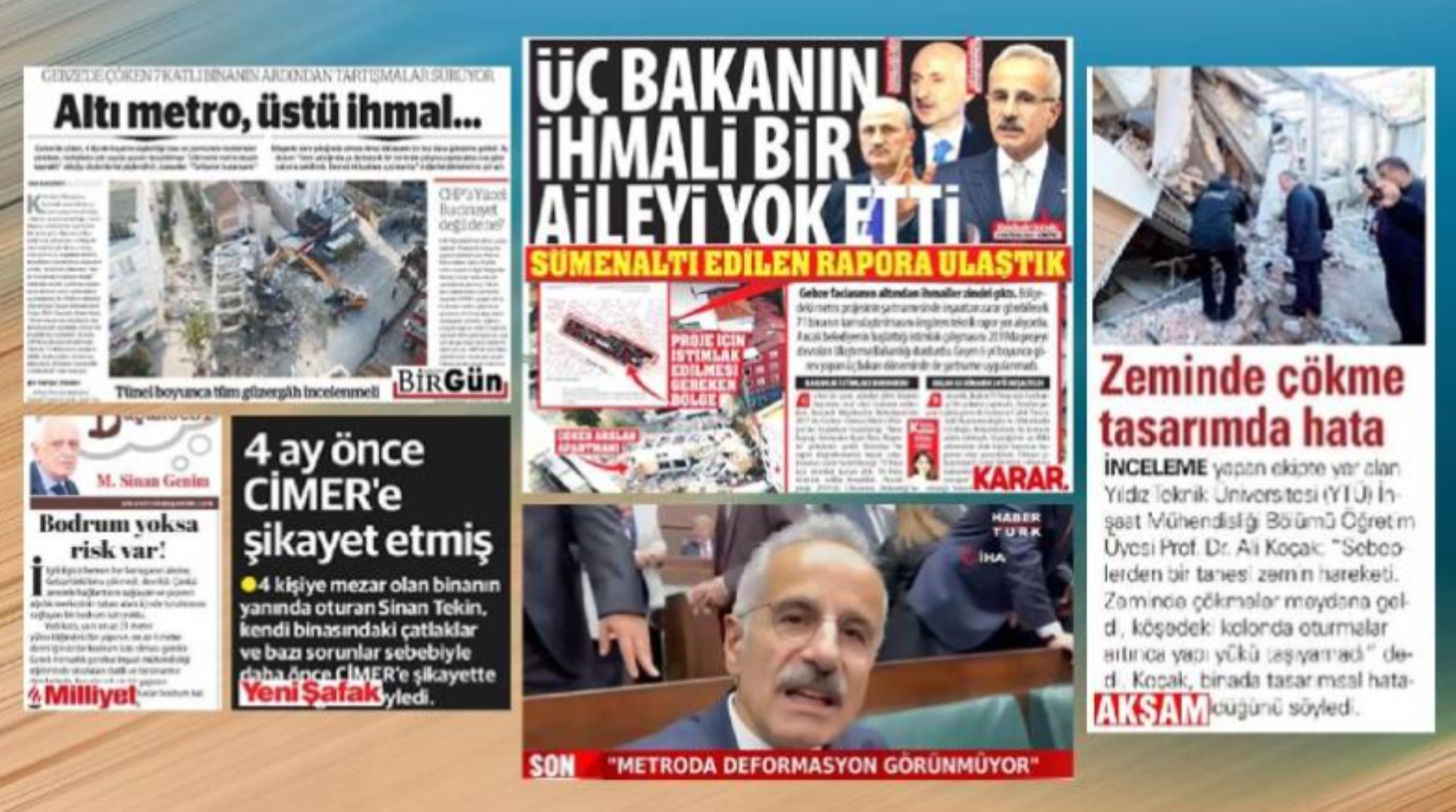
In the following days, the metro construction was not even mentioned in the sidelines. Although 21 apartment buildings near the collapsed structure were evacuated due to cracks forming in their columns and foundations, they brushed it off by saying, "Subsidence in the ground, error in design."
Fortunately, the opposition media did not stop focusing on the possibility that the metro construction passing under the buildings and the vibrations caused by dynamite used during tunnel excavation might have affected the structures.
However, for days, no information came from the authorities other than statements that technical teams were continuing their investigations. In fact, an access ban was even placed on a post by Alican Uludağ from Now TV, which stated that "experts determined that underground waters were drained due to the metro construction passing directly under the building, and the resulting voids caused the ground to subside and the building to collapse."
Reporters from the opposition media were able to catch up with Minister of Transport and Infrastructure Abdülkadir Uraloğlu in Parliament a week later to ask him. Uraloğlu was smiling while answering the question from Aslı Kurtuluş Mutlu of Sözcü TV; he was not aware of the gravity of the situation. He argued that "it is not right to have prejudices before seeing the technical results," but he also cleared the metro construction of any blame:
"It has been two years since the metro construction was finished, there is no deformation in the metro, let's see the result, and as the ministry, we will decide what needs to be done."
These words of Uraloğlu also found wide coverage in the opposition media, but although the Anadolu Agency, İhlas News Agency, and ANKA agency reported it, the pro-government media—with the exception of Habertürk, TRT Haber, and NTV—managed to ignore this news. M. Sinan Genim, an architect, was also able to write in his column in Milliyet, completely skipping over the metro construction, by saying, "If there is no basement, there is risk."
Fortunately, the opposition media did not let the matter go. Two days later, Karar revealed with the headline "The negligence of three ministers destroyed a family" that a decision for expropriation had been taken for 71 buildings that could be damaged by the construction, in accordance with a report prepared by the Kocaeli Metropolitan Municipality when it started the metro construction in 2017. Although 16 buildings were expropriated and evacuated after the report, the Ministry of Transport and Infrastructure stopped the expropriation of the remaining 55 buildings after taking over the construction in 2019. Now, it is necessary to ask Uraloğlu, who was speaking with a smile that day, about this report.
The essential thing in journalism is the public interest; it is human life. Reporting done with the concern of not harming the political power, even in a case where four people died and dozens of buildings are facing the danger of collapse, is not journalism, but a public relations activity. Journalism in such an event requires focusing on all possibilities without prejudice and making an effort to uncover the responsible party. Whoever the addressee may be...
THEY ESTABLISHED A 'MEDIA COURT'
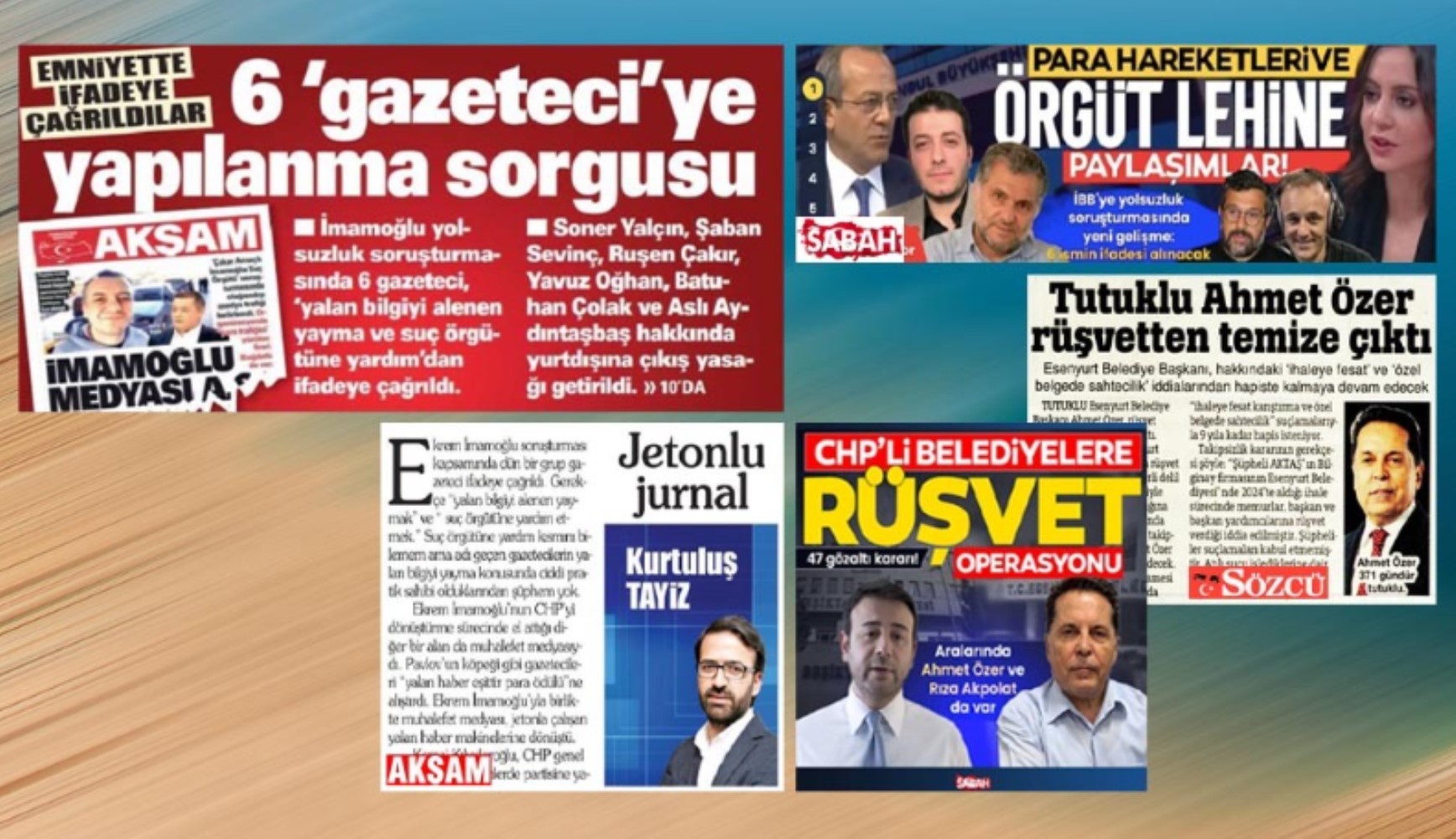
On the morning of November 6, we started the day with the news that the prosecutor's office had issued detention warrants for journalists Aslı Aydıntaşbaş, Batuhan Çolak, Ruşen Çakır, Şaban Sevinç, Soner Yalçın, and Yavuz Oğhan (CHP Communication Coordinator). Before we could even understand what they were accused of, the "guilty" label was stamped on our colleagues on the Sabah newspaper's website:
"The press wing is being exposed: Money movements and posts in favor of the organization / New development in the corruption investigation into the IMM: Statements of 6 names will be taken."
They had decided they were guilty before their statements were even taken and before the trial had begun. They had stopped practicing journalism and using objective language, and were declaring verdicts like prosecutors and judges.
However, let alone detention, everyone is considered innocent until the trial is completed and the conviction against them is finalized. Indeed, the Turkish Declaration of Rights and Responsibilities of Journalism includes the principle: "A journalist should not be a party to the judicial process. Unless a judicial decision is finalized, a suspect or defendant should not be declared guilty." I am skipping over professional solidarity, of course...
Unfortunately, the Akşam newspaper had also targeted 11 journalists, including those detained, in a news story titled "İmamoğlu Media Inc." about six months before the prosecutor's operation. That news was denied by the parties involved, and criminal complaints were filed, but Akşam still did not refrain from boasting after the detentions, saying, "We had written it." One of its writers, Kurtuluş Tayiz, did not shy away from accusing all opposition journalists in his column "Jetonlu Jurnal" (Coin-operated Informant).
In Akşam's news, the fact that the sentences ended with "it was determined," "it emerged," and "it was identified" instead of "it was alleged" and "it was claimed," as is the case in outlets like Sabah and Yeni Şafak, confirms that they have stepped outside of journalism. They have established a "media court" and are announcing the verdict.
Moreover, this approach is valid in almost all news about investigations into CHP-run municipalities, opposition figures, and opposition journalists published in the pro-government media recently. The news is created in the language of the police, prosecutors, and judges; journalism is becoming an extension of the authorities conducting the investigations; those detained are shown as guilty from the start. The news about our journalist friends Fatih Altaylı, Merdan Yanardağ, and Furkan Karabay, who are still being held in prison, is always in the same style. They brand them from the start and convict them in their own minds...
Moreover, when the people they declare guilty are acquitted, they ignore the judicial decision and do not even report it. The latest example is the news about the investigation conducted against CHP Esenyurt Mayor Ahmet Özer on the allegation that he "received bribes." The pro-government media, which showed Ahmet Özer as guilty, did not report the decision of non-prosecution—with one or two exceptions. This is another proof that the pro-government media has become a party in these investigations...
ERRORS IN THE ÇATLI NEWS
BirGün's news titled "Offer to Armenian actors: 'Be an ASALA militant'" began with the sentence, "Filming has begun for the movie 'Çatlı', which is about the life of Abdullah Çatlı and directed by Onur Tan."
Who is Abdullah Çatlı? It was in the internet version of the news, but there was no information on this subject in the printed newspaper; there was no mention of who Çatlı was. When I saw this deficiency, I wondered about the source of the news; the source was not specified in the news either. This was also wrong.
With a quick internet search, I found that the news was taken from the Agos newspaper. Moreover, a part of Agos's news titled "Çatlı movie: Offer made to Armenian actors: 'Will you play an ASALA militant?'" was quoted almost exactly!
Moreover, there was detailed information about Çatlı's identity in Agos's news. Agos, rightly, listed data such as the fact that after the sentence "Çatlı is one of the most controversial and dark names in Turkey's recent history," he was accused of being an instigator in the "Bahçelievler Massacre" in 1978, where 7 TİP (Workers' Party of Turkey) youth were killed, and that information about his involvement in the state's secret operations was reflected to the public after the Susurluk scandal. This information was not quoted in BirGün.
In addition, I also evaluated the news about the start of filming for this movie last month. I criticized the fact that Çatlı was defined as a "mafia leader" in Hürriyet, but that sites like Haber3, Haberler.com, NTV, Türkiye, Türkgün, Odatv, and Yeni Şafak were content with saying for Çatlı that he "lost his life in the Susurluk accident that occurred in 1996," calling them "incomplete, superficial, and unlabored news."
Moreover, Abdullah Çatlı was on the front page of BirGün on November 3, the anniversary of the Susurluk Scandal; his dark role in the mafia-state-politics network was being reminded. Given this, BirGün's news about the "Çatlı" movie, which was filmed under the supervision of Çatlı's daughters, should have been more careful.
FAILING IN THE 'WOMAN WHO FELL INTO THE SEA' NEWS
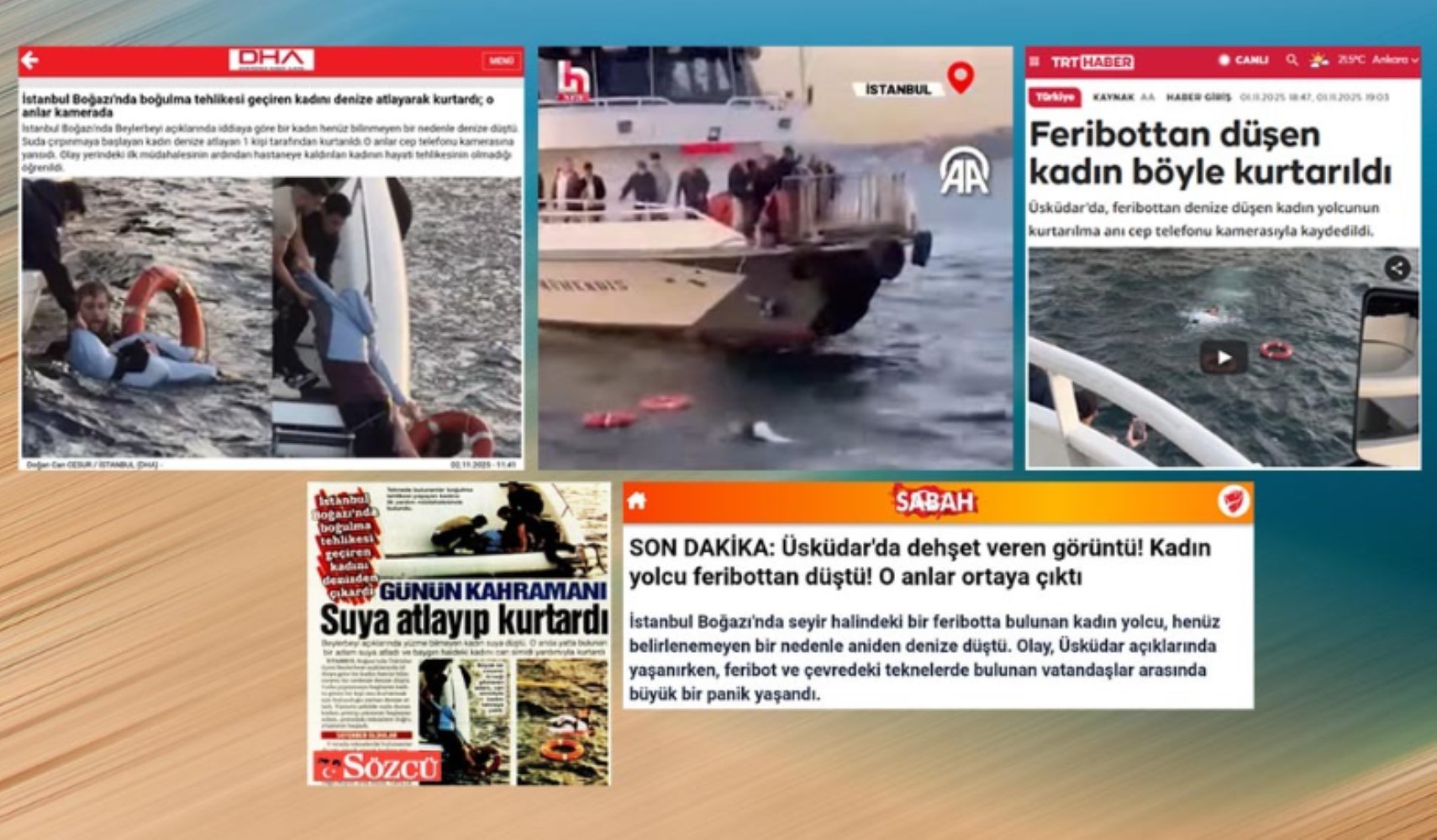
It was around 17:30 on October 31 when a woman fell from a moving ferry off the coast of Üsküdar Beylerbeyi in the Bosphorus.
The Anadolu Agency was only able to report this incident a day later, on November 1; in the news titled "How the woman who fell from the ferry was saved," there was neither the time the incident occurred nor the names of the woman and the rescuer. Even why and how the woman fell into the sea could not be learned, and it was said, "A female passenger fell into the sea for an as-yet-unknown reason." The news was made based solely on the footage.
The Demirören News Agency (DHA) reported a day after the AA news, on November 2, "He saved the woman who was in danger of drowning in the Bosphorus by jumping into the sea; those moments are on camera." If we don't count the details, the only advantage of DHA's news over the AA news from the day before was that the date and time of the incident had been learned. However, there were no names or the reason for the incident in this news either.
Unfortunately, such a text and footage full of unknowns not only passed the control of AA and DHA editors and were published; they were used exactly as they were in dozens of media outlets such as CNN Türk, Halk TV, Habertürk, Haber7, TVNET, TRT Haber, Milliyet, Sabah, and Sözcü. They also did not question the distortions in the news.
Fortunately, DHA did not let the matter go; it did the research it should have done at the beginning days later; it found and spoke to yacht captain Orhan Kanburoğlu, who was among those who saved the woman. The captain was saying that the incident occurred on October 31, that the woman who fell into the sea was 69-year-old tourist Rana Parviz, and that the rescuer was also a tourist. He had also given the photo of the tourist who saved her to the reporters... DHA conveyed this information and the photo of the tourist who saved the woman in the news on November 4.
In short, an incident that happened in the middle of Istanbul is not researched; it is laid out based on cell phone footage and published with its deficiencies. Information regarding the incident is only learned and completed four days later; then it is presented as if it were new news! A complete journalistic failure.
A journalist researches first, then writes. News is not created without learning the answers to basic questions such as why, when, and who. Publishing first and researching later invites error.
In a single sentence:
The news of the dealer meeting attended by Mücahid Ören, the owner of TGRT Haber, was repeated in the main news bulletin, Cem Küçük's morning program, and the "Haberin İçinden" program; the Türkiye newspaper also devoted extensive space to it as "Good news of a new factory."
Yeni Şafak did not mention the organization owner, the Istanbul Metropolitan Municipality, or CHP Chairman Özgür Özel, who started the race, in its news titled "The race between two continents was run for the 47th time."
In Habertürk, M. Akif Ersoy said at the end of the news, "Of course, we cannot have a main news bulletin without American President Trump. Let's go immediately and see what he has 'hatched' this time."
An access ban was placed on a post by journalist Serdar Akinan, which included footage related to TÜGVA and claimed that this foundation was "organized with FETÖ tactics."
Akşam published a half-page promotion of the AKP-run Pursaklar Municipality as if it were news under the headline "Future scientists are being raised" and without putting a "Paid Advertisement" warning.
Hürriyet, which wrote "Hürriyet wrote, access ban came," and Akşam, which reminded of the "Trap for citizens dreaming of a home" news, entered a race to claim credit for the blocking of fake websites.
The fact that the suicide method of Thodex founder Faruk Fatih Özer, who was found dead in his prison cell, was reported in detail in the media was problematic.
FOR YOUR CRITICISMS, COMPLAINTS, AND SUGGESTIONS: [email protected]
Most Read

Striking picture for Özgür Özel's 'New Party'

The PKK opening and Özgür Özel’s path!..

How did the newspapers view Özgür Özel's farewell to the CHP?

He killed his wife by slitting her throat: Their children witnessed the moments

What did the CHP do?

Özel’s new party move in the world press

Fire at TUSAŞ engine factory in Eskişehir under control

The New CHP, against CEHAPE

From self-efficacy to despair

Kılıçdaroğlu's first message on Özgür Özel's new party announcement