



Our media seems to have reached a consensus on portraying bipolar patients as aggressive types and encouraging negative public sentiment toward them.
Headlines like "Bipolar man spreads terror," "Suspect who killed the person he argued with by saying 'You are an infidel' turns out to have bipolar disorder," "Bipolar patient kills his wife and commits suicide," and "Schizophrenia and bipolar claims regarding the defendant who stabbed an old man in the heart" are pouring into the media...
Last week, Posta announced the capture of Murat H., the helmeted attacker who stabbed a young man named Aslıhan Zengin on the street in Istanbul, with the headline "He turned out to be bipolar." In reports of "Family-wide atrocity" in Artı Gerçek, Habertürk, Milliyet, Karar, Korkusuz, Takvim, T24, 10Haber, and Yeni Asır, it was also written that the man who killed his wife and committed suicide had "bipolar disorder."
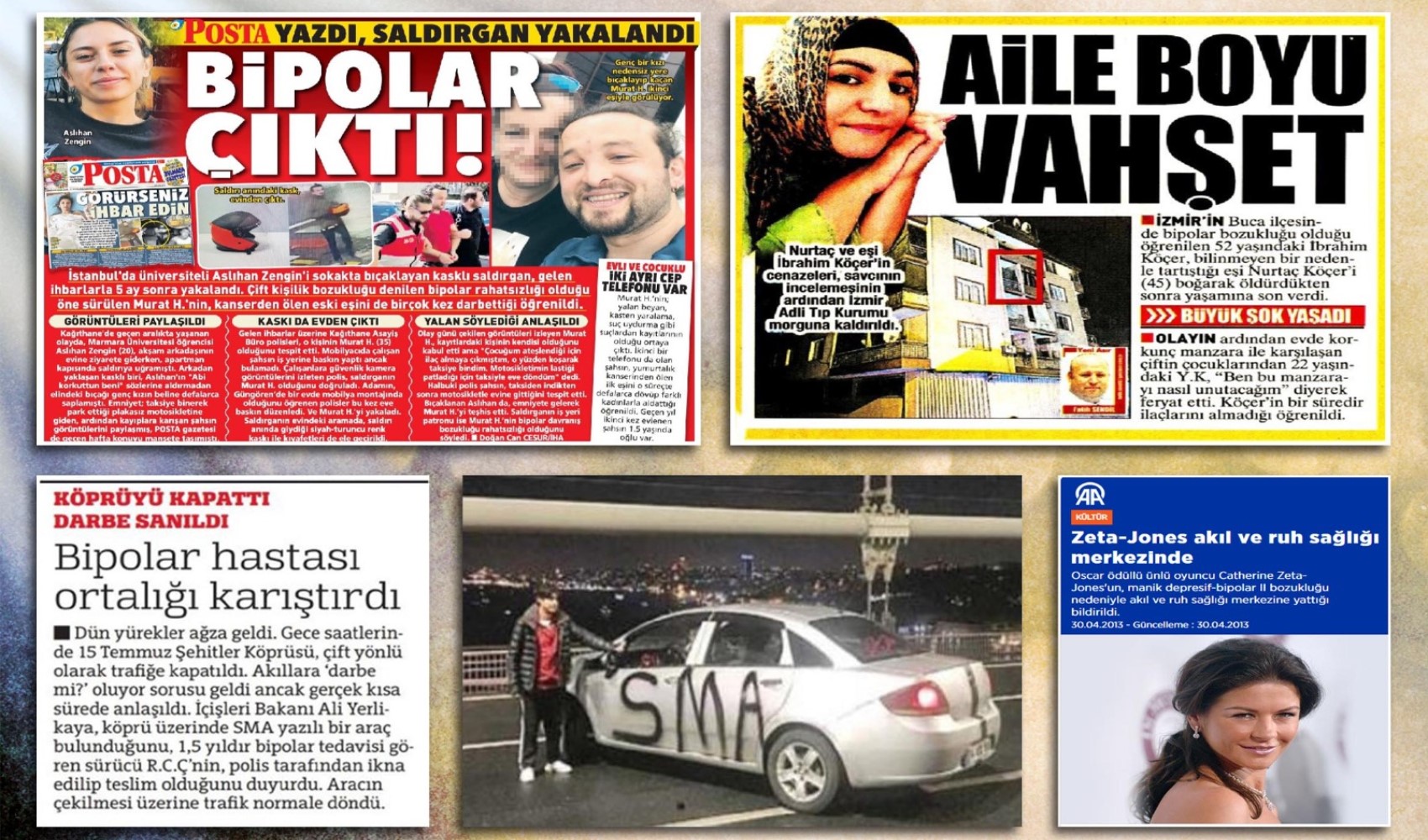
Finally, Interior Minister Ali Yerlikaya's statement—or rather, his gaffe—that the young man who stopped bridge traffic with his vehicle to protest was "bipolar" led to news reports titled "Bipolar patient stirs things up." Journalists participating in "Ateş Çemberi" (Circle of Fire) on CNN Türk also played psychiatrist, making frightening comments about this condition. However, the protesting young man was reacting to the state's failure to help SMA patients; the issue had nothing to do with his condition.
Moreover, "Bipolar disorder" is a psychiatric condition that can be treated. It is unfair to associate bipolar patients with violence or portray them as people who harm others.
Instead of stigmatizing bipolar patients and portraying them as violence-prone individuals, we should inform the public about bipolar disorder and guide those who have it toward treatment. In necessary cases, instead of writing "bipolar," it would suffice to say "psychological condition."
Let us not create a new enemy by stigmatizing bipolar patients. Let us not forget that the famous painter Van Gogh was bipolar, as is actress Catherine Zeta-Jones. Neither of them harmed anyone...
WHOM DID THE TURKISH JOURNALISTS ASSOCIATION CONDEMN?
The Board of Directors of the Turkish Journalists Association (TGC) issued a statement condemning "politicians who have recently been targeting and threatening journalists by naming them and their institutions."
The interesting part of the statement, which said "It is a crime for politicians to threaten journalists," was that it failed to state the actual reason why such a condemnation was deemed necessary. It did not write who had threatened which journalists "recently"; the statement had no addressee! By saying "politicians," those who targeted journalists were anonymized...
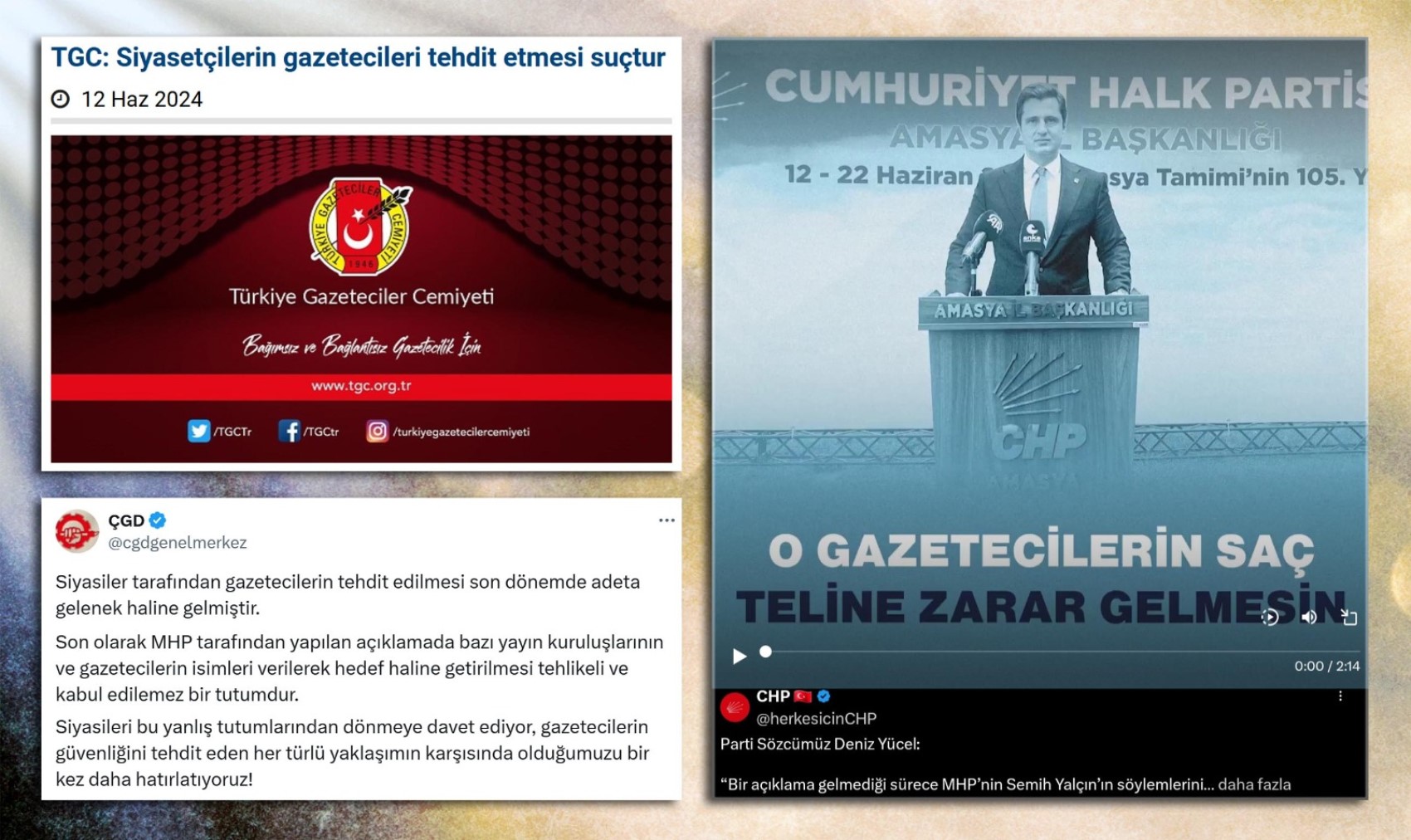
However, those who were accusing, threatening, and targeting journalists and media organizations that day were MHP Deputy Chairmen Feti Yıldız and Semih Yalçın. Feti Yıldız had targeted Gözde Şeker and İbrahim Kahveci, who were speaking on the "Kırmızı Çizgi" (Red Line) program on Halk TV, by labeling them "slanderers." Semih Yalçın also accused Halk TV, TV 100, and Sözcü TV, as well as journalists Barış Yarkadaş, Bahar Feyzan, Ali Kemal Erdem, and Osman Sert who appear on these channels, in harsh language, calling them "MHP-opposing types" and hurling insults. Yalçın also referred to Hürriyet columnist Abdülkadir Selvi as a "human bomb," mentioning him alongside the other journalists he called "MHP-opposing types," and insulted him once again.
Indeed, on the same day, CHP Spokesperson Deniz Yücel reacted by naming names, saying, "If a hair on the heads of the journalists mentioned in the statement is harmed, we will hold Semih Yalçın responsible." Similarly, the Progressive Journalists Association also opposed the language of threat, mentioning the MHP by name.
There can only be one meaning for the TGC not naming names in the statement despite the perpetrator being so obvious: to pretend to condemn while not angering the MHP...
THE SPANISH JOURNALIST ALSO HELD HIS HEAD HIGH
The pro-government media—as always—welcomed President Erdoğan's outburst at a press conference in Spain, where he said, "It is deeply saddening for a member of the press to stand up and defend terrorists like this. Don't shake your head, don't shake your head. Look, I am continuing my work upright":
"Erdoğan's adjustment to the insolent journalist" (Türkiye), "Adjustment to the terror-loving journalist" (Yeni Akit), "A slap-like response from Erdoğan to the Spanish journalist" (24 TV), "A slap-like response from President Erdoğan to the Spanish journalist's provocative question: Don't shake your head at me" (Sabah)
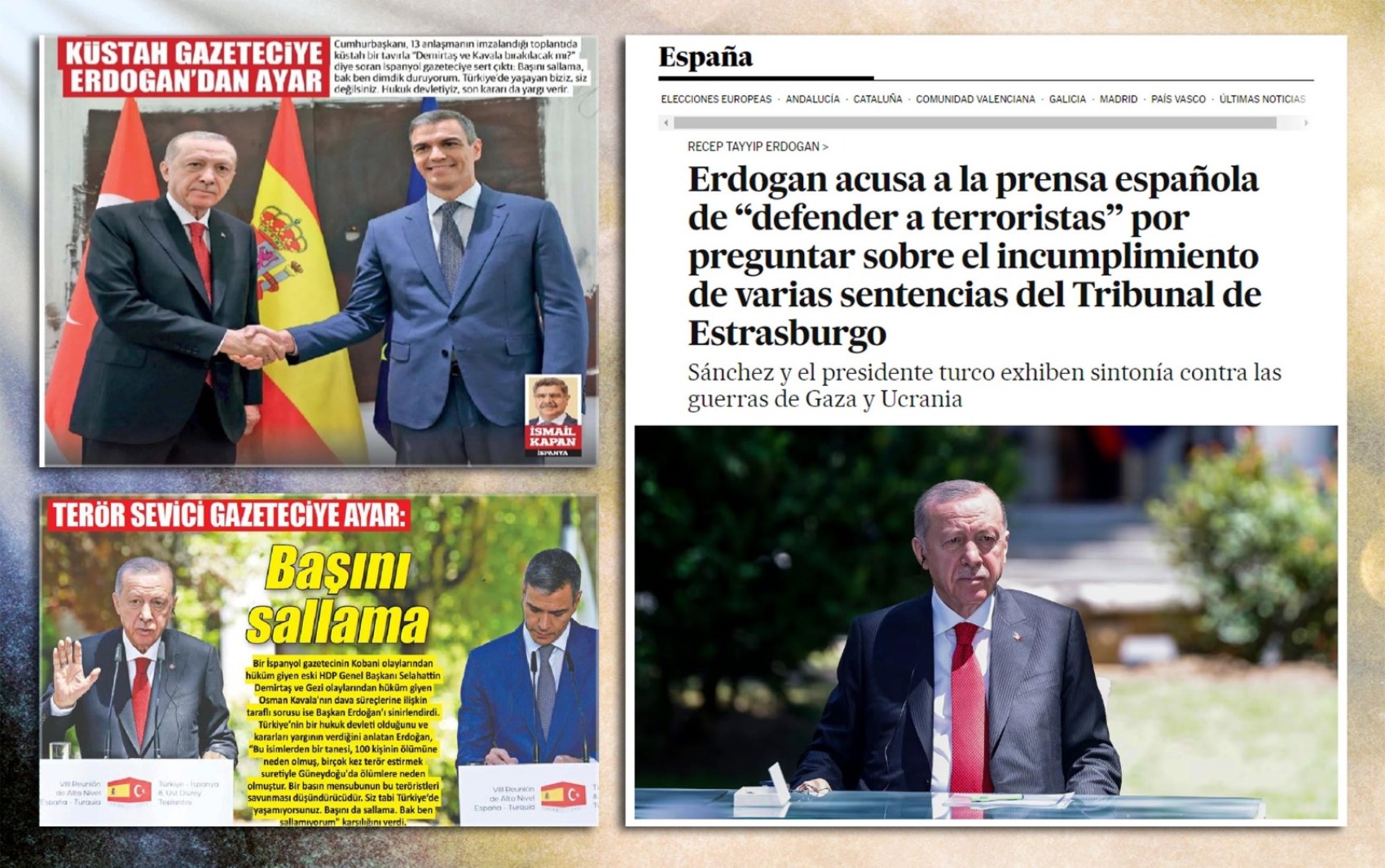
They didn't even write the question correctly, brushing it off as "about Selahattin Demirtaş and Osman Kavala." In fact, "the rule of law in Turkey" was being questioned through Demirtaş and Kavala:
"How can Spanish companies trust the legal security of Turkey, which refuses to comply with the ECHR's decisions for the release of former HDP leader Selahattin Demirtaş and philanthropist Osman Kavala?"
Moreover, it was a joint question from the Spanish journalists there; El Pais correspondent Carlos E. Cue had voiced it on their behalf. With that anger, Erdoğan was effectively calling all the Spanish journalists there "terrorists."
Indeed, El Pais published the news with the headline "Erdoğan accuses the Spanish press of 'defending terrorists' for asking about non-compliance with the Strasbourg Court's decisions." Contrary to the reports here, there was no mention of the "Don't shake your head" scolding. But by providing information about the non-implementation of ECHR decisions, it emphasized that Turkey's legal system was "unreliable"; Erdoğan was being answered through journalism.
The Spanish journalists fulfilled their duty by asking the question and providing this information in their reports; they didn't even take Erdoğan's attitude seriously. What is wrong is the attitude of the pro-government media in Turkey. Just as a journalist asking a politician a question cannot be shown as a crime, no matter what question a journalist asks, it does not give the politician the right to scold them.
THE "MOVIE-LIKE ROBBERY" CLICHÉ IS NOT ENOUGH
Four robbers, collaborating with a security guard, entered the Memduh Paşa Mansion in Sarıyer, Istanbul, at night and stole foreign currency worth 130-150 million liras from four safes! The first question that should have come to the mind of a journalist seeing this news should have been why so much foreign currency was kept at a company headquarters instead of a bank. After all, if it is not dirty money, a bank is safer.
However, in many places, the event was reported and passed over with the "movie-like robbery" cliché without asking this question. In the DHA-sourced news that Sözcü put on its front page on June 11 as "Robbery at Memduh Paşa Mansion," the name of the mansion's owner wasn't even mentioned!
In the İHA-sourced news in the Türkiye newspaper titled "Movie-like robbery at the mansion," in addition to what was in Sözcü, only the information that "the business owner was Ümit E." was given. The reports in Milliyet and Karar were more detailed; it was written there that the mansion belonged to NAB Holding. None of this information was in Cumhuriyet's tiny news snippet.
The ones who pursued the questions and reached remarkable information about the robbery were Takvim and Sabah newspapers. In its headline "Kasa de papel," Takvim wrote that the mansion's owner, the Iranian construction company NAB Holding, belonged to Behram Eromi, the brother-in-law of Reza Zarrab.
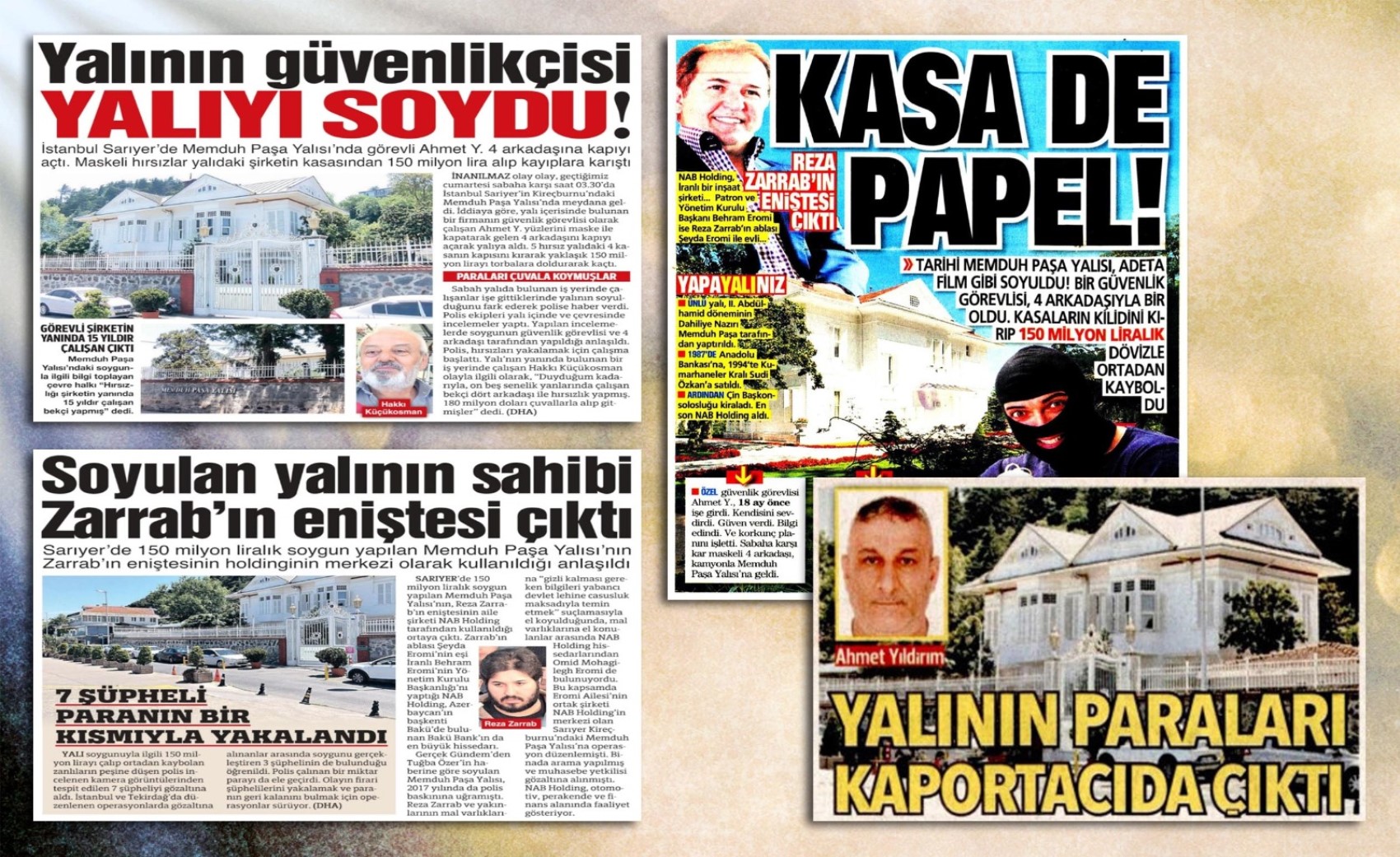
This information was an important clue as to why there was so much foreign currency in the mansion. This information in Takvim also appeared exactly the same in its sister newspaper, Sabah. The Reza Zarrab information was also in Hürriyet, but it was not put at the beginning; it was placed at the very end of the news. Hürriyet only made the Reza Zarrab element a separate news story five days later. Sözcü tried to make up for the deficiency one day later by adding information circulating on the internet, saying, "It turns out Zarrab's sister's company was in the robbed mansion."
It is essential that news reports undergo strict editorial questioning and that the questions that arise are pursued and answered. There should be no unanswered questions in a published report. But our media still does not question the source of millions in foreign currency.
THE CHILD WHO COULDN'T BUY ICE CREAM
A 10-year-old child, to whom a Batman Sonsöz reporter held a microphone, was complaining about the high cost of living, saying, "The broken economy affects me. How will I get married? I was going to buy ice cream, it was 20 liras."
This interview received a lot of attention in the media after social media; newspapers, news sites, and Now TV, Halk TV, and Sözcü TV reported on it; Sözcü newspaper published it on its front page. Fortunately, while the child's image was clearly published, his first and last name were never given. But it is certain that he is known in Batman, in his surroundings, and at his school.
In the "Guide to reporting on children" prepared by UNICEF for journalists, it is emphasized that in interviews with children, one must "ensure that it does not endanger the child or reflect negatively on them" and that "permission must be obtained from the child and their legal representative for the shooting." These are rules established with the "best interests of the child" in mind...
In the interview with the child in Batman, there is neither permission from a legal representative nor any consideration for negative repercussions. No one can guarantee that this interview, which will not please the government and its supporters, will not bring negatives into the child's life. Therefore, conducting such an interview is wrong. The "best interests of the child" should not have been sacrificed to the anxiety of ratings and high readership.
In a single sentence:
* Except for Hürriyet, the pro-government media did not report on the demotion of Deputy Chief Prosecutor Durdu Özer, who included the expert report in the file in the Sinan Ateş murder investigation, to a regular prosecutor at the regional administrative court.
* Sabah reported on the 3,000 lira holiday bonus payments with the headline "42 billion liras are being deposited into accounts," as if that much money were being given to every retiree.
* While there were so many schools, Sabah published news of the graduation ceremony at Hasan Kalyoncu University, which bears its boss's name, and Hürriyet published news of the report card distribution at the Demirören Vocational and Technical Anatolian High School, which its owner had built.
* Although there was no confidentiality order in the "attack on the MIT campus" case, the presiding judge asked journalist Müyesser Yıldız "not to write the defendants' statements verbatim."
* An investigation was launched against BirGün reporter İsmail Arı due to his book titled "Menzil'in Kasası" (Menzil's Safe), in which he describes the commercial relations and public organization of the Menzil Sect.
* Yeni Şafak did not publish the DEM Party's statement against the baseless "Qandil appointed a trustee to Diyarbakır" news; it did not grant a right of reply either.
* Cumhuriyet reported with the headline "'Political' backstage from Cübbeli Ahmet: 'A ministry can be given to CHP'" by accepting a person named Ahmet Mahmut Ünlü as a source of information.
* Akşam and Türkiye used a photo of a wild dog that had nothing to do with the dogs in Ş. Urfa in their news "Carried rabies from 850 km away" without stating that it was from the archive.
* Takvim violated the privacy of model Deniz Akkaya's young daughter, who is under state protection, by publishing her photo with her face visible.
* Takvim mocked the death of British doctor Michael Mosley on the Greek island of Simi by using the headline "Inkilliz doctor" (a derogatory misspelling of English).
FOR YOUR CRITICISM, COMPLAINTS, AND SUGGESTIONS: [email protected]
Most Read

Striking picture for Özgür Özel's 'New Party'

The PKK opening and Özgür Özel’s path!..

How did the newspapers view Özgür Özel's farewell to the CHP?

He killed his wife by slitting her throat: Their children witnessed the moments

What did the CHP do?

Özel’s new party move in the world press

Fire at TUSAŞ engine factory in Eskişehir under control

The New CHP, against CEHAPE

From self-efficacy to despair

Kılıçdaroğlu's first message on Özgür Özel's new party announcement