



If you are debating the Republic and its revolutions with a Political Islamist, it is inevitable that the Hat Revolution and dress code regulations will be among the first sentences they utter.
Emphasis is placed on the "imposition" of the Republic in this regard, and the argument even extends to the lie that those who did not wear hats were executed.
You would think that the Ottoman Empire was a regime of freedoms and that the public was completely free to wear whatever they wanted.
However, in the Ottoman Empire, dress code was always the subject of edicts and regulations, and penal sanctions were applied to those who did not comply.
While restrictions, especially on women's clothing, increased with the acceptance of the Caliphate in the 16th century, the attire of non-Muslims was also determined in detail.
The thickness, color, and patterns of women's feraces (outer garments) and veils, as well as the hem lengths of their çarşafs (chadors), were the subject of edicts and maintained their status as a political issue for centuries.
One of the most interesting examples of women's clothing remaining a priority on the agenda, even during periods when the country was experiencing its most burning problems, occurred during the Gallipoli Campaign.
The extraordinary struggle waged against the enemy in the Gallipoli Campaign and the blood of martyrs flowing like water did not affect the priority status of women's clothing.
The most critical days of the war were being experienced. The Italians had joined the Allied Powers and declared war on the Ottoman Empire. And what was the Minister of War, Enver Pasha, sitting in Istanbul, concerned with during this process?
The length of women's çarşafs...
The length of a woman's çarşaf was more important than even the Italian declaration of war.
He immediately summoned the Istanbul Garrison Commander and gave his order.
"Ottoman women cannot dress like this! The length of women's çarşafs cannot be so short as to show their ankles! Those who do not obey this order will be taken into custody!"
Bringing women's clothing to the agenda by provoking radical Islamism and overshadowing the dire situation the country was experiencing is an old Ottoman method that was also inherited by Turkey.
DRESS CODE LAWS AS A TOOL OF SOCIAL DISCIPLINE:
In the Ottoman Empire, dress code laws aimed to keep the state's subjects under control.
It made religious identity visible
It determined social status
It segregated professional groups
It defined the hierarchical structure.
The public was forbidden by edicts from wearing the clothes or headgear they wanted.
The laws enacted during the reign of Murad III were continued with the edict of Selim III (1568).
Muslims were forbidden from wearing the clothes worn by non-Muslims, and non-Muslims were forbidden from using the clothes worn by Muslims.
The issued edict included the provision: "It is forbidden for Muslims to take on the appearance of infidels and walk around with hats and infidel attire."
Non-Muslims were forbidden from using high-quality fabrics such as atlas, kemha, kutnu, sable fur, elvan, and broadcloth.
Ermine and lynx fur could only be used by viziers, the ulema, and state employees; it was forbidden to the public.
Jews had to wear red hats and black shoes, and Christians had to wear black hats. The colors of their clothes had to be dark blue or black. They could never wear turbans, yellow shoes, or fezzes.
Yellow shoes and fezzes were mandatory only for Muslims.
During the reign of Selim III, the overcoats (mantos) of non-Muslims had to be only ash-colored deer-hide broadcloth, the value of the sash they wrapped around their waists could not exceed 30-40 akçes, and they could not wear the shoes called "başmak" that Muslims wore. The use of silk fabrics was forbidden.
The clothing of non-Muslim women was also divided into different colors according to their religion. They could never wear a ferace.
There were rules such as the clothing of the non-Muslim public having to be made of coarse fabric and unpressed.
HEADGEAR AS A STATUS INDICATOR:
The Muslim public was also bound by certain rules regarding clothing. Headgear, in particular, was an indicator of their social status.
Those who had the right to use a KAVUK were palace personnel, the military, the bureaucracy (clerks), the Ilmiye class (scholars), and members of religious orders. However, they wore different kavuks according to their status and rank. For example, the Grand Vizier, viziers, and Kapudan Pashas used the Kallavi Kavuk, and no one else could wear these.
State dignitaries used the Müceveze Kavuk, and high-ranking Janissaries and palace officials used the Katibi Kavuk.
There were also types of headgear called turbans, börk, and örf.
WESTERN FASHION TRENDS IN THE 19TH CENTURY
With the Tanzimat and Second Constitutional Era, Western fashion trends influenced the use of clothing in the Ottoman Empire.
Men began to wear Istanbulin, frock coats, and trousers, and palace women began to wear European-style clothes and high-heeled shoes. Fashion magazines were published.
Changes were made to military uniforms.
Women went out in colorful feraces and thin veils. There were even those who wore mantos and jackets, and those who uncovered their heads.
Upon this situation, the Ministry of the Interior started a new restriction on women's clothing in 1909 and announced that women walking around immodestly would be taken into custody.
However, the mandatory increase in women's participation in working life due to men being drafted into the army during World War I contributed to women's freedom of dress by leading to the adoption of practicality and comfort in clothing.
It is also clear that palace women led the way in the 1900s, not only in women's clothing preferences but also in starting to walk around with uncovered hair and cutting their hair short in accordance with European women's fashion.
LOADING RELIGIOUS BELIEF ONTO CLOTHING AND ROBED RELIGIOSITY/SKULLCAP MUSLIMHOOD
The Ottoman period was a time when the public was segregated through their clothes according to their religious beliefs, and they were even humiliated by being deprived of the right to use quality clothing.
Loading belief onto clothing resulted in making discrimination in society visible.
It is regrettable that this understanding still continues today.
Robed Religiosity and Skullcap Muslimhood are signs of sheer ignorance.
Shall we explain the Robe and the Skullcap to those who put on a robe and a skullcap to engage in religious profiteering and those who declare the Hat and Dress Revolution as "irreligion"?
The robe is also a monastic garment. Although it comes in different fabrics and colors, it is used by clergymen in Roman Catholic, Anglican, Lutheran, and Protestant rituals. Even in Judaism, the garment called Kittel, worn on holy days, is a cotton robe.
It has a common feature used in religious rituals in all religions. Even the Torah mentions the robe.
It is known that Shamans also use robes.
It is also used as an academic garment that spread to the whole world starting from Columbia University in 1321. It is another folly for those who call academic attire a "priest's robe" to sanctify their own sect's robes.
The skullcap is also a common religious garment. Like the Jewish Kippah or the Pope's zucchetto, it is a type of headgear that exists in all religions.
Instead of sanctifying religion, fetishizing and sanctifying religious clothing actually symbolizes the profit-oriented approach of those who are not "religious" but "narrow-minded" (dini dar).
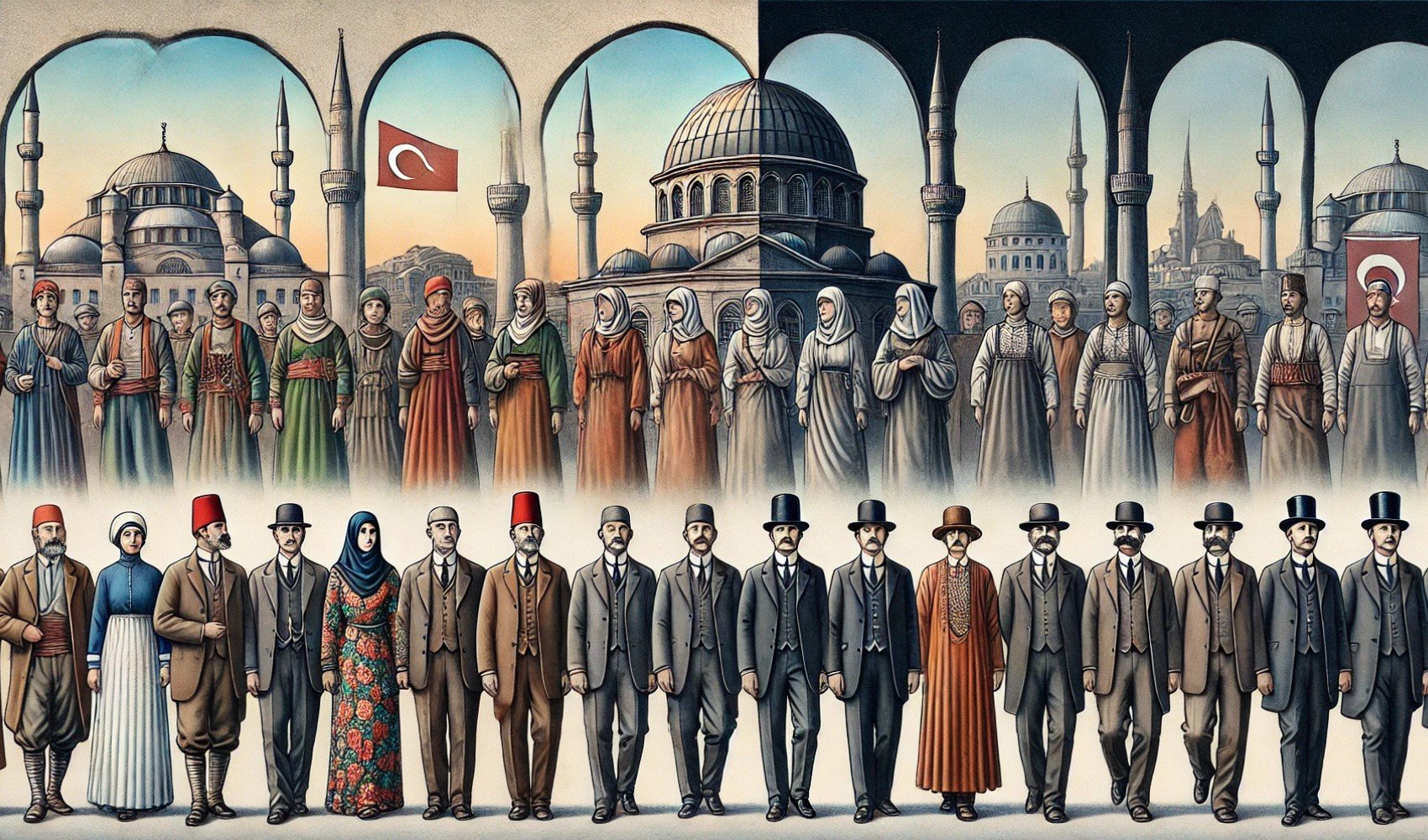
THE HAT REVOLUTION
The Hat Revolution (November 25, 1925) and the Law on the Prohibition of Wearing Certain Garments (December 13, 1934) carry meanings far beyond being an indicator of Westernization.
It is a complement to the Secular Republic.
It is the challenge of the concept of a nation, which is based on being bound to the State of Turkey by the bond of citizenship, to discrimination.
It is the embrace of its people by the Republic, which does not segregate its nation according to religion, sect, profession, or social status.
It is the closing of doors to those who use religion as a tool of oppression for their own interests, and to those who crush the people with their robes and turbans.
The fact that the hat and dress regulation only covered Civil Servants and members of the Grand National Assembly of Turkey, and that the Judiciary was later added to this, is an expression of the State and the Judiciary basing themselves on equality before all beliefs.
The fact that women were not subjected to any coercion is proof of the Republic's respect for established culture and social order.
It is the product of Atatürk's effort to integrate the Turkish Nation with the civilized world.
While those who ignore the Ottoman Empire's humiliating and oppressive edicts and bans, and who try to erode the Revolutions with slanders, continue to live in their dark worlds by targeting the great genius of Mustafa Kemal Atatürk, the Turkish Nation will continue to walk toward the light in His light.
Most Read

Striking picture for Özgür Özel's 'New Party'

The PKK opening and Özgür Özel’s path!..

How did the newspapers view Özgür Özel's farewell to the CHP?

He killed his wife by slitting her throat: Their children witnessed the moments

What did the CHP do?

Özel’s new party move in the world press

Fire at TUSAŞ engine factory in Eskişehir under control

The New CHP, against CEHAPE

From self-efficacy to despair

Kılıçdaroğlu's first message on Özgür Özel's new party announcement