



In the face of Israel and the US attacking Iran in violation of international law, the reactions of the world's ruling "leaders" remained weak. One example was very strong: Pedro Sanchez (Prime Minister of Spain).
Why Spain?
This country, which plundered Latin America by the power of the sword in the 16th and 17th centuries and brought thousands of tons of gold and silver to the feet of Spanish kings, thought at the time that growth through imports would suffice. In those two centuries we mentioned in Europe, they also became a significant power, just like the Ottoman Empire with its sword power in the Balkans and the Mediterranean. However, as time passed, when acting as the protector of the Genoese "Financial Accumulation Circle" (today's northern Italy) did not work, it fell far behind in competition in later centuries.
All of these are elements contrary to Adam Smith's book published around 250 years ago. For Smith had predicted that when money owners have more servants, they will become increasingly poorer compared to those who employ workers. Surplus value came from the worker's labor power.
There is a Spain that has learned lessons from these developments in the last century. It has realized the importance of production. It has a national income (by a small margin) above Turkey's GDP in both purchasing power parity and nominal (fixed) prices. Spain, whose population is approximately half of Turkey's, also has a per capita national income that is approximately double (35 thousand dollars).
Today, Spain's EU membership since 1986 and the sphere of influence of the language it uses are significant. Since Spain uses the "Euro" currency, there is no exchange rate risk. Therefore, it does not need reserve management very much. Because with 280 tons of gold reserves (less than half of Turkey's), it has the opportunity to access ECB (European Central Bank) reserves.
With Spain leaving its own language and people in Latin America, Spanish has come to the present day as the second most spoken native language. Spanish ranks fourth in the world in terms of total languages spoken and is the official language in 23 countries.
The Spanish economy is an economy that grows above the European average and gives a current account surplus thanks to tourism. The budget deficit is in line with norms (3 percent), its debts are high relative to its national income, but it does not pose a problem because it does not have a current account deficit. The inflation rate is 3.3 percent, and it has finally managed to pull its historically high unemployment below 10 percent. By increasing the minimum wage for groups at risk of poverty (an increase of nearly 50 percent), it also wants to overcome the regional income distribution inequality. There is a relative success in this regard in terms of trends. In short, it can be added to the well-off, as the per capita income is over 35 thousand dollars.
AND TURKEY?
However, Turkey's inflation is approximately 10 times that of Spain. Spain is pursuing increasing worker productivity by working less. But while Turkey is struggling with high inflation, it cannot even attempt to reduce working hours.
On the other hand, Spain draws attention with its high exporter position in the defense industry and automotive, attracting three times more foreign direct investment annually than Turkey. We are facing a Turkey where income distribution is more distorted than in Spain and is becoming increasingly distorted. The socialists in Spain, who are trying to correct income distribution, have also been somewhat successful.
High-tech exports in Spain (10.8 percent of total exports) are more than double that of Turkey's. Spain will buy 2.9 billion euros worth of aircraft from Turkey with the Hürkuş training aircraft agreement. It is natural for Turkey to cooperate with this country, whose high-tech exports in Defense, Automotive, Pharmaceuticals, and renewable energy are gradually increasing.
It is possible to say that Spain is a country with a say in Europe and high efficiency in electric vehicles. Because both countries are dependent on fossil fuels for energy (at 90 percent levels). However, Spain draws attention with its leap in renewable energy production and the export of its vehicles. With its income that appeals to high-income European tourists in tourism revenues and leads to a current account surplus, Spain is comfortable because it is far from the war. However, Turkey has already faced a reservation cancellation of around 30 percent in tourism. This means a decrease in foreign exchange income from there, and this is happening while the current account deficit is increasing.
I think Pedro wanted to use these advantages. He gave an important message and announced that they would not allow US bases to be used for Iran, and he did not take a step back.
On the other hand, why Turkey, which declared its neutrality in a high-pitched manner on the Iran issue, remains silent about what is done to its neighbor should be questioned. The reason for this is hidden in the economic picture we tried to explain above. Turkey, which is struggling with high inflation and current account deficit risk, is weaker in capital accumulation and dependent on capital inflows. Spain, on the other hand, can control both its debt burden and capital accumulation with its current account surplus and low inflation.
Spain, where the real estate bubble burst after the 2008 global crisis, is taking serious steps to solve this problem today. For example, allocating empty houses to social housing, setting an upper limit on rental contracts in big cities, etc.
RELYING ON EXTERNAL CAPITAL INFLOW
Turkey, as it did before the 2008 global crisis, has been one of the countries that relies on external capital inflows thanks to low interest rates after it. It financed its long-term investments quite expensively by attracting short-term capital with the high interest, low exchange rate dilemma. When the reserves in Turkey, which could not withstand the engine of the world economy that stalled after Covid, melted away, we were left with a structure struggling with high inflation as a result of wrong macroeconomic policies (especially monetary policy). For that reason, Turkey could not support the lawlessness committed against its neighbor Iran with the argument of "today for you, tomorrow for me".
Iran, which responded to the attacks of Israel and the US with the decision to close the Strait of Hormuz and new attacks, caused oil prices to rise. Oil exceeding 100 dollars per barrel seems to bring an additional burden of 35 dollars to us, causing an increase of 25 billion dollars in the current account deficit already.
There is an equal amount of melting in the reserves, because a rapid short-term capital outflow is taking place. Foreigners have sold almost half of their bond and stock portfolios, and they may sell the remaining part as well.
The state's share in gasoline and diesel has reached its end with the sliding scale system. From now on, the prolongation of the war means both an increase in Turkey's energy bill and current account deficit and an increase in borrowing (with rising interest rates), as well as inflation rising again. Already, household inflation expectations have reached 50 percent. However, Spain wants to prevent the public from being negatively affected by oil prices by allocating 5 billion dollars from its budget.
If you ask, "Why couldn't economically strong Germany and France say a strong no on the Iran issue?", I can attribute this to Europe's inertia. This inertia weakens the power to resist the US and Israel. Both countries are being dragged into the impasse of orthodox policies followed by center-right governments. However, Spain is determined to use its potential for sphere of influence better by strengthening cooperation with countries like Turkey.
Moreover, the socialists do not have a very comfortable majority in the Spanish parliament. But they have a leadership staff that has the initiative to mobilize the power to resist the strong with its own potential.
This is what it means to be aware that American hegemony is weakening.
Most Read

Striking picture for Özgür Özel's 'New Party'

Özgür Özel gives a dated response regarding the number of resignations

Forest fire in Antalya brought under control

The PKK opening and Özgür Özel’s path!..

How did the newspapers view Özgür Özel's farewell to the CHP?
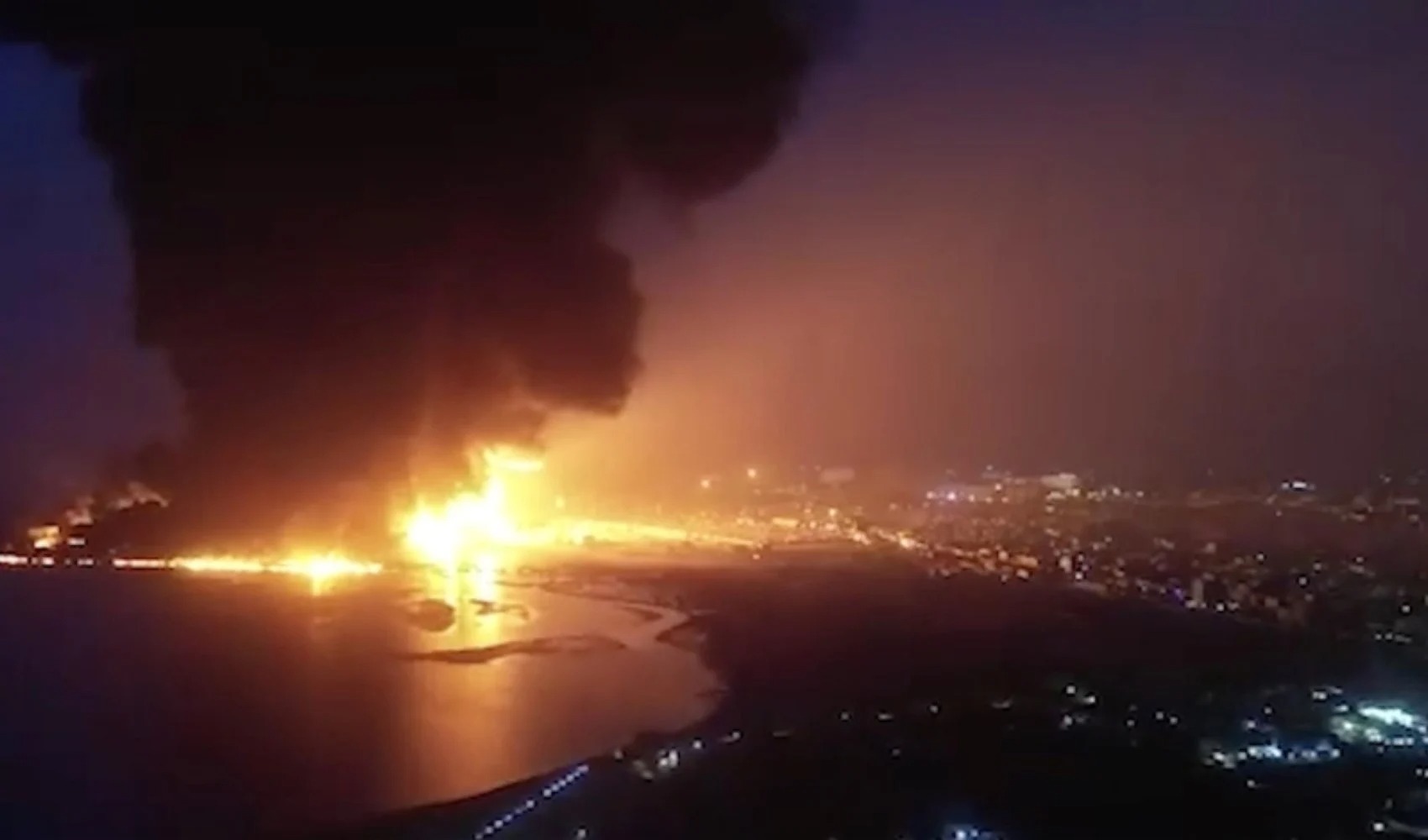
Houthis strike Saudi-owned tanker

What did the CHP do?

Özel’s new party move in the world press

The New CHP, against CEHAPE

From self-efficacy to despair