



Adam Smith, on page 468 of his book “The Wealth of Nations” (İş Bankası Publications), emphasizes that armies are prepared for war not by gold and silver, but by being fed with consumer goods. Of course, this is also a reference to the period in the second half of the 18th century when mercantilism was collapsing.
As is known, accumulating gold and silver by exporting more goods was the fundamental tenet of mercantilism. However, about 250 years later, this mercantilist approach has regained importance today—not necessarily in terms of the source of national wealth, but in terms of strengthening reserves and preparing for both wars and the danger of economic collapse.
Admittedly, the neoliberal understanding (the full economic policy name is the “New Neoclassical Synthesis”) had theorized for 40 years that the reserve management mechanism was an important buffer for central banks in warding off the danger of crisis. The Iran War is one of the application areas of this theory. If oil prices rise, your energy bill swells. “You can provide the strength to withstand this by managing your reserves,” is the summary. Many central banks, led by the People's Republic of China, have been buying gold for quite some time.
Those with large amounts of gold reserves, such as the USA, Germany, Italy, and France, are determined not to sell the reserves they hold, and even to increase them. France, not trusting the USA on this matter, brought the gold reserves remaining in New York back to Paris. Countries with strong foreign exchange reserves, such as China, Japan, and India, have also started to increase their gold reserves.
In particular, in addition to approximately 3.3 trillion in foreign exchange and bond reserves (around 700 billion dollars in US Treasury bonds) in China, 2307 tons of gold have been accumulated. This gold is not even 10 percent of total reserves for China (April 2026). When other countries followed suit due to the effect of uncertainty in the world economy, gold prices soared and soared.
ENERGY EXPENSES BURN THE BUDGET
One of the countries with the highest gold weight in reserves, like the USA, Germany, Italy, and France, is Turkey (30 percent). However, countries other than Turkey have a high advantage because they use their own currencies, the dollar and the euro, for importing goods. Turkey, on the other hand, disposed of and sold 56 tons of its approximately 600-ton gold reserve in London last March. By converting it into approximately 19 billion dollars in foreign currency, it provided fresh money against the foreign trade deficit and current account deficit. A foreign journalist likened this situation to “burning the furniture at home to keep warm.” Because it is clear that there is an additional expense to pay the natural gas and oil bill.
In fact, if there had not been a short-term capital outflow during the same period, and if liquidity had continued, this sale might not have been necessary. Although the foreign portfolio investor obtained a return above what they could get in their own home in dollar terms, they started to leave, thinking that the risk had increased due to the proximity to Iran.
If even Jasek, a Polish economist who came to our faculty, questions whether it is possible for Israel to attack Turkey, we can say, what should the portfolio investor far away think?
The neoliberal financial order suggests seeking a safe haven instead of panicking. According to the theory, a country that is losing money must also use its reserves. It is calculated that the increase in foreign exchange prices will return as inflation, the environment, which is already fragile due to inflation at the 30 percent level, will deteriorate further, and the mass whose purchasing power has decreased significantly may increase even more.
So, are Turkey's reserves sufficient for any moment of crisis?
It can be said that gross reserves are hovering below the national income ranking (in the top 20). According to the calculation made by the IMF, there is a sufficiency at the lower limit. According to the reserve adequacy ratio calculation called “ARA,” an ideal reserve ratio of 150 percent is determined based on the criteria of your short-term debts (30 percent), liabilities arising from portfolio investments coming to your country (15 percent), the effect of resident investors on the money supply (5 percent), and export revenues (5 percent).
AS THE DISINFLATION POLICY CONTINUES...
Turkey, which continues its disinflation policy, is at the lower limit with a reserve adequacy of only between 80-100 percent, despite its high interest rates. In this sense, if it adds around 64.7 billion dollars to its current reserves, it will only be in a position to reach a ratio that covers short-term debts.
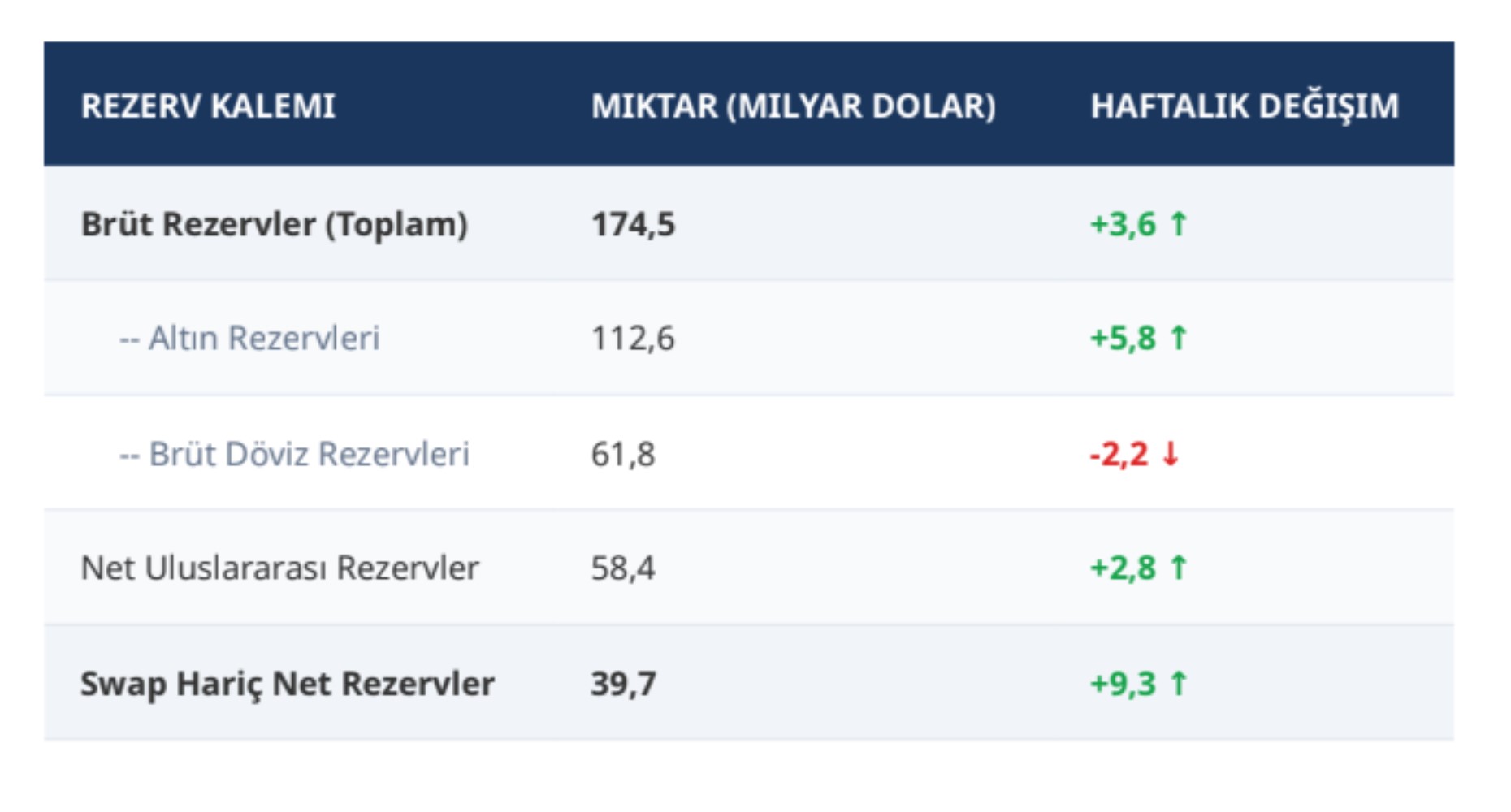
At the end of the article, you can see the latest situation in Turkey's gross and net reserves. In addition, although net reserves excluding swaps, calculated by deducting borrowed foreign currency, are on an upward trend, they are at an insufficient level. The uncertainties continuing in the Iran War—despite the ceasefire—increasing geopolitical risks and the rapidly rising short-term external debt (with 1 year remaining to maturity) reaching 239.2 billion dollars are important factors in terms of the reserve adequacy ratio.
The CBRT's decision to pass last Wednesday and leave the policy rate at 37 percent seems to have increased concerns, despite the fact that actual borrowing has reached 40 percent.
As an economist, while I acknowledge the importance of reserve management in the “neoliberal order,” I think that structural problems are not being addressed in order to reduce short-term borrowing.
Because there are sectors in the country (such as the defense industry) where we cannot calculate the import share and do not really know the added value. Rather than rapidly increasing exports, I think the concern should be "how can we reduce imports?" Not only do we not see this concern, but we are witnessing an increase in the foreign trade deficit as a result of the current monetary policy. If the high real interest rate rising to 10 percent is not enough for some economists, the situation is dire.
We can understand to some extent that the program-like financial initiative put forward to prevent inflation is concerned with balancing reserves, not with the structure. We know that the IMF is not very interested in issues such as added value in Turkey, the deterioration of income distribution, and the transformation of surplus value into investment, that it looks at the result, and that it makes calculations based on reserve adequacy and the capacity to pay short-term debts. This leads us into the impasse of neoliberal economic policy.
Are we not putting our future and our children at even greater risk by investing what the retiree, the farmer, and the fixed-income earner in the country have saved from their own mouths into either reserves or sectors whose added value we cannot even calculate? If the issue is to increase reserves, who will decide which added value will not turn into investment, and how?
If even the method regarding this issue is controversial, woe to us. Is the legal entity (companies and institutions) that made a 14 billion dollar foreign exchange deposit increase last week wrong?
Since even Adam Smith must be “turning in his grave,” we shall see...
Most Read

Striking picture for Özgür Özel's 'New Party'

The PKK opening and Özgür Özel’s path!..

How did the newspapers view Özgür Özel's farewell to the CHP?

He killed his wife by slitting her throat: Their children witnessed the moments

What did the CHP do?

Özel’s new party move in the world press

Fire at TUSAŞ engine factory in Eskişehir under control

The New CHP, against CEHAPE

From self-efficacy to despair

Kılıçdaroğlu's first message on Özgür Özel's new party announcement