



You might come across an imposing statue in the courtyard of the US Department of the Treasury in Washington: Alexander Hamilton. Serving as the first US Secretary of the Treasury for 6 years starting in 1789, following the US War of Independence against the United Kingdom, the military-background Hamilton was famous for imposing high customs duties on imports, particularly spirits like whiskey. In fact, Friedrich List, the theorist of German protectionism, traveled to the US to study this tax system on-site.
After a gap of nearly 250 years, we observe that taxes on imports have once again become the number one topic on the economic agenda. Although economic literature generally treats customs duties as market-distorting, yet beneficial to the state treasury, it also acknowledges the differing effects on consumers and producers. For instance, the consumer is forced to consume less of the higher-priced domestic goods instead of cheaper imported ones. The producer, if they can utilize it well, may encounter prices exceeding production costs, gaining the opportunity to increase production and profit. The goal here is both to close the budget deficit and to increase domestic production.
The global annual trend of customs tariffs, weighted by trade basket, which is impossible to sustain, is shown in the graph below.
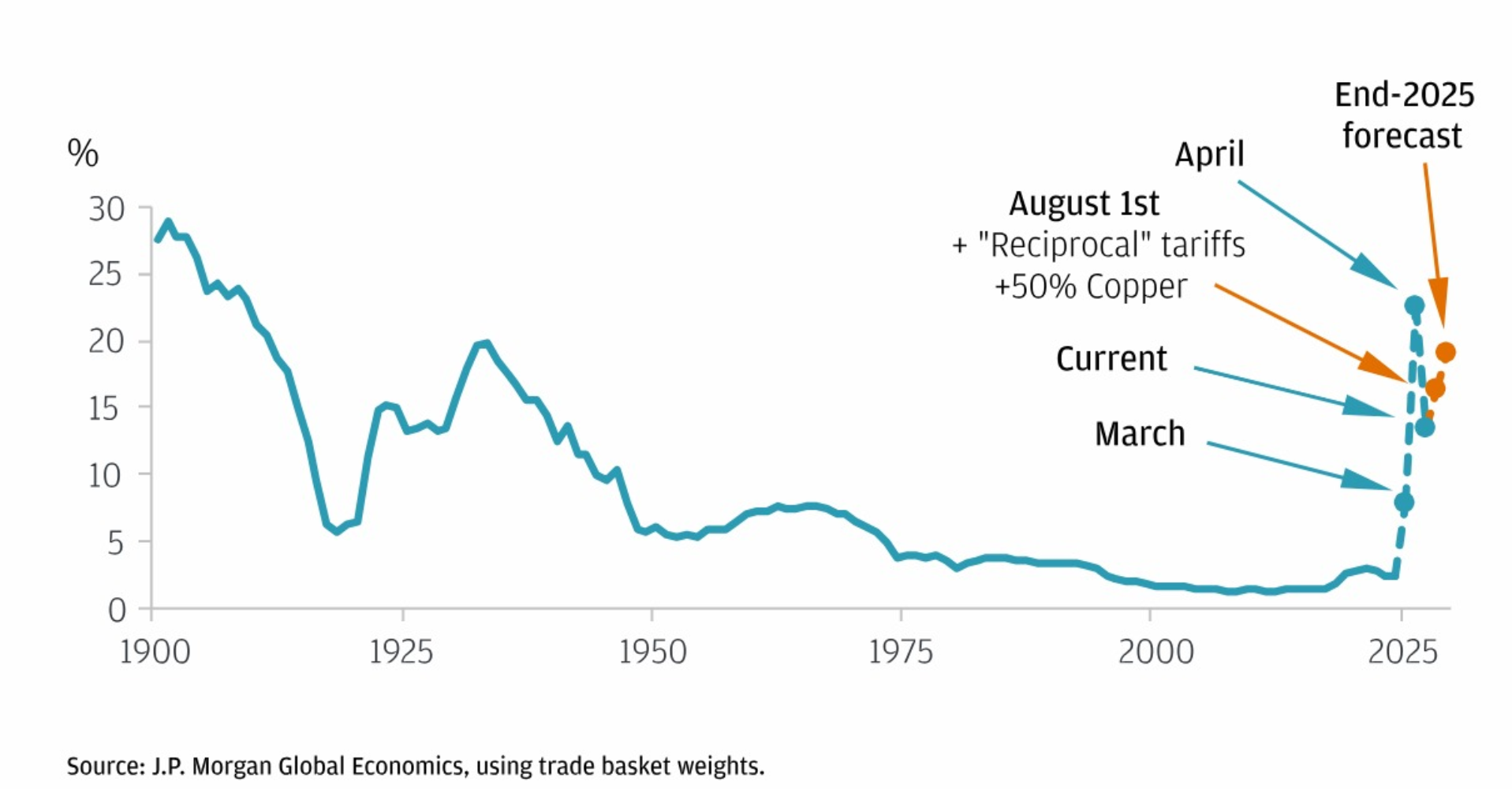
Customs tariff rates globally, which reached up to 30 percent as we entered the 20th century, were rapidly reduced after the 1929 Great Depression and the Second World War. However, the real decline occurred after 2000 with neoliberal economic policies. The rates announced by the Trump administration in 2025 are converging back to the levels of the early 1900s. JP Morgan estimates that through negotiations, we will face a global tariff position exceeding 15 percent by the end of 2025. This means a cost impact in international trade that exceeds 5 times the average in customs tariffs.
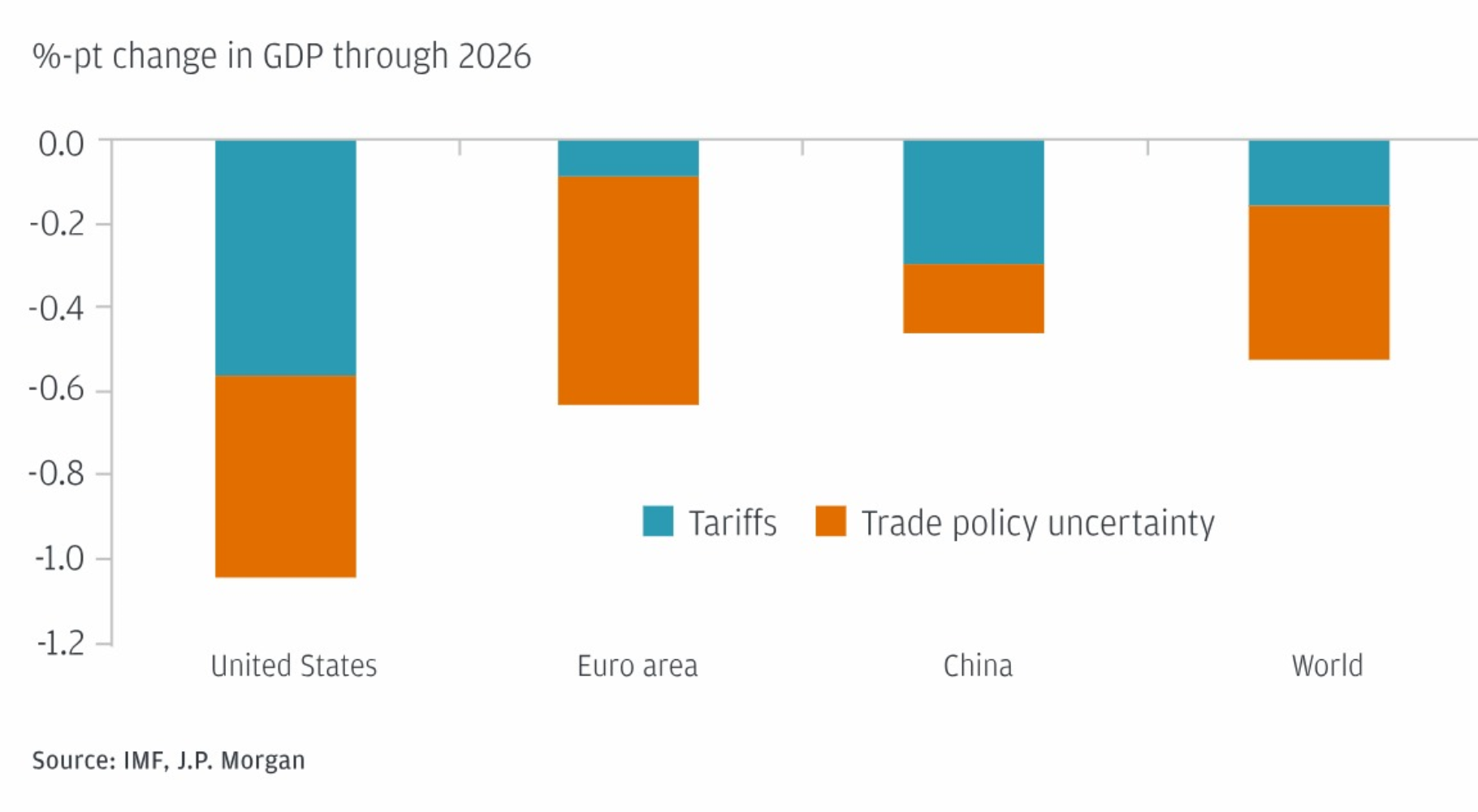
The US may gain the opportunity to cover a portion of its budget deficit with tariffs, but a decline in global consumption, particularly among US consumers, is expected. This is because goods will circulate at higher prices, thereby fueling inflationary trends. Again, according to JP Morgan, global output, particularly in the US, will fall in 2026. This decline in output value, which we also conceptualize as Gross Domestic Product, reaches 1 percent in the US, 0.6 percent in the EU, 0.5 percent in China (quite low), and 0.6 percent for the world. This is actually not a low rate for the world, and it is especially frightening that these effects stem from trade uncertainty (the brown area) for the world, the US, and the EU. For China, the impact is small, and the uncertainty is also low. My prediction is that growth in the global economy will fall toward below 3 percent next year due to slowing international trade. This is a development that lowers the average of recent years and increases the probability of an economic recession.
In this case, is the goal being achieved for the US? No, at least in 2026, the main impact will be on the West. It is not difficult to predict that trade uncertainty in Turkey, as part of the world, will also increase, and that the inflationary effect will come in addition to the domestic one. The Turkish economy, which is in a disinflation process, will be affected by this major upheaval in the global economy, both in terms of trade and foreign investment. It is already observed that markets in trade are gradually shrinking. This contraction will continue. On the other hand, if it solves its political and legal problems, it will also be able to benefit from foreign investment opportunities.
In this sense, it is important not to repeat the monetary policy mistake (rapid interest rate cuts) made in December 2021, and to maintain input costs and reserves (via portfolio inflows) with an exchange rate that is not undervalued. If the domestic market is to take precedence, and it is possible to predict that it will, raising real wages will be good for everyone. Attempts to reduce the budget deficit through corporate taxes and by taxing high earners will also provide an important infrastructure.
Furthermore, re-establishing the domestic production relationship that balances the export market could be useful in terms of synchronizing the Turkish economy with the global economy. Especially having or not having an infrastructure that will deserve the "probable" and potential foreign investment to come from China and the EU..
That is where the whole issue lies. Only then might it become easier to solve the inflation detail.
NOTE: In this first article, I wanted to nurture a small hope, as much as possible.. Hello to everyone..
Most Read

Striking picture for Özgür Özel's 'New Party'

The PKK opening and Özgür Özel’s path!..

How did the newspapers view Özgür Özel's farewell to the CHP?

He killed his wife by slitting her throat: Their children witnessed the moments

What did the CHP do?

Özel’s new party move in the world press

Fire at TUSAŞ engine factory in Eskişehir under control

The New CHP, against CEHAPE

From self-efficacy to despair

Kılıçdaroğlu's first message on Özgür Özel's new party announcement