



The Treasury's interest payment of 453 billion liras in January alone is on everyone's lips. Even the ruling party is starting to show signs of internal discord. To understand the magnitude of this figure, it is enough to look at the 2026 budget targets: The total annual interest expenditure forecast is 2 trillion 741 billion liras. In other words, in just the first month of the year, approximately 16.5% (one-sixth) of the total interest budget has already been spent.
When this massive interest payment caused a public outcry, Minister Mehmet Şimşek immediately went on the defensive and blamed the past. In a statement made through social media and the press, Şimşek essentially said the following:
"This interest payment in January is not a result of today's economic policies, but stems from the maturity of inflation-indexed treasury bonds (CPI-indexed) issued exactly 10 years ago. This is a burden from the past."
While Mehmet Şimşek tries to shift the blame to 10 years ago, he probably thinks we won't refresh our memories. Yes, 10 years ago, in 2016, the AKP government was in power in this country as well. But the truly dire and ironic part of the matter is this: The person who made those borrowing decisions was Mehmet Şimşek himself.
In 2016, the Ministry of Finance and the Treasury had not yet been merged. Naci Ağbal was sitting in the Minister of Finance seat. Mustafa Elitaş and Nihat Zeybekci were serving as Ministers of Economy. However, these individuals did not deal with borrowing, treasury auctions, or the Central Bank; they were occupied with finance, industry, trade, and exports.
In the state structure of that day, the Undersecretariat of Treasury and the Central Bank were directly subordinate to the office of the Deputy Prime Minister in charge of the Economy. And who was the Deputy Prime Minister in charge of the Economy who conducted these "inflation-indexed" borrowing auctions and determined the borrowing strategy at that time? Mehmet Şimşek again!
Mehmet Şimşek… He served as the Deputy Prime Minister in charge of the economy in Prime Minister Davutoğlu's cabinet on November 24, 2015. Davutoğlu left on May 24, 2016, and Binali Yıldırım became Prime Minister, but Mehmet Şimşek's tenure continued during the Binali Yıldırım period until July 9, 2018.
While Şimşek cuts the bill to 10 years ago to escape criticism, he is actually scoring an own goal. He is the architect of that high-cost borrowing that he calls a "burden of the past" today. They say those who sow the wind reap the whirlwind… But here the subjects change. Mehmet Şimşek sowed the wind, and unfortunately, it is the nation that is reaping the whirlwind and facing the storm… What is the result?
• "No resources" when it comes to retirees: While millions of retirees struggle to survive below the hunger threshold, those who say "there are no resources" are transferring 453 billion liras to interest lobbies in a single month.
• Interest instead of service: The taxes paid by the nation are not going to roads, schools, hospitals, or prosperity; they are going to faulty borrowing.
• Deteriorating income distribution: Collected taxes are being transferred to high-income groups that lend money to the state.
There is no hope that this picture will change in the coming period. The increase in collected tax revenues is higher than inflation... On top of that, state assets are being sold. But still, there is not enough money for budget deficits and interest payments. The public sector's debt stock keeps ballooning. It has not been able to get on track since the transition to the Presidential Government System in 2018.
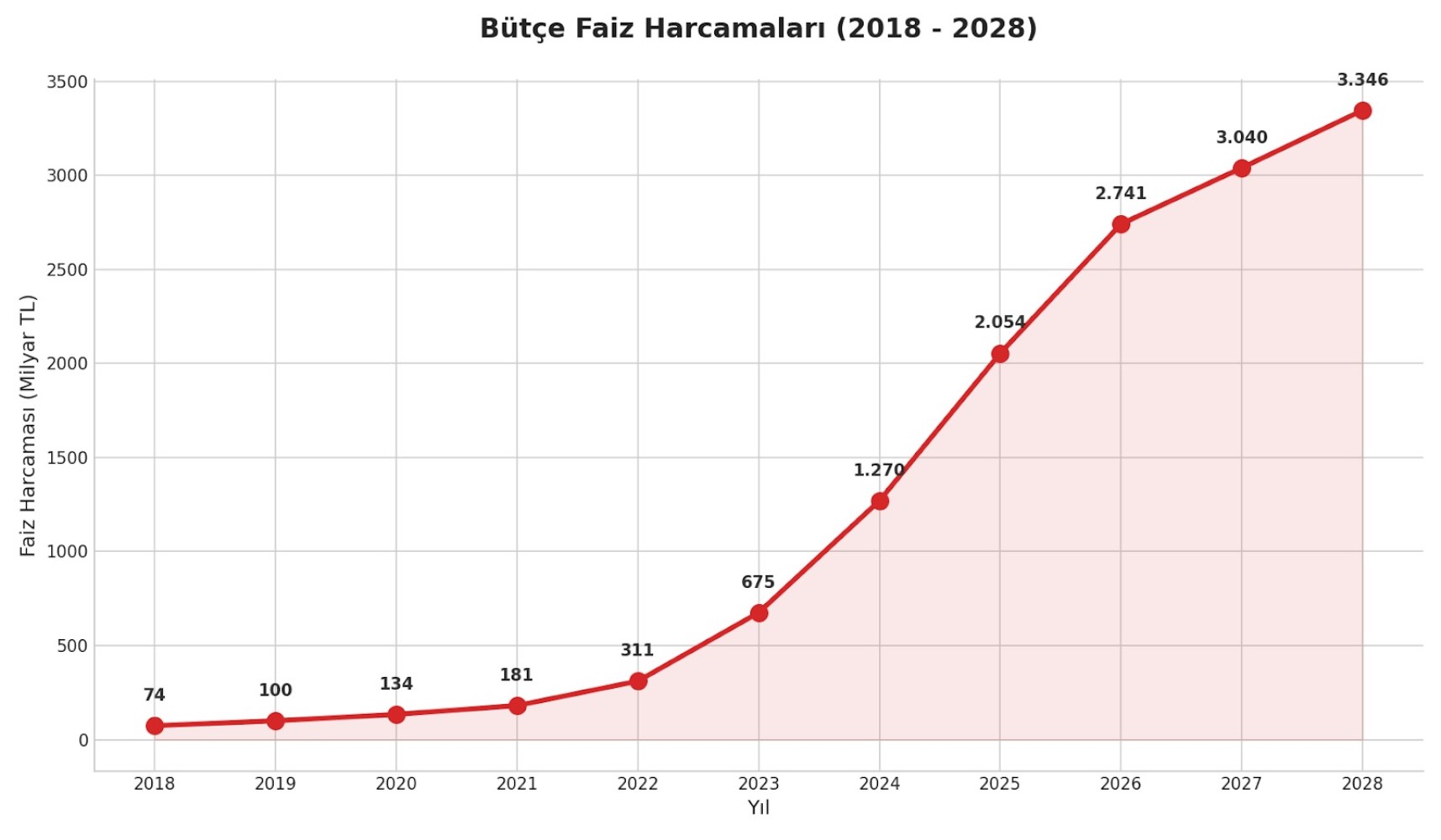
The graph above shows very clearly. While interest payments in the budget were 74 billion liras in 2018, they rose to 2 trillion 54 billion liras in 2025. We will pay 2 trillion 741 billion liras in interest in 2026, and according to the medium-term program, 3 trillion 346 billion liras in 2028.
The second graph below shows how the Black Hole is growing.
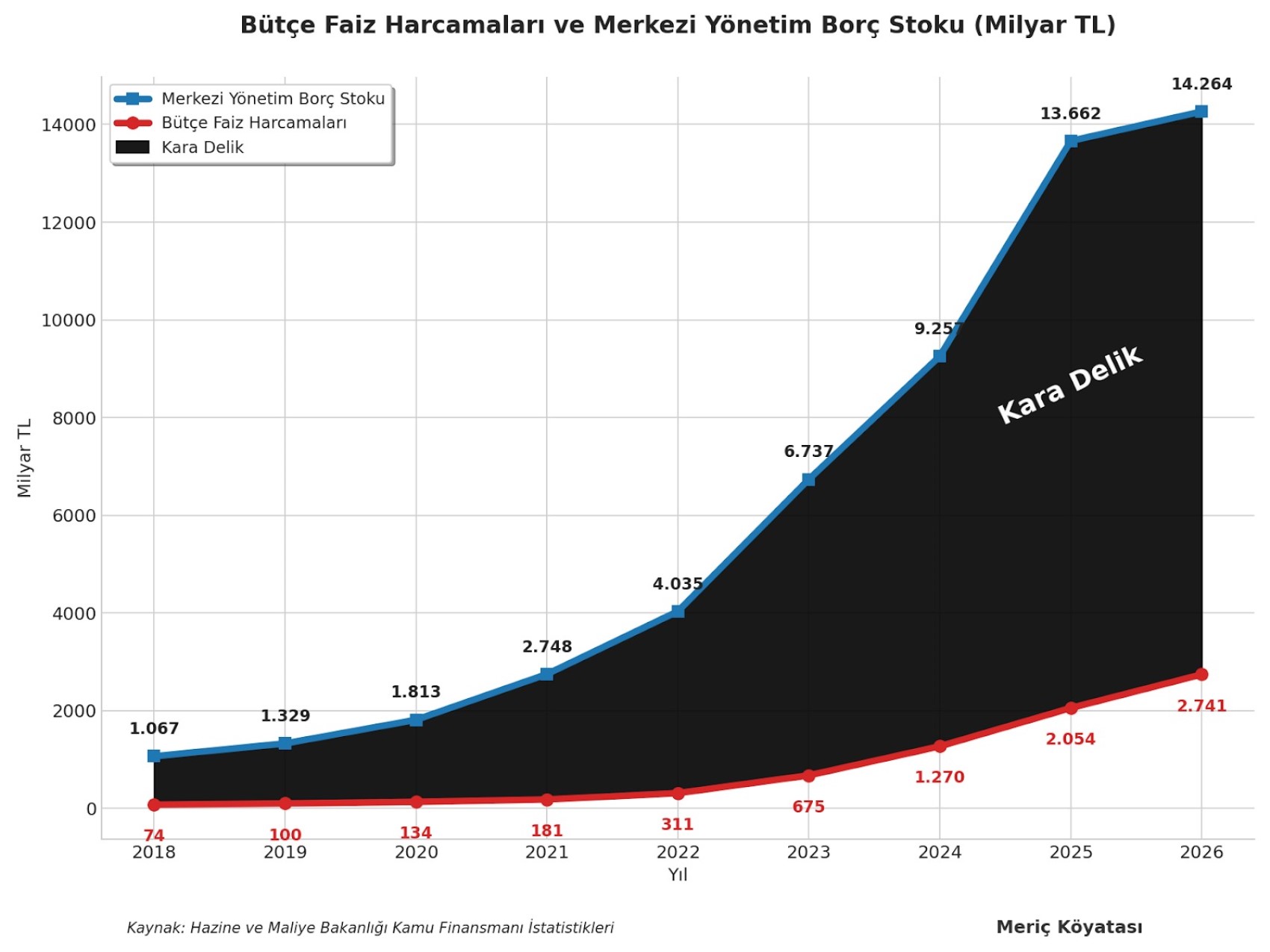
Despite this massive increase in interest payments, and despite collecting more taxes than the increase in inflation, the Central Government Debt Stock is not shrinking; on the contrary, it is increasing every year. The black hole is getting bigger and bigger. The second graph shows the gravity of the situation very clearly. As of January 2026, the Central Government Debt Stock reached 14 trillion 264 billion liras. When the transition to the Presidential Government System was made, the Central Government's Debt Stock was 1 trillion 67 billion liras. In this 8-year period, while our interest payments have increased approximately 28-fold, our debt stock has grown 13-fold. And there is no sign on the horizon that budget deficits will close or debts will be erased… Gabar oil and such are just fairy tales…
Most Read

Striking picture for Özgür Özel's 'New Party'

The PKK opening and Özgür Özel’s path!..

How did the newspapers view Özgür Özel's farewell to the CHP?

He killed his wife by slitting her throat: Their children witnessed the moments

What did the CHP do?

Özel’s new party move in the world press

Fire at TUSAŞ engine factory in Eskişehir under control

The New CHP, against CEHAPE

From self-efficacy to despair

Kılıçdaroğlu's first message on Özgür Özel's new party announcement