



S&P has upgraded Turkey’s credit rating from B+ to BB- (minus). It also defined the outlook as stable. The meaning is that we have moved out of the “Highly Speculative” country status. We have risen to the “Speculative” country position. Our economic management and the pro-government media are very happy. Looking at the winds of lies blowing, it is useful to remind once again what these credit ratings mean.
Many institutions, large and small, perform credit ratings and assign grades for countries and companies. Among these, there are three most influential organizations: S&P, Fitch, and Moody’s… Previously, Fitch and Moody’s had upgraded Turkey’s credit rating by one notch.
From my article titled “The joy of a student who gets a 1 out of 10 raising their grade to a 2” published in 12 Punto on Sunday, March 10, 2024:
“Three weeks before the elections, the international credit rating agency Fitch upgraded Turkey’s credit rating from “B” to “B+” and its outlook from “Stable” to “Positive.” The economic management and pro-government media are very happy.”
Now that it has increased by one more notch… let us also upgrade the grade as “The joy of a student who gets a 2 out of 10 raising their grade to a 3.”
We could say this: If you were a new government and within a year or two you raised the country from a “Highly Speculative” position to just a “Speculative” position, we would say, “They still have a lot of work to do, but they are on the right track.” But that is not the case; you have been in power for 22 years. Raising the country from a single B rating to BB in 22 years is no great feat.
Towards the end of this article, I will present the meaning of these ratings and the country groups we are in with a graph and a table. Before that, I want to make this assessment: We are in a place to be ashamed, not to rejoice. The level we should have reached in 22 years was not to get a 2 or 3 on a math exam, but a 9 or 10. It was for the country’s rating to be at the AA or AAA level. Because the Turkish nation gave you whatever you asked for.
WE GAVE YOU WHATEVER YOU ASKED FOR…
We are among the world’s 20 largest economies. But this size stems from a high population. We are cumbersome, not strong. According to credit rating agencies, we are in the same category as Albania, Armenia, Bangladesh, Jamaica, Turkmenistan, Honduras, North Macedonia, South Africa, and Uzbekistan. Yet, in your 22 years of power, this nation gave you whatever you asked for. First of all, it gave you single-party rule. It gave you a parliamentary majority. That was not enough; due to the incompetence of the opposition, it did not make a peep about the dubious constitutional change and gave you one-man authority, free from oversight, in the administration of the country. And along with these powers, it provided unprecedented resources.
Let’s not even include the private sector’s external debts.
In the last 22 years, you have increased the public’s external debt from 87 billion dollars to 241 billion dollars. You have increased it by 154 billion dollars.
You have taken on 137 billion dollars worth of domestic debt.
You have carried out nearly 80 billion dollars in privatizations.
On top of that, you have provided an additional 175 billion dollars in treasury guarantees for airports, bridges, highways, and hospitals built and operated by the private sector.
As the public sector alone, you have used 154 + 137 + 80 + 175 = 546 billion dollars in non-tax resources.
In the last 22 years, excluding hot money, 260 billion dollars in direct foreign capital and 70 billion dollars in real estate investment have arrived.
If we add these, the non-tax resources used amount to 546 + 260 + 70 = 876 billion dollars…
So, what did the “old Turkey” you dislike do in 80 years…
Including both public and private sectors, 131 billion dollars in external debt + 89 billion dollars in domestic debt + 14 billion dollars in direct foreign capital, add them all up: 234 billion dollars. All the investments you see, infrastructure and superstructure, the factories you sold, were all built with this much resource.
On one side 234 billion dollars, on the other side 876 billion dollars…
On top of these, you have collected 3.5 trillion dollars in taxes. You have used nearly 4 trillion 400 billion dollars in resources in 22 years.
What did you give to Turkey… Upgrading the credit rating from B+ to BB-…
TURKEY’S CREDIT RATING HISTORY…
The graph shows it very clearly. (From Prof. Dr. Hakan Kara’s X account)
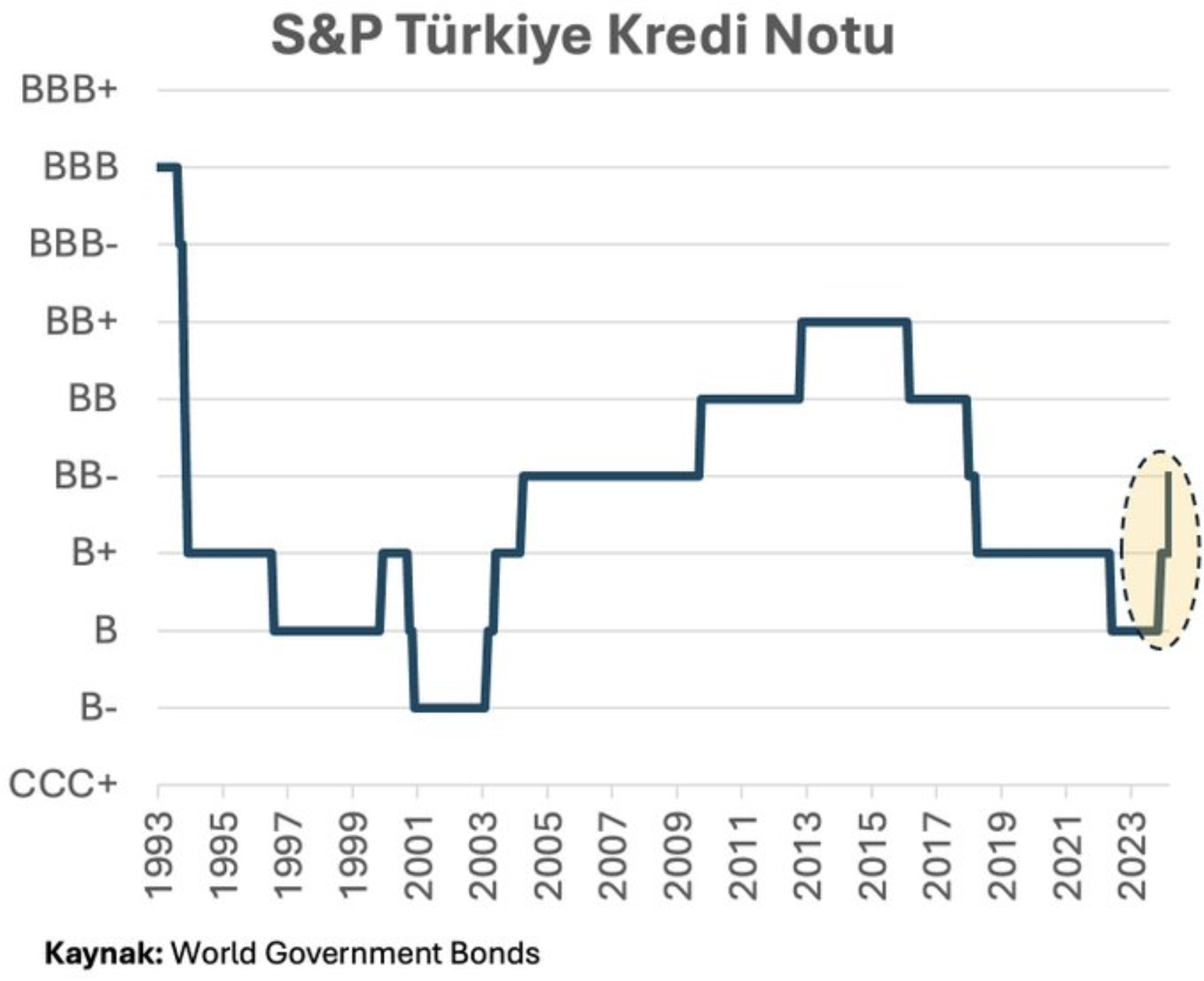
Turkey has been evaluated by credit rating agencies since 1992. Between 1992 and 1994, during the Süleyman Demirel-Erdal İnönü coalition, our rating was BBB, at an investment-grade level. Later, with Tansu Çiller, Turkey fell into the Highly Speculative Countries category. In 2002, we were at our current credit rating of B stable. When full membership negotiations with the EU began, there was a significant jump in foreign investments independent of credit ratings, but the credit rating still could not reach the investment-grade level of BBB. It reached its highest level in 2013 at BB+. The meaning is two notches higher than today’s BB-, but still a “Speculative Country”… Since 2017, we had fallen back to the “Highly Speculative Country” position with a single B.
THE MEANING OF CREDIT RATINGS AND WHICH COUNTRIES TURKEY IS EQUIVALENT TO
We see it very clearly in the table.
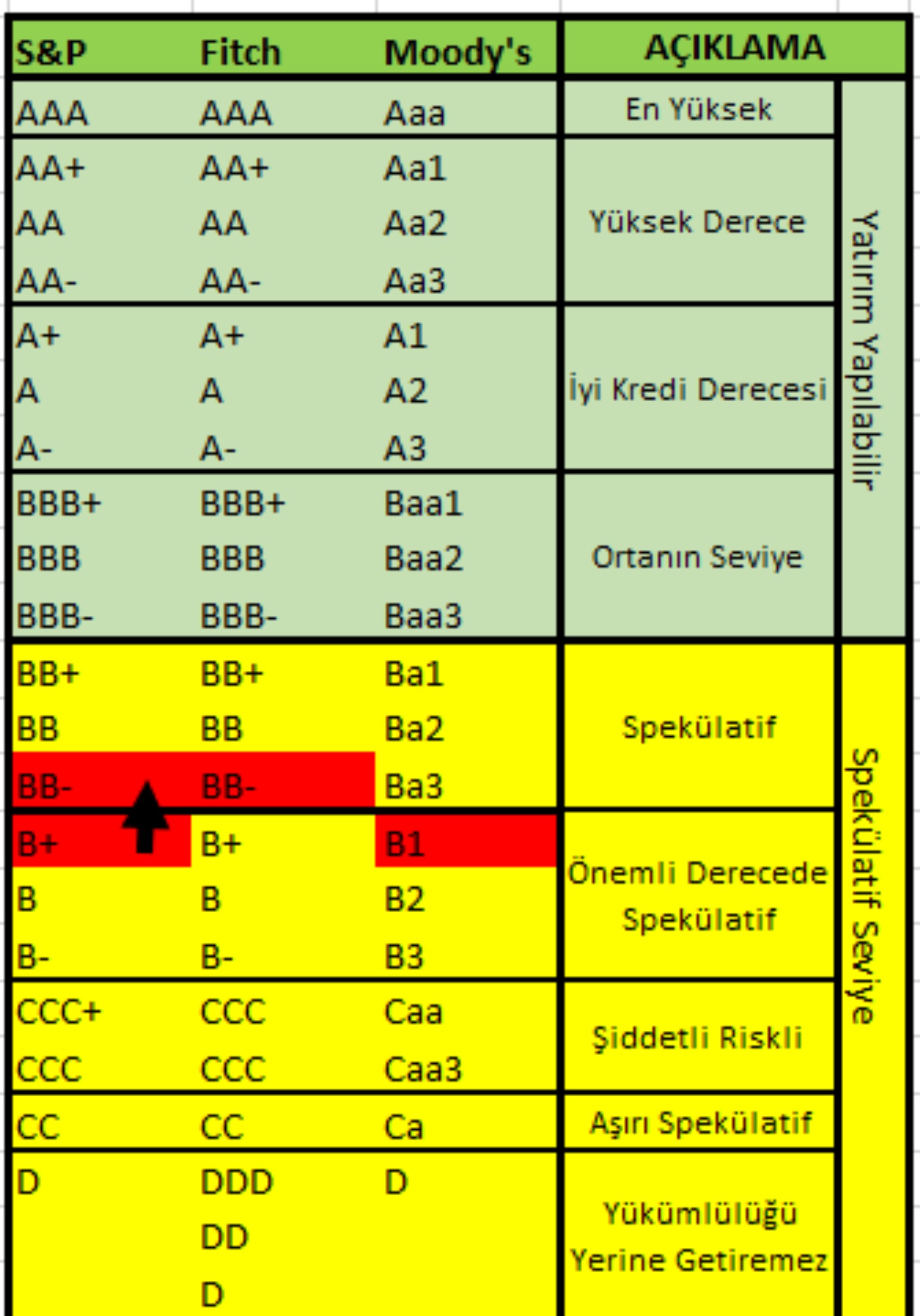
Which countries were in our old B+ category?
Bahamas, Bahrain, Senegal, Fiji, Bosnia and Herzegovina, Jordan, Rwanda
Which countries are in our new BB- category?
Albania, Armenia, Bangladesh, Jamaica, Turkmenistan, Honduras, North Macedonia, South Africa, Uzbekistan
CREDIT RATING AND THE STATE OF THE PUBLIC
It is good for credit rating agencies to give high ratings, but it is never enough on its own to show that a country’s economy is doing well. What is important here is not the level of prosperity in the country, but that country’s capacity to repay the debt it has taken. With the economic policies implemented in the country, you can severely deteriorate income distribution, drag the people into misery, and suck the marrow out of a significant portion of society. What matters is whether you can pay your debt or not.
Indeed, S&P also wrote it clearly in the justification for its rating upgrade:
“…the authorities’ ambitious plans to reduce still-high inflation, manage employees’ wage expectations, and rebalance the Turkish economy…”
If we translate this into Turkish: “Do not raise wages as much as past inflation, but as much as future inflation expectations (at most 25 percent). Even if future inflation expectations are at the 25 percent level, continue to give us 50 percent interest. You can also lower it to 45 percent…”
MY COMMENT ON THE CURRENT RATING
Following the upgrade of Turkey’s rating to the B+ level before the local elections, I made the following comment in my 12 Punto article dated March 10, 2024:
“This rating sends this message to foreign investors and Turkey: For direct foreign capital investments, Turkey is still not an investment-grade country. But there is no risk of Turkey defaulting in the near future. It has the capacity to borrow at high real interest rates and repay its debts. Hot money can come if it finds suitable interest rates.”
Indeed, since that date, over 15 billion dollars of hot money has flowed into Turkey. Foreign exchange reserves have increased even further. However, we are still not in a position to be a country for direct investment. A permanent decline in inflation is a distant possibility for now… Even if inflation falls relatively slightly, an increase in the prosperity of society is not even a question during this government’s term.
Most Read

Striking picture for Özgür Özel's 'New Party'

Özgür Özel gives a dated response regarding the number of resignations

Forest fire in Antalya brought under control

The PKK opening and Özgür Özel’s path!..

Houthis strike Saudi-owned tanker

How did the newspapers view Özgür Özel's farewell to the CHP?

What did the CHP do?

Özel’s new party move in the world press

The New CHP, against CEHAPE

From self-efficacy to despair