



In economics, a quarter is defined as 3 months. Economic indicators are evaluated based on these three-month periods. The Turkish economy has been growing consecutively for the last 21 quarters (7 years). A crisis in the economy is defined as the economy entering a stagnation, and it is technically said that for an economic crisis to be mentioned, the national income (GDP) must shrink for two consecutive quarters. I object to such a shallow perspective. If we look at the issue solely in terms of growth data, are we to say there is no economic crisis in Turkey?
There is a very severe distribution crisis in Turkey. Hunger and misery are becoming widespread. I will touch upon this again at the end of the article, but the problem is not limited to income distribution alone. The economy in Turkey is deteriorating in a way that will create more severe problems (crises) in the future.
In addition to growth, we must also evaluate inflation, unemployment, external deficits, and budget deficits together. As the economy grows, Turkey's external deficit and indebtedness grow. The economy is growing, but unemployment is not decreasing. On the contrary, broad-based unemployment is increasing. What kind of growth is this?
Furthermore, they invent excuses as if it were a general economic theory, such as "If we do not sacrifice economic growth, we cannot lower inflation." Moreover, some economist friends from the opposition are also supporting this excuse.
INFLATION AND GROWTH NONSENSE
The saying "If there is economic growth, there will be inflation, or inflation cannot be reined in" is a huge piece of nonsense, an urban legend. Instead of bloated growth, if you establish a planned development model without recklessly distributing resources to cronies, you will not create inflation, your economy will grow, and the welfare level of society will increase. Let us recall two periods from Turkey. The era of Gazi Mustafa Kemal Atatürk... The average annual growth was at the level of 9 percent. Inflation was close to zero.
The 1965-1971 period... The period when the State Planning Organization was newly established with the 1961 Constitution. Prime Minister Süleyman Demirel... The average annual growth rate was 7.5 percent, and inflation was 5 percent...
Let us also look at China. Growth at the level of 10 percent annually since the year 2000. Is there runaway inflation there?
CAN THERE BE GROWTH WITHOUT AGRICULTURE AND INDUSTRY?
There is no quality to the growth in Turkey... There is no growth through construction. Let us look at the first years when the AKP came to power. End of 2004... The share of agriculture in national income was 11.6 percent. Today it is 5.8 percent... In 20 years, the share of agriculture in national income has halved. Yet, agriculture is a strategic sector. In the 2000s, we were one of the rare countries that were self-sufficient in agriculture; now we have fallen into a state of importing lentils that have been produced on these lands since antiquity. In addition to the lack of planning in agriculture, as a result of negligence in water management, the risk of hunger and famine cannot be ignored.
Did agriculture decline and the share of industry increase? In 2004, the share of industry in national income was 29.7 percent, now it is 19.7 percent... With this production structure, with this education structure, with this legal structure, and with this market structure dominated by "laissez-faire" and cronyism, what economic growth are you talking about?
We cannot produce enough external resources for the wheels of the economy to turn. The chance of our human capital (education and people) and the technological level of capital producing enough external resources in the short term is very low. We are now transforming into a colonial-type economy structure for external resources. It is now the turn of selling mines, rare earth elements, and coastlines to keep the wheels of the economy turning.
WE ARE WORKING FOR 1 PERCENT OF THE POPULATION
After recalling this structure, we can understand the growth in the economy and the distribution crisis we are experiencing more clearly. We used to call growth without agriculture and industry "hormonal growth." I now call it toxic growth. Because instead of the society's welfare increasing as it grows, on the contrary, the country's external debt is increasing. The debt of a large segment of society is increasing. It is becoming impoverished. Only 1 percent of the population can get a share of this growth. Let us examine the table below.
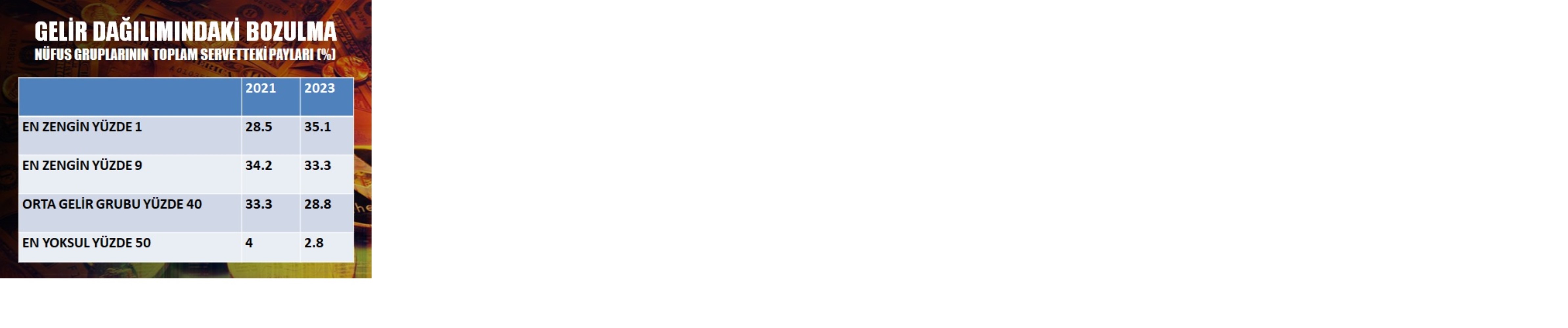
Especially as a result of the monetary and interest rate policies implemented after October 2021, a tremendous transfer of wealth occurred in society from the poor to the top income group. According to the World Inequality Database prepared by the Paris School of Economics (The World Inequality), while the poorest 50 percent of the population in Turkey received 4 percent of the total wealth, their total wealth fell to 2.8 percent by the end of 2023. The wealth of the middle-income group fell from 33.3 percent to 28.8 percent. But the most interesting part of the matter is that the wealth of the richest 9 percent also fell from 34.2 percent to 33.3 percent. 86 million people worked for 1 percent of the population. The economy grew, only the wealth of 1 percent of the population increased. It rose from 28.5 percent to 35.1 percent.
Behind this table lie pension and wage policies that drag a large segment of society into misery. Behind this table are agricultural policies that make it impossible for farmers to plant their fields. Behind this table lie monetary and fiscal policies that ignore the public and protect the top income group. Behind this table lies the collapsing education system. Behind this table lies the decaying social morality.
Most Read

Striking picture for Özgür Özel's 'New Party'

The PKK opening and Özgür Özel’s path!..

How did the newspapers view Özgür Özel's farewell to the CHP?

He killed his wife by slitting her throat: Their children witnessed the moments

What did the CHP do?

Özel’s new party move in the world press

Fire at TUSAŞ engine factory in Eskişehir under control

The New CHP, against CEHAPE

From self-efficacy to despair

Kılıçdaroğlu's first message on Özgür Özel's new party announcement