



At this point, the accuracy or inaccuracy of what TÜSİAD has said does not matter much. From now on, we will be watching the flow of foreign capital into Turkey. We will look at this through three windows.
First Window: Hot money coming in for high Turkish Lira interest rates (Carry Trade) and the yields on Turkish bonds…
Second Window: The foreign investor, who has been eagerly awaited in the stock market for almost a year… Will they come, or will they reduce their share?
Third Window: This is the most important one… Foreign direct investment for new projects…
You can download and read the 42-page brochure titled “Perspective 2025/Roadmap & Recommendations for Transformation and the Future,” in which TÜSİAD announced its proposals along with its General Assembly, from their website.
I believe that Mehmet Şimşek and the Central Bank would also sign off on many of the headings included in TÜSİAD's findings and recommendations. I agree with some of the proposals, but I have doubts about how sincere TÜSİAD is in these suggestions, and I would expect self-criticism in some areas. If the agenda does not change, we will address this in another article so as not to digress.
THE CAUSE OF THE ANGER AND MEHMET ŞİMŞEK
In the “Perspective 2025” brochure it prepared, TÜSİAD emphasizes the importance of the rule of law and judicial independence for economic development and the arrival of foreign capital. In his opening speech, High Advisory Council President Ömer Aras gave examples of issues such as democracy, human rights, the rule of law, and judicial independence, and his finding that “The system has collapsed” infuriated first the Minister of Justice and then President Erdoğan.
TÜSİAD's criticisms have a greater impact than those of any non-governmental organization or opposition party. However, I think the effect of President Erdoğan's anger and the image of the two TÜSİAD presidents being walked for a long time through courthouse corridors with police on their arms at midnight will be much different than many other events.
What I mean is… The words “Hey Netanyahu” are perceived as a message given to the outside from the inside and are not taken very seriously. But the sight of the High Advisory Council President and the Chairman of the Board of Directors of TÜSİAD being walked with police on both arms is not perceived as consolidating the pro-government base or sending a message to a group inside. Its effect abroad will be much greater. It is perceived as frightening in the financial centers of New York, London, the Gulf Countries, and East Asian Countries. I wonder what Mehmet Şimşek thinks. I wish the Minister of Justice had spoken with Treasury and Finance Minister Mehmet Şimşek before immediately appearing in front of the cameras.
THE COST OF AN EXTERNAL-DEPENDENT ECONOMY
Unfortunately, the Turkish economy cannot stand on its own resources… Especially after the 2000s, it needs foreign capital and foreign debt to keep the current wheels turning, to be able to export, and for new investments. A country that constantly runs a foreign trade deficit is dependent on external resources. When we try to reduce the foreign trade deficit, the economy shrinks and unemployment rises. When we say let the economy grow, this time the foreign trade deficit and current account deficit swell. We pay the world's highest interest rates on hot money to cover the foreign exchange deficit. We are currently facing a colonial interest burden of 30-35 percent annually in dollar terms. This means a massive transfer of resources from Turkey to abroad. This is not a sustainable structure.
Both Mehmet Şimşek and the senior management of the Central Bank are traveling the world incessantly to find foreign direct investment, to find low-interest foreign debt, and to bring hot money funds to Turkey. If your external deficit and foreign debt are high, dependence on the outside has heavy costs.
FOREIGN CAPITAL INFLOW HAS WEAKENED
I must also state this… Turkey attracted a significant amount of foreign direct investment, first with Kemal Derviş policies and then with the story of full membership in the EU in 2004. However, it did not shift the incoming foreign capital to areas oriented toward exports and industry. It allocated it to concrete and consumption. A virtual period of prosperity like the Tulip Era was experienced. The structure of industry and agriculture was damaged. We became even more dependent on foreign resources. Recently, especially after the transition to the Presidential system, there has been a serious decline in incoming foreign capital. In addition to this, foreign direct investment is leaving Turkey for abroad. Many companies in the textile and ready-to-wear sectors have invested in Egypt. Among these are MÜSİAD members as well as TÜSİAD members. Real estate investments abroad by the wealthy of the ruling party have also increased.
Our colleague Alaattin Aktaş from Ekonomim Newspaper compiled this from Central Bank data. In 2024, foreign purchases of housing in Turkey amounted to 2 billion 825 million dollars. (It was 6 billion 273 million dollars in 2022.) Turkish purchases of housing abroad amounted to 2 billion 153 million dollars. (It was 628 million dollars in 2022.) The gap is closing. If it continues like this, next year, Turks' housing purchases abroad will exceed foreigners' purchases in Turkey.
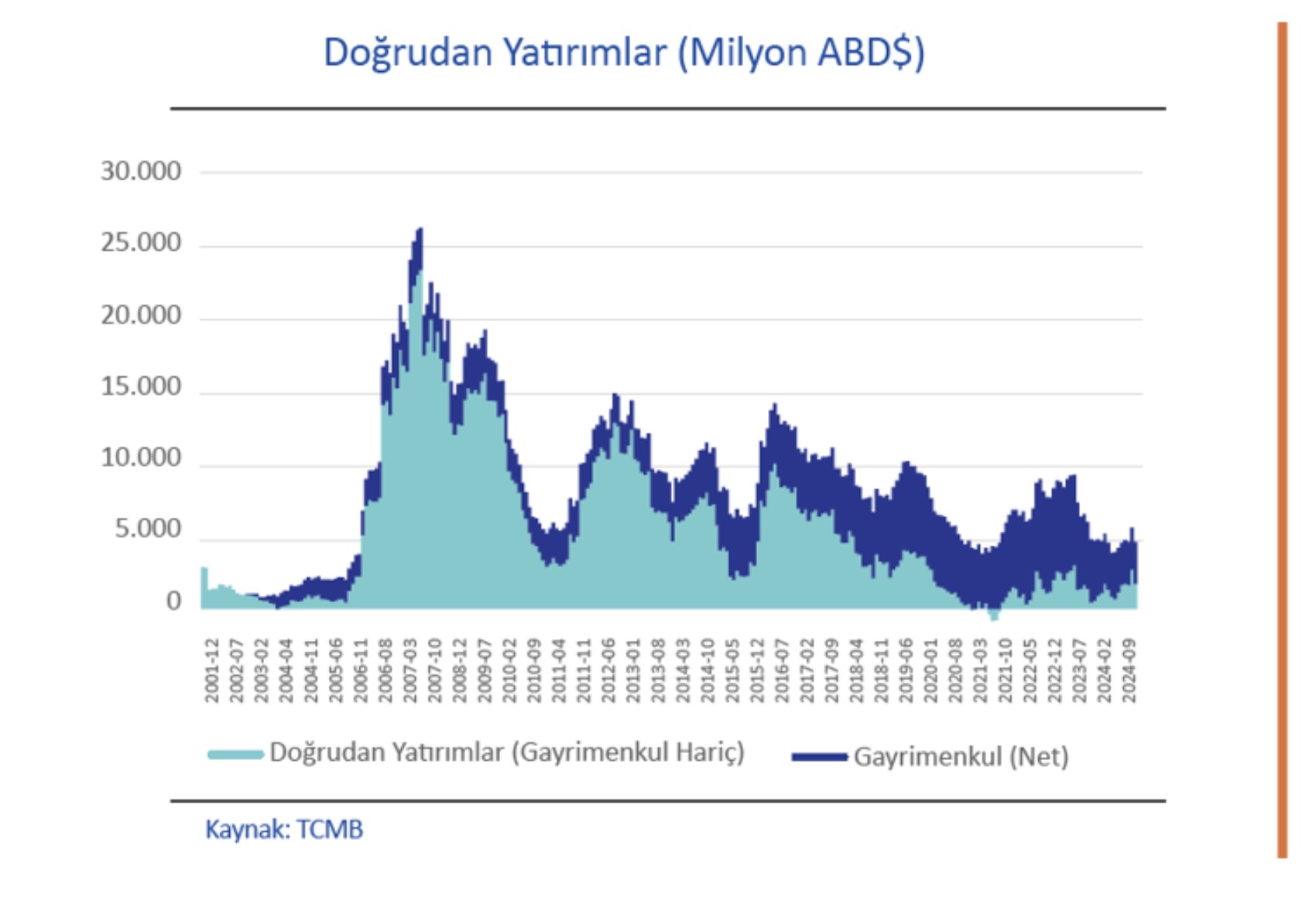
Again, according to what Alaattin Aktaş reported from Central Bank data, the net foreign direct investment inflow excluding housing in 2024 is 6.2 billion dollars. In contrast, the amount of Turkish direct investment abroad excluding housing is 3.3 billion dollars. The net foreign direct investment inflow corresponds to 2.8 billion dollars. The annual net foreign direct investment inflow between 2016-2024 is around 4 billion dollars on average. In the early periods of the AKP, this level was 16 billion dollars.
Another piece of data is from the valuable economist Mahfi Eğilmez… He shared it three days ago. According to the IMF report, a total of 41.1 trillion dollars in direct investment took place in the world in 2023. Turkey received a share of 10.7 billion dollars (including housing). We can evaluate this data as follows. We are among the top twenty countries in the world in terms of economic size. We produce approximately 1 percent of the world economy in terms of economic size. Our share of foreign direct investment is 2.5 per ten thousand… There is a serious problem here.
I took the Foreign Direct Investment inflow graph from the brochure prepared by TÜSİAD. There is no lie or false information here. These are Central Bank of the Republic of Turkey data… The dark blue sections are not industrial investments, but real estate investments… The graph shows how dramatically foreign capital inflows have fallen in recent years. I am sharing the graph at the end of the article…
TÜSİAD reminded that foreign capital inflow must increase for the economy to develop. For this money to come, it said “Rule of law, judicial independence, economic stability, transparency.”
What happened to them is obvious. However, there is something like this… There may be some small exceptions, but foreign capital comes to large companies and companies with which it has previously established partnerships. These companies are predominantly companies belonging to TÜSİAD members… There is another interesting aspect to the matter. High Advisory Council President Ömer Aras, who was banned from traveling abroad, is the Chairman of the Board of Directors in Turkey of Qatar's QNB Bank, the country with which Turkey has had the most business partnerships in recent times… We will witness interesting developments. I hope it does not have a heavy price. However, there is a proverb…
“He who rises in anger sits down with loss.”
Individuals suffer the greatest harm not from their opponent (enemy), but from their own anger. It is clear that the potential damage in question here will affect not the individual, but the Turkish economy.
Most Read

Striking picture for Özgür Özel's 'New Party'

The PKK opening and Özgür Özel’s path!..

How did the newspapers view Özgür Özel's farewell to the CHP?

He killed his wife by slitting her throat: Their children witnessed the moments

What did the CHP do?

Özel’s new party move in the world press

Fire at TUSAŞ engine factory in Eskişehir under control

The New CHP, against CEHAPE

From self-efficacy to despair

Kılıçdaroğlu's first message on Özgür Özel's new party announcement