



The agenda in Turkey changes every day due to investigations, detentions, and arrests launched on unimaginable grounds against opposition journalists, politicians, municipalities, social media users, and NGO leaders.
We have been writing and explaining this for a long time. Turkey is experiencing a process of multi-layered institutional and social decay and collapse. Even TÜSİAD recently defined the detention and arrest of politicians, journalists, and businesspeople, as well as the dismissal of lieutenants who said "We are the soldiers of Mustafa Kemal" from the army, as "a collapsing system."
Of course, these are very important issues. Of course, we will defend the rule of law, and of course, we will resist lawlessness, but while resisting this collapse, we must not let the livelihood struggles of the vast majority of society and the ever-declining living standards fall off the agenda.
Last year, we were talking about children going to school hungry. This year, things have gotten even worse. School cleanliness and hygiene have become a problem. The Ministry of National Education, which opens its doors to and transfers resources to religious sects, has become unable to even provide soap to schools. Citizens have been unable to access healthcare services for a long time.
Last week, the Central Bank Governor announced that they had raised the 2025 inflation target from 21 percent to 24 percent at the end of the very first month. Previously, they cited three reasons for their deviations from inflation targets: increases in housing rents and education services, and price hikes in unprocessed food products. In all three areas, they would say, "There is nothing the Central Bank's monetary policies can do," and shift the responsibility to the government. In their latest statement raising the inflation target, one more excuse was added: abnormal price increases in healthcare services... The Central Bank says that monetary policy will not yield results in this area either. That is true. This statement by the Central Bank is an admission of the phrase we have been saying for a long time: "the social state is dead."
Food prices cannot be controlled. Housing rents cannot be managed. Healthcare services have become inaccessible due to the ruthlessness of the market and the profit greed of capitalism. The state has moved away from providing education and is pursuing the goal of raising a vengeful generation that obeys and submits. Quality education has become accessible only to the children of families in the highest income group. We are talking about private school fees reaching 2 million liras annually.
A CITIZEN'S RIGHT IS THE STATE'S DEBT
If we are talking about someone's right, it means the other party has a responsibility. Human rights, or citizenship rights, mean the state's responsibility, the state's debt. The most fundamental human rights are the right to life, the right to housing, the right to access healthy food and nutrition, the right to education, freedom of thought, and the right to freely disseminate one's thoughts. It is the state mechanism that will provide these rights.
We said that citizens' rights are the state's responsibility and debt.
If we cannot provide quality and free education services to everyone;
If we cannot provide quality, free, and immediate healthcare services to everyone;
If we cannot provide the environment to meet everyone's housing needs;
If we are fueling inflation with faulty economic policies, eroding people's purchasing power, preventing access to healthy food, and condemning them to hunger;
If we are turning the most fundamental citizenship rights from state services into market commodities, the question is: "Why are we paying taxes to the state?"
The problem has ceased to be an inflation problem and has become a survival problem. A country's most important resource is its human capital.
To be productive in the economy and to have a strong army, we must raise well-educated and healthy new generations. We cannot provide children with a good education, and we cannot ensure they are fed healthily. Due to uncontrollable food prices, children cannot be fed with sufficient protein and vitamins. It is known that children who satisfy their hunger with grain do not show sufficient intellectual and physical development. This is a survival problem in itself...
Turkey is not a desert country. It is in a position where agricultural production and animal husbandry can be carried out in all four seasons. Before the AKP government, Turkey was one of the 7 countries in the world that could be self-sufficient in agriculture. And now, we are talking about hunger.
Even if inflation falls, prices have reached an unreachable level. Inflation is the rise in the general price level. A decrease in the rate of inflation is not a decrease in prices, but a decrease in the rate of price increases. Especially since October 2021, inflation skyrocketed due to the "Interest Rate Nas (Religious Decree) Policies." Inflation, which was 19 percent in October 2021, reached 36 percent at the end of 2021, rose to 85 percent in subsequent years, and fell from 85 percent to 44 percent. But prices have reached such a level that even if inflation were to hit zero, citizens—especially workers, retirees, and farmers—have no way to meet their nutritional, health, and housing needs because their incomes have not increased and their purchasing power has dropped. I must also add this: The inflation data I am referring to belongs to TÜİK (Turkish Statistical Institute), and TÜİK's inflation measurements are not considered credible. The inflation measured by ENAG, which consists of independent economists, is more than double that of TÜİK. Since pension payments, wage, and salary increases are calculated according to TÜİK inflation, reaching the actual price level will not be possible even with zero inflation. In the charts below, we see very clearly the difference between TÜİK and ENAG inflation and the erosion of the minimum wage and pension incomes.
WHAT HAPPENED TO 100 TL FROM JANUARY 2022 TO TODAY?
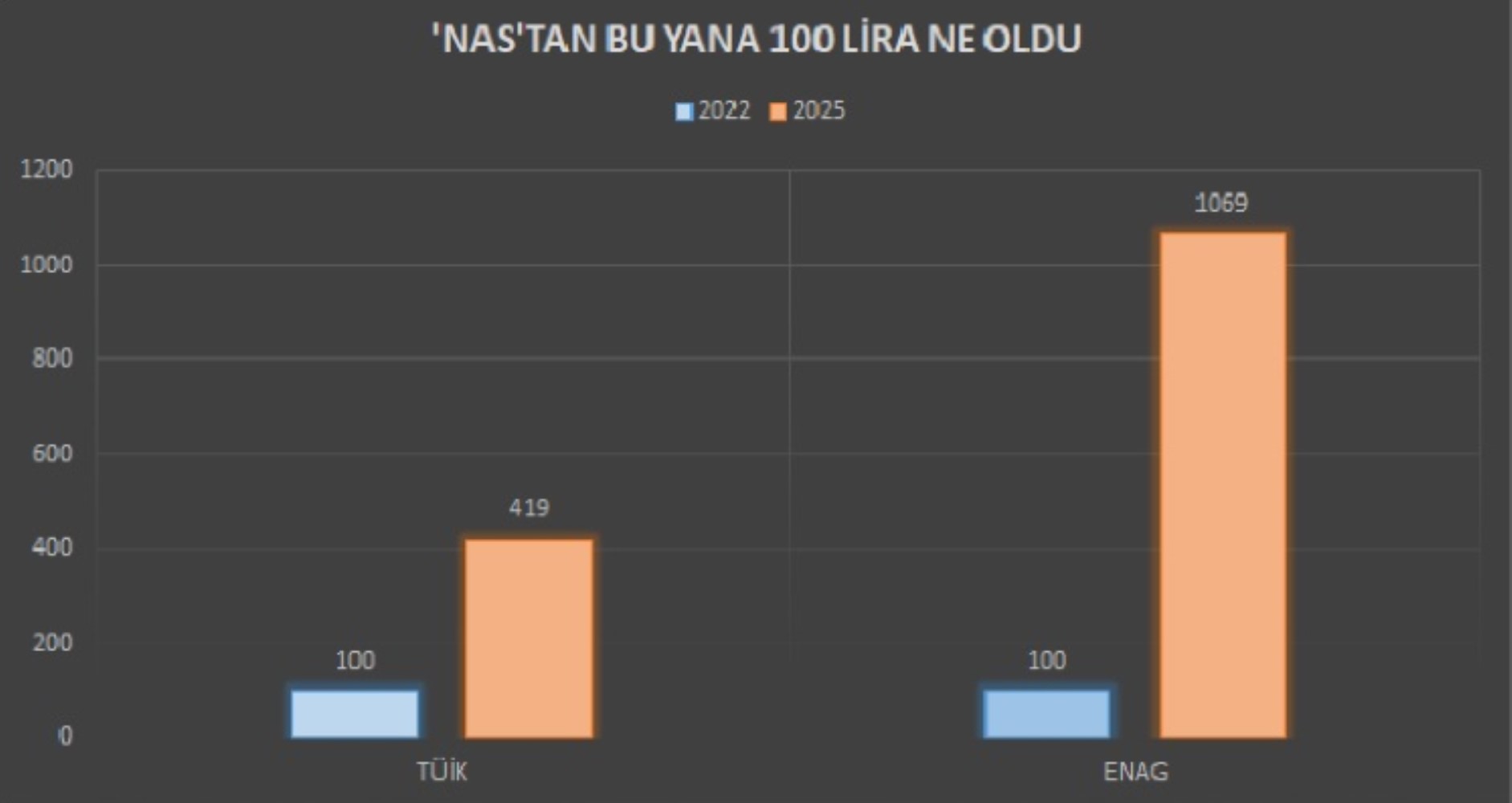
Goods and services purchased with 100 liras in January 2022 can be purchased for 410 liras according to TÜİK and 1069 liras according to ENAG in January 2025. 2.6 times more.
FALLING INFLATION, RISING PRICES
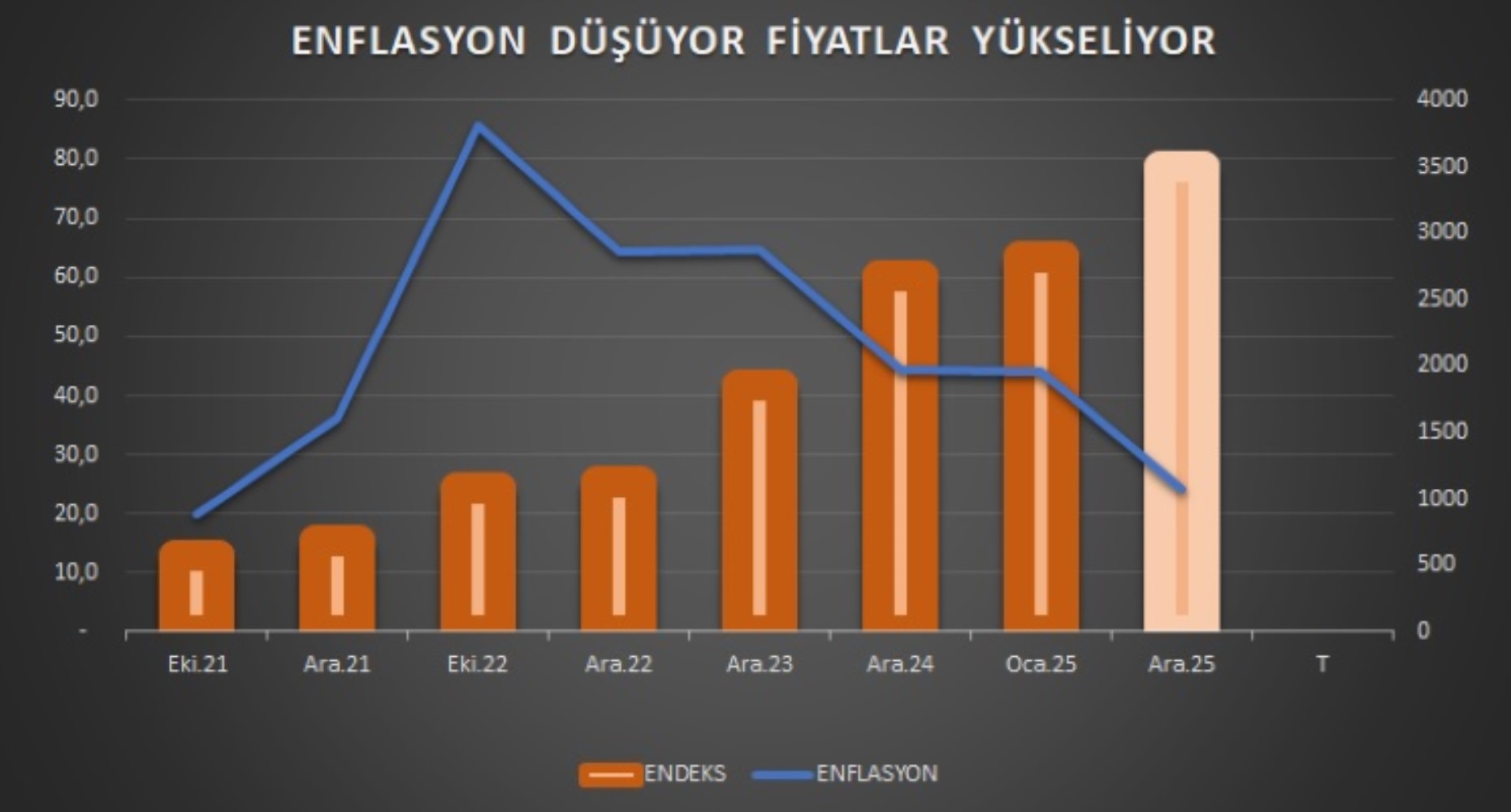
The blue line in this chart shows the annual inflation measured by TÜİK from October 2021 to January 2025. The December 2025 section on the far right of the chart assumes the 24 percent inflation target according to the Central Bank. The columns show the general price level at which these inflation measurements were made. The light-colored column on the right indicates where the general price level will reach if the 24 percent inflation targeted by the Central Bank is achieved at the end of 2025.
With the lowering of interest rates in October 2021 under the pretext of "there is Nas," TÜİK inflation, which was 19 percent, rose to 85 percent according to TÜİK in October 2022. In October 2022, ENAG inflation was 185 percent. The consumer price index value, where inflation was measured in October 2021, was 584, and it was 687 on January 1, 2022. When inflation fell from 85 percent to 44 percent, the general price level rose from 687 to 2819 in the three years between January 2025. The difference between TÜİK's inflation measurements and ENAG's inflation measurements was not at a level to be taken very seriously at first. However, it began to widen significantly starting in 2022. If the general price level of 687 in January 2022 had been measured according to ENAG inflation, the price level reached today would not be 2819, but 7344. In other words, the entire basket of goods and services purchased for 687 liras in January 2022 can be purchased today for 7344 liras, not 2819 liras. It is almost impossible for these skyrocketing prices to come back down... We see in the chart below that wages have not increased this much and that inflation has crushed purchasing power like a steamroller.
MINIMUM WAGE AND PENSION PAYMENTS IN 2022 AND 2025
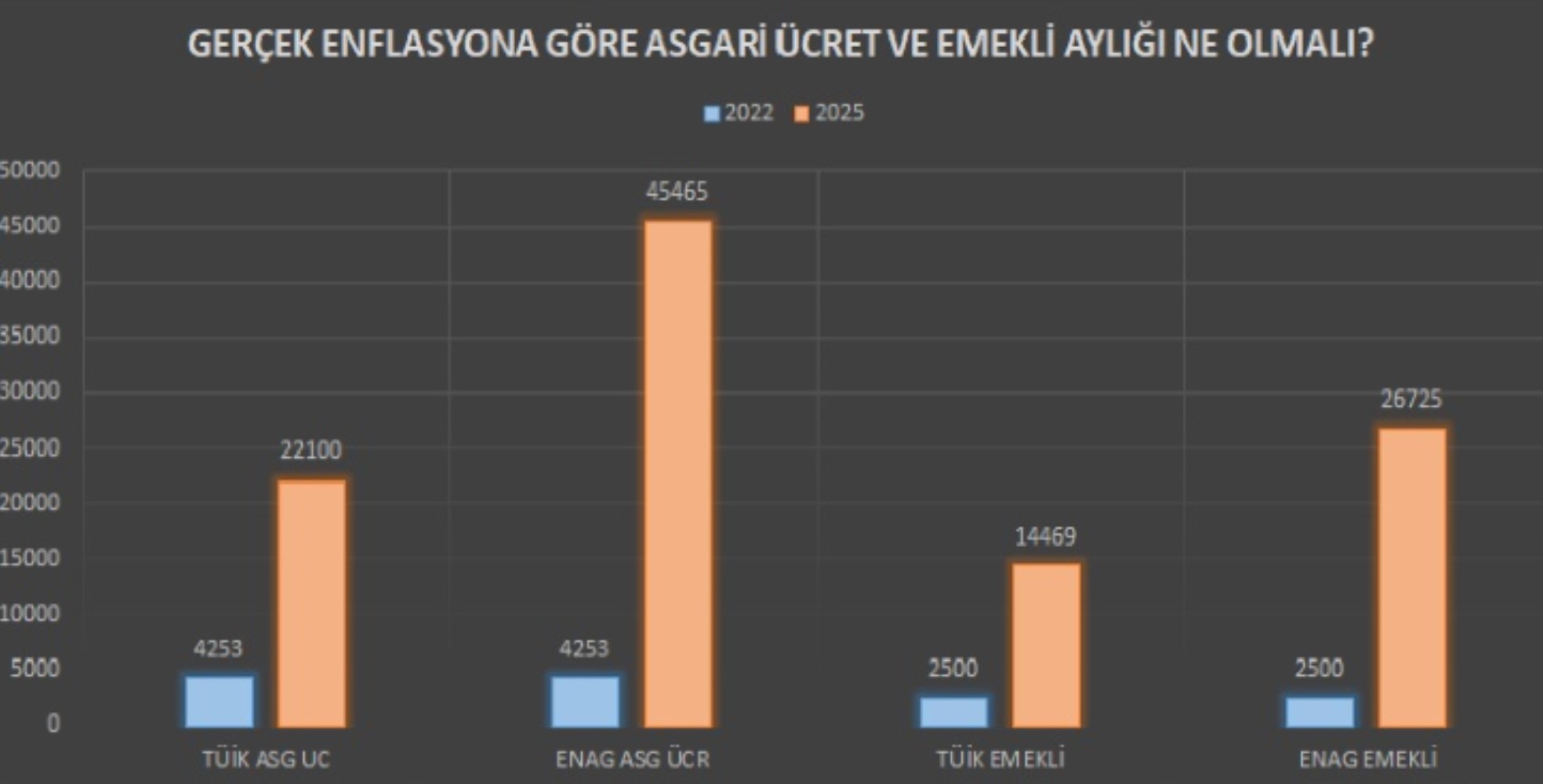
In January 2022, the net minimum wage was 4253 liras. By 2025, it was announced as 22,104 liras, just slightly above TÜİK inflation. However, if it had been calculated according to ENAG inflation between 2022-2024, it would have been 45,465 liras. The same situation applies to the lowest pension payments... In January 2022, the lowest pension was 2500 liras, and it reached 14,469 liras in 2025, taking TÜİK data into account. However, the level it should have been according to ENAG measurements was 26,725 liras. If we consider that the lowest pension was 40 percent higher than the minimum wage before the AKP era, the lowest pension that should have been reached would be 65 thousand liras.
I must also state this: These minimum wage and pension levels that should exist are not a fantasy or a dream. They are the levels of January 2022, when no one was happy with the situation either... And in January 2022, the ratio of the state's budget deficit to national income, which paid those pensions to retirees, was better than it is today. In other words, the state was not going bankrupt because of retirees. And again, in January 2022, at the minimum wage level, companies were not going bankrupt and were making quite good profits. Today, workers and retirees are desperately missing the January 2022 incomes they were not happy with back then.
Inflation, the cost of living, hunger, nutritional problems, inaccessible healthcare services, and housing and education problems are the most important agenda items for citizens and should not be dropped from the agenda under any circumstances.
Most Read

Striking picture for Özgür Özel's 'New Party'

The PKK opening and Özgür Özel’s path!..

How did the newspapers view Özgür Özel's farewell to the CHP?

He killed his wife by slitting her throat: Their children witnessed the moments

What did the CHP do?

Özel’s new party move in the world press

The New CHP, against CEHAPE

Fire at TUSAŞ engine factory in Eskişehir under control

From self-efficacy to despair

Kılıçdaroğlu's first message on Özgür Özel's new party announcement