



Because I did not trust TURKSTAT's inflation data, I began measuring my own inflation based on my own consumption basket starting at the beginning of 2022. It was neck-and-neck with the inflation measured by ENAG, which consists of independent economists. I continued until May 2025. Since there was a significant difference between my data and TURKSTAT's, but no significant difference with ENAG's, I stopped calculating my own inflation as of May 2025.
During the Mehmet Şimşek era, I stated that I found the policy of reducing inflation through a suppressed exchange rate to be very inadequate; since that date, I have repeatedly said, 'Turkey is not only experiencing TL inflation, but also inflation in dollar terms.'
Almost everyone was in consensus that the suppressed exchange rate policy was hitting exporters and tourism professionals. But I also explained the inflation experienced in dollars in Turkey to determine the extent of the damage. Hardly anyone paid attention to this side of the matter. Where we have arrived today, not only exporters but also tourism professionals are complaining quite a bit.
Turkey now has to discuss the inflation it is experiencing in dollars as well.
First, the objections of exporting industrialists had risen. They were complaining about high interest rates. They experienced both the difficulty of accessing credit and, as a result of the suppression of the exchange rate due to high interest rates, they began to lose their competitive power in foreign markets.
The same thing applies to tourism professionals.
Tourists come to Turkey with euros and dollars. In the summer heat, the use of air conditioning in hotels reaches its peak; the electricity bills paid, the open buffet food expenses in all-inclusive hotels, and the prices of meat, cheese, and milk are increasing at very high rates in Turkish Lira. However, the dollar and the euro are not increasing at the same rate. Profit margins are declining, and after a while, sales prices in tourism cannot cover costs.
Now we are in the middle of the summer season. This time, the same objection is coming from the tourism sector. Hotels are full, but businesses cannot make money. Credit debts to banks are swelling. In smaller-scale places that mainly cater to domestic tourism, such as Çeşme and Bodrum, facilities can increase their prices. However, large-capacity hotels where all-inclusive mass tourism is practiced, especially in Antalya, cannot increase their prices due to international competition. Whatever price they sold a room for last year, they have to sell it at that same price this year. Maybe they can increase it by 5 percent at most. However, the gap between inflation and foreign currency has widened much more. I will try to explain the issue with a detailed table below.
THE FIGURES ARE CLEAR
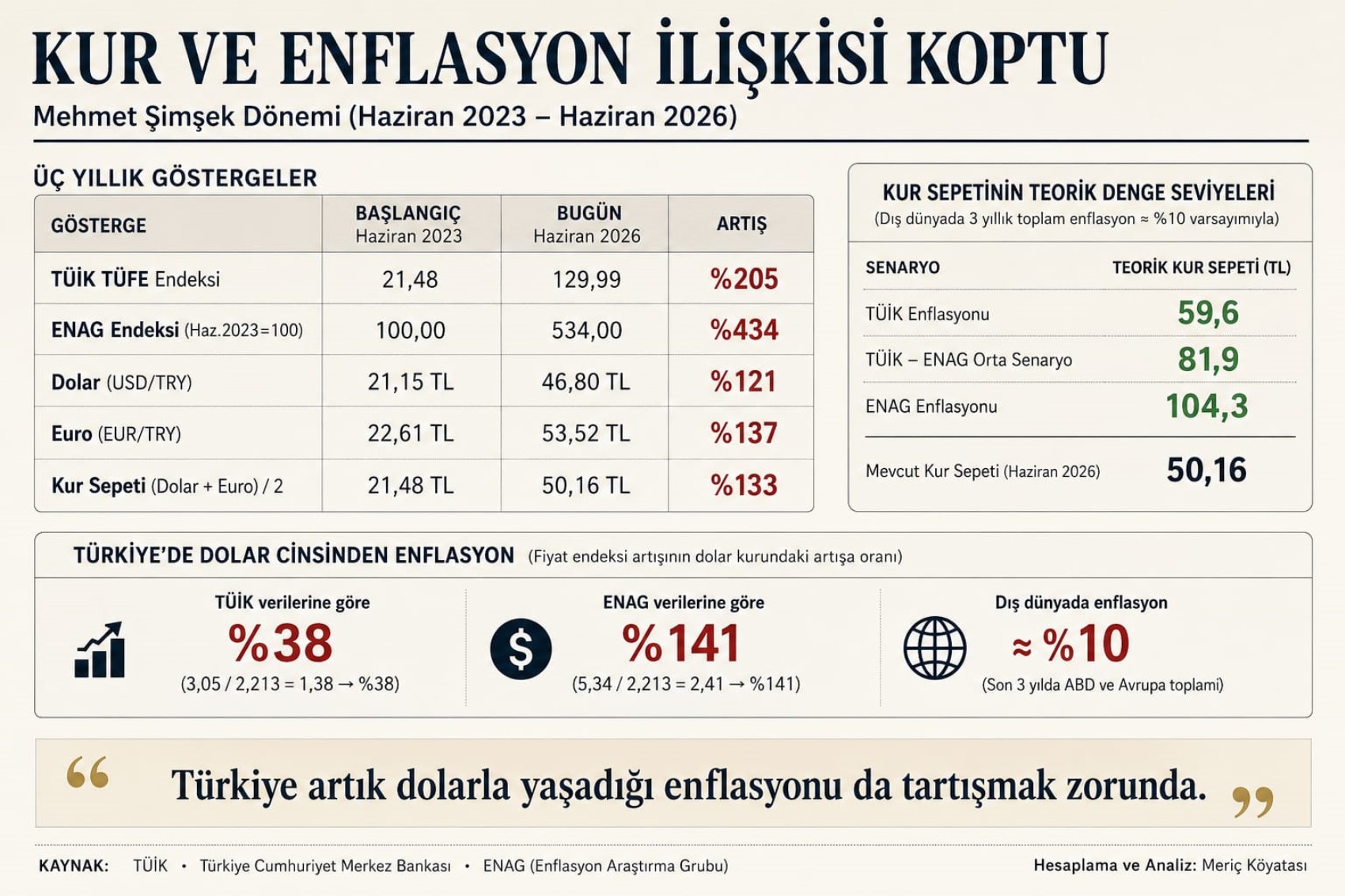
When Mehmet Şimşek took office, the dollar was 21.15 liras; today it is 46.80 liras.
The increase is 121 percent.
The euro rose from 22.61 liras to 53.52 liras.
The increase is 137 percent.
The currency basket consisting of the dollar and the euro rose from 21.88 liras to 50.16 liras.
The increase is 133 percent.
In the same period, TURKSTAT inflation was approximately 205 percent.
In the compound calculation we made based on the monthly inflation rates published by ENAG, the index, which was accepted as 100 in June 2023, rose to 534 in June 2026. According to ENAG, the cumulative inflation in the same period was 434 percent.
The currency basket remained approximately 72 points behind official inflation and more than 300 points behind ENAG inflation.
We should not see this as an ordinary statistical calculation done for fun. This is the erosion of Turkey's international competitiveness. These are alarm signals that Turkey's current account deficit will swell even more every year, that it will be more deeply mired in a foreign debt trap, and that more resources will be transferred from domestic to abroad through interest payments.
INFLATION IN DOLLARS
I mentioned it in the introduction of the article. To see the magnitude of this destruction, we must take into account and discuss inflation in dollars.
You see it in the table. The dollar exchange rate increased approximately 2.21 times in this period. According to TURKSTAT, prices increased approximately 3.05 times. (When we divide 3.05 by 2.21, we find the result 1.38.)
According to TURKSTAT's official data, prices in Turkey have increased by approximately 38 percent in dollar terms over the last three years. This means an annual compound average of approximately 11 percent inflation in dollar terms. I draw your attention, according to TURKSTAT...
So, according to ENAG... The cumulative inflation in dollars for the last three years is 141 percent. According to ENAG, the annual compound equivalent of the 141 percent increase over three years is approximately 34 percent inflation in dollars.
Can an exporter or a tourism professional increase their prices in foreign currency by the rate of dollar inflation experienced in Turkey?
Dollar inflation, which is 11% annually even according to TURKSTAT and 34% according to ENAG, is an unsustainable rate that no foreign tourist or importer in the world can accept.
How will the tourism professional compete with this difference? How will the exporter sell goods with this difference?
WHAT DOES THE THEORETICAL EQUILIBRIUM EXCHANGE RATE SHOW?
Let's also do a theoretical exchange rate calculation. I am not saying “the exchange rate should be this.” I am asking, “If the relationship between the exchange rate and inflation had not broken, if the increases had gone parallel to each other, what should the dollar, euro, and basket exchange rate have been?”
We are calculating what levels the currency basket would point to if the inflation difference between Turkey and the outside world had closed. I assume a total three-year inflation of 10 percent in the outside world and subtract it from our inflation.
In this case, approximately;
The dollar exchange rate, which is 46.80, should be 59 according to TURKSTAT today, 103 liras according to ENAG... In a scenario between the two, 81 TL
The euro, which is 53.52 TL, should be 63 according to TURKSTAT, 110 TL according to ENAG, and 86 TL according to a scenario between the two.
The 50 lira basket exchange rate, which we calculate as (Dollar + Euro) / 2, should have been 60 according to TURKSTAT, 104 TL according to ENAG, and 82 according to a scenario between the two.
How is it, do the fault lines give an idea about the energy accumulated for an earthquake? This is something similar. The theoretical exchange rate calculation is important in terms of showing the pressure of energy accumulated for devaluation, even if it is not exact.
WON'T INFLATION EXPLODE?
If the current exchange rate and interest rate policy is abandoned and the exchange rate reaches these levels we mentioned in a short time, of course, inflation will go completely off the rails. However, it is also clear that inflation has not fallen as a result of the current interest rate and exchange rate policy.
You can use the exchange rate as an anchor for a short time in the fight against inflation.
6 months, 9 months. A year at most...
But if you say I will reduce inflation with monetary policy alone, three years pass, and you will not have made any progress. You make the poor poorer. You impoverish society. While saying I will cut demand, you undermine production and supply. You slaughter the geese that lay golden eggs, the exporters, the tourism professionals, who bring in foreign currency.
With this exchange rate policy, you make imports cheaper, but you make the farmer, the industrialist, and the tourism professional unable to compete. In the end, you blow up the current account deficit. You have to find more foreign resources to finance the current account deficit.
You pay higher interest to attract more hot money, and you transfer more resources from inside to outside.
Moreover, despite all this, inflation remains stuck at 30 percent according to TURKSTAT and 50 percent according to ENAG.
Since the day it was announced, we have written about the shortcomings of the disinflation policy implemented for three years, and we have explained it on television. Retirees, workers, and farmers have paid the heavy price of this policy. Society has become increasingly impoverished. Now, the non-labor segments of the economy, exporting industrialists, and tourism employers have also started to lose.
If all productive forces, from labor to capital, are complaining, and only those who do business with the state, rentiers, and speculators of money and capital markets are winning, it means that both the economy and the social structure of that country have entered a process of great decay and collapse.
Most Read

Striking picture for Özgür Özel's 'New Party'

Özgür Özel gives a dated response regarding the number of resignations

Forest fire in Antalya brought under control

The PKK opening and Özgür Özel’s path!..

Houthis strike Saudi-owned tanker

How did the newspapers view Özgür Özel's farewell to the CHP?

What did the CHP do?

Özel’s new party move in the world press

The New CHP, against CEHAPE

From self-efficacy to despair