



The government is usurping the rights of pensioners and workers through the Turkish Statistical Institute (TÜİK). ENAG, established by independent scientists, has been measuring inflation since 2020. There is a massive gap between the two.
I wrote about this in 12 Punto on Sunday, July 7. If the minimum wage and pensioners had been given inflation adjustments based on ENAG's measurements since January 2020;
The minimum wage, which was 2,350 TL in January 2020, would have been 49,500 lira in January 2024,
And the lowest pension, which was 1,500 lira in January 2020, would have been 32,000 lira in January 2024 and 45,000 lira in July 2024. (If we take into account that the lowest pension is 1.4 times the minimum wage, the lowest pension should have been 69,000 lira, which is 40 percent more than 49,500.)
Roughly speaking, 66 percent of the minimum wage went into the pockets of bosses, and 70 percent of pensions (or 80 percent if the pension were 40 percent higher than the minimum wage) went into the state's coffers.
I received some questions following this article. Wouldn't employers go bankrupt if the minimum wage were 49,000 lira, and wouldn't the state go bankrupt if the pension were 45,000 (69,000) lira?
Through intense propaganda and constant lies, such a perception has been created that the vortex of misery caused by high inflation has become normalized even among low-income segments.
First, let us emphasize this. I made the calculation starting from 2020 because an alternative (and closer to reality) inflation calculation has been made since that date. And it is certain that neither the worker nor the pensioner was satisfied with the conditions of January 2020, the 2,325 lira minimum wage, or the 1,500 lira lowest pension at that time. But today, we are desperately looking for salaries at that level, and unfortunately, today, the question can be asked whether the real value of the 2,325 lira and 1,500 lira of January 2020 could bankrupt companies and the state.
For the minimum wage, the 2,325 lira of January 2020 is equal to today's 49,500 lira. (Before the July 2024 raise). Whatever the 1,500 lira of January 2020 was, today's 45,000 lira is the same. (With the July 2024 raise). Was the state going bankrupt in 2020 for it to go bankrupt today? Was the private sector going bankrupt in 2020 for it to go bankrupt today?
Let us give the best answer to those who will say, "Sir, the minimum wage and pensions would have gone bankrupt if they hadn't been eroded by inflation," again with statistics.
Let's look at the state first…
At the end of 2020, the ratio of the budget deficit to national income was 3.4 percent…
The state evaporated 80 percent of pensions. However, by the end of 2023, the ratio of the budget deficit to national income rose from 3.4 percent to 5.2 percent. In fact, the government played with the data again in 2023. It loaded the loss seen in the Treasury due to the money it took from the poor and transferred to rentiers via the Kur Korumalı Mevduat (FX-Protected Deposit) scheme onto the Central Bank. At the end of 2023, the Central Bank incurred a loss of 818 billion lira. If this accounting trick had not been performed, the ratio of the budget deficit to national income would have actually been 8.3 percent.
In the last four years, despite them seizing 80 percent of pensions, the ratio of the budget deficit to national income did not decrease; it increased exactly 2.5 times. Even if no money were paid to pensioners at all, our budget deficit will continue to increase every year due to the government's political preferences, its passion for pomp and splendor, and its goals of enriching cronies and religious sects. No matter how much taxes are increased, it will not be able to close the black hole that is growing larger every day.
WOULD EMPLOYERS GO BANKRUPT WITH A 49 THOUSAND LIRA MINIMUM WAGE?
Around the days when the minimum wage was announced as 17 thousand lira, the Türk Metal İş union signed a collective bargaining agreement in the automotive sector in Bursa. The average monthly wage for blue-collar workers was set at 80 thousand lira. Approximately 2,300 Euros… In the EU, the minimum wage for automotive workers is around 2,200 Euros, and the average is around 3,500 Euros… Did the automotive sector go bankrupt? Look, direct foreign capital investment has not been coming to Turkey for years. Now the Chinese automotive giant BYD is coming… Turkey's exports in the automotive sector decreased by 2 percent in quantity and 1 percent in dollar terms compared to last year. The reason for this was not so much competitiveness as it was the contraction in foreign markets. This is just one example…
Another striking example is the share of profits and wages in Turkey's top 500 industrial companies… The chart below shows this most clearly. The share of wages in production-based sales never exceeds 8 percent. (I took the chart from Dr. Duvan Berke's post on X). The situation may be different in the services sector.
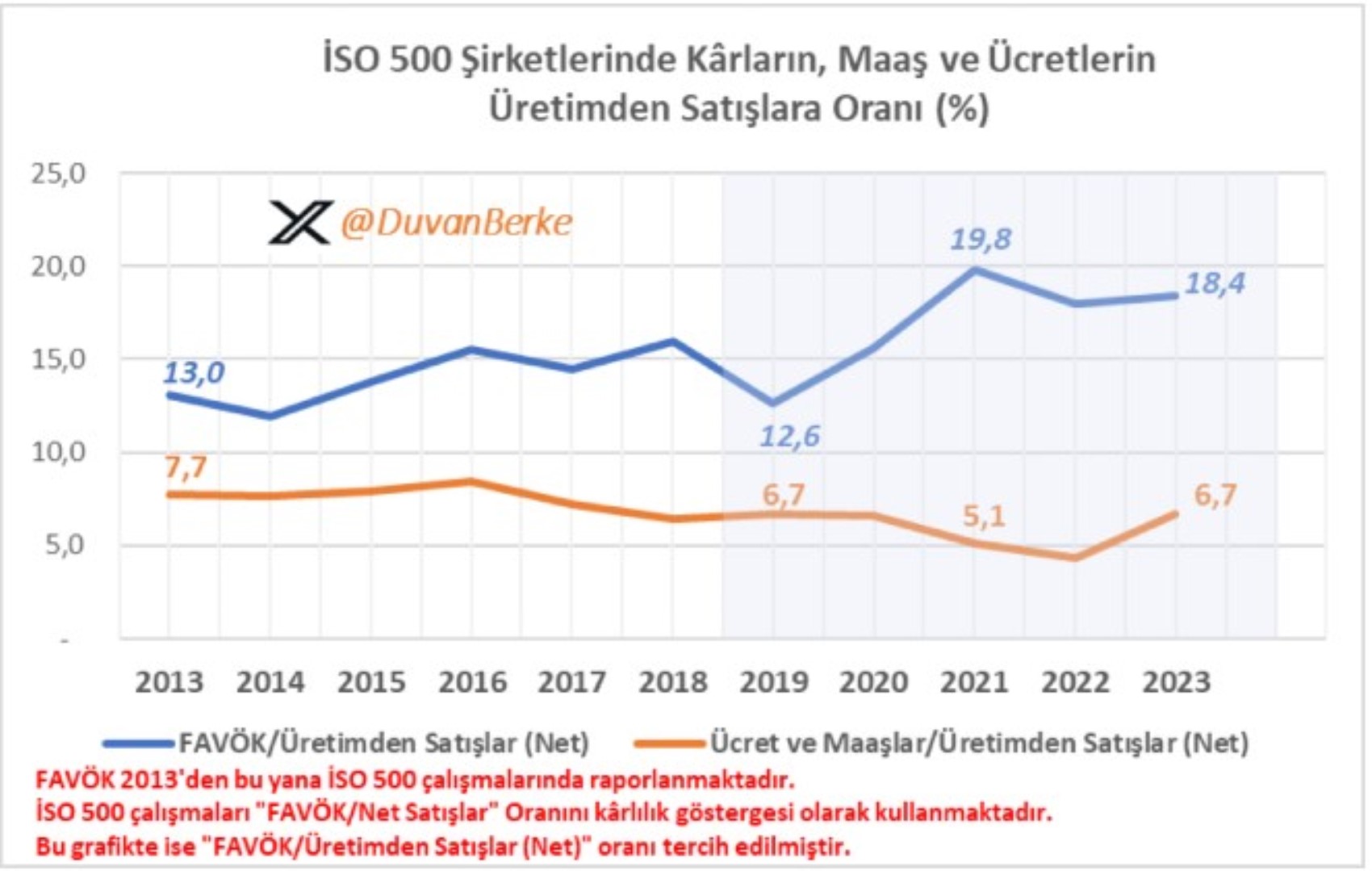
This chart refutes the claim that wage increases in Turkey will cause inflation through cost increases. If the minimum wage increases by 100 percent, its effect on the price of a good is 8 percent… However, it is another Turkish reality that when the minimum wage increases by 40 percent, firms raise their product prices by 40-50 percent…
THE SHARE OF LABOR AND CAPITAL IN NATIONAL INCOME
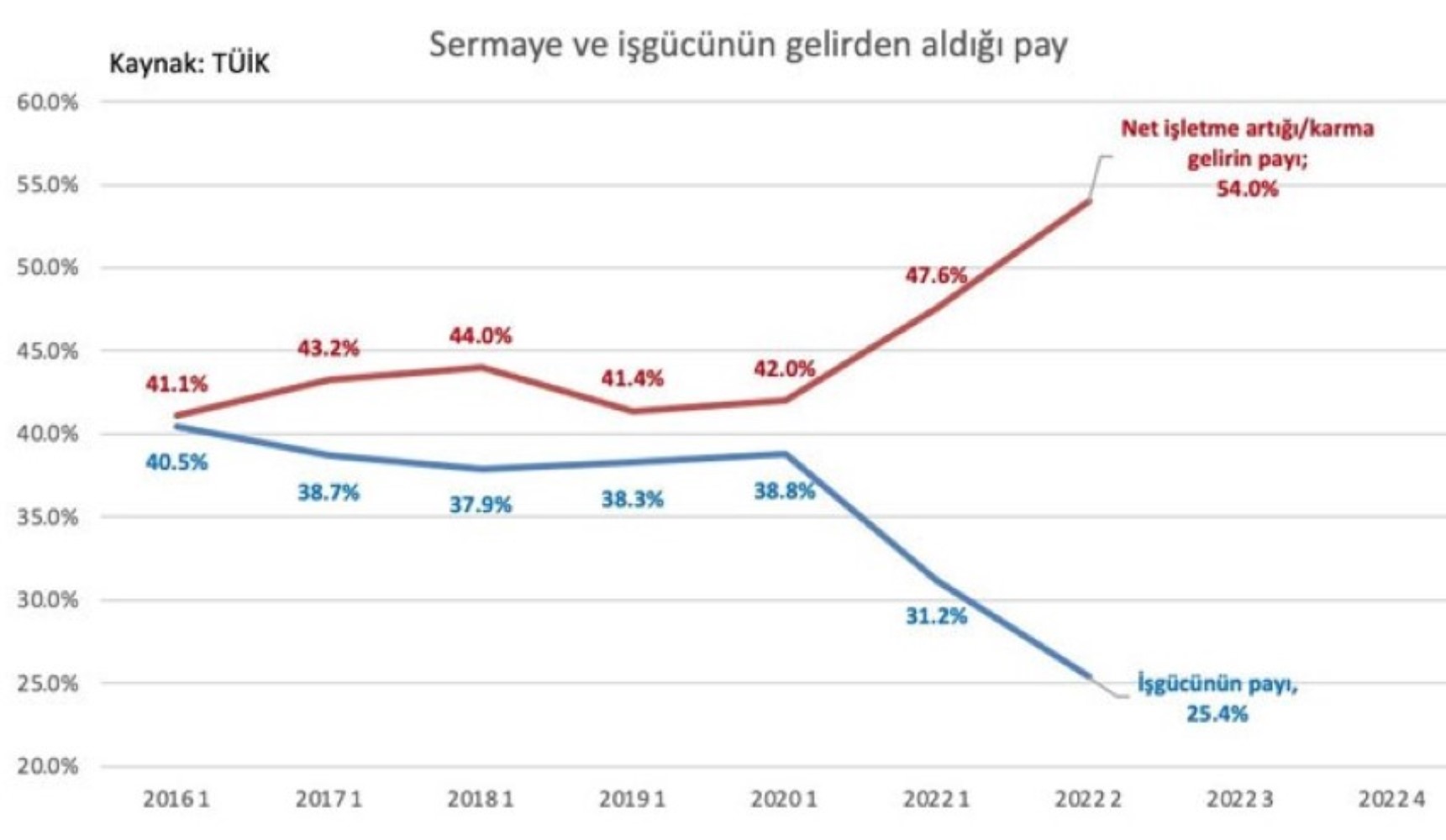
The clearest indicator we can look at to find an answer to the question of whether employers will go bankrupt if wages increase is the shares that both segments receive from the national income. The chart prepared by economist Uğur Gürses based on TÜİK data shows the share of labor and capital in the national income. There is no need to explain at length the dramatic decline in labor's share after 2020. In four years, it has crashed from 38 percent to 26 percent… Capital's share has risen from 49 percent to 54 percent. Now we can clearly answer the question of whether companies will go bankrupt if wage levels return to 2020 levels.
Note: If we add the 2023 data to this chart… In 2023, payments made to those who retired via EYT (Retirement at Age of Entitlement) were classified as labor payments, and although labor's share actually fell, it was shown as having risen to 28 percent in 2023.
Most Read

Striking picture for Özgür Özel's 'New Party'

Özgür Özel gives a dated response regarding the number of resignations

Forest fire in Antalya brought under control

The PKK opening and Özgür Özel’s path!..

Houthis strike Saudi-owned tanker

How did the newspapers view Özgür Özel's farewell to the CHP?

What did the CHP do?

Özel’s new party move in the world press

The New CHP, against CEHAPE

From self-efficacy to despair