



Those who have been closely monitoring the economy and the markets recently, especially those looking at the 2024 budget items, are issuing warnings about what will happen after the election, much like meteorologists issuing severe storm warnings. A very difficult period truly awaits Turkey after the election. The interesting part is that while no one is voicing it, when looking at the methods for combating inflation, it becomes clear that neither Finance Minister Mehmet Şimşek nor the managers of the Central Bank, who are claimed to be competent, understand the economy.
FOREIGN CURRENCY WARNING: Citizens are aware of what will happen with foreign currency. Queues have formed in front of currency exchange offices, and despite all the interventions by the Central Bank, exchange rates are rising slightly every day. The Central Bank conducts a survey every month among actors in the money markets, whom it calls market participants. The financiers participating in this survey are people from different worlds... They don't live in space, they live in Turkey, but I cannot understand where they are looking or how they are making their predictions. According to the market surveys the Central Bank conducts with characters from the Alice in Wonderland fairy tale They say inflation will be 44 percent and the dollar will be at the 40.53 level by the end of the year. No one believes these forecasts. Although, if inflation is going to be 44 percent by the end of the year despite these projections, then a 45 percent deposit interest rate, does not stop citizens from turning to foreign currency. Minister of Economy Mehmet Şimşek also says, “I cannot understand why citizens are turning to foreign currency. The exchange rate will fall; if it rises too much, we will intervene” he says.
For Mehmet Şimşek to understand what is happening, he needs to analyze why citizens do not trust them. There is tremendous pressure on foreign currency, and contrary to what it claims, the Central Bank is intervening in the exchange rate. Net reserves excluding swaps fell from minus 37.5 billion dollars at the end of the year to minus 53.9 billion dollars in the first week of March. According to the calculations of economist İris Cibre, the Central Bank, burned through 22 billion dollars in net reserves from January 1st to March 8th, and 9 billion dollars in just the first 8 days of March. However, despite this, the exchange rate does not stop rising.
The fact that the exchange rate, which was said would not rise after last year's May elections, increased by 40 percent in two months is still fresh in everyone's memory. For that reason, despite those who say the exchange rate will not rise, people's demand for foreign currency continues. Furthermore, no one believes that the current inflation is 68 percent or that it will fall to 44 percent by the end of the year. My year-end inflation expectation is at the 130-140 percent level. I do not take TÜİK (Turkish Statistical Institute) seriously. I am making a forecast for ENAG inflation. Since there is so much pressure on the dollar, making a dollar forecast has become meaningless. However, no matter how much it is suppressed, it is certain that it will make a correction equal to inflation after a while.
BUDGET WARNING: After the election The Central Bank and Minister of Treasury and Finance Mehmet Şimşek are announcing that they will take even stricter measures to combat inflation. The Central Bank has increased reserve requirement ratios, and restrictions on credit cards and commercial loans began before the election. Given that these measures were taken before the election, it is obvious that even tighter measures will be implemented after the election. But will these measures ensure that inflation falls? Inflation cannot be reduced solely through monetary measures. Combating inflation solely with monetary measures can only be effective in economies where the budget is balanced, inflation is between 5-8 percent, and competitive conditions, even if not perfect, are functioning in the markets.
I believe that Mehmet Şimşek and the Central Bank team are unaware of the economy and the causes of inflation in Turkey. According to them, the cause of inflation is the workers and retirees whose purchasing power has fallen in real terms. They claim that the increase in demand caused by the raises given to this segment, which remain well behind inflation, is the reason for inflation in Turkey. We have written about this many times and explained it on television. They did not understand, and they have no intention of understanding. The demand of a segment whose physical consumption volume is falling and whose purchasing power is decreasing in real terms does not cause inflation. In the last two years, the price of beef tenderloin has gone from 300 liras to 1200 liras. I wonder which minimum wage earner or which retiree's demand caused the price of tenderloin to explode. Or are minimum wage earners buying tenderloin in installments with credit cards? I wish Mehmet Şimşek and the Central Bank's brilliant macroeconomists, whose merits are praised to the skies, would explain it so we could learn.
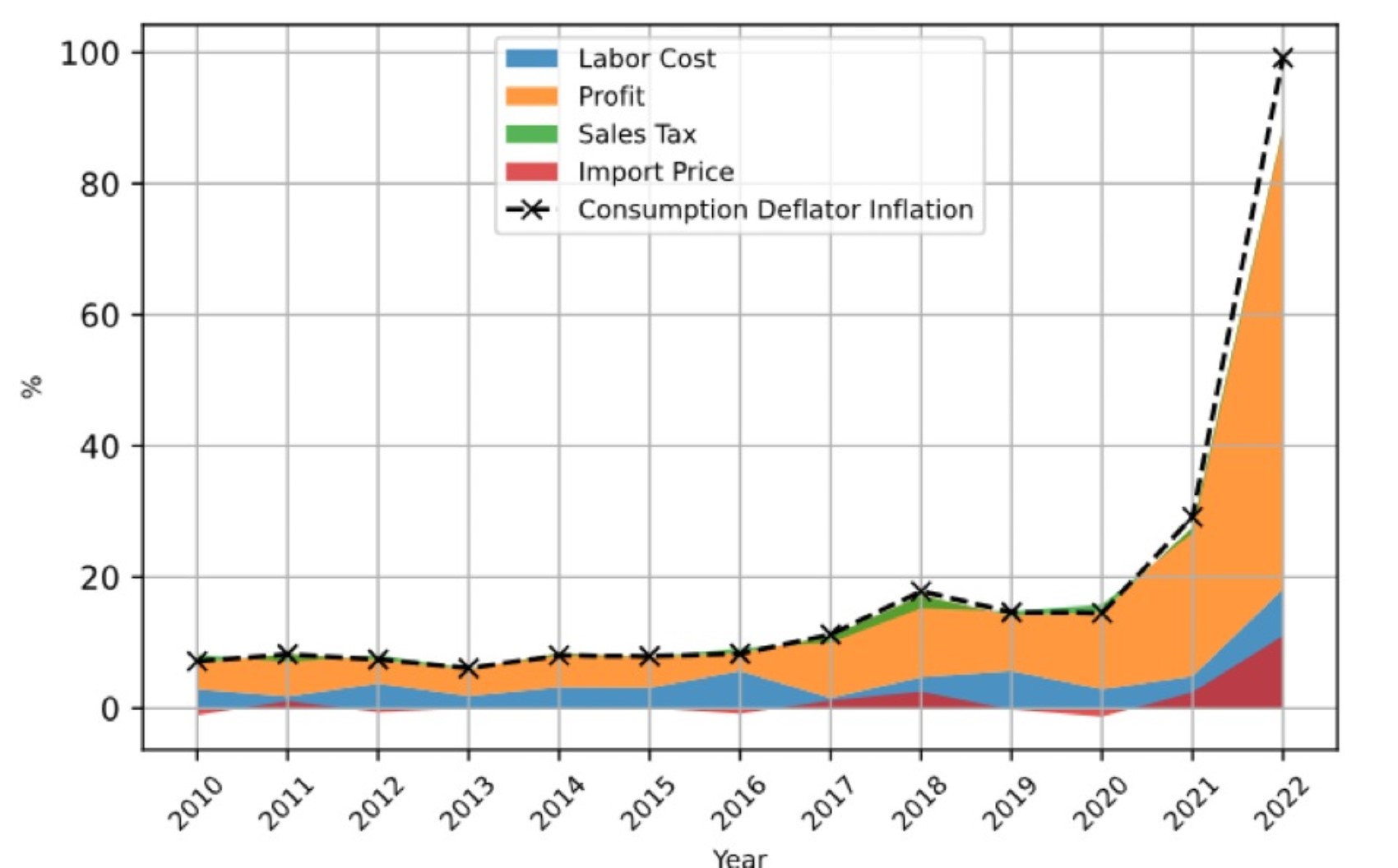
Eighty percent of the public is below the poverty line. This segment has neither the ability to save nor the ability to overspend. Food prices have been falling globally for the last two years, yet they are rising in Turkey. What is it if not mocking people to talk about fighting inflation with monetary measures after consciously reducing agricultural production? What is fueling inflation in Turkey is the demand of the top 20 percent. It is the massive budget deficits. It is the money you transfer from this budget to crony businessmen and religious sects, and the unrequited payments you make to the nearly 15 million refugees. You caused the demand of the top 20 percent to explode with your low-interest rate policy. Industrialists, seeing the demand that this 20 percent brought forward, inflated prices, and both inflation and their profits exploded. There is a graph below. In this graph, you can see which factors have an impact on inflation. In the chart, the red area shows the inflationary impact of imported goods prices, the blue area shows the impact of wages, and the orange area shows the impact of profits. (The chart is taken from a post by Ensar Yılmaz on X.)
However, Mehmet Şimşek and the economic management hope to lower inflation by dealing with the credit card spending of retirees, minimum wage earners, and low-income groups. Everyone knows that they not only fail to stop the plunder, extravagance, and waste in the budget, but they also lack the power to even address it.
We are waiting with curiosity to see how they will lower inflation with a budget that targets a 2024 budget deficit of 2 trillion 652 billion TL, a fourfold increase compared to the previous year. With this budget, no one takes seriously the fairy tale of reducing the 68 percent TÜİK inflation, which no one believes in, to 36-40 percent.
They have written into the budget that they will increase the VAT collected domestically by 230 percent and the SCT collected from fuel by 163 percent compared to last year. Even though Mehmet Şimşek says there will be no new taxes after the election, the rain of price hikes on fuel products will continue throughout the year. VAT rates might be raised from 20 percent to 24 percent, or perhaps a significant portion of products currently subject to 10 percent VAT will be moved to the 20 percent bracket.Since even these two measures will directly affect final product prices, they will trigger inflation rather than lower it.
These measures, which are being considered to combat inflation, will not only fail to lower inflation but could also bring about a serious recession. In the meantime, a decline in the annual inflation trend will be seen in July and August due to the base effect, but let us remind you that this will be misleading. Those who are curious about this base effect can take a look at our “The Cunning Fox and inflation” article from Sunday, February 25.
Most Read

Striking picture for Özgür Özel's 'New Party'

The PKK opening and Özgür Özel’s path!..

How did the newspapers view Özgür Özel's farewell to the CHP?

He killed his wife by slitting her throat: Their children witnessed the moments

What did the CHP do?

Özel’s new party move in the world press

The New CHP, against CEHAPE

Fire at TUSAŞ engine factory in Eskişehir under control

From self-efficacy to despair

Kılıçdaroğlu's first message on Özgür Özel's new party announcement