



The attack by the US + Israel alliance on Iran did not receive support even among NATO countries, let alone the rest of the world. It created inflationary effects across the globe due to increases in oil and natural gas prices. Moreover, it is not just inflation; the world is also facing the danger of stagflation (stagnation + unemployment within inflation).
Many states, and almost all peoples in general, are angry at the US and, naturally, at the petrodollar system. It is also a separate fact that the US conducts these wars to protect the petrodollar system.
On the other hand, with the rise of China, new expectations and questions have emerged in the world: "Could the yuan be a new payment system against the dollar, or are we moving toward a multi-reserve currency era rather than a single new reserve currency?"
We touched upon the fact that reserve currencies are formed as a result of major crises and major wars in this column on April 12 under the title "The recurring financial violence of history". It is worth reading again for those interested.
But can the yuan be a reserve currency on its own? China is taking steps in this regard with investments ranging from the Belt and Road Initiative to Eximbank lending, from the international payment system CIPS it has developed to its navy for the control of world trade routes. But the biggest obstacle before the system is not Washington, but Beijing itself...
Let's explain the issue with a simple model. Let's consider Turkey–China trade. Turkey sells 1 yuan worth of goods to China and buys 40 yuan worth of goods from China. 1 yuan enters our treasury, but we need to make a payment of 40 yuan. We have to find the remaining 39 yuan. So, from where?
Either we will borrow from China, or we will earn yuan from trade we conduct with other countries. Or we will sell dollars and buy yuan from the market. If it is going to be like this, what we call trade with the yuan is actually nothing more than indirect trade with the dollar. For trade with the yuan, there needs to be widespread circulation of the yuan in the world.
When we look at the size of the world economy today, the picture becomes even clearer. The US is still at the center of the global financial system with its economy of approximately 28 trillion dollars. China, with its production power approaching 18 trillion dollars, is the factory of the world. But the critical difference is this: while the US distributes dollars to the world by running a deficit, China withdraws liquidity from the world by running a surplus.
THE CRUX OF THE MATTER
This is where the crux of the reserve currency system lies... How does the dollar system work? The FED prints money, and this money turns into not just the US's money, but the world's money. The US runs a current account deficit, the world earns dollars, and those dollars return to US bonds. In other words, the US deficit becomes the world's liquidity. By exporting paper, the US consumes more than it produces and transfers wealth from the world into itself. Thanks to the petrodollar system, countries also use the dollar in trade among themselves. The US remains within the payment system, and the world financial system largely runs on the dollar.
The situation in China is different... China consistently runs a foreign trade surplus. In 2025, China's goods trade surplus reached a record level of approximately 1.19 trillion dollars. This shows the fundamental contradiction in the yuan becoming a global reserve currency: China sells goods to the world but does not distribute enough net financial assets, i.e., yuan, to the world. For this reason, although the yuan is a currency that can be used in trade, it cannot advance toward becoming a global reserve currency. Because what we call a reserve currency is not just a means of payment, but also an asset that must accumulate in the hands of the world.
Let this not be interpreted as the thesis that running a current account deficit is good. Turkey consistently runs a current account deficit, and its economy is dependent on the outside to a degree that threatens its survival. What is at issue here is not running a current account deficit or surplus, but rather what kind of liquidity effect this deficit or surplus creates within the global financial system.
HOW MUCH MUST THE YUAN SPREAD TO BECOME A RESERVE CURRENCY?
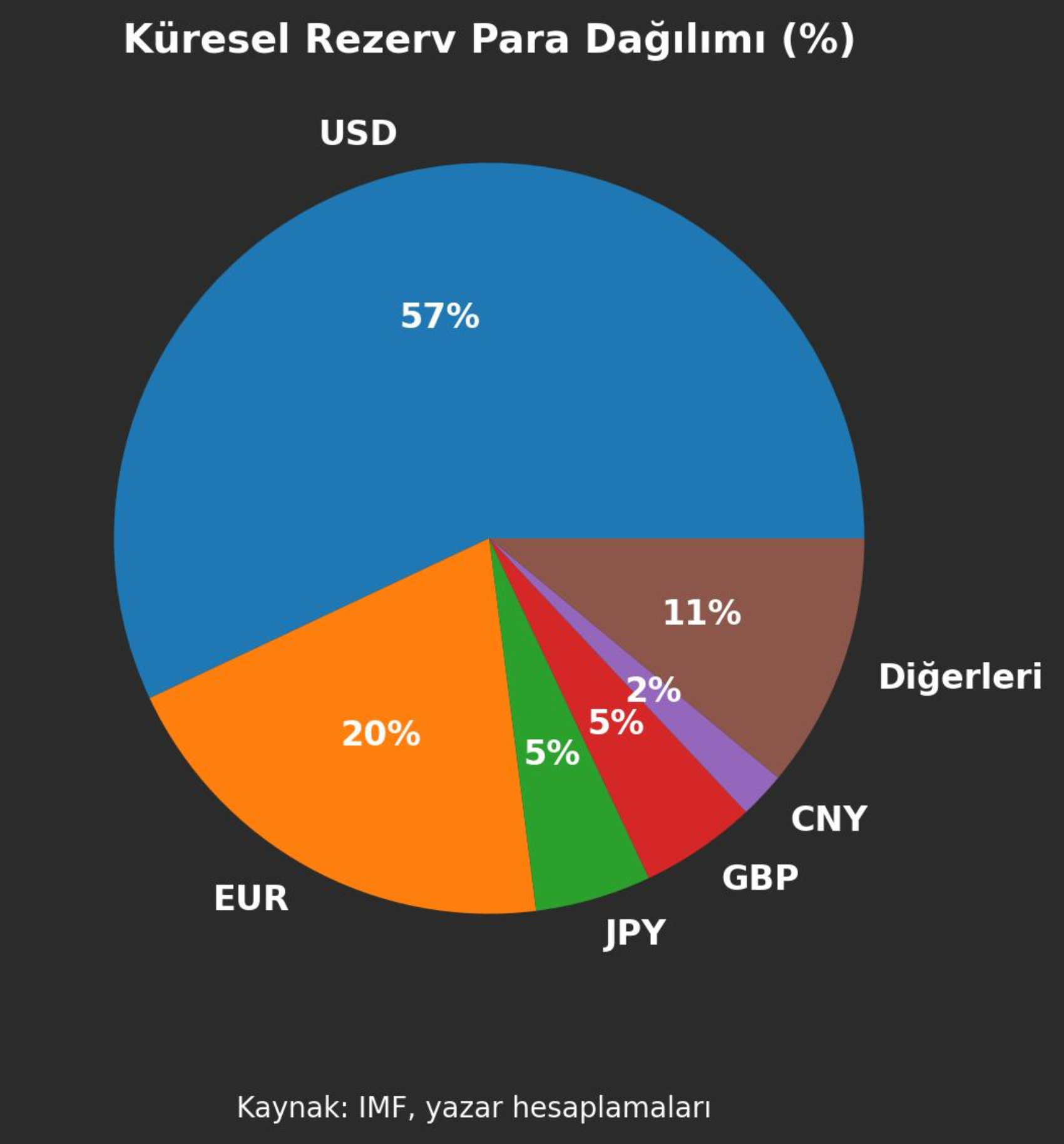
According to IMF data, the distribution of world reserve currencies as of the end of 2025 is in the graph above... The share of the yuan in global official reserves is only 1.95%. The share of the dollar is approximately 56.77%. Within the 'others' category, the largest shares are held by the Canadian Dollar (2.5–3%), the Australian Dollar (1.5–2%), and to a more limited extent, the Swiss Franc (0.2–0.3%). China is not yet at the level of Canada and Australia.
This roughly means the following:
• Global reserves: approximately 13 trillion dollars
• Yuan reserves: approximately 250 billion dollars
• Let's assume that for the yuan to be a second reserve currency, its share needs to reach 10%. Approximately 1.3 trillion dollars.
• For China to make the yuan a serious reserve currency, it is not enough to just sell goods to the world; it must also produce trillion-dollar yuan-denominated safe financial assets and offer them to the global system.
CAN THE BELT AND ROAD INITIATIVE CLOSE THIS GAP?
The steps China has taken in recent years are important. With the Belt and Road Initiative, it is making infrastructure investments, providing loans through China Eximbank, and facilitating yuan payments with the CIPS system. It is signing off on critical infrastructure projects, especially in Africa, such as ports, railways, and highways. In other words, it is actually trying to inject yuan into the world.
In 2025, China's external economic engagement within the scope of the Belt and Road grew significantly: approximately 128.4 billion dollars in construction contracts and 85.2 billion dollars in investments were announced. Since 2013, the total engagement has reached the level of 1.399 trillion dollars. This amount catches up to the figure we mentioned above. But the problem is this:
Not all of this financing is done in yuan. A significant portion takes place in the form of project loans, corporate investments, or commodity-linked financing. But this effort is not yet sufficient. Because to be a reserve currency, it is not enough for China to just export goods; it must also lend large-scale financial assets, i.e., debt, to the world. This is exactly what the US does: with the financial system under the control of the US and the FED, it is the key to a massive bond market seen as a safe haven, in addition to lending. In this state, the US is also the world's largest debtor.
China, on the other hand, faces two difficult choices. Either it will continue its current model and continue to run a surplus, keeping the globalization of the yuan limited. Or it will accept running a deficit, borrowing from the world, and opening its financial system more, just like the US.
RESERVE CURRENCY AND THE STAGES OF IMPERIALISM
Because the issue is not just economics, but also the evolution of power relations... At this point, it is necessary to place the issue in a broader historical framework. When we look at the stages of the development of imperialism, the following sequence roughly emerges:
• Direct seizure of resources (military occupation)
• Buying cheap raw materials and selling expensive manufactured goods (capitulations, colonies)
• Profit transfer through direct investments
• And the final stage: controlling by lending (finance capital, financial imperialism)
Today, China is attempting to transition to this final stage. The Belt and Road Initiative, China Eximbank loans, and the CIPS system it developed are parts of this strategy.
In other words, China is no longer just a country that sells goods; it is also becoming an actor that lends, finances infrastructure, and tries to control the financing of trade. However, a critical contradiction arises here. While China wants to transition to the stage of financial imperialism, on the other hand:
• It strictly controls capital movements,
• It does not make the yuan fully convertible,
• It does not fully open its financial system to the outside world.
For this reason, a hybrid structure emerges:
The yuan enters circulation but cannot circulate freely.
This prevents the loans China provides and the investments it makes from turning into a self-sustaining reserve currency mechanism as in the dollar system.
As a result, the issue is deeper than the question of "yuan or dollar?" The world economy is perhaps moving from a single reserve currency system toward a multi-currency system. However, even in this new order, what will determine the weight of the yuan will not be Washington, but Beijing's own economic model.
Being a reserve currency is determined not only by production power but also by the capacity to distribute liquidity to the world.
Most Read

Striking picture for Özgür Özel's 'New Party'

The PKK opening and Özgür Özel’s path!..

How did the newspapers view Özgür Özel's farewell to the CHP?

He killed his wife by slitting her throat: Their children witnessed the moments

What did the CHP do?

Özel’s new party move in the world press

The New CHP, against CEHAPE

Fire at TUSAŞ engine factory in Eskişehir under control

From self-efficacy to despair

Kılıçdaroğlu's first message on Özgür Özel's new party announcement