



The duty of economists is to monitor what is happening in the country and the world in every field and to make forecasts for the future.
Turkey is a country where making forecasts has become difficult due to the one-man regime.
In a country where the one-man rule increases its authoritarianism day by day, and where the concepts of the rule of law and judicial independence have lost their meaning, it is impossible to speak of either political or economic stability.
The first three-day bill of the civil coup carried out in the fields of law and democracy has been very heavy. But I must say with regret that the bill will continue to grow. At the time this article was written, Ekrem İmamoğlu and his colleagues were in custody. If the court decides on a trial without arrest, the events might subside slightly, but the losses in the economy will not return. We will continue to pay a heavy price in the economy. For example, we will pay the costs in the coming period, such as the increase in the exchange rate triggering inflation, new hikes in fuel prices coming next week, rising inflation, and the increasing interest burden on the nation's back. There is no escape or turning back from this. If an arrest warrant is issued, the cost of this to the economy will be too heavy for me to write here.
For 18 months, a single-legged disinflation policy was being implemented. We wrote and explained the shortcomings of this policy many times. We warned that it would not work just by keeping interest rates high and suppressing the exchange rate. We said, include fiscal policy, cut budget expenditures, and collect taxes from segments you do not collect taxes from. 80 percent of the population became impoverished. The purchasing power of retirees, workers, and farmers fell. We said, do not deal with their demand, but with the inflationary demand of the top 20 percent of the population.
They only followed high interest rates, tight monetary policy, and a suppressed exchange rate policy. Even if incomplete and insufficient, there were base-effect declines in inflation. Mehmet Şimşek and the new management of the Central Bank took over in mid-2023. Inflation, which was measured at 61 percent by TUIK and 130 percent by ENAG in September 2023, fell to 39 percent in TUIK and 80 percent in ENAG by squeezing the throats of low-income earners, retirees, and workers. These declines are insufficient, prices continue to rise, but still, 39 percent is better than 61 percent, and 80 percent is better than 130 percent.
While the Central Bank was accumulating foreign exchange reserves with these policies, the Turkish people also paid heavy prices for the hot money coming from abroad. I will not drown you in numbers. I will add a table at the very end of the article for those interested. But I must say this briefly. During the AKP era, the Turkish people pay around 10 billion dollars in interest abroad every year for hot money. On average during the AKP era, we paid 39 percent interest on portfolio investments and 32 percent on deposits-loans every year. Considering that the return on the dollar in the world is at the level of 4-5 percent, the extent of the heavy exploitation we are enduring becomes clear.
In exchange for what? So that the government can find plenty of foreign currency, make imports, and the Central Bank can accumulate foreign exchange reserves. The hot money they call carry trade, which came in small amounts over the last 18 months, was approximately 30 billion dollars. The nation made so many sacrifices for this money. 23 billion dollars, or 75 percent, of the 30 billion dollars that came in 18 months, left in three days.
HEAVY BLOW TO THE STOCK MARKET
The stock market had been waiting for foreign investors for a year. There had been record inflows in the last two weeks. A civil coup was carried out before the week of the money they brought was even up. The stock market lost 16 percent of its value in three days. The loss in banking stocks reached 26 percent. The foreigners who came packed up and left. Foreigners had a stock of shares worth 35 billion dollars in the stock market. We will learn how much of it left from the Central Bank statistics on Thursday. It is said that the market value of the companies in the stock market has declined by approximately 50 billion dollars. The trading volume for the last week is 807 billion liras. The loss is 16 percent... Approximately 130 billion liras... If we express it in dollars, those who sold their shares in the last three days lost 3 billion 400 million dollars. Those who hold them do not yet have a real loss. In such panic environments, any decision made can be wrong or right.
40 PERCENT OF RESERVES HAVE FLOWN AWAY
In the week of March 14, before the events broke out, the Central Bank's gross reserves were 171 billion dollars, and the net reserves accumulated excluding swaps were 65.4 billion dollars. Experts monitoring the money market say that about 25-26 billion dollars of foreign exchange reserves were burned in just three days.
This means... Approximately 40 percent of the net reserves, which were accumulated by squeezing the throats of the Turkish people and enduring sacrifices, were burned for the sake of one person's ambition.
We do not yet know where this will end. The main question here is: What will be the possible foreign exchange demand of Turkish Lira deposit holders, those investing in money market funds, and companies? I sought an answer to this question according to various scenarios. I gave up calculating it for fear that these scenarios might turn into a speculative article. I think the Central Bank has calculated these scenarios. Of course, it is not enough for the Central Bank to calculate these scenarios. They need to convey these scenarios to the President in some way.
What should not be forgotten is this: Before the high-interest period, the share of foreign deposits in Turkish Lira, including KKM, was 42 percent. Now it has fallen to 35 percent. The domestic market foreign exchange demand that a 5-point shift here will cause is 20 billion dollars. There is no need to panic. The Central Bank can cover this. But the price we will pay will increase.
A ROUGH DAMAGE ASSESSMENT
The budget balance will be negatively affected due to the increase in both interest rates and exchange rates. An attempt is being made to keep the dollar at 38 liras. Let's assume it is kept at 38 liras. We are talking about an out-of-program increase of 1 lira 35 kuruş for no reason.
Including the public, the Central Bank, and the private sector, Turkey's external debt stock is 526 billion dollars. In one day, for no reason, the Turkish Lira equivalent of the external debt increased by 710 billion liras.
The external debt of the non-banking private sector in Turkey is 314 billion dollars. The Turkish Lira equivalent of the private sector's external debt increased by 420 billion liras in one day. This means that the private sector will make an additional price hike of at least 420, or perhaps even 800 billion liras by adding the uncertainty factor, to its products in the coming days, citing this as a reason. For those who cannot make this hike in their prices under market conditions, bankruptcy and layoff risks may arise. Meanwhile, the profits of exporting companies will increase. On the other hand, let's not ignore the rise in the prices of imported goods and its inflationary effect. In periods when such fluctuations are high, the exchange rate pass-through to inflation is high.
The state's debt stock is 9 trillion 909 billion liras. 5 trillion 424 billion liras of this is in foreign currency. This makes approximately 143 billion dollars. As a result of the foreign currency increasing by 1 lira 35 kuruş for no reason, the Turkish Lira equivalent of this debt burden increased by 193 billion liras in three days for no reason. We will pay this extra 193 billion liras.
Turkey's risk premium, CDS, rose from 255 basis points to 328 basis points. Two-year bonds went from 37 percent to 45 percent. The benchmark interest rate rose from 37.1 percent to 44.6 percent. Turkey's borrowing cost increased by 7.5 points overnight. The state's Turkish Lira debts are 4 trillion 485 billion dollars. The cost of interest that the Turkish nation will pay in the coming period has increased by another 336 billion liras.
The external debt burden of the banking sector is 173 billion dollars. Here, too, the Turkish Lira equivalent of the banks' external debt burden increased by 230 billion liras in one day. This means that all kinds of loan interest rates will rise. It is currently being talked about that banks have stopped commercial loans or have increased loan interest rates by 8-10 points. This will mean a new wave of price hikes.
The anti-inflation program has disappeared. The main pillar of the program was to keep the exchange rate stable and curb inflation by paying high interest on money coming from abroad. The foreigners have left.
HUMBLE RECOMMENDATIONS
I had written and said on television before. It is not possible for the Turkish economy to improve with the economic policy and economic preferences of this government. There is no technical measure it can take for the economy to improve. However, the situation we are currently facing is not the improvement of the economy, but the extinguishing of the fire. Therefore, I will make a few humble recommendations. What needs to be done to prevent the foreign currency from skyrocketing further and to stop the bleeding in the stock market?
Interest rates have already increased on their own. Announce that you accept this. However, banks and individuals in money market funds and pension insurance companies now have government domestic debt securities that are losing value. There is a risk that these securities will be sold off for next to nothing and the demand for foreign currency will increase. The Treasury needs to swap existing DIBS with new ones without creating new liquidity. The additional cost will be a maximum of 336 billion liras. However, the cost of the foreign currency increasing by one more lira will be much heavier. It is also easy to find the source of this 336 billion lira additional cost.
POSTPONE TREASURY-GUARANTEED PAYMENTS: Treasury-guaranteed contractors have already made a lot of money. 202 billion liras will be paid to these projects in 2025. The amount to be paid in three years is 678 billion liras...
INVESTMENT FROM THE WEALTH FUND TO THE STOCK MARKET: Another recommendation... Cut meaningless expenditures in the 2025 budget. Let the public save, not for show, but truly. Transfer money from the budget to the Wealth Fund or the Social Security System, preferably 5 billion dollars, at least 2 billion dollars. Manage a stock fund in the stock market with this money under the joint management of 3 public banks and the 3 largest private banks. Foreigners who have been scrutinizing stocks recently would not have invested in those stocks if they did not see a bright future. Focus not on the companies of your own supporters, but on the stocks that foreigners entered and then exited in a panic. That is why I recommend joint fund management by public banks and private banks.
The Turkish nation will pay the entire bill. Some will pay with inflation, some will pay with taxes. But I estimate the number of people who have suffered serious direct losses to be 21 million.
The number of investors in the stock market was 8 million at one time, now it is around 7 million. The number of investors in money market funds is 5.5 million... There are also 9 million people in the Private Pension system. We are talking about a total of 21 million people. Among them, there may be those who have invested in two or three areas at the same time. But if we consider the approximately 9 million people in the private pension system, we can see that this number is not less than 15 million people. The savings of all these people have also melted away significantly in the last three days. The measures to be taken to prevent this group from converting their savings into foreign currency and to protect the 13 trillion liras of Turkish Lira deposits in banks must be announced to the public by Sunday evening, March 23, at the latest.
I HAD ALSO MADE RECOMMENDATIONS TO TANSU ÇİLLER BEFORE THE CRISIS IN 1994
I do not think these recommendations of mine will be taken into account. But let me make a reminder. Before the crisis broke out in April 1994, the signs of this crisis began to appear in the last week of January, and in February, the crisis was signaling loudly as if it were coming.
No matter how much we criticize, in the 1980s and 90s, we could meet and talk with Turgut Özal, Süleyman Demirel, and coalition partner Erdal İnönü, both as Prime Minister and President. We could also meet directly with the cadres and ministers responsible for the economy of these leaders, such as Güneş Taner, Işın Çelebi, Tansu Çiller, Sümer Oral, and Prof. Dr. Onur Kumbaracıbaşı. We not only wrote our findings and recommendations on various issues but also discussed them by going into technical details.
About two months before the 1994 crisis broke out, I called the then Prime Minister Tansu Çiller, explained that the crisis was approaching, and presented a package of recommendations. I explained these recommendations to her husband Özer Çiller and to Osman Ünsal, whom she called half of her brain at the time, who was previously the Undersecretary of the Treasury and later the Undersecretary of the Prime Ministry. The dollar had risen from 8 thousand liras to 14 thousand liras. Banks and brokerage houses were doing unsecured repos. The dollar and interest rates were facing the risk of skyrocketing.
My recommendation was this.
Establish a Turkey Fund. (I don't remember the amount now.) Let 60 percent of this fund be 6-month and 2-year treasury papers. Let the remaining 40 percent be the shares of companies that were state-owned at the time and traded on the stock market, such as THY, Ereğli, Tüpraş, Petkim, and Telekom. Put this fund up for sale in foreign markets. Thus, you would privatize these companies not through block sales, but in a way that ownership and management remain with the state, and you would both close all the state's internal debts and prevent possible jumps in foreign exchange and interest rates...
It went in one ear and out the other. If I remember correctly, I was woken up by a phone call from Prime Minister Tansu Çiller at 6:30 on the morning of April 3 or April 4.
"Meriç, you told me and our people something about two months ago. Come to Ankara and tell it one more time," she was saying.
My answer was short. "That recommendation was before the fire started. There is nothing left to do after this point..."
During the period when I made the recommendations, the exchange rate, which rose from 8,500 liras to 14 thousand liras, skyrocketed to 42 thousand liras, Treasury borrowing interest rates, which were 90 percent, to 160 percent, and overnight borrowing interest rates to 1400 percent. After interest rates reached this level, the dollar, which rose to 42 thousand liras, calmed down at 30 thousand liras. Three banks went bankrupt. The crisis spread to the real sector. At least 2 million people lost their jobs.
31 years have passed. I have no contact with President Erdoğan, nor with Mehmet Şimşek and the Central Bank management. And it cannot happen after this point anyway. But the duration of the recommendation I made above is until 19:00 on Sunday, March 23.
FOREIGN CAPITAL THAT CAME AND THE PRICE WE PAID
For those interested, I present for your examination a table by my dear friend Prof. Dr. Yaşar Uysal showing the foreign capital that came to Turkey and the profit transfers and interest collections made in return.
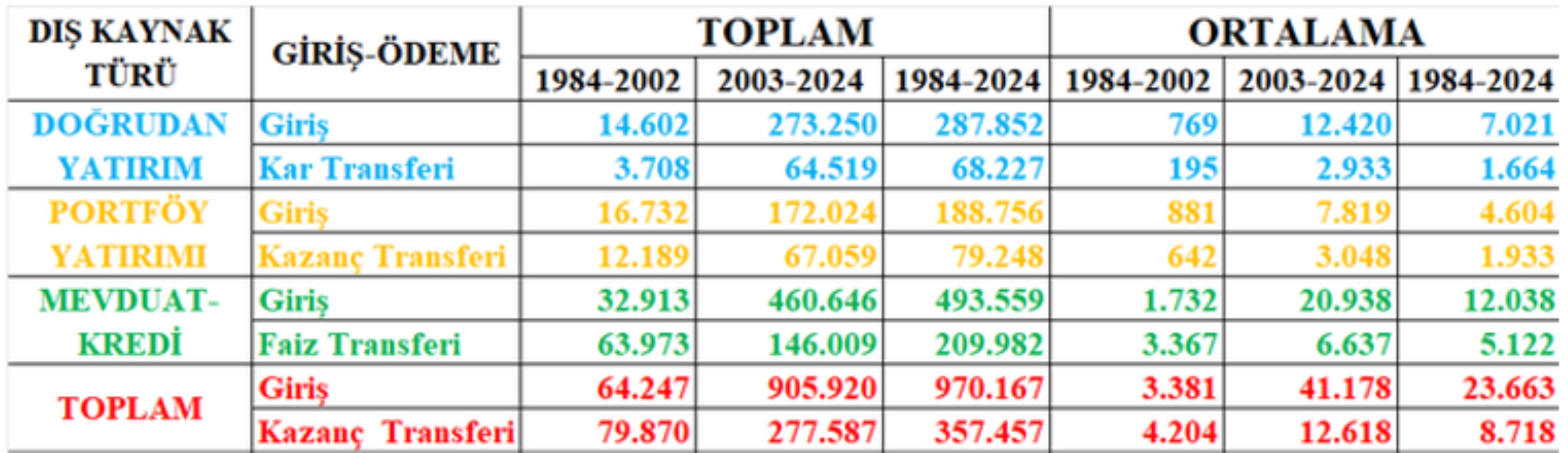
My comment on this table is as follows:
As an average for 2003-2024
Direct investment profitability (return) rate: 2933/12420 = 23.6 percent
Portfolio investment return rate 3048/7819 = 38.9 percent
Deposit – loan return rate 6637/20938 = 31.7 percent
Total external resource return rate (lump sum) 12618/41178 = 30.6 percent
We transfer about 30 percent of our profits abroad annually on average. This is the price of growing by giving a current account deficit. This confirms the thesis that national income is growing but Turkey is becoming poorer. In other words, we have been quite nicely exploited. They will not be seen around for a while. They will ask for more interest to come back.
Most Read

Striking picture for Özgür Özel's 'New Party'

The PKK opening and Özgür Özel’s path!..

How did the newspapers view Özgür Özel's farewell to the CHP?

He killed his wife by slitting her throat: Their children witnessed the moments

What did the CHP do?

Özel’s new party move in the world press

The New CHP, against CEHAPE

Fire at TUSAŞ engine factory in Eskişehir under control

From self-efficacy to despair

Kılıçdaroğlu's first message on Özgür Özel's new party announcement