



When we look at Trump's statements and policies, it's confusing. It's a monument to instability... At first, many economists thought, "The US is a great power." We were saying, "Surely Trump knows what he's doing while attempting to change the world order established for the dominance of the dollar after World War II." However, over time, Trump's retreats changed these thoughts.
Yes, the US is the country with the world's largest foreign trade deficit and the largest debtor nation. However, it pays for its foreign trade deficit and its debts with its own currency, the dollar. It does not suffer a loss of wealth while making these payments. Its income does not fall. It pays for its trade deficit by printing paper and raises the welfare of its people with imported goods. Despite this, why can Trump stand up and say, "The whole world has exploited us," by looking at trade deficits?
As if the US were not an imperialist country that sticks its nose into military and foreign policy affairs all over the world, changes governments in countries, plans military coups, incites civil wars, seizes the resources of countries, and holds the world to ransom with the seigniorage rights of the dollar...
Trump's statements and the increase in customs tariffs, especially the trade war with China, have reduced confidence in the dollar. It has opened the reserve currency status of the dollar to debate. We wrote about these issues in recent weeks.
When the US-originated 2008 financial crisis broke out, the Fed's balance sheet size was 900 billion dollars. As large companies, banks, and insurance companies went bankrupt one after another, the US found the solution in printing dollars. The 900 billion dollar Fed balance sheet size increased fivefold to 4.5 trillion dollars. Then came the Covid-19 pandemic. Both the Fed and other central banks started printing money without backing. The Fed's balance sheet size reached nearly 9 trillion dollars. The US exports "inflation" to the world by printing dollars during periods when the economy enters a crisis.
The question here is this: While all central banks, especially the Fed, were printing money crazily in 2008 and 2019, if China, which became the world's factory from 2000 onwards and significantly increased its production and exports to the world from 2010 onwards, did not exist, where would the inflation rates, which reached 8 percent in the US and 8.5 percent on average in the EU, have gone in response to this increasing money supply?
Can an econometric modeling study be done for the answer to this question, can a scenario be produced? I conveyed this question to my dear friend, economist Prof. Dr. Emin Akçaoğlu. He said, "There is Artificial Intelligence now."
I asked this question to artificial intelligence, and many data points appeared in seconds. When I looked at the data, the most obvious thing that emerged was this. From 2008 to 2016, the Fed's balance sheet size increased exactly 5 times. It jumped from 900 billion dollars to 4.5 trillion dollars. But there is no increase in inflation in the US and EU countries. Especially after 2010, China's production and exports to the world skyrocketed. With the 2019 Covid crisis, this time the Fed's balance sheet size doubled, reaching 9 trillion dollars (8.8 trillion dollars). But due to disruptions in the supply chain due to the pandemic, inflation in the US reached 8 percent and 8.5 percent on average in the EU.
Later, I prepared graphs with my nephew based on these data. I asked what US and EU inflation would be if China did not exist based on these graphs and these data.
According to the artificial intelligence's "what if China didn't exist" scenario, the inflation experienced in the US and EU would be 30 percent higher than the inflation experienced. (To avoid misunderstandings... It does not mean there would be 30 percent more inflation and it would reach 38 percent. It is 30 percent of 8 percent. (8 x 1.30 = 10.4))
HERE ARE THE GRAPHS AND THE ARTIFICIAL INTELLIGENCE'S INTERPRETATIONS OF THESE GRAPHS
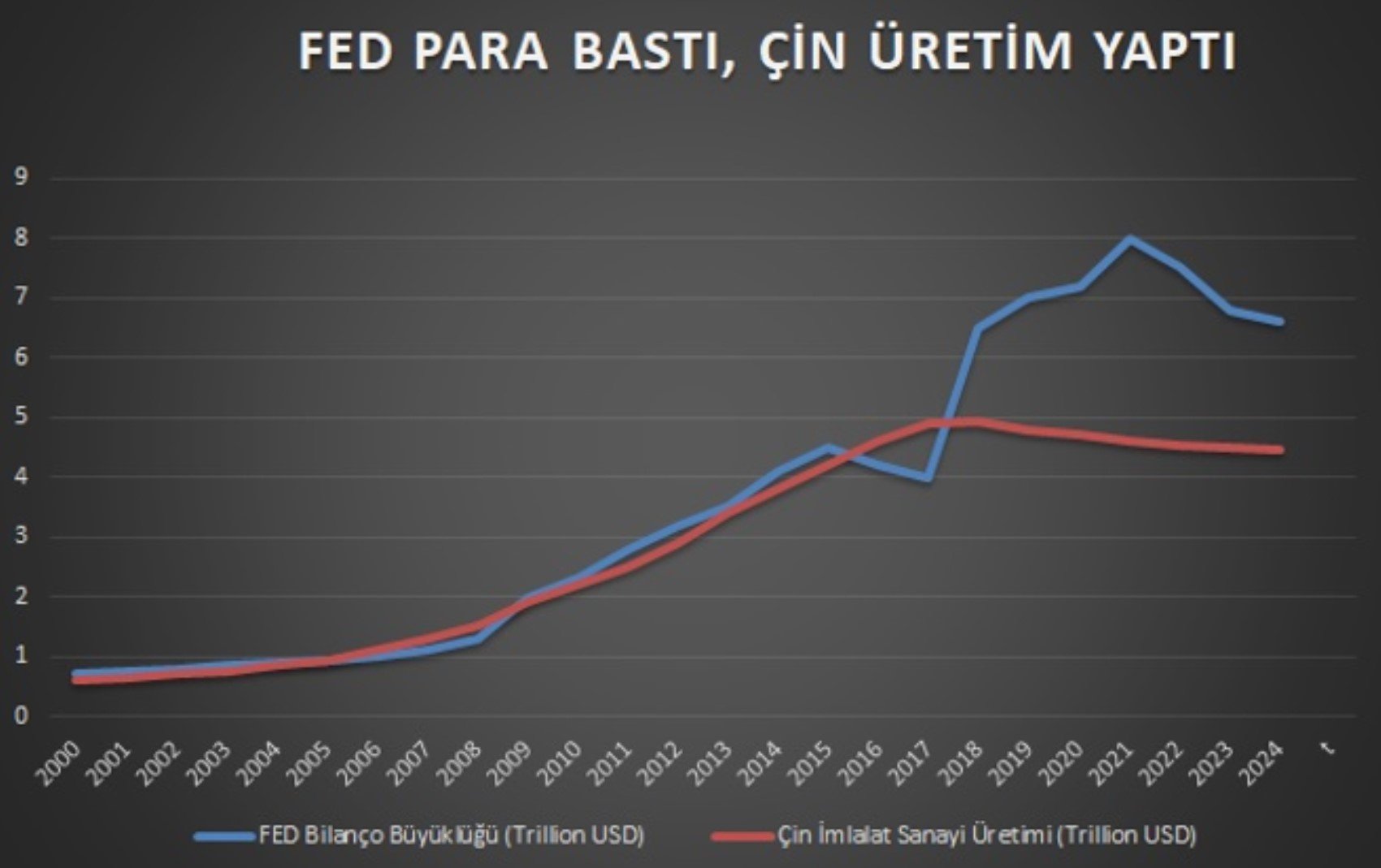
"Sources: U.S. Federal Reserve, National Bureau of Statistics of China"
Economic Analysis: China's Role in Suppressing Inflation
• The Fed's massive money supply after 2008 had the potential to create high inflation.
• However, thanks to China's increasing production and exports to the US, this money supply was met with real goods.
US INFLATION AND THE “WHAT IF CHINA DIDN'T EXIST” SCENARIO (2000–2024)
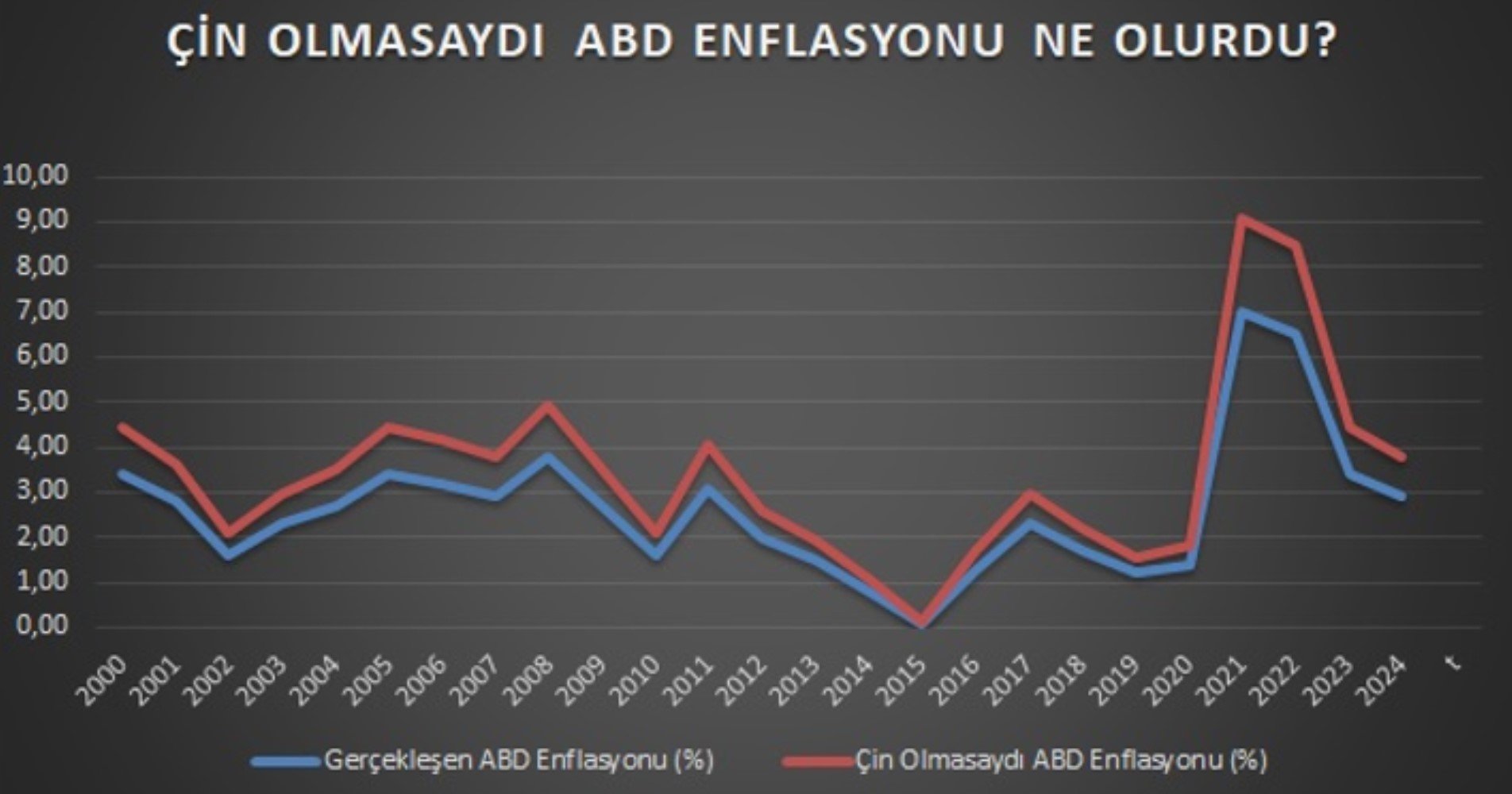
I must emphasize this immediately. The "what if China didn't exist" scenario is an AI-supported estimate where China's export contribution is ignored.
There are two main lines on the graph.
• US Inflation (Realized): The annual CPI data announced by the US Bureau of Labor Statistics.
• “If China Didn't Exist” Inflation (%): Estimated inflation likely to occur without China's export support to the US (modeling).
Key Findings:
• "2000–2008: China's impact is limited but starting.
• 2008–2020: Thanks to Chinese exports, inflation remained 1–1.5% lower.
• 2020–2022: When Chinese production was disrupted, inflation could have been 30% higher."
Evaluation:
The Fed's monetary expansion moves can only be absorbed without turning into inflation when real production is provided in return.
In the post-2008 period, China provided this real production to the world. However, when China's production speed slowed down, the US money supply was not suppressed from the consumption side, and this paved the way for the inflation explosion in 2021–2022.
Based on this graph, an inference can be made as follows:
Strategic Conclusion:
The global monetary system needs a new production-backup center. If China cannot maintain this role or if its production capacity shifts to domestic demand, the US (and therefore the West's) monetary policy will have a more limited room for maneuver.
"If China's production growth and exports to the world had not increased so rapidly, as a result of this monetary expansion, the resulting inflation would not have been at the 8-8.5 percent level, but at least 30 percent higher, at the 11-12 percent level.
A 4-point annual inflation difference is of great importance for the US and EU countries. However, for countries like Turkey, which reached 180 percent in the past and still has inflation hovering around 80 percent in reality even today, this difference may remain less significant.
References
- U.S. Bureau of Labor Statistics
- U.S. Federal Reserve Balance Sheet Data
- U.S. Census Bureau, Trade Statistics
- IMF World Economic Outlook
- World Bank Trade Databases
Most Read

Striking picture for Özgür Özel's 'New Party'

The PKK opening and Özgür Özel’s path!..

How did the newspapers view Özgür Özel's farewell to the CHP?

He killed his wife by slitting her throat: Their children witnessed the moments

What did the CHP do?

Özel’s new party move in the world press

The New CHP, against CEHAPE

Fire at TUSAŞ engine factory in Eskişehir under control

From self-efficacy to despair

Kılıçdaroğlu's first message on Özgür Özel's new party announcement