



Even though Treasury and Finance Minister Mehmet Şimşek and the Central Bank management say that the “disinflation program is working,” things are not going well at all in the economy.
Sixty percent of the population is below the poverty line. The demand from this segment is falling, and 20 percent are barely getting by. The demand from this group has also been curtailed. However, the demand from the top 20 percent income group, which receives half of the national income, continues to rise. Despite signs of stagnation in the economy, inflation cannot be reined in due to the demand from this top 20 percent. A program based on money and interest is not working.
When looking at fiscal policy, the hopelessness increases even further. During the week, the Ministry of Finance announced the budget results for the 4-month period of January-April.
A one-sentence summary of the budget: On the horizon, there is no sign of service to the citizens, support for farmers, or providing even a slight breather for retirees.
What is visible?
What is visible is the transfer of more resources to those who have money.
Without getting bogged down in too many numbers, let's compare the budget between January and April with the same period last year using a few charts.
“We have reduced the non-interest budget deficit,” they boast. While the non-interest deficit was 327 billion liras in the 4 months of last year, it has decreased to 161 billion liras this year. While boasting about this, they are actually admitting that they are cutting the services they provide to citizens and transferring resources by paying more interest to rentiers who have money. They cut services, paid money for interest, and increased the budget deficit from 691 billion to 886 billion liras in the first four months. We see it very clearly in the chart below. While the budget deficit increased by 28 percent, budget expenditures by 45 percent, and budget revenues by 51 percent, interest payments increased by a full 99 percent. There is no one better than the government at making statements against the interest lobby. But there is also no one who can hold a candle to this government when it comes to transferring resources to rentiers through interest.
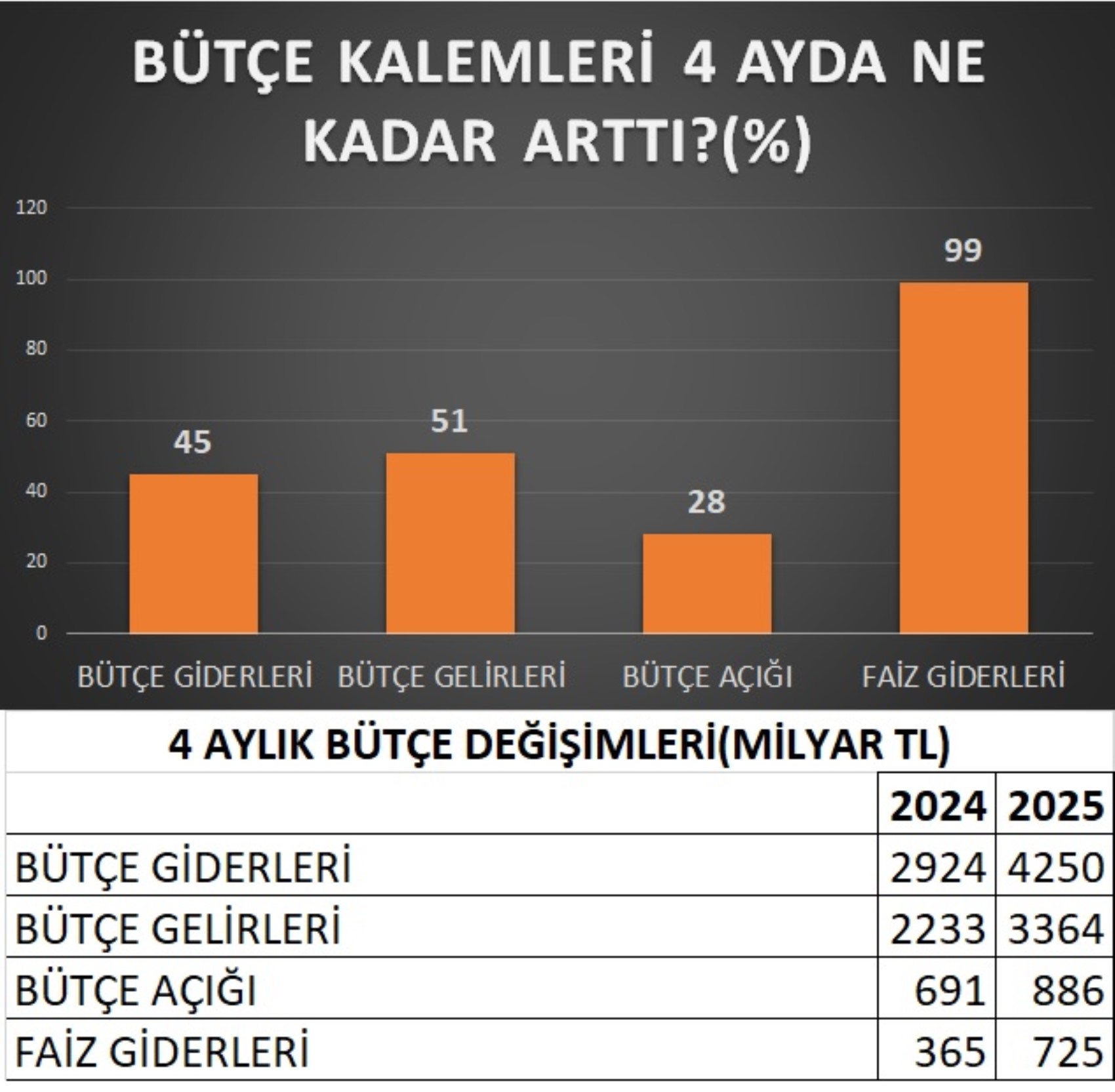
23 LIRAS OF EVERY 100 LIRAS OF REVENUE GOES TO INTEREST
In the chart below, we see how interest payments have skyrocketed in the four-month period. We made 365 billion liras in interest payments in the first four months of last year. This year, it rose to 725 billion with a 99 percent increase. The share we paid for interest within all budget revenues was 22.6 percent.
They had projected the money they would pay for interest until the end of the year as 1 trillion 950 billion liras. So far, they have paid 37 percent of it in 4 months. It is as clear as day that this calculation will go awry and we will pay even more interest. After the legal coup on March 19, the public borrowing interest rate suddenly increased by 10 points. With this judicial coup, we not only lost over 50 billion dollars in reserves, but the interest burden we will pay has also increased and will continue to increase.
The state paid 23 liras of every 100 liras of taxes and non-tax revenues it collected to interest. The remaining 77 liras went to civil servants, retirees, the splendor of state officials from the palace to the district mufti's office who do not save in any way and do not cut spending, to enriching cronies, to the army, police, judiciary, education that has deviated from its purpose, refugees, and sluggish health services where one cannot even get an appointment.
Unfortunately, with the March 19 judicial coup, the portion of the money collected by the state that goes to interest will most likely exceed 23 percent by the end of the year. The Central Bank will pay higher interest to accumulate reserves, we will accumulate reserves again, and we will burn those reserves again with behaviors outside of law and democracy.
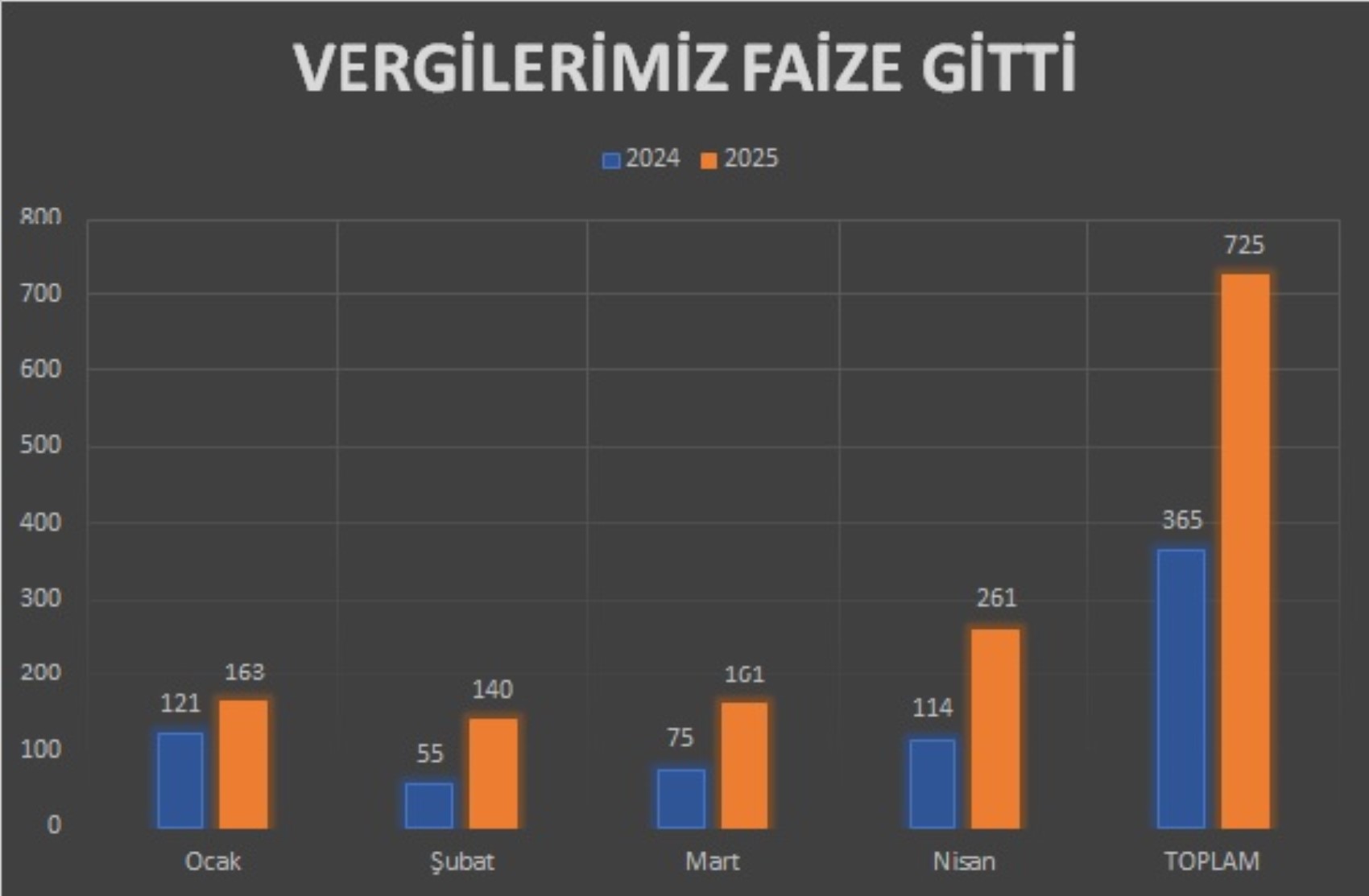
OUR JOB WILL BE EVEN HARDER NEXT YEAR
Meanwhile, the balance sheets of publicly traded companies are being announced. Some companies are reporting losses in their balance sheets due to inflation accounting, while others are reporting lower profits compared to last year due to the contraction in the economy. This means the following: The Treasury will not be able to collect the taxes it expects next year. If publicly traded companies with transparent balance sheets are reporting losses, who knows what companies that are not transparent and hide a significant portion of their income will do? Closing the state's deficit will again be loaded onto the backs of low-income earners through indirect taxes.
Most Read

Striking picture for Özgür Özel's 'New Party'

Özgür Özel gives a dated response regarding the number of resignations

Forest fire in Antalya brought under control

The PKK opening and Özgür Özel’s path!..

How did the newspapers view Özgür Özel's farewell to the CHP?

He killed his wife by slitting her throat: Their children witnessed the moments

What did the CHP do?

Özel’s new party move in the world press

The New CHP, against CEHAPE

Fire at TUSAŞ engine factory in Eskişehir under control