



The Ayhan Bora Kaplan criminal organization case, which opened with flashy arrest operations and very serious accusations, is on its way to becoming a textbook case due to the scandals that have emerged during both the investigation and trial phases.
You are familiar with the developments regarding the investigation process; the case's most important secret witness not only fled in plain sight and revealed his identity, but also claimed that he was asked to mention certain AKP members in the police statements... Along with this, the allegation that a police chief received 300 thousand dollars from Kaplan's lawyer, and that he requested this for the Menzil sect, came to the agenda... The police officers who conducted the Bora Kaplan operation and investigation were arrested... While the Ankara Anti-Smuggling and Organized Crime (KOM) Branch Manager became a confessor, everyone blamed each other, etc.
We have tried to report on what has been happening in the case heard at the Ankara 32nd High Criminal Court throughout the hearings. Finally, it emerged that the Court collected "evidence" regarding a defendant through clerks, and that the Presiding Judge, instead of writing an official letter, sent these via the WhatsApp application on his phone to the Deputy Branch Manager of the KOM, who is now under arrest, and asked for the said "evidence" to be turned into a file and sent to them.
SUICIDE OR MURDER?
It turns out that other scandals occurred before and after the Court's last hearing on May 24. Before explaining these, let us provide brief information about the subject of the scandal.
One of the accusations against the Bora Kaplan organization is the murder of Mahfuz Tatar.
The incident is as follows: Mahfuz Tatar goes to one of Bora Kaplan's venues around 02:30 on the night of October 1, 2016. When he is not allowed in because he is extremely intoxicated, he insults and swears at the staff at the door. Later, he goes to another venue with those who are with him. Subsequently, the staff members named Muhammet Kaplan and Semih Arslan, who were subjected to these insults and profanity, find the venue where Tatar went and kill him as he leaves. After the murder, they go to the house of an acquaintance named Mahmut Gökhan Çanga in the North Ankara region and hide. Two days later, while Muhammet Kaplan leaves here to surrender, Semih Arslan stays at the house.
The following developments occur subsequently:
One day after Muhammet Kaplan surrenders to the Murder Bureau, Semih Arslan, according to one claim, commits suicide by jumping from the balcony of that house on the 9th floor to avoid going to prison. According to the other claim, he is thrown down by the other individuals in the house, Mahmut Gökhan Çanga and Sercan Keleş.
While Muhammet Kaplan is tried and convicted for this murder, a decision of non-prosecution (KYOK) is issued regarding the death of Semih Arslan.
After the Bora Kaplan operation, this death, along with the Mahfuz Tatar murder, is included in the investigation by lifting the non-prosecution decision based on the statement of the secret witness "M7" and added to the file as "Incident-1". While his family states that Bora Kaplan gave the order to kill Semih Arslan, the secret witness coded "M7", Serdar Sertçelik, says the following in summary in his statement:
"Semih Arslan was a good boy who prayed five times a day. He did not use alcohol or drugs. The probability of him committing suicide is zero. As far as I heard, they locked the door from the outside so that Semih Arslan would not escape from this house and took the key from the door. Mahfuz Tatar is from the Tatar tribe. The tribe was seeking revenge. For this, they met with Ayhan Bora Kaplan. Afterwards, they agree in exchange for a certain amount of money and a life. I heard that the life was the person named Semih Arslan."
Let us look at the defenses of the defendants.
Bora Kaplan claims that he was not at the venue when the argument with Mahfuz Tatar took place, that he heard about the murder the next day, and that he only knew Semih Arslan by name.
Mahmut Gökhan Çanga and Sercan Keleş, who are accused of killing Semih Arslan, explain that they gave the key to the house to Arslan, who came on his own, that he came and went whenever he wanted, that he was definitely not held by force, and furthermore, that they are 1.60-1.65 meters tall and weigh 60-65 kilograms, and that it is impossible for them to throw Arslan, who was 1.90-2.00 meters tall and weighed 100 kilograms, over the high iron railings on the balcony.
G.Ö., the attendant of the apartment building in question, who was heard as a witness in the 11th session on May 21, also reports that Semih Arslan entered and exited the house and walked around the site, and claims that the police wrote the statements under pressure, and even threatened him with his wife.
THE DECISION CANCELED IN FOUR DAYS
One of the main pieces of evidence that will shed light on the death of Semih Arslan is the two keys found in his pocket. These keys have been in the estate file at the Ankara 7th Civil Court of Peace since 2016.
According to the defendants and their lawyers, those keys are the keys to the apartment where Semih Arslan was allegedly held by force.
However, there is a problem with this: On the day Arslan died, the police had a locksmith open the steel door of that apartment and the lock cylinder was broken. This is also confirmed by the report of the Crime Scene Investigation Branch Directorate and the camera recordings related to it. Furthermore, it is unknown how many tenants have lived in that apartment in the past 8 years, or whether the tenants have changed the lock cylinder.
For this reason, on April 8, the defense lawyers asked the Court to conduct an on-site inspection of the apartment's walls regarding the height of the balcony railings and whether the neighbors could have heard if there had been a struggle in the event that Arslan was thrown down, even though there is no possibility of conducting an inspection regarding the keys found in Semih Arslan's pocket.
However, the Court did not make any decision regarding this request during the hearings on April 15-26, where the first part of the case was heard.
Before the hearings to be held between May 20-24, on April 30, it wrote a letter to the Ankara 7th Civil Court of Peace and requested the keys belonging to Semih Arslan to examine and return them. The 7th Civil Court of Peace sent these two keys on May 6.
Of course, since it was not uploaded to UYAP, no one knew about this development until the interim decision given by the Court on May 24, the last day of the hearings. On that day, the Court announced that the keys found on Semih Arslan had been obtained, and that it had been decided to conduct an on-site inspection on May 29 regarding the balcony of the apartment and to determine whether these keys opened the door of the apartment where Arslan was said to have committed suicide or been killed.
Upon this, the lawyers of the defendant Mahmut Gökhan Çanga, in their motion for the recusal of the judge they filed three days later, not only mentioned this inspection decision and reminded that the report kept regarding the door lock during the examination in 2016 and the camera recordings taken were in the file; they verbally warned the Court, saying, "It will not make any contribution to the file, because the result of the inspection is obvious," and requested that the inspection be carried out in line with their own requests.
But the Court did not give up on the inspection decision. Upon this, the lawyers went to the court and had the videos from 2016 in the file watched.
It was only after this that the Court convened on April 28 and, having also received the Prosecutor's written opinion, completely canceled the inspection it had decided to conduct the next day. The reason for the decision is the report and images from 2016, which the lawyers insistently drew attention to.
Although it is sufficiently understood from what has happened how much the Court is in control of this important file, there is more.
MAY THEY NOT BE THE KEYS TO THE VICTIM'S OWN HOUSE
On the day the defense lawyers made their written and oral applications regarding the inspection, that is, before the inspection was abandoned, the Court took an interesting step and requested "1 lock cylinder" from the lawyer of Semih Arslan's family, who is the complainant and intervening party in the case.
The lawyer also submitted this to the court on the same day.
One day after the cancellation of the inspection decision, the Court wrote an official letter to the family's lawyer again and asked for the key and lock cylinder of the house where Semih Arslan lived with his family.
What is understood from this correspondence is that this time, it is being investigated whether the two keys found in Semih Arslan's pocket could belong to his family's house.
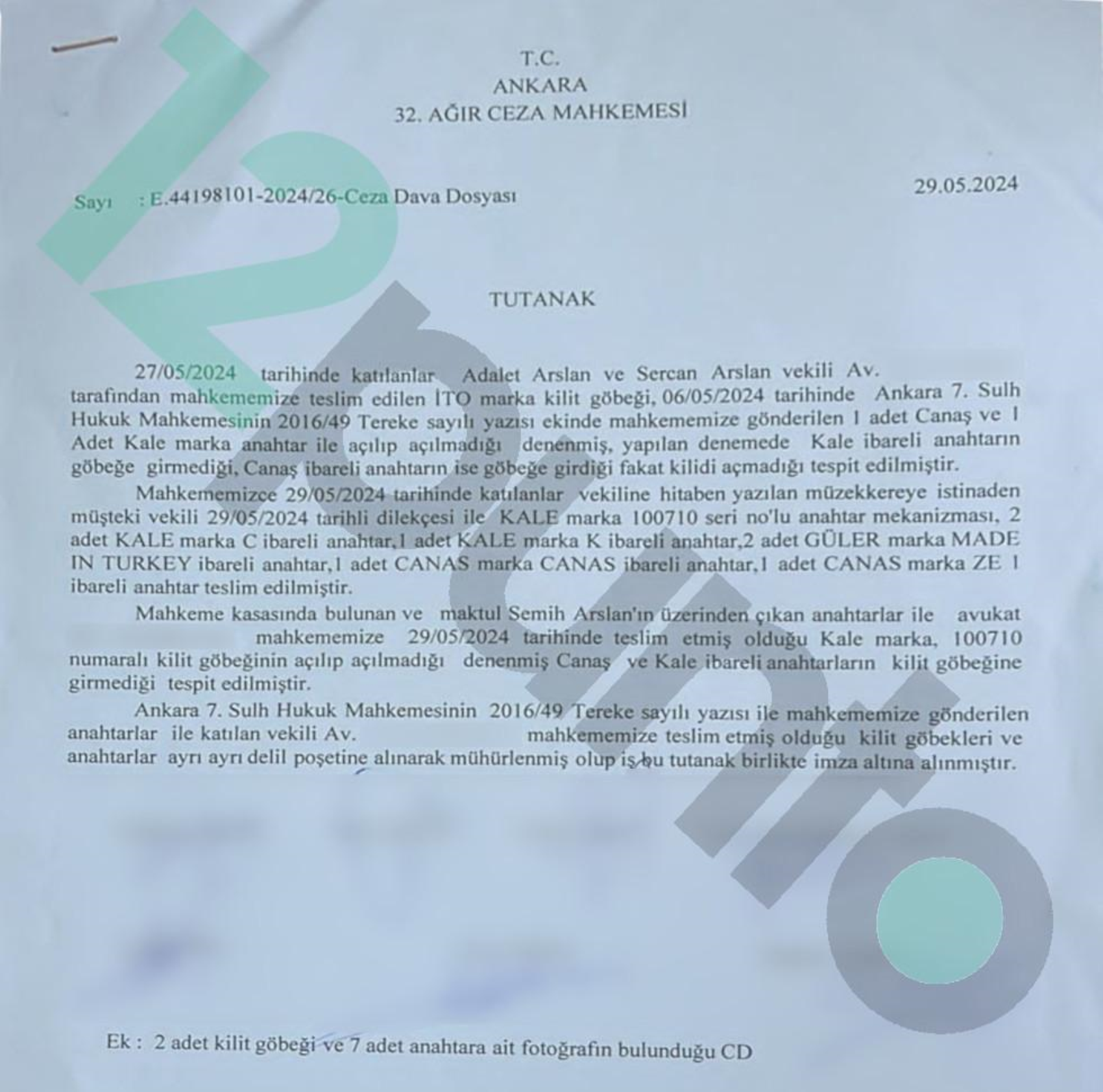
In the answer he gave to the Court on the same day, the lawyer stated that the family had moved out of the house where they lived with Semih Arslan, that two different people had resided in that house afterwards, and that each of them had changed the door lock, but that they had obtained these locks and lock mechanisms, and sent four keys and two lock mechanisms.
The Court also convened on the same day and tried both the keys found on Semih Arslan and the keys sent by the lawyer on the lock cylinders. As a result of the trial, a report was drawn up stating that neither the keys on Semih Arslan nor the keys delivered by the family's lawyer opened any of the lock cylinders.
Those who have signatures on the report are -along with the panel- the court bailiff, two clerks, and the director of the registry office!..
What is the meaning and importance of this important inspection?
It is obvious that the court, which is obliged to prosecute limited to the indictment, has officially set out to conduct an investigation to find new evidence, and furthermore, has hidden this from the Prosecutor and the lawyers.
Although it is another example of the "normalizing" states of the "new judiciary" of the "new Turkey", continue to be surprised and question!..
Müyesser YILDIZ
June 3, 2024
Most Read

Striking picture for Özgür Özel's 'New Party'

Özgür Özel gives a dated response regarding the number of resignations

Forest fire in Antalya brought under control

The PKK opening and Özgür Özel’s path!..

How did the newspapers view Özgür Özel's farewell to the CHP?

He killed his wife by slitting her throat: Their children witnessed the moments

What did the CHP do?

Özel’s new party move in the world press

The New CHP, against CEHAPE

From self-efficacy to despair