



The 2024 election results show us that there is a correlation between the AK Party's loss of votes and poverty. When examining the voting behavior of residents in poor neighborhoods in particular, it is possible to observe this striking result empirically. For example, when we examine Istanbul, the following table emerges.
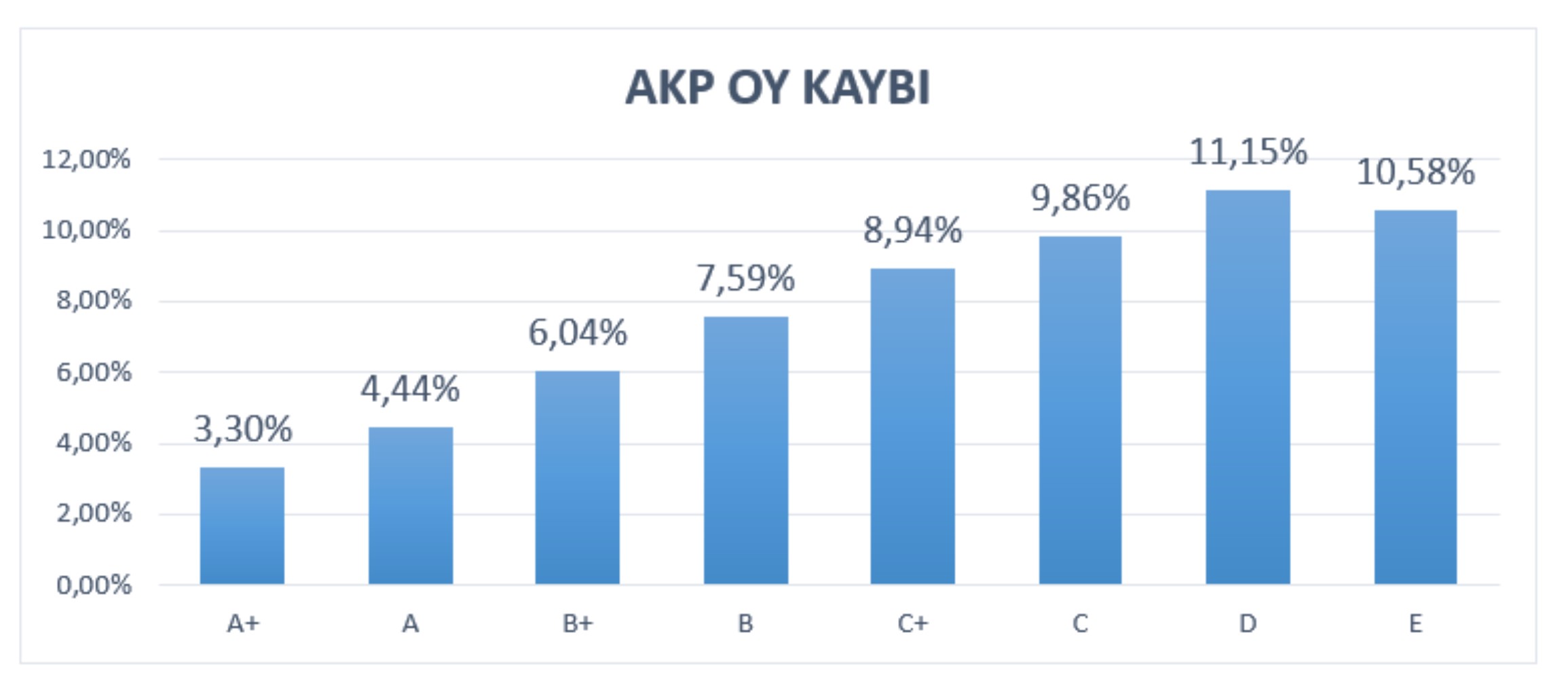
(The rate of vote loss for the AK Party in the 2024 Local Elections in neighborhoods classified according to Socio-Economic Status (SES) scores. A+ is the highest, and E is the lowest)
The reasons for this can be explained as follows:
1- The AK Party's inability to engage in economic populism due to the IMF-style program without the IMF that it implemented before the election, and its failure to meet the economic expectations of voters,
2- As a result of this, as reflected in the GINI data, income inequality in 2023 reached its peak in the last 20 years,
3- The appreciation for the social municipalism implemented by İmamoğlu in Istanbul,
4- The fact that İmamoğlu's anti-polarization language prevented negative identification among voters.
The importance of the third and fourth points, in particular, can be understood when considering that the majority of voters in these neighborhoods chose to turn to other parties or not go to the polls at all, rather than breaking away from the AK Party and turning to the CHP. If İmamoğlu had used a polarizing language instead of a unifying one, and if he had disrupted social aid as the government claimed throughout the 2019 election process, it would have been difficult for this picture to emerge.
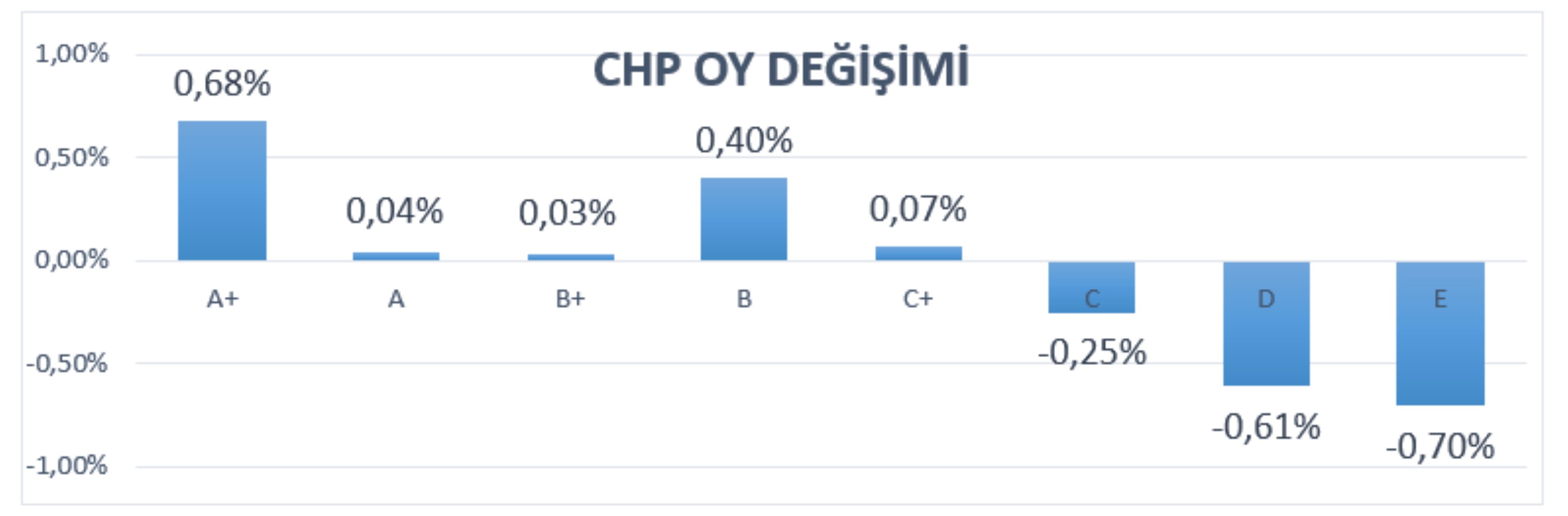
However, because İmamoğlu did not make mistakes on these points, he prevented negative identification against him in the eyes of the voters and—despite all the government's efforts—prevented himself from turning into an object of hatred in the eyes of these voters. As a result, a significant portion of urban poor voters, who had difficulty breaking away from the AK Party due to both social aid and the power of identity codes, did not go to the AK Party even if they did not come to the CHP. When İmamoğlu's efforts were combined with the government's failure in the economy, İmamoğlu was able to consolidate his own voters, while the government failed to do so.
In fact, this also reflects what we call the "economic voting behavior" of the Turkish voter, that is, the behavior of determining who to vote for by looking at the economy. Undoubtedly, the economy does not always shape the voting behavior of voters, but in times of such deepening crises, the importance of the economy cannot be denied.
In other words, just as the price hikes and "free" election benefits distributed by the AK Party before the election were important in the behavior of voters who mostly turned to the AK Party just 1 year ago, its inability to do so in this election seems to have produced a result in the same way.
Indeed, research conducted to date on Turkish voter behavior also reveals that voters cast their votes by evaluating the economic performance of the last 1 year and the possible economic performance of the coming year.
This points to a risk for the opposition and an opportunity for the government for the first general election to be held: If the government can recover the economy to the extent that it can distribute election benefits, it can turn these voters back to itself. Therefore, while the opposition presents uncomplicated solution proposals to the society's deepening problems without giving the appearance of internal debate, it should also avoid rhetoric that would push them toward identity polarization and lead them to the government. In addition, the opposition should also form an economic team that will show that it can manage the economy very well, and whose every word is practically law in the eyes of the public.
On issues such as migration and health, those who will be the owners of these issues in the eyes of the public should both develop their rhetoric with projects and policies that will convince the public and be made more visible on behalf of the party. In short, a concrete story should be written, ranging from the presidential candidacy to who will solve Turkey's accumulated priority problems and in what way. The way to do this, as I wrote last week, is to answer the 5W1H questions with a simplicity and concreteness that will not exceed the society's perception threshold. Just as İmamoğlu did in 2019 with promises like nurseries and the 'annekart' (mother card)…
Most Read

Striking picture for Özgür Özel's 'New Party'

Özgür Özel gives a dated response regarding the number of resignations

Forest fire in Antalya brought under control

The PKK opening and Özgür Özel’s path!..
Houthis strike Saudi-owned tanker

How did the newspapers view Özgür Özel's farewell to the CHP?

What did the CHP do?

Özel’s new party move in the world press

The New CHP, against CEHAPE

4 drones shot down near US Consulate General in Erbil