



I am Medusa, whose innocence was found guilty...
as they tore my body apart,
with gilded divine swords, sons from my own blood,
my killers were written into history
as brave warriors, kings brighter than the sun.
Masculinized mothers nursing virile sons at their breasts,
as they inscribed my name on the first line of their cursed amulets,
I, raped within my own home,
a snake-haired monster who shamed her mother even in death.
Let dark drums be struck with blood-red mallets,
let it be known... my murder, unsolved for three thousand years,
they loaded it onto the back of a winged horse and carried it to the stars...
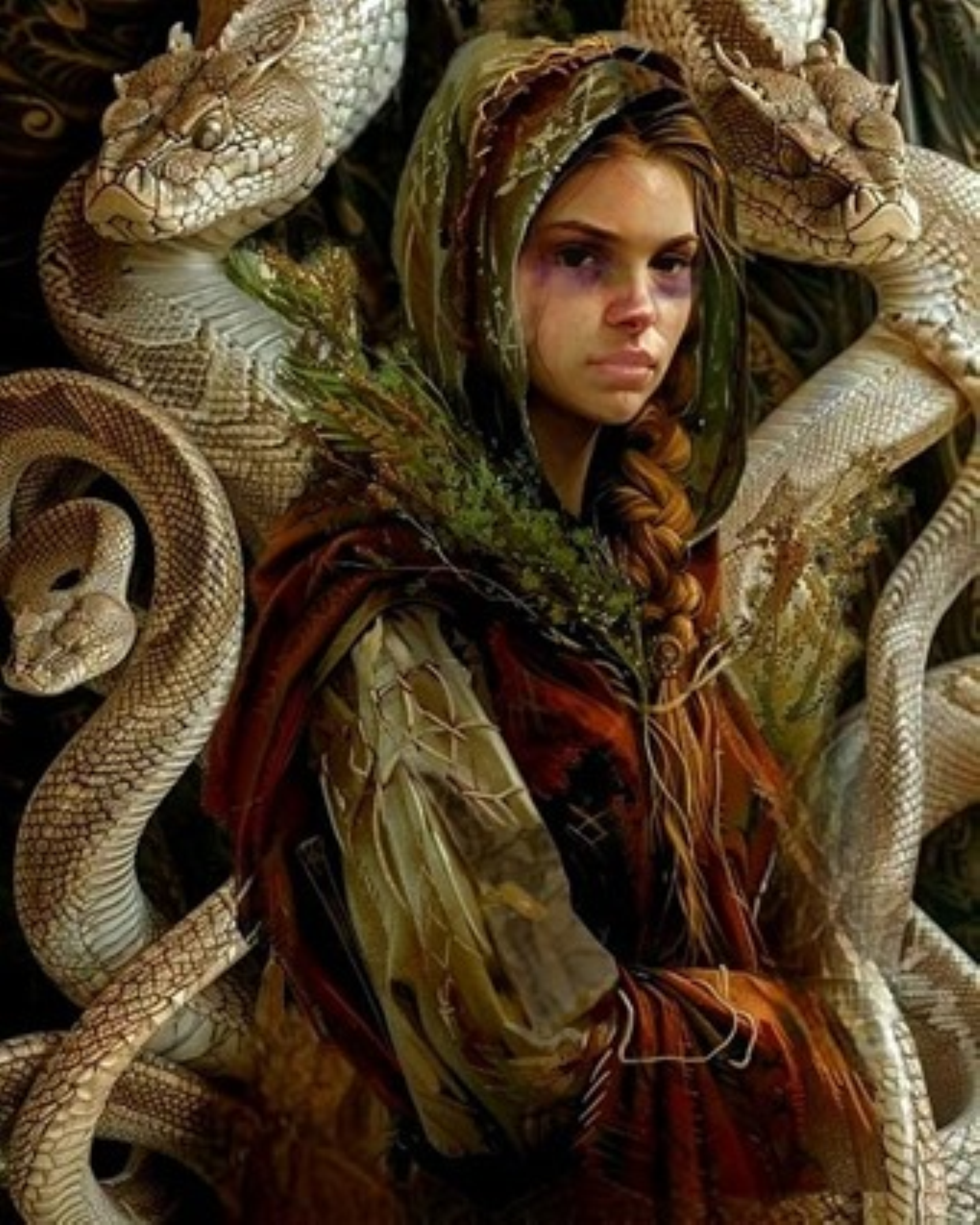
Brought before a court where the innocent are tried,
Because she was innocent, Medusa was found guilty.
Medusa is one of the most popular characters in mythological narratives. The gods have inscribed her story into the sky with stars, so that it may live forever. Her severed head has been in Perseus's hand for thousands of years, hanging in the heavens. The male world focuses on the heroism Perseus displayed in saving his mother and the woman he loved. But the true protagonist of the story is Medusa.
MEDUSA IN GREEK MYTHOLOGY
The templates used in Greek mythology depict a chaotic situation frequently encountered in society that cannot be resolved. Storytellers aim to educate society through dramatic resolution and to prevent such events from recurring. They leave the interpretation of a story written before time, and the lesson to be drawn from it, to the collective conscience of society.
Although the patriarchal mindset — which mistakes the metaphors in these stories for reality and shapes these inferences for its own benefit — has manipulated the story for thousands of years to reinforce its own power, Greek mythology has nonetheless managed to convey to the present day a terrifying, self-repeating problem of the community.
What falls to us is to reinterpret the story from a human perspective and to retell Medusa's blood-curdling story anew. The truly disturbing element in the story is that the psychosocial distortion rooted in tradition and culture, as described in Medusa's tale, continues to be lived out on our own soil with the same dramatic intensity as it was 3,000 years ago.
SO WHO IS MEDUSA?
In the best-known version, is she a terrifying monster — feared by all, with disheveled wavy hair cascading down her bare back, each curl a venomous snake, tearing her prey apart with wild boar tusks, her shriek deafening, capable of turning men to stone with a single glance, slaying those who come to kill her with her poisonous arrows?
Or is she a highly intelligent, breathtakingly beautiful, innocent young girl — given by her family to serve in Athena's temple, raped by Poseidon, rendered unrecognizable by the blows dealt to her body, condemned and cursed by Athena and Zeus, and cast out?
Medusa is born as one of three daughters of a powerful family; her family are the Gorgons, known as gods who ruled over serpents and monsters and understood their language. Although they are depicted in mythology as monsters bearing serpentine traits, when the story's metaphors are interpreted rationally, the evidence points to a powerful family possessing knowledge of snake venoms and their antidotes. And this, in turn, points to Medusa's abilities with serpents and the education she received from her family.
In a world without medicines, vaccines, painkillers, or antidotes, a family possessing such knowledge was both greatly feared and greatly respected. For just as they could produce antidotes to save lives, they could also use those poisons to kill.
From a very young age, Medusa was a highly intelligent girl who could communicate with snakes and was curious about and learned from the effects of mushrooms, plants, and other venomous creatures. For this reason, it was not difficult for her to make progress in toxicology, the family's area of expertise. From childhood, she had two enormous, highly venomous white snakes that never left her side.
When she reached the age of young womanhood, her beauty and her knowledge began to spread from tongue to tongue. However, this intelligent girl's ability to wield both the poisons and the antidotes of snakes and plants did not make her an ideal candidate for a wife who would accept enslavement in the world she lived in. Accordingly, her family had her take a vow of chastity and sent her to Athena's temple as a priestess.
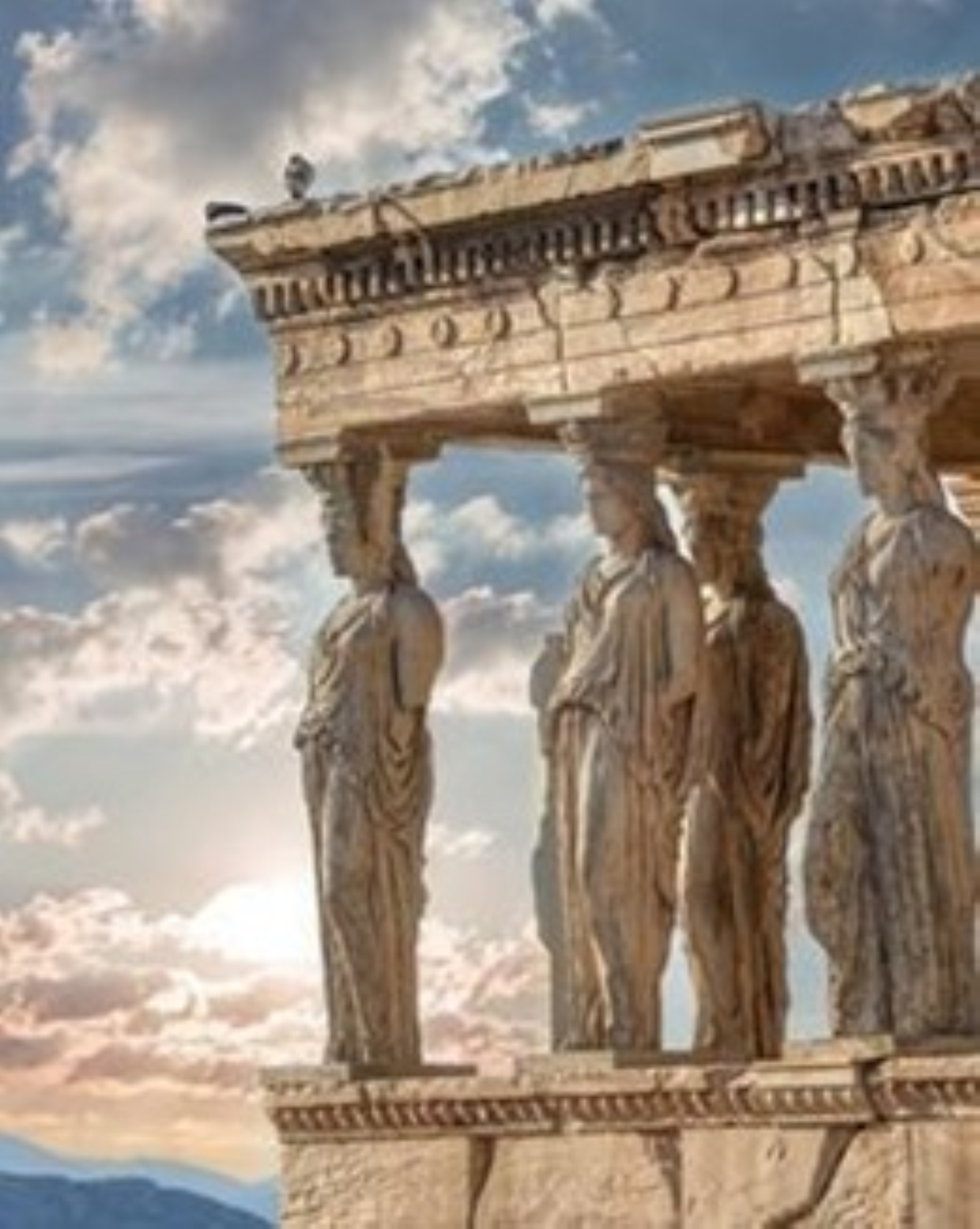
Medusa cared more about the healing powers of poisons than their lethal aspects; she had accepted becoming one of Athena's temple priestesses in order to expand her knowledge and experience, and to combine the temple's knowledge with her own. She could set aside desires such as marriage and childbearing and dedicate herself to helping people. She had been forced to bid farewell to her white snakes when she left for the temple. Medusa was not aware of how powerful the knowledge and protection her snakes had given her truly was.
After several years of training, she had become a priestess whose name was spoken far and wide. Her intelligence, her mastery of oratory, her healing abilities, and her mesmerizing beauty caused people to flock to the temple from great distances. The beauty of her long, silky, wavy hair was spoken of from tongue to tongue.
The city's nobles and soldiers were desperate to marry Medusa and bring her power under their control. But the seal of the young woman's chastity was in the hands of the goddess Athena. Without the permission of Athena and Zeus, it was impossible for Medusa to marry. The fact that people were coming to the temple to see Medusa rather than to worship Athena had begun to greatly disturb Athena. This state of jealousy had reached the ears of the sea god Poseidon.
THE QUARREL BETWEEN ATHENA AND POSEIDON
Athena and Poseidon were the two major powers of the region — on one side, Athena, the highly intelligent and warrior daughter of Zeus; on the other, Poseidon, Zeus's brother and god of the seas. Both wanted this city. Athena had given the local people olive trees so they would choose her as their ruler, saying: these fruits may taste bitter to you, but once you process them, you will have something you can eat as well as a liquid worth its weight in gold. Poseidon, meanwhile, offered the salty seawaters teeming with fish that reached the city's shores, saying: with these fish you can both feed yourselves and sell them. The people, who chose Athena, named the city after her and built temples in the city to honor the goddess.
RAPE OF MEDUSA
Poseidon, knowing that Athena was jealous of Medusa, begins following Medusa everywhere. One day he calls out to Medusa as she walks along the seashore, whispering her name to draw her near, then attacks her as she approaches the sound. His aim is to take Medusa's virginity and thereby tarnish Athena's reputation. But Medusa manages to escape Poseidon's grasp and begins running toward the temple. Medusa knew that the only power capable of saving her from this attack was Athena. Managing to throw herself into the temple, Medusa falls at the feet of the enormous statue of Athena inside, pleading through her tears — but Athena and Zeus, who watch what is happening, do not help the wretched young girl. It is abundantly clear that the young girl was offered up as a sacrifice to Poseidon because of Athena's jealousy.
Poseidon, seeing the girl's entry into the temple as an even greater opportunity, rapes Medusa, the virgin priestess of the temple. He has taken his revenge on Athena by violating the sanctity of the temple.
Poor Medusa's life is turned upside down in a matter of minutes. She had not accepted the attack planned against her and had resisted Poseidon with all her strength. As she lay unrecognizable in a pool of blood on the white marble at the center of the temple, the blood flowing ceaselessly from the cuts above her brows had left her hair soaked in blood and stained her pure white tunic dress crimson; her front teeth were broken, her face and eyes were covered in bruises and swelling, and her legs and arms had given out. Poseidon had vented his rage at Athena upon Medusa's body, attacking her with all his might.
When the word "rape" is conceptualized on its own, what effect does it produce in people's minds? How many of us, when we hear this word, picture the suffering of a young woman whose body has been torn apart, whose face has been rendered unrecognizable, whose ribs have been broken, who cannot breathe, whose life can never again be what it once was? Can the act of conceptualizing events push the true face and effects of an incident far from forensic moral reasoning, clouding our minds?
Otherwise, it would be impossible to understand how a victim who has endured all of this could be abandoned after a trial ends in a courtroom to a fate of being uglified and isolated by society — or how the perpetrator could receive a sentence reduction for good conduct simply by putting on a suit and saying "I'm sorry," or be released without serving time because he had not committed such a crime before.
EXILE AND PUNISHMENT
At this point in the story, we expect everyone to feel compassion for Medusa, who was chosen as a victim — we expect her to be lifted from the ground, her wounds tended to, help given to her, and her revenge taken. Unfortunately, that is not what happens.
The Mother Goddess, Athena, in a great fury, accuses Medusa — saying that with your serpentine curling hair, your voice, your words, you seduced Poseidon — blaming her for the defilement of the temple's purity, that is, its honor. With the accusation "You are a diabolical monster wicked enough to seduce the god-man of the house!" she declares the innocent young girl a devil and drives her from the temple.
The mythological story says that Athena cursed Medusa by transforming her into a snake-haired monster. Athena, displaying a patriarchal attitude, both rid herself of a young and beautiful woman she saw as a rival, and sent a message to her uncle — the god-man, the elder of the family — who had raped the young girl in his own home, that this rape was his right and that he bore no guilt.
This is nothing other than a case of rape within the family. Is the man of the house worth more, or is the daughter of that same house — seen as a slave within it — worth more? Or is the young woman taken in as a bride worth more?
The mother or mother-in-law who witnesses the rape within the home and turns a blind eye, when the incident comes to light, cries out with all her might: you seduced my husband or my son, you are the devil, you are a snake. Athena, too, in order to protect the man of the house, slanders the young woman, declares her a monster, a devil, and a witch, and sends her into exile in the outside world where she will be left completely defenseless.
And what of the girl's own powerful family — we expect them to open their arms and protect her, do we not? After all, Medusa is the daughter of a powerful family — by the mythological story's own definitions, she is the daughter of Phorcys and Ceto, gods known as sea deities, creators of many fearsome monsters, symbols of power and dread. But here, too, things do not go as hoped. Her own family, who had given their daughter to the goddess Athena's temple as a slave and servant, closes its doors to Medusa.
In a court where victims are declared guilty, Medusa — whose womanhood is put on trial — can no longer be acquitted anywhere. The men who, when she was a virgin priestess, had admired her and wished to sacrifice everything they owned to possess her, now pursue Medusa like savage hyenas.
Left homeless and alone, Medusa takes refuge in the ruins of an old temple where she had played games as a child, in order to protect herself from the rape of other men. With blood dried in her wavy hair, her body already frail and covered in dust and dirt, the wounds on her face, her skin cracked by the sun, and her broken teeth, Medusa has truly become the cursed monster Athena attributed to her. She is not yet aware that she is pregnant. The snakes that had been with her since childhood, hearing Medusa's weeping and screaming, have not abandoned her even in these ruins. By following the snakes, she finds water sources, and manages to survive by catching and eating small prey animals.
EXONERATING THE KILLER
One day while hunting, Medusa finds a broken statue among the rubble. The relentless complexity of human psychology has not left Medusa alone either — the broken statue head she finds belongs to Athena. Medusa cleans this statue and places it in the most prominent corner of the temple. She arranges flowers around it, begins to pray to the goddess mother who has done all these terrible things to her, and continues to love her.
Medusa is an intelligent woman; through this act she has created a protected space around herself — a new temple, so to speak — backed by the power of Athena and Zeus. But the psychological dimension of the matter is somewhat more complex. Medusa, as many children in her situation do, has wanted to exonerate her mother, to believe that she too was at least as helpless as Medusa herself. With the assumption that "my mother must surely be glad I survived," she has allowed her subconscious to play tricks on her, and in order to remain at least somewhat at peace in her inner world, she has chosen not to sever her bond with the mother goddess Athena — whom she has worshipped all her life — by placing her statue in the place of honor.
CHOOSING NOT TO BE A VICTIM
In real life, as it is lived in our country, women in Medusa's situation are either killed, driven to suicide to ease society's conscience, or become victims of men who sharpen their teeth against them as sex workers. But Medusa has not fit into any of the molds prepared for her. She has neither accepted the rape and fallen silent, nor committed suicide to cleanse the so-called honor of her own mother and father, nor, after the rape she suffered, allowed men to treat her like a sex worker. Medusa has become a woman strong enough to resist all these expectations and attempts.
One of the symbols of Asklepios, the god of health and healing in ancient Greece, is a staff entwined with a snake. Among the people, those who could collect snake venom and make medicine from it — called "pharmakeus" or "herbalist" — were both feared and respected. Medusa was one of these people. She has a profession; she is master of the knowledge of poisons and antidotes.
With this knowledge and ability, Medusa has built a powerful structure around herself, and over time has established a temple strong enough to repel all attacks made against her. So much so that, according to the story, Medusa's garden is filled with the petrified statues of men who came to attack and rape her.
What is interesting is that Medusa's popular epithet among the people is "protector." Women see Medusa as the protector of their children; they place an iron talisman bearing Medusa's head in front of their hearths — the purpose is not to frighten children with Medusa, but to protect them from fire. Similarly, when Medusa's story is told especially to young girls, the purpose is not to portray Medusa as a devil, but to protect their own daughters from such a fate. Medusa's story is not the kind of story anyone would wish upon their own child. Most of all, Medusa's open, flowing hair is seen as a threat, and young girls are advised to cover their hair.
TRICHOPHOBIA AND POTENZ (MASCULINE POWER) ANXIETY
Oppressive patriarchal cultures equate controlling a woman's hair with controlling her feminine energy, her sexuality, and therefore her efforts to assert her existence. So much so that a woman's hair causes discomfort in the patriarchal world to the point of phobia. The name of this fear in the literature is trichophobia. Faced with a young woman's feminine energy, the patriarch with low self-confidence feels his "potenz" threatened. Consequently, 3,000 years ago just as today, how a woman's hair is to be covered remains the greatest preoccupation of male congregations and traditional rule-makers.
MEDUSA'S CHILDREN AND HER KILLERS
After Poseidon's rape, young Medusa — struggling to survive alone in the ruins of an abandoned temple — gives birth to two sons on her own. But Medusa, not yet at full strength, is unable to prevent Zeus from abducting her children. One of the twin children is named Pegasus — that is, the well-known winged white horse. The other is the warrior giant Chrysaor, whose name means golden sword.
Our minds, which now know and understand that events in mythology are processed through a metaphorical system and that template stories leaving tragic marks on humanity's consciousness are conveyed to the public through these methods, will have no difficulty guessing — contrary to what is told in Hesiod's Theogony and Apollodorus's Bibliotheca — that these two children did not spring from the blood flowing from Medusa's neck as she died. For Medusa's pregnancy resulting from the rape is the beginning of the story.
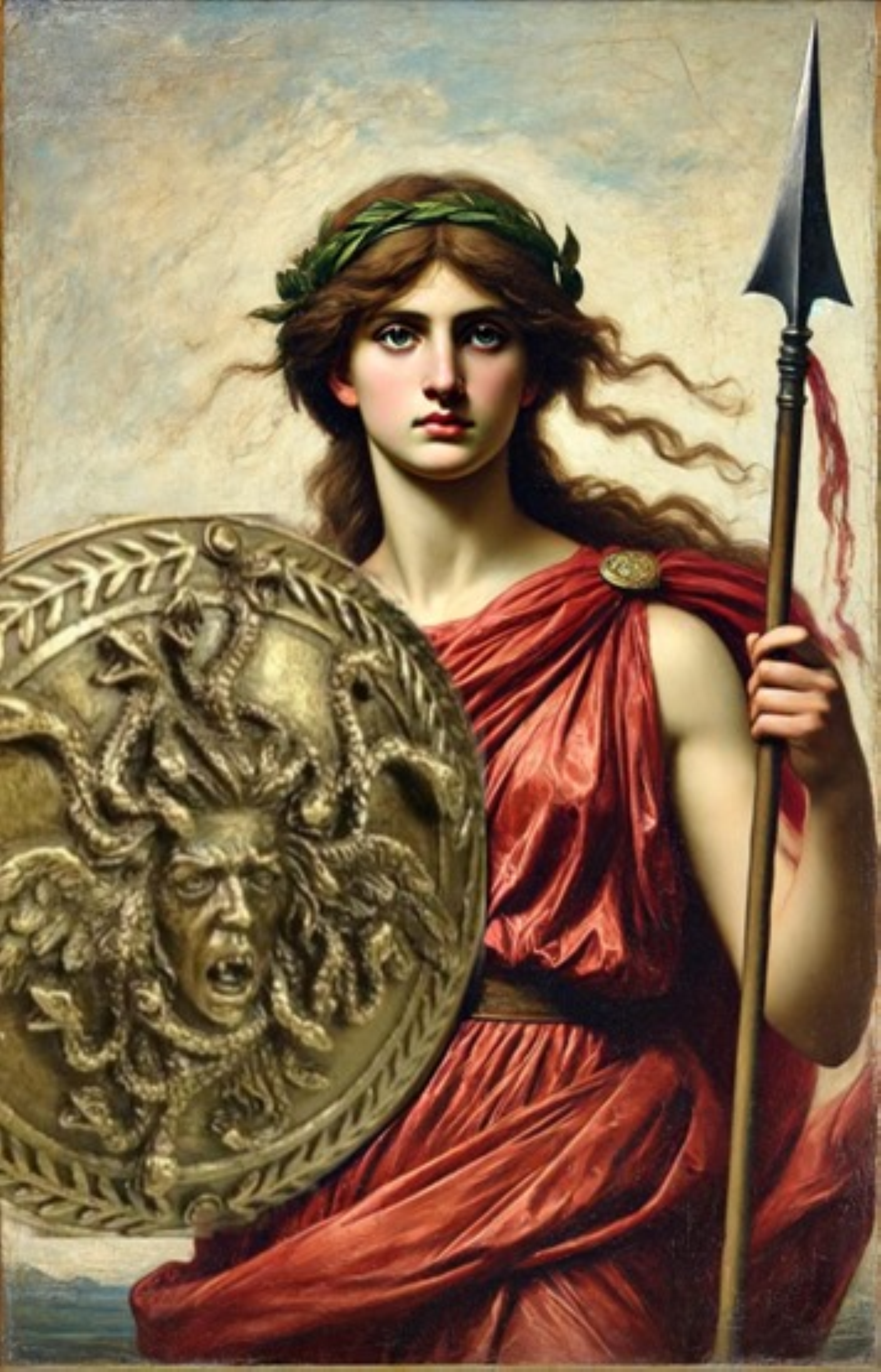
What a remarkable coincidence it is that one of Perseus's greatest helpers, sent to kill Medusa, is a winged horse, and the other is a golden sword. These gifts are given to Perseus by his father Zeus. The gleaming shield given to Perseus, meanwhile, is given by Athena herself, and bears Athena's crest.
Zeus, the god-father who constantly renews his power and dominion through dramatic acts, rapes, and intrigues, has sent alongside Perseus — to kill their own mother — the very children born of Medusa's rape.
It would of course not have been difficult for Medusa, who had grown sufficiently powerful, to defeat Perseus — an inexperienced young boy who had barely passed through adolescence. But what convinced Medusa to accept death was seeing, arrayed against her, her own children and the shield of the goddess mother Athena — whom she had prayed for all her life and never managed to be angry with. Those who come to kill her are the family she could never bring herself to rage against and never stopped worshipping.
THE RETURN HOME
Medusa's heart breaks; she is weary of fighting, and she gives up. She allows Perseus to kill her. For only in death will she be able to return to her mother's hearth. In a tragic victory, even at the cost of her life, Medusa will settle accounts — only through her own death — with her mother Ceto, who had sent her as a slave to Athena's house, never stood by her in any way, and remained silent when she was raped.
The mythological story does not recount the event in these terms, but the name of the sea monster killed using Medusa's gaze is Ceto.
Medusa's survival after everything she has endured, her transformation into a powerful woman, means nothing to her own family. They do not accept Medusa into their home. Because for them, she is no longer a young girl living in their house — she is a woman who has been raped, whose virginity has been taken, whose honor has been defiled. Even if she is their own child, they will not allow her through the door of their supposedly honorable, clean home. There is only one way for Medusa to return to her father's hearth: to give up the life she has grown weary of fighting for, and to die.
The monster mother Ceto, confronted with her daughter's severed head, is turned to stone and buried in the depths of the sea.
ATHENA'S BLOODY VICTORY
Perseus brings Medusa's severed head to Athena. Athena has the image of a snake-haired monster — depicted as grotesquely as in the slander she had cast — engraved upon her famous shield. The victor of the battle appears to be Athena, the mother goddess and enforcer of patriarchal law.
AND WHAT ABOUT TODAY, 3,000 YEARS LATER?
Can we say that the young women who are victimized in this story — which repeats itself tirelessly — ever win? In developed countries, perhaps partially yes.
But in our country, are not most rapes committed within the family?
While the woman who stays silent and endures continues her life as a domestic slave, is not the woman who resists and fights back killed — by her own children, her husband, her brothers, or her father?
Is not the woman cast out into the street pushed aside and isolated by everyone — including her own family — and, if she cannot stand on her own two feet, ultimately abandoned to the use of predatory men because the state does not support her sufficiently either?
Are not the children she has given birth to and cannot care for seized by her husband's family?
Do we not live in a country where people are still made uncomfortable by a free young woman's gaze, her speech, her achievements, her hair, her laughter, her walk, her desire to read?
Does not the concept of a free, independent woman still correspond in Anatolia to the definition of a wayward, ownerless woman?
Medusa, whose story is written in the stars, is the woman of our own land.
The woman whose intelligence, beautiful hair, voice, and achievements are seen as a threat. Is this woman not still being imprisoned behind dark veils, stripped of her profession, stripped of her qualifications, robbed of her voice, and kept confined within homes?
THE PEN THAT WRITES THE STORY
What drives the goddess mother, the god father, and the patriarchy they embody most mad is that they were unable to silence Medusa's cry — that she was able to build a life on her own, that she grew stronger, and that she survived despite the sick love she felt for them.
But the pen that writes the woman's story is still in the hands of the patriarchs, and so dominant history becomes the history of the dominant... As long as the patriarchy that commits rape is the one writing the story of the woman who is raped, the young woman continues to be portrayed as a devil, snake-haired, forked-tongued, a monster to be feared.
Medusa's 3,000-year history, written by men, still echoes in the faces and names of different women, in halls of justice, in councils, on the walls of courtrooms. For some reason, innocence is still found guilty, and a history in which killers receive sentence reductions for good conduct — continuing to live freely in their natural environments under the pretext of masculinity — has been repeating itself for thousands of years.
Medusa the woman was raped, her innocence stolen, found unclean and driven from the doors by her own mother and father, punished, exiled, isolated, and killed. This is a grave crime against humanity that spans the ages.
TEMPLATES IN GREEK TRAGEDY
Each of the characters in Greek tragedy is in fact a template. Zeus and Poseidon correspond to the theocratic or autocratic ruling class; these patriarchs do not always have to be kings. These men are sometimes the governor of a province, sometimes a tribal chief, and sometimes simply the father or grandfather within a household.
Athena corresponds to the type of woman who has accepted the order created by men. Women who fall into this template endorse the patriarchal system's oppression of women at least as much as men do, and ensure its continuation. In fact, because they have greater control over situations within the home, they behave even more cruelly. After all, it is Athena — a woman — who places the weapon in Perseus's hand to kill Medusa.
Perseus, meanwhile, is typically the young man who is handed a weapon by the powerful patriarch and made to commit murder. The persuasive power of traditions and customs, and the patriarch's influence over the young man, are so great that the young man, with the weapon placed in his hand, kills the young woman he does not know and has no quarrel with without a second thought — and in return is declared a hero for having cleansed the honor of his father, his household, and indeed of manhood as a whole.
The characters who fill these templates and the traditions that define the broad outlines of this template are encountered with particular frequency in our country. So much so that the number of femicides committed each year is rising sharply. That is to say, the killer Perseus — handed a weapon by his patriarch — continues to spill Medusa's blood in the corridors of courts where innocence is found guilty, like a 3,000-year victory cry of the patriarchal world.
As long as our country continues to adopt and perpetuate as culture the traditions of a patriarchy that thundered three thousand years ago and holds no meaning for developed nations, neither will femicides come to an end, nor will it be possible to escape being judged by advanced civilizations as underdeveloped, primitive, tyrannical monsters.
Most Read

It never ends: Another FETÖ memory

A mind fixated on leggings...

Famous director Ezel Akay and his brother have been detained

He announced which municipalities will join the 'New Party', the Istanbul detail drew attention

The official, rumored to be switching to the AKP, has begun a persuasion tour

The debates within the CHP do not interest me at all

A critical distinction in the claim about eating out

Ümit Özdağ's comment on the new party

Strict oversight for novice drivers

Enver Altaylı claim in the Yazıcıoğlu file