



We Are Now Members of a Community That Has Not Just Changed, But Has Been Transformed
What does an advanced society promise its members? Even without going into a detailed definition, when we list the first few items that come to mind, we create a picture in our minds and involuntarily compare this tableau with the opportunities of the community in which we live.Let us think together; even if our words are not exactly the same, it is highly probable that we would list the same things, with perhaps one or two variations: the protection of the right to life, security of housing, the absence of anxiety regarding nutrition, opportunities for working under safe and legal conditions, and the existence of a legal system and law enforcement whose justice is trusted.
Furthermore, since we do not evaluate life solely from our own perspective, another natural expectation is the need to know that our future generations are secure. These prerequisites, which come to mind at first thought and barely exceed the fingers of one hand, are our essentials for the livability of the community in which we live.
Even if this list does not consist of expressions whose demands are obvious or familiar in everyday language, their absence causes common reactions to be displayed as a community. In the current situation, the fact that we are hearing emergency sirens in all news sources reflecting the public is undoubtedly a result of this reaction.
Redefining the Community
Perhaps it is time to gather around a table and define the situation we are currently in? We need to redefine the community we live in. We keep making all sorts of comments about a society we haven't defined and therefore don't truly know, constantly expressing astonishment and saying, 'this situation cannot continue like this.' This reaction is certainly necessary to draw attention to the course of events; however, we must sincerely admit that we are being drawn into a spiral of endless repetition that is not effective. Because we are drifting along with the very community that ends up on the third page of newspapers, the one we report on, feel sad about, get angry at, and even feel rage toward. We are no longer members of a changing society, but of one that has already changed, and unfortunately, our new characteristic features do not point to a civilized community.
So, in a country that has settled into a sedentary order, where there is a parliament, where a bunch of men in ties and suits walk from here to there, where there are universities, professors, hospitals, all sorts of institutions, a legal system, and media outlets, wouldn't it be a bit strange to call this country a tribe? It is a situation whose peculiarity is self-evident. Even though all the system components are present and appear to be functioning, could it be that the gears are actually turning backward? And instead of becoming a civilized society, could we be turning into a primitive tribe?
Differences Between Primitive and Modern Societies
In his work titled The Division of Labor in Society, Durkheim analyzes the differences between primitive and modern societies, pointing to the dominance of mechanical solidarity in primitive societies. According to Durkheim, mechanical solidarity, is a type of solidarity where individuals have similar functions and common values prevail. In such societies, law is repressive and punishes the violation of social norms severely.
In modern societies, however, organic solidarity prevails, and the law is more restitutive in nature.
Therefore, in societies where the law is forced to take on a repressive role, the community's relationship with crime, morality, and ethics is at a much different level than it is in modern societies. Can we speak of the absence of degeneration and destruction in a community where crimes trigger punishments and punishments trigger crimes?
So, what kind of country are we? What kind of community are we members of? Who are we?
Could we be a tribe that has been dressed in the clothes of civilization and appears modern, but when looked at from within, does not hesitate to kill, normalizes violence, and is moving further away from scientific methods and scientific ways of thinking with each passing day, holding itself back?
Can a person determine what needs to be fixed without knowing what they are? Therefore, we must first identify who we are and where we stand on the scale of civilization through the most realistic analyses. After all, the accurate measurement of variables depends on predetermined fixed values. The scale of civilization is not as abstract a unit of measurement as we might think.
Specifically, no community has transformed into a modern society without overcoming the painful processes of being a primitive tribe. Therefore, the constants regarding what a modern society should look like are available to humanity. Even when we look at the first names that come to mind, the exact correspondence of the findings we encounter is astonishing.
It is truly surprising to clearly see the characteristics of the society we live in within the templates created by scientists who have worked on this subject and analyzed primitive societies, modern societies, and the differences between them.
The Scale of Civilization
For example, when Freud discusses legal systems in primitive tribes, he states that law is built upon collective consciousness and shared values. Social norms are maintained through beliefs and values shared by tribe members. Therefore, instead of written laws, social pressure and exclusion—common rules that everyone knows and follows—play a significant role. Individuals who do not conform to social rules may be ostracized by the tribe or face ritualistic punishments. Thus, such social mechanisms compel individuals to behave in accordance with social norms.
Max Weber emphasizes the importance of rationalization as a fundamental characteristic of modern societies. He defines rationalization as the process of organizing social life and institutions in a rational and systematic manner.This process is characterized by the replacement of traditional and charismatic authorities with bureaucratic and legal authorities. According to Weber, in modern societies, decisions and actions are taken within the framework of rational and legal rules rather than personal and arbitrary judgments. This is because bureaucracy, a management system where specialized and professional administrators conduct their work within the framework of specific rules and procedures, is the most prominent feature of modern societies. Bureaucracy, which ensures efficiency and accountability, is the only way to regulate the complex needs and functions of modern societies. Furthermore, Weber states that law forms the foundation of the rationalization process in modern societies.
While continuing this discussion, it is, of course, impossible to overlook Claude Lévi-Strauss’s book, The Savage Mind. In his work 'The Savage Mind', Lévi-Strauss discusses the most prominent units of measurement on the scale of civilization while describing the characteristics of communities that exhibit tribal traits versus modern communities. According to Lévi-Strauss, primitive societies behave more like 'bricoleurs' to make sense of their environment; that is, they use existing materials and resources. Modern societies, on the other hand, use 'scientific' and systematic methods to make sense of the environment in which they live. While social systems in modern societies rely on bureaucratic and institutional organizational structures, the social systems of primitive societies are generally based on kinship ties and rituals.
Mythology and rituals are the methods by which primitive societies understand and explain the world. So much so that while myths are used even to make sense of natural phenomena and social norms, the methods modern societies use to explain themselves do not go beyond a scientific and rational framework.
Nancy Fraser, meanwhile, ties the prerequisite for achieving a modern society to the necessity of carrying out economic, cultural, and social reforms in tandem. According to Fraser, the dynamics of social justice, economic equality, and recognition in a society are directly linked to gender equality within that society. Gender equality is the touchstone of the multifaceted reforms necessary for a modern society.
In the light of the work of these and similar masters, the templates of civilized society we have reached are the result of experiences formed through cross-era research. Therefore, it is not possible to assign this knowledge to a single nation, a single class, or a biased framework.
Therefore, when we look at our own position within this template of experience, findings, and accumulated knowledge, the reality that we receive as a grave insult is this: "Acting like a primitive tribe, the only result that can be achieved is to become a primitive tribe."
If, in the community we live in, the voices of the tribe are rising every day with more confidence under the guise of 'our cultural characteristics.' And if these voices are conveying to us a pedophilic criminal act—that a 13-year-old girl can be married off with an Islamic marriage contract if her mother and father permit it. If the same voice is powerful enough to conceptualize honor killings under the veil of tradition, positioning the murderer in a justified place within the conscience of society. I believe it is not a very complex process to determine whether the voices rising from the traditional pit we call culture are emerging from a modern society or a primitive tribe. Moreover, if these voices are being served to real lives on the stage of dogmatic constants as practices whose implementation is clearly evident, don't we really need to stop and think:
Are we a primitive tribe of 80 million? What are the most fundamental reforms a tribe needs to become a civilized society? What are the ways to bring the necessary reforms to today's society?
Most Read

Striking picture for Özgür Özel's 'New Party'

Özgür Özel gives a dated response regarding the number of resignations

Forest fire in Antalya brought under control

Houthis strike Saudi-owned tanker

4 drones shot down near US Consulate General in Erbil

Özel’s new party move in the world press

Famous director Ezel Akay and his brother have been detained
The new rule of the field: Attrition
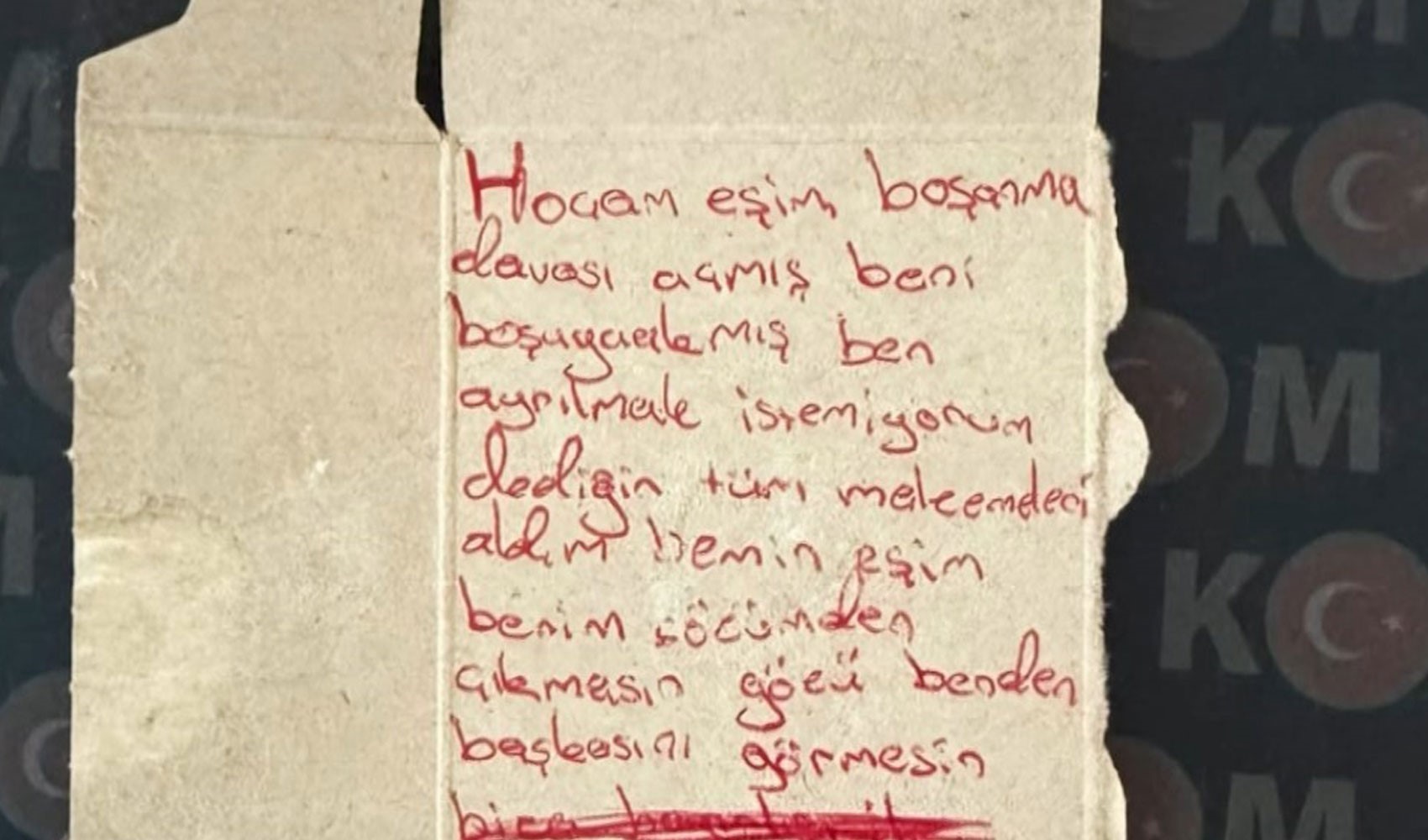
'Papers with spells and curses' operation: 'Master, my spouse filed for divorce'

Key figure in Epstein files found dead at home