



THE UNEASINESS OF CIVILIZATION
In his book Civilization and Its Discontents, Sigmund Freud states: civilization is founded on the suppression of individuals' primitive instincts, and the tension this suppression process creates in human psychology.
If we draw an inference from the word tension, there is an inverse correlation between civilization and violence.
According to Freud, there are two basic instincts in human nature. The first is what he calls the life instinct; Eros, which expresses drives toward love, sexuality, and creative energy, and the second is Thanatos, which expresses drives toward destructive, aggressive, and violent tendencies, that is, the death instinct. Human nature suppresses drives that need to be repressed, such as violence and sexuality, in order to adapt to social order and live in a safe environment. This state of beneficial conflict is what we call civilization, to the extent that individuals can restrain themselves.
In this case, is it possible to say that in a place where there is no civilization, all obstacles to violent tendencies will be removed and society will drift into chaos?
Before reaching such a definitive judgment, we need to take a look at what civilization means in our cultural consciousness...
SOCIAL CONTRACT AND CIVILIZATION
Let us imagine a tribe that we assume to be primitive; even if they are unaware of any of the stages of civilization we have today, it is necessary for the people of this community to create a set of rules that everyone accepts in order to live together. To maintain their existence in safety and survive, the people of the community must choose to submit to the rules of the community by giving up their individual freedoms. Otherwise, they will destroy each other in a very short time.
One of the important thinkers of the Enlightenment period, the English philosopher John Locke, says, "Where there is no law, there is no freedom; for freedom is to be free from the restraint and violence of others. This is not a freedom where everyone can do whatever they want. Who could be free in a place where everyone acts according to their own whims?"
However, a lot of water has flowed under the bridge since people lived only in tribes. As you are well aware, there are now countries with populations exceeding billions. Although not all countries are at the same level of development, there are modern, scientific, economically prosperous countries that act according to rational principles in terms of civilization. It is not that we do not know which enlightenment stages these functional countries have gone through and, therefore, how a civilization should be built.
For example, we now know that a community cannot be kept from crime solely through a punishment system. We also now know that in a civilized society, individuals must be included in a rational, scientific, and civilized education system.
"SELF-MORALITY"
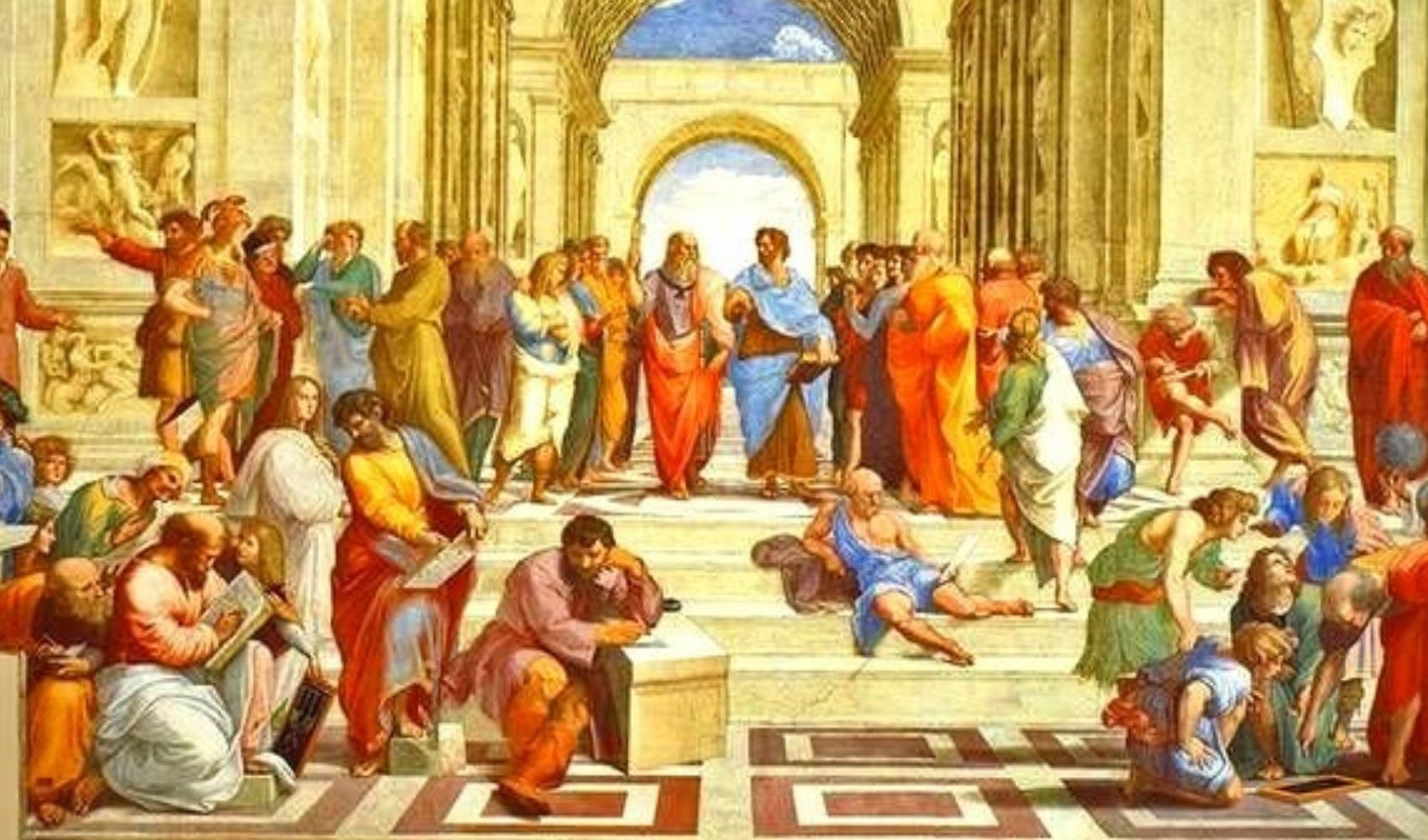
(The School of Athens-1509 and 1511-Raphael)
We cannot expect people who do not receive a rational education, who do not learn scientific thinking methods, and therefore cannot healthily establish connections and causal relationships between events, to form a concept of individual "self-morality." Individuals who lack self-morality and shape their character through the pressures of externally sourced moral principles, when faced with a moral dilemma, make decisions in favor of their personal interests due to the lack of a moral structure that has not taken shape within their essence. In a community composed of such individuals, it is not possible to keep injustices and, naturally, violence under control.
What was Kant saying when he spoke of the "Kategorische imperativ" principle? "Handle so, dass die Maxime deines Willens jederzeit zugleich als Prinzip einer allgemeinen Gesetzgebung gelten könne." "Act only according to that maxim whereby you can at the same time will that it should become a universal law."
Civilization can only be spoken of in a country composed of individuals who possess the moral structure expressed by Kant. Otherwise, we are forced to live in a country established by people who serve at every level of society but lack individual "self-morality."

This photo is from a highway in Germany. Cars that hear the sound of an ambulance pull over to the right and left as much as possible to make way for the ambulance. The reason for this is not the idea that "one day we might be in that rescue vehicle." Because this behavior is a kindness that contains self-interest, is insincere, and is even partially malicious. The goal of the people opening the way is to maintain the functionality of the system they are in, in the person of the individual in the ambulance. It does not cross the mind of any of them to follow the ambulance to speed through the road, nor to endanger the life of the patient in the ambulance by usurping the rights of all other vehicles waiting on the road. Both the patient inside the ambulance and the workers possess this knowledge and sense of trust. There is a sentence often said in Germany in such situations, which translates roughly to: "If we break even this simple rule, where will we end up as a community?" they say.
CRACKS IN THE WALL OF CIVILIZATION
In countries where civilization can be established, there is a social contract between the state and the nation. This contract has been signed between the legal entity of the nation and the legal entity of the state. This social contract, whose purpose is to ensure the welfare and security of the community, is based on mutual trust.
However, when the contract is not adhered to in practice, moral gaps begin to form in the social contract based on trust. According to Locke, chaos prevails in a society where there is no social contract. When these moral corruptions permeate institutions, education, and daily life, the social contract between the state and the nation is completely broken in the long run.
And returning to the very beginning, we are faced with candidates for humanity, as Freud mentioned, who have severed their ties with civilization and do not shy away from committing violence.
For a person whose trust in social commitments has been shaken, cracks have already formed in the wall of civilization between them and violence. Violence, which emerges along with the collapsing moral values of people, first begins to harm the most needy and vulnerable members of the community: animals, babies, boys and girls, the elderly, women, and men. Screams begin to rise from all over the country. Murders, suicides, income inequality, class gaps, thefts, and frauds increase rapidly and exponentially.
Everyone waits for this disaster, which they watch with fearful eyes, to stop somewhere. However, without a serious, broad-based, and reformist intervention, unfortunately, this situation is not a process of deterioration that has an end. A nation is too valuable to be sacrificed to ideological fights, ambitions for power, political interest struggles, and material gains. While the gears of the broken system have begun to grind people, and the country has turned into a place of fire, measures must certainly be taken.
Moreover, these measures do not need to be invented from scratch. Both the mobilization for civilization and modernity implemented by Mustafa Kemal Atatürk in our recent history is an example that is possible and essential to repeat, and there are many examples in the world of countries that have successfully completed the Enlightenment period and are still developing. These measures are necessary for every corner of our country with a requirement that transcends politics and ideologies. Otherwise, within the next ten years, our country will turn into a country we do not recognize, do not want to live in, and are even looking for ways to escape from.
Most Read

Striking picture for Özgür Özel's 'New Party'

Özgür Özel gives a dated response regarding the number of resignations

Forest fire in Antalya brought under control

The PKK opening and Özgür Özel’s path!..

How did the newspapers view Özgür Özel's farewell to the CHP?

What did the CHP do?

Özel’s new party move in the world press

The New CHP, against CEHAPE

From self-efficacy to despair

The return of craftsmanship in the age of artificial intelligence