



Were trade routes built between civilizations, or were civilizations established along routes where these paths were geographically possible? The story of the Silk Road, along which hundreds of civilizations have emerged and vanished, drives us to the threshold of such a paradigm.
Although the saying "Whoever holds the seal is Solomon" is common among the people, when we step aside and look at the situation from a broader perspective, we can easily see that whoever controls the trade route holds the seal.
The Silk Road is, of course, the most impressive of these routes; in the minds of most of us, a historical, even fairy-tale scenario comes to life, with caravans crossing deserts, mountains, and plains, bringing all kinds of spices and colorful woven silks to the ports on the coast.
However, even though this story has been rewritten countless times over thousands of years, the Silk Road route has always continued to exist.
The Western Han Dynasty played a significant role in the establishment and development of the Silk Road. During this period, the route starting from China, crossing the Taklamakan Desert, and then reaching Uzbekistan, Kyrgyzstan, and Kazakhstan, branched out in Central Asia; while some paths went south to India, others continued through Persia and Mesopotamia. After passing through the Middle East, it reached the Mediterranean in cities like Antioch and Tyre, and the goods that had arrived here were transported to Europe, especially to Rome.
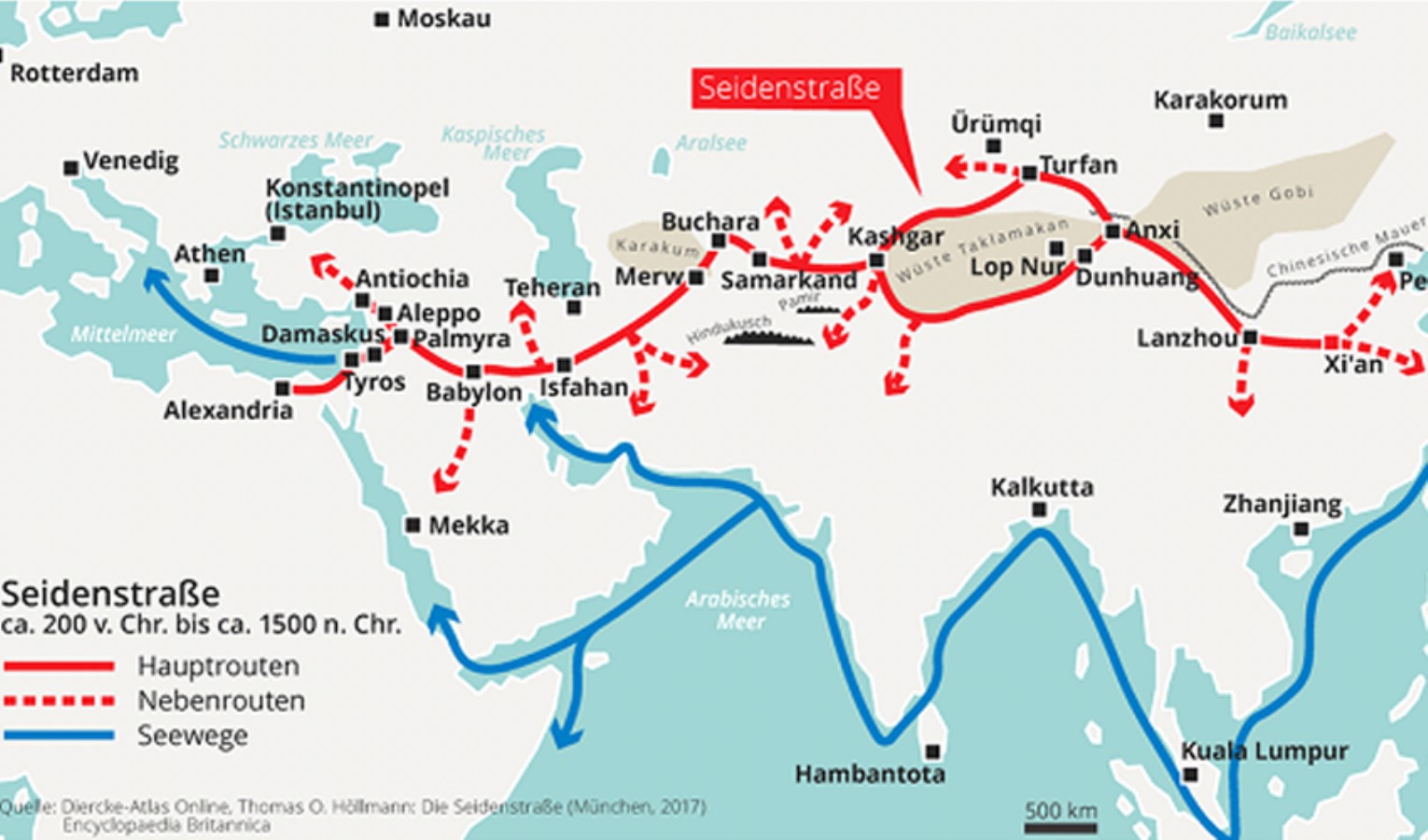
The Silk Road 200 B.C. – 1500 A.D.
FROM OBOR TO IMEC: THE CHANGING GEOPOLITICS OF TRADE ROUTES
Launched in 2013 by Chinese leader Xi Jinping, "One Belt, One Road" (OBOR) – also known as the New Silk Road Project – saw 140 countries participate in the summit held last week to celebrate its 10th anniversary.
There are 64 countries, including Turkey, within the scope of the New Silk Road project. China, which has no rivals in this field, holds sole dominance over the routes below.
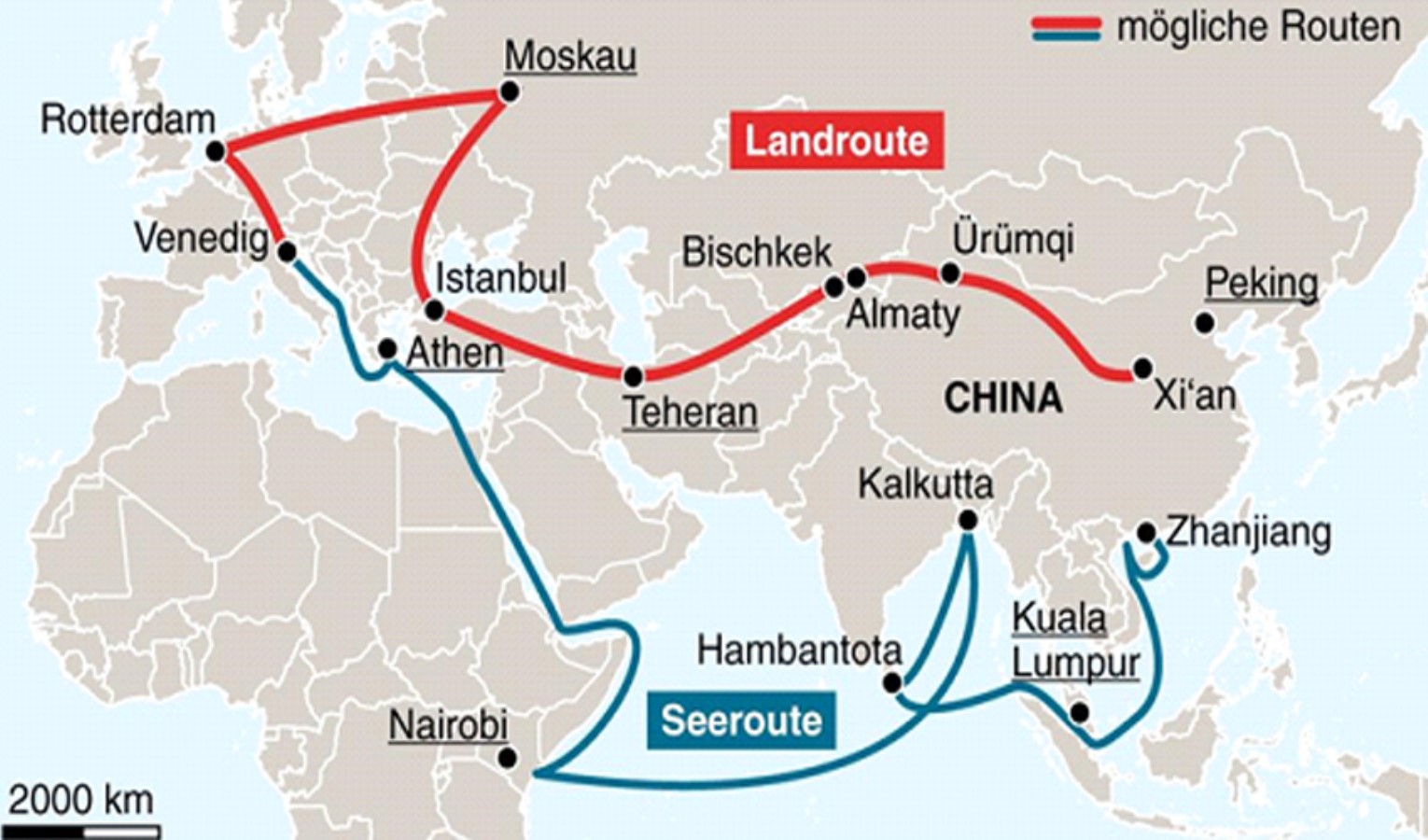
OBOR (One Belt, One Road)
The fact that control of the New Silk Road project lies solely in China's hands worries other superpowers. This is because it represents not only a supply system outside their control but also a security concern.
OBSTACLES TO EUROPE'S SILK ROAD STRATEGY
For a long time, Europe has been preparing global infrastructure projects to balance China's dominant influence over trade routes. It is understood that if an unexpected disruption occurs on a route controlled by a single power, it is not possible to establish trade routes overnight.
The problem is not just about investing or building infrastructure, of course; political balances in the region must also be aligned accordingly, and countries with disputes must be persuaded to work together.
POWER STRUGGLE OVER TRADE ROUTES: CHINA, THE EU, AND THE US
At the G-20 summit held in New Delhi last September, European Union countries, along with America, India, Saudi Arabia, and Israel, agreed to establish a new trade route connection and decided to create a trade corridor.
European Commission President Ursula von der Leyen described this formation, called "IMEEC" (India-Middle East-Europe Economic Corridor), "the beginning of a historic project" as. US President Joe Biden promised a brighter future for the Middle East. IMEEC is intended to be an alternative to the "New Silk Road."
The absence of any alternative trade route to the New Silk Road in the region is causing anxiety not only for countries competing with China but also for member states that are dependent on a single trade route.
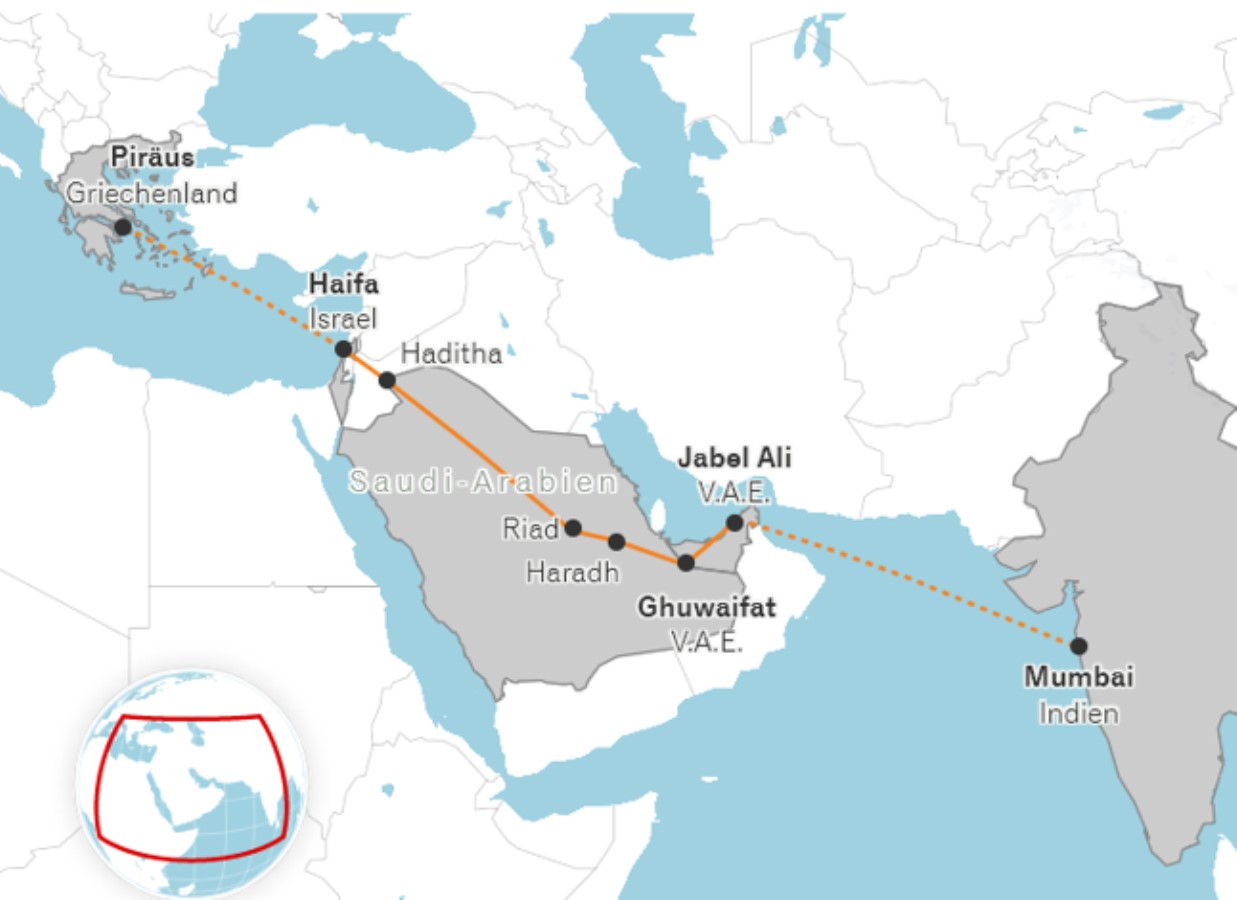
IMEC (India-Middle East-Europe Economic Corridor)
MIDDLE EASTERN DYNAMICS: THE FUTURE OF NEW TRADE ROUTES AND OBSTACLES
IMEC is a trade route project aimed at connecting India to Europe via the United Arab Emirates, Saudi Arabia, Jordan, Israel, and Greece. Containers loaded in the Indian city of Mumbai would first be sent to Dubai, from where they would cross the Arabian desert via a planned railway to reach Israel's Haifa Port. From Haifa, they would be shipped by sea to the Port of Piraeus in Greece and then on to Western Europe.
The prerequisite for establishing a trade corridor intended to pass through the Middle East was to secure peace between Saudi Arabia and Israel in the region and to convince these two countries to work together on the creation of the new trade route.
While the cooperation of these two countries was expected to act as a key to opening the doors for the IMEC Project, negotiations between Saudi Arabia and Israel have come to a standstill due to the suddenly ignited Israel-Hamas war in the region.
Shortly thereafter, the German Federal Foreign Office announced that the project had been halted and postponed to an indefinite date, as the consequences of the war between Israel and Hamas are currently unpredictable.
I must note here that one should not fall into the trap of simple conspiracy theories. Especially when it comes to legal trade, every country seeks to protect its own interests, and statecraft is capable enough of utilizing alternatives and bureaucratic channels without needing such games.
However, there is one thing that never changes, and that is criminality, pirates, gangs, and terrorist organizations.
Just as they threatened countries trading along the Silk Road in the 200s BC, the situation remains the same today. Lacking a higher intelligence, they can prepare impulsive scenarios and even shake international balances. Isn't this one of the reasons for the formation of state structures anyway? Using monopolized violence for defense and control within the framework of a constitutional order is undoubtedly one of the primary duties of states.
EUROPE'S ANTI-SILK ROAD STRATEGY
EU countries and America are aware that this is a long-term project and of the problems they may encounter along this long road. The purpose of the GLOBAL GATEWAY FORUM meeting held in Brussels last Wednesday and Thursday was to explain the major infrastructure projects they envision for developing and emerging countries and to take the necessary steps to realize these projects.
EU Commission President von der Leyen spoke at the meeting as follows: "Europe needs to have a positive offer for these countries. Our goal is to make the EU a geopolitical actor. Europe's proposal is not to engage in debt-trap diplomacy by buying the political loyalty of developing countries like China does. Our goal is to be partners on equal terms with the countries we work with. The world truly needs investment."
Von der Leyen added that they would make the necessary investments to establish the infrastructure for renewable energy and green energy restructuring efforts within the scope of the project.
Europe plans to allocate a total of 300 billion Euros for the Global Gateway project. The source of a large portion of this money will be private investors. In this context, while it is planned to support Bangladesh with 400 million Euros in the field of renewable energy, an agreement including 500 million Euros in support for green restructuring in energy supply was signed with Vietnam last Wednesday.
EUROPE'S SILK ROAD STRATEGY: IDEALISM OR REALISM?
Experts noting that Europe is at a disadvantage against China's scale argue that a rational competition strategy and the selection of the right projects are crucial in the long term, with the most important point being that investments must be made where they can be most effective. On the other hand, they observe that developed and developing countries have not seen their expectations met in agreements made with China regarding the new Silk Road, and that the infrastructure projects China has carried out in these countries have led to environmental pollution and high levels of debt. They state that while China grapples with its own economic stagnation, it has chosen to cut costs in its investments in these countries, thereby alienating some of them.
Indicators also suggest that the timing is ideal for Europe to make offers to these countries against China, and that while the state of war in the Middle East is stalling Europe, which is at the beginning of the road, there are no obstacles preventing China from increasing its diplomatic influence through the logistics network it has established, despite its disadvantageous position.
According to Gunter, an expert at the Mercator Institute for China Studies, although China may have to modify its plans, it will continue to generate gains and increase its diplomatic influence in the region in the coming period through the system it has established.
Most Read

Striking picture for Özgür Özel's 'New Party'

The PKK opening and Özgür Özel’s path!..

How did the newspapers view Özgür Özel's farewell to the CHP?

He killed his wife by slitting her throat: Their children witnessed the moments

What did the CHP do?

Özel’s new party move in the world press

Fire at TUSAŞ engine factory in Eskişehir under control

The New CHP, against CEHAPE

From self-efficacy to despair

Kılıçdaroğlu's first message on Özgür Özel's new party announcement