



Is the expression of human emotions through flowers a consumption trick invented by capitalism, or is it an instinctive need, woven into our subconscious with the scent of flowers tens of thousands of years ago? Before the earth's plants, which are vibrant and capable of various effects, were imprisoned in flower shops, they were a part of people's daily lives.
For women living tens of thousands of years ago, the importance of flowers was far greater than it is for modern women today.
So, what made flowers so important to women?
All over the world, despite religious and cultural differences, festivals are held at every spring equinox. The purpose of these festivals, called by similar names such as Paskalya, Easter, Ostern, Pascua, and Pesach, is to bless the arrival of spring, reproduction, sexuality, fertility, and renewal.
In times when people were intertwined with nature, the most important actors of these festivals, which were essential for continuity, were young, vibrant women and young men wearing crowns made of colorful flowers on their heads.
In these festivals, offerings were made to the spring goddess Flora, and she was thanked for recreating the new spring, flowers, and fruits.
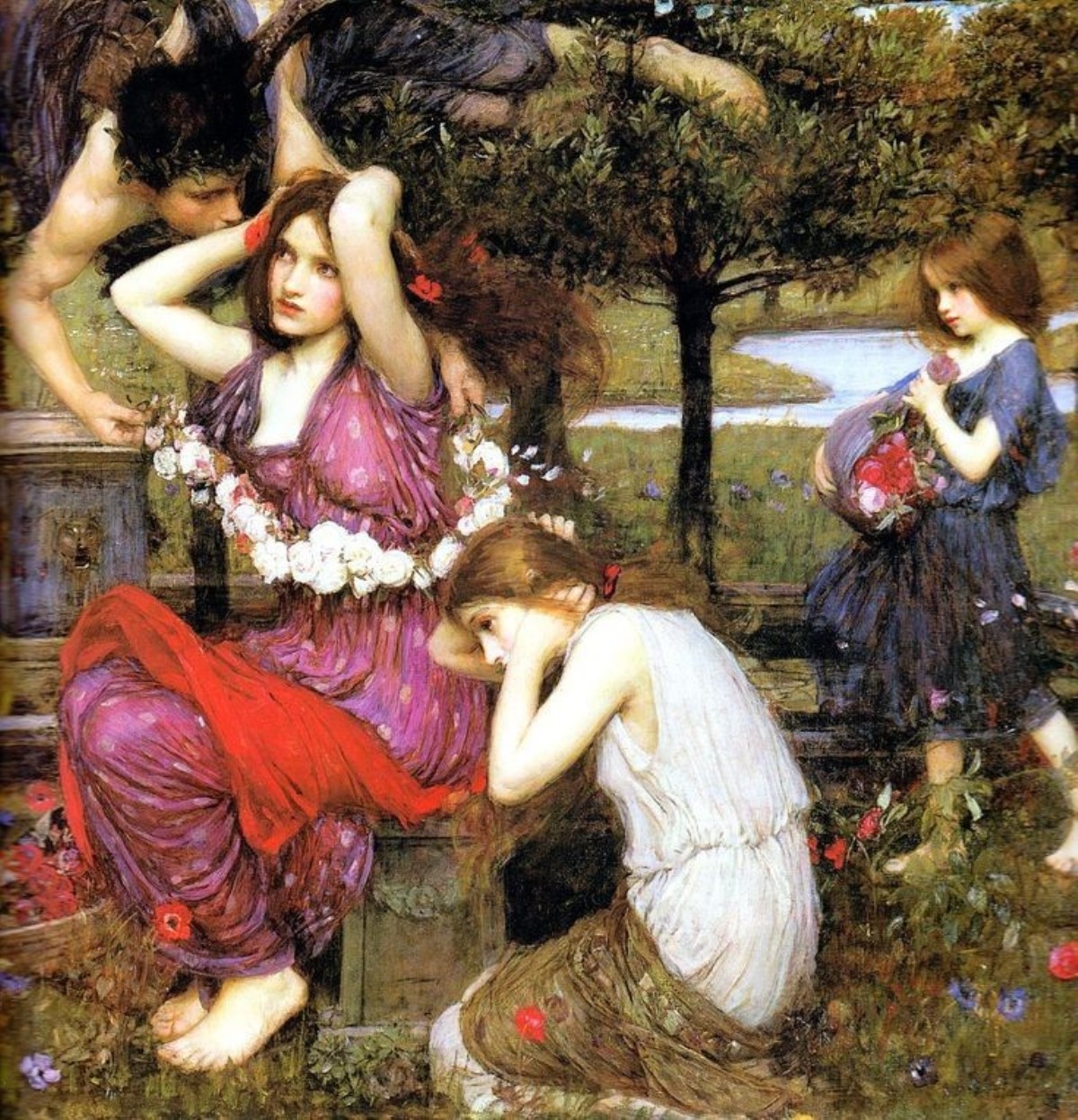
(The painting was created in 1916 by the famous British painter John William Waterhouse. Combining classical mythology, literature, and historical subjects with a contemporary aesthetic, this work by Waterhouse, who left an impact beyond his time, is based on the story collection 'The Decameron' by Giovanni Boccaccio, who is considered one of the pioneers of the Italian Renaissance. Above)
The god of the west wind, Zephyrus, wants to rest on a tree while taking a walk in the forest one day, where a sparkling river flows by. Just then, he encounters the beautiful fairy Chloris, who is adorning her hair with flowers she gathered under the tree. The wind god falls in love at first sight with the fairy, who decorates her brown hair with red flowers. Chloris, whose name means 'the green that sprouts in spring,' is also captivated by the charm of Zephyrus, who gifts her white flowers.
Before long, they decide to marry. After they marry, Chloris becomes the goddess of spring, and wherever she and Zephyrus go, nature is renewed, trees turn green, and colorful flowers of all kinds bloom everywhere. That is why the spring goddess Chloris takes the name Flora; Flora's symbol in Roman mythology is the flower.
The flower, which is generally symbolized by concepts such as love and affection, is the symbol of regeneration and pregnancy when it comes to the goddess Flora. The flower, by its biological function, is the reproductive organ of plants. It contains the stamens, the male reproductive organ, and the pistils, the female reproductive organ, which are necessary for reproduction.
The fertilization of the flower leads to the formation of seeds, which are the beginning of new life, and new seeds mean an increase in nature's diversity and new plants. Therefore, in many cultures, flowers symbolize the beginning of the life cycle, spring, and renewal; just as pregnancy symbolizes the constant renewal of life on earth in the process from fertilization to birth.
For this reason, young girls wear crowns made of special flowers on their heads during the spring festival, and together with the young, the old, and children, they dance joyfully among the food and drinks prepared for that day, wearing their most beautiful dresses. Just having survived the difficult winter season and opening the fertile door of nature once again is a great reason to celebrate.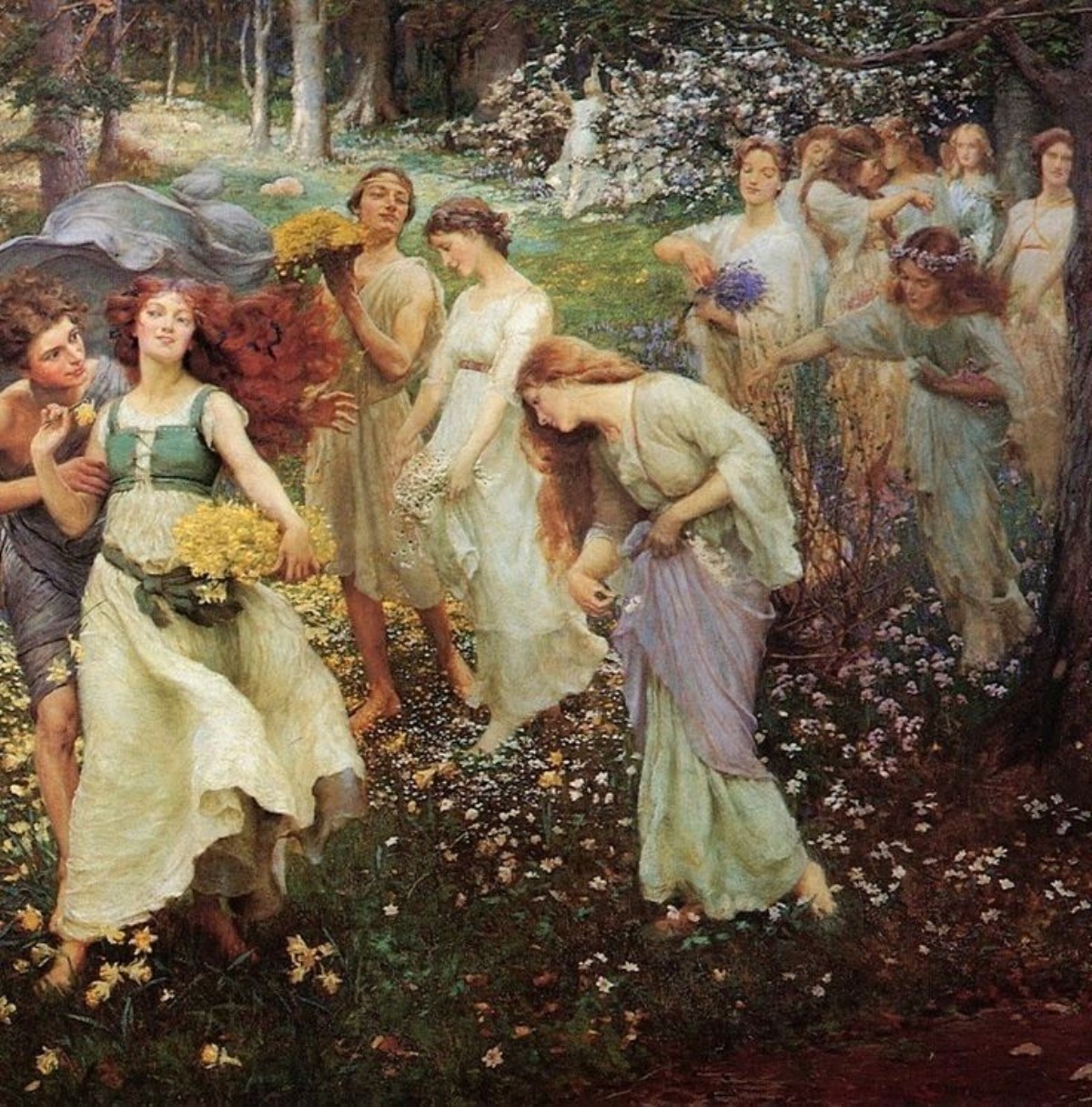
(Charles Daniel Ward, The Progress of Spring, 1905)
In the autumn, perhaps during the harvest festival, women who have begun the pregnancy process are expected to give birth nine months later, that is, in the spring months. This is where the true importance of flowers emerges; mothers and sisters actually save the life of the pregnant young woman with the flowers they make into crowns for their heads.
In times when medical help, medicine, and doctors were not even mentioned, the risk of a pregnant woman losing her life during childbirth was much higher than it is today. The only way to reduce these risks was to understand the language of flowers, herbs, roots, and fungi. This must have been the reason why women gave gifts to the goddess Flora and danced for her at spring festivals.
Flora, together with her lover Zephyrus, gifted flowers to women during the most difficult times of their lives. What was the benefit of the flowers that young women decorated their hair with and wore as crowns, and what were these plants used for?
Since I do not find it appropriate to give the names of these plants, which are much more potent than we think and some of which are even poisonous, I preferred to write about these plants using names I invented myself.
Earring Ruby Branch: Tea made with this plant strengthened the womb for birth; this led to more efficient labor pain activity.
Sunburn Herb: It was used to support postpartum uterine healing and to regulate menstruation after birth. Dalinciten herb was used to increase breast milk after birth.
Black Lake Herb: Despite its strong poisonous properties, it was used in the past to alleviate labor pains, under control and in very small doses. It was used as a muscle relaxant only in cases where birth was dangerous, to relax the birth canal muscles.
In dangerous births or miscarriages, these plants were of vital importance despite being risky. In a world where painkillers, antibiotics, and effective birth control methods did not yet exist, it is not difficult to understand what these flowers, roots, and fruits meant to a woman who spent most of her life pregnant, and why they were so revered. Moreover, until our recent past, these plants continued to be used in regions deprived of medical facilities, despite the risks.
Actually, when a man buys flowers for the woman he loves, he speaks to his partner's thousands of years of subconscious learning and fears. He is actually expressing that he understands how dangerous the pregnancy process can be, that she should not be afraid, and that he will be by her side.
It might be interesting to look at the peaceful happiness of a bouquet of wildflowers you will gift to the woman you love in the spring season from this window of our subconscious.
Most Read

Striking picture for Özgür Özel's 'New Party'

The PKK opening and Özgür Özel’s path!..

How did the newspapers view Özgür Özel's farewell to the CHP?

He killed his wife by slitting her throat: Their children witnessed the moments

What did the CHP do?

Özel’s new party move in the world press

Fire at TUSAŞ engine factory in Eskişehir under control

The New CHP, against CEHAPE

From self-efficacy to despair

Kılıçdaroğlu's first message on Özgür Özel's new party announcement