



ON KERİM SADİ'S IDENTITY CARD
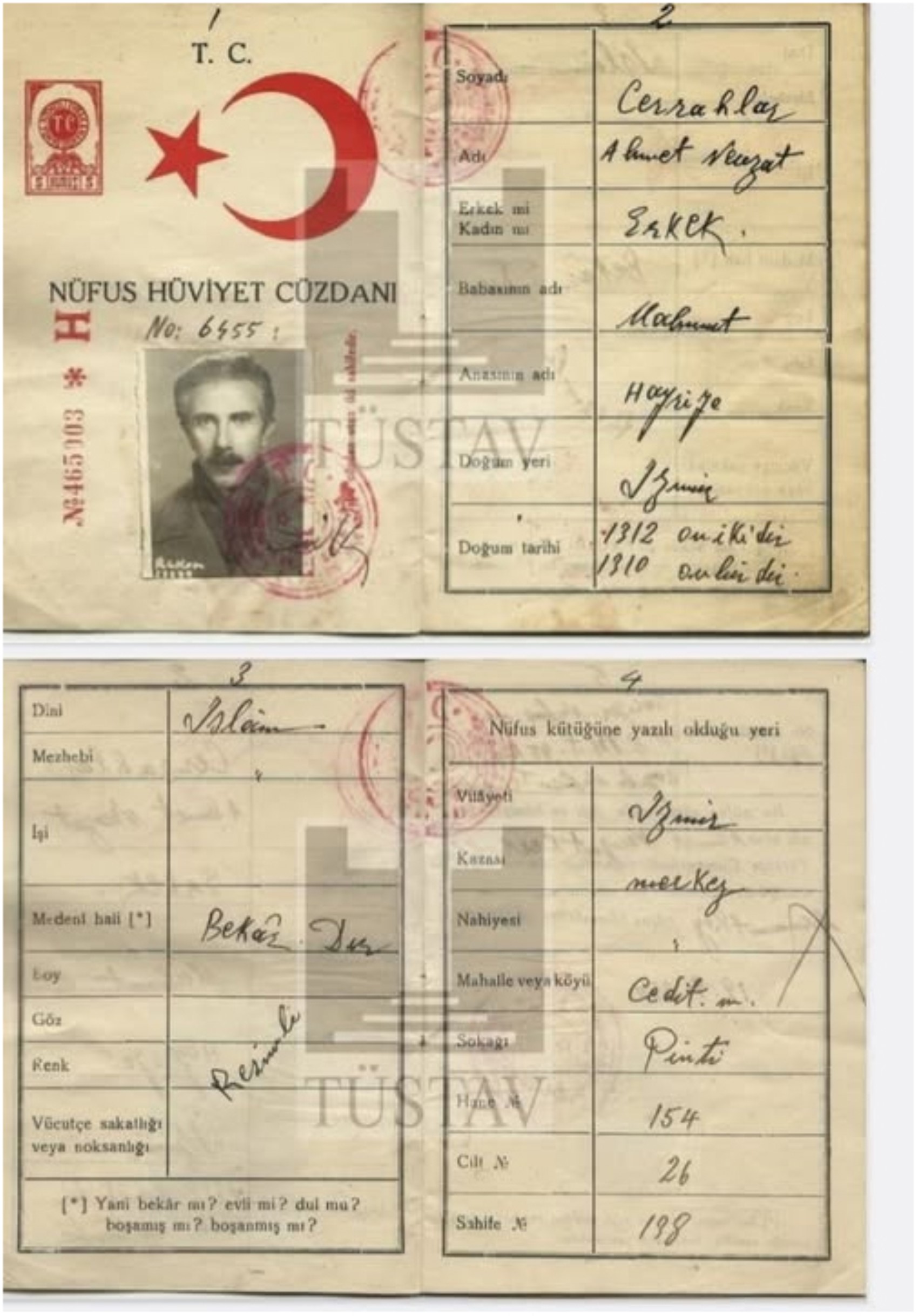
Source: Tüstav Archive
In writing this piece, I drew heavily on the TÜSTAV website. Most of his books are available there in PDF format. I highly recommend it.
Among the documents donated to the foundation is an identity card. The Marxist writer we know in the Turkish left as Kerim Sadi is registered in the civil records as Ahmet Nevzat Cerrahlar. The books he wrote after the 1960s were published under the name A. Cerrahoğlu. Professor Zafer Toprak used to refer to him as Cerrahoğlu.
I examined the identity card carefully. The card issued in 1941 was renewed on 19.9.1950. My interpretation is this: Kerim Sadi's marriage to Semiha Uzunhasan ended in divorce — or more precisely, he was abandoned by Semiha Hanım, for reasons I consider justified. Semiha Hanım had always been by his side during his exiles. She was betrayed in Konya. In the end, the card was renewed in the autumn of 1950 due to a change in marital status. Semiha Hanım married Kemal Tahir that same year.
Kerim Sadi's birth year is given as either 1900 or 1902. This information conflicts with the 1312–1310 entries in the identity card.
His marital status is recorded as single. His second marriage, dated 13.2.1962, was registered by the Üsküdar Civil Registry Office. As far as I know, his second wife was a pianist, but he later divorced her as well. When Kerim Sadi passed away, he was unmarried and had no children. (1977)
An interesting aside: Semiha Hanım has happy wedding photographs with both Kerim Sadi and Kemal Tahir. She too had been in Moscow, her connection to TKP circles running through her brother.
ZAFER TOPRAK'S ENCOUNTER WITH KERİM SADİ
VENUE: Hakkı Tarık Us LIBRARY
Professor Zafer Toprak had completed his master's degree in England after graduating from Mülkiye. Upon returning, he began his doctoral studies in economic history under Halil Sahillioğlu at the Faculty of Economics. In the meantime — to use his own term — he was appointed as a "lektör" at Boğaziçi University, a position equivalent to that of a lecturer or teaching fellow. I first saw him as a young academic who had just completed his doctorate, at our faculty's Ümit Yaşar Doğanay lecture hall.
Our professor Tarık Zafer had been invited to give a conference. The year was 1981. The conference topic was his doctoral thesis. We all know that the thesis was published under the title Türkiye'de Milli İktisat.
Professor Zafer Toprak used to visit the library managed by the foundation of former parliamentarian and journalist Hakkı Tarık Us. I went there too. The collection of newspapers from the constitutional period was particularly impressive. Today, everything in the library has been transferred to the Bayezit State Library.
Despite its invaluable holdings, it was not a place many people visited. Only engaged readers who were aware of the treasure would come.
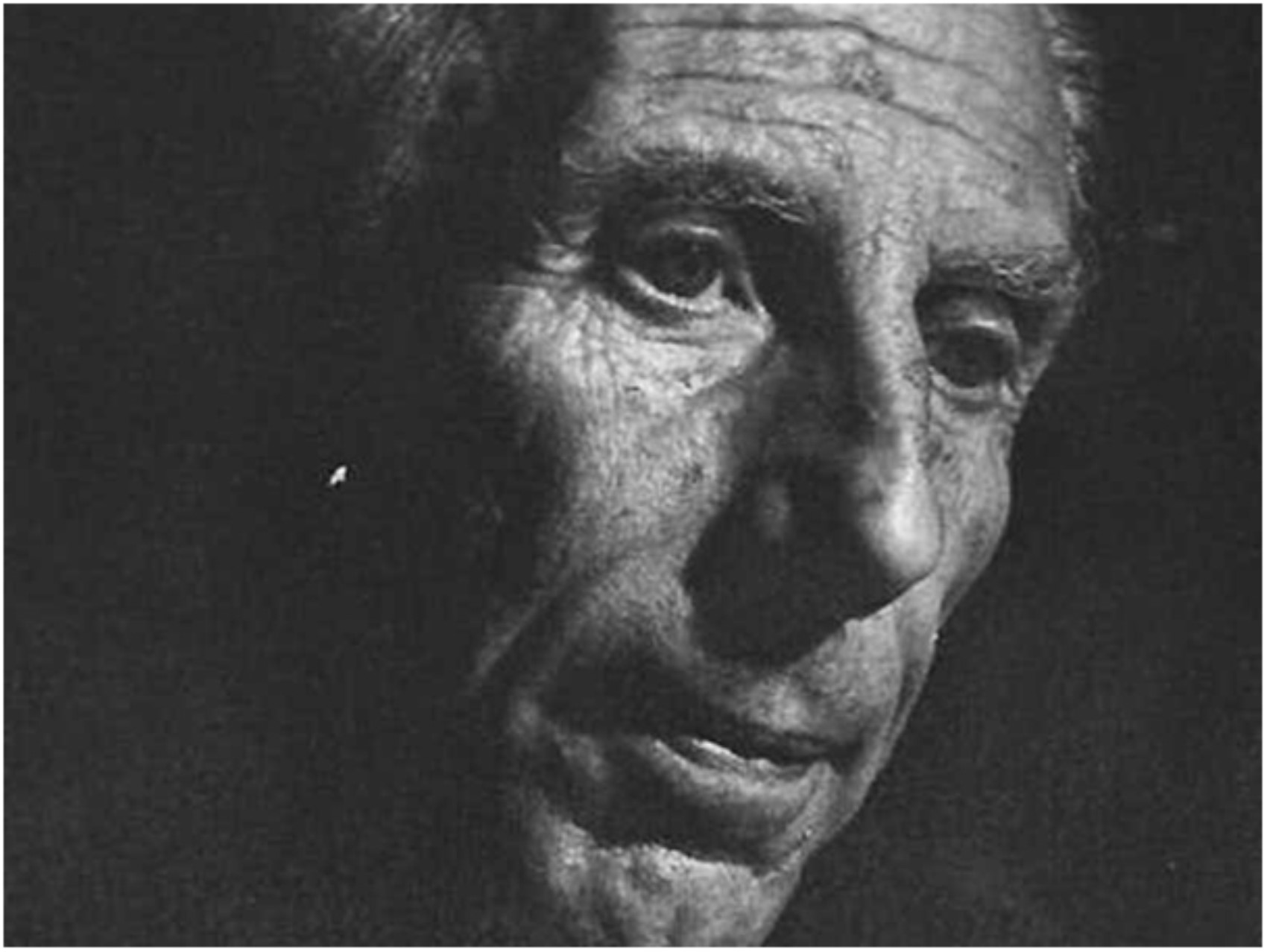
One day, while Professor Zafer was working there, a frail, elderly gentleman entered the library. This was Kerim Sadi. He used to refer to him as Cerrahoğlu — the last pen name he used.
Excited, Cerrahoğlu put Professor Zafer through a leftist knowledge test. He pointed to people in newspaper photographs and asked if he recognized them. For instance, pointing to İştirakçi Hilmi, he asked, "Do you know this man?" In the article he later wrote, Professor Zafer recounts with the pride of a student who passed the exam that he answered correctly.
As is well known, Professor Zafer Toprak had a personal history of "leftism." He even enjoyed being associated with the TKP. He also wrote several articles under a pen name in the TKP tradition (Hakkı Onur).
The date of Professor Zafer Toprak's encounter with Kerim Sadi must have been 1976, given that he says Kerim Sadi died a year later. I came across this pleasant meeting in the article Hoca wrote titled "Aydınlıktan Katkıya Kerim Sadi'nin Türkiye'de Marksist Düşünceye Katkısı."
I do not find it particularly meaningful to remember Kerim Sadi primarily as a TKP member. His party affiliation belongs to his youth, during the era of Dr. Şefik Hüsnü. He was a Marxist. He was an intellectual. He was a bibliomaniac.
I now better understand that the excitement behind Professor Zafer Bey's emphasis on "Cerrahoğlu" in his talks stemmed from that encounter at the Hakkı Tarık Us Library. At the time of that meeting, Kerim Sadi was one of the monuments of Turkish left history, while our Professor Zafer was still a doctoral student who had just entered academia.
KERİM SADİ'S CRITIQUES AND POLEMICS
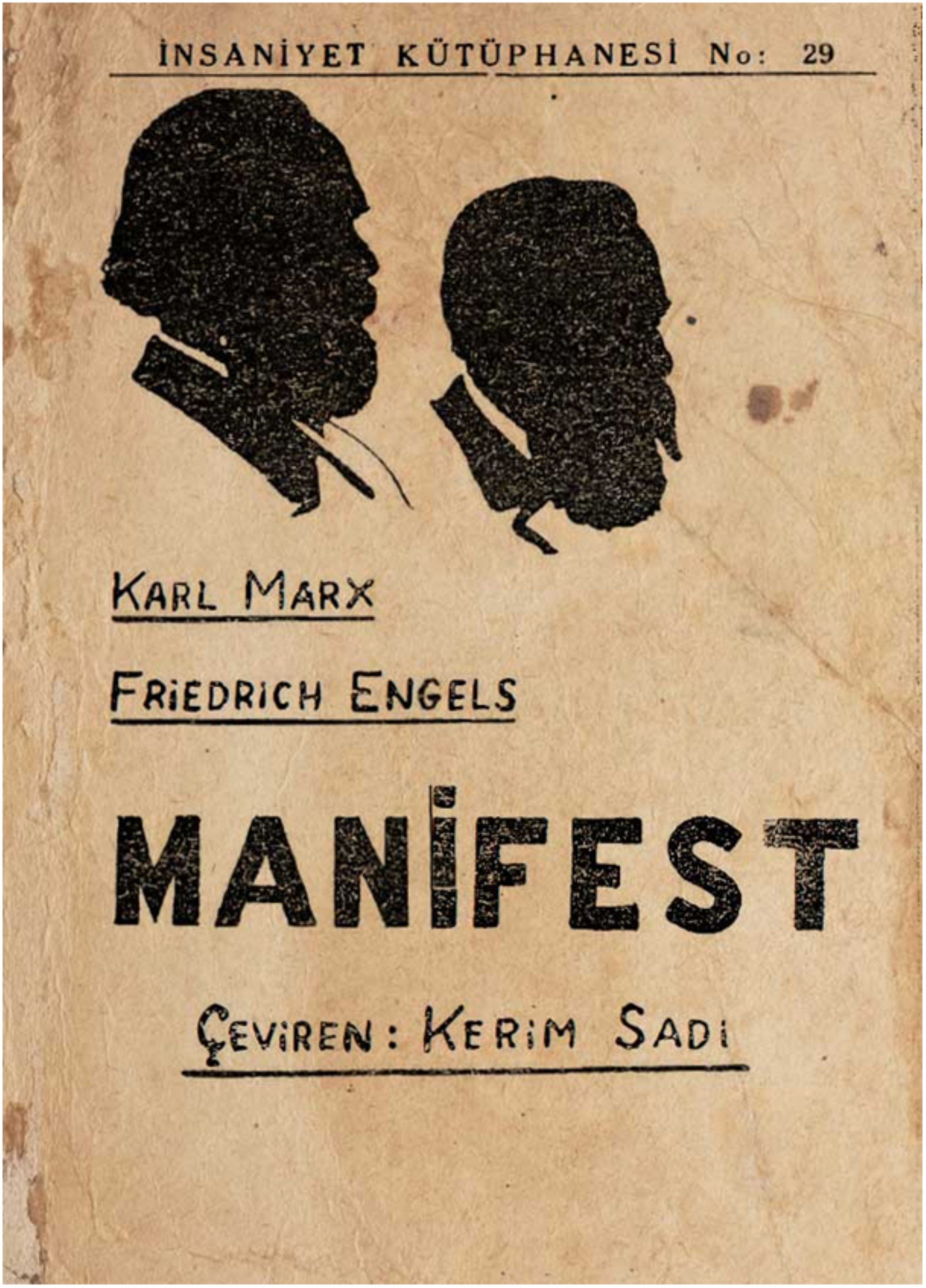
The pamphlets Kerim Sadi published — particularly those issued under the heading İnsaniyet Kütüphanesi — had an impact far exceeding their modest size. The period: Atatürk's Turkey.
He also published books and pamphlets after the 1960s.
What I wish to convey in this piece for now is that the academic staff of Istanbul University, established after the 1933 Darülfünun reform, became the target of fierce attacks through Kerim Sadi's publications.
Among them were also foreign professors who had come to Turkey.
Leaving the details to another article, the following names may be mentioned as a reminder.
He wrote about and criticized many figures, including Prof. Gerhard Kessler, Hilmi Ziya Ülken, Vehbi Sarıdal, Mehmet Ali Ayni, Ahmet Haşim, Halide Edip Adıvar, and Sadi Irmak. He would also publish a scathing critique of Fuat Köprülü's historiography in the 1960s.
I would like to mention two pamphlets that gave me considerable satisfaction: the first, his rebuttal to Kessler — Anti-Antimarksizm — and the other, the tract in which he thoroughly demolishes Fuat Köprülü, titled "Tarih Anlayışı Olmayan Tarihçi: Fuat Köprülü." This last tract is a 40-page publication dated 1964. Had he still been alive when the tract was published, Ali Emiri Efendi would have been just as pleased with this pamphlet as I am.
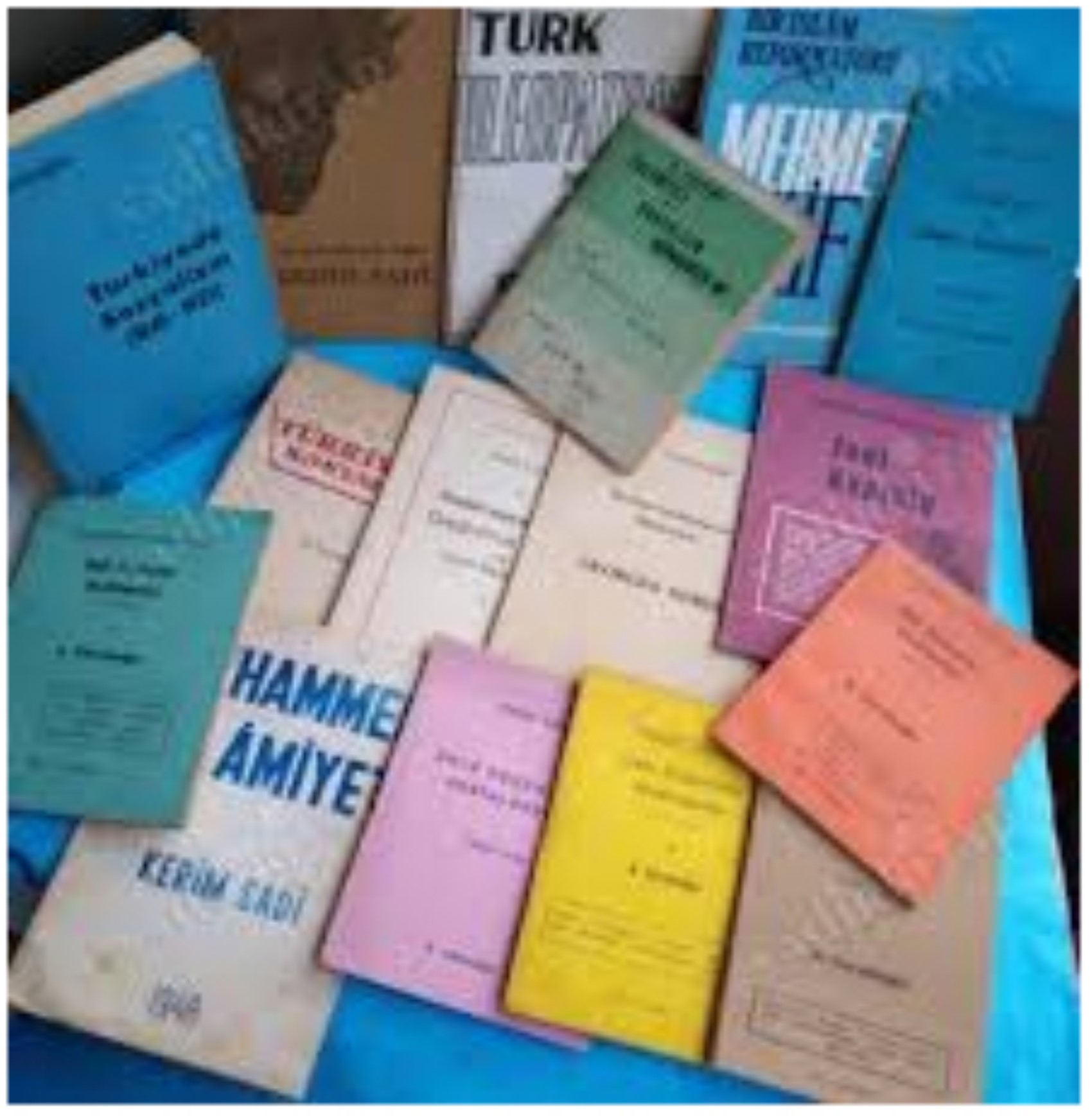 Samples from Kerim Sadi's books
THE PERCEPTION OF SOCIALISM IN THE 1960s
In the 1960s there was an atmosphere in which everyone saw themselves as connected to socialism — even Yakup Kadri claimed to be a socialist at heart. Kerim Sadi, noting that some people mistook paying alms for socialism, specifically emphasized that socialism is not solidarism. He argued that politicians like Léon Blum — the French Socialist Party leader of the 1930s — who were in reality guardians of the capitalist order, could not speak in the name of socialism.
He said that every publication containing the concept of socialism "flew off the shelves like fresh börek from Hasan Paşa's bakery," yet its content was utterly hollow. In Kerim Sadi's own words, in the 1960s quantity had increased while quality had declined.
ON TİP AND YÖN
Two left-wing movements stand out in Turkish history: the Kadro Movement led by Şevket Süreyya Aydemir in the 1930s, and the National Democratic Revolution line in the 1960s. Starting from the Revolution and Kadro conference, Kadro had sought to give Kemalism the color of a Third World socialism.
The intellectual existence of this line was tolerated, but its dominance within the party was not.
A similar movement began in the 1960s with the publication of the Yön Declaration, which later evolved into a journal. Yön was the rebirth of Kadro thirty years later.
This movement too was a left-wing interpretation. The MDD adherents saw the class basis of their "revolution" in the Zinde Kuvvetler (Vital Forces). The MDD assigned to Turkey's intellectuals the mission of completing Kemalism from the left.
This class was what Marxist literature defined as the petty bourgeoisie. Kerim Sadi did not consider this class perspective Marxist and criticized it. Consequently, he had no genuine intellectual rapprochement with the Yön circle.
The "revolutionary team" around Doğan Avcıoğlu viewed Kerim Sadi as an old-guard socialist deserving of respect, but did not see him as relevant to the strategy of their own revolution.
As for TİP, one would have expected Kerim Sadi to join it. But he did not. He found TİP's class base, organization, and leadership problematic from the standpoint of socialist theory.
In the final analysis, in the 1960s Kerim Sadi aligned himself neither with Aybar's TİP nor with Avcıoğlu's "vital forces thesis."
ATATÜRK AND SOCIALISM
In the 1960s one can speak of a feverish effort to cast Atatürk as a socialist. It is more accurate to interpret this as an attempt to extract something left-leaning from the Atatürk reforms.
When the subject came up in his interview with Papirus Dergisi, Kerim Sadi began by saying that in order to say anything about the relationship between Atatürk and socialism, one would need to identify connections from the perspective of socialist theory and economic doctrines.
For instance, the content mattered: the books he read, the notes and annotations he made, his intellectual formation, the approaches of the government figures he worked with to the country's problems, and the substance of his exchanges of ideas. Kerim Sadi believed that a proper assessment would require an analysis of all these elements.
In the interview, he particularly emphasized the need to examine the ideas in his letters and to scrutinize the position of the CHP relative to the socialist parties of the world.
He also touched on the need to examine Atatürk's will and estate, and to determine his understanding of private property and inheritance. He stated in the interview that only in this way could Atatürk's proper place in history as a statesman and political leader be correctly defined.
From his words, it is clear that he found the efforts to extract socialism from the Atatürk reforms overly strained — indeed, fanciful. I share this view.
Let us recall that during Atatürk's lifetime, the CHP participated as an observer in the alliance of European Radical left parties. This was a platform. The word "Radical" signified opposition to aristocracy and clergy. In the Europe of the 1930s, this amounted to an alliance of the most secular, republican, and social-democratic parties. It was led by Édouard Herriot, the leader of the French Radical Socialist Party. The political position it occupied was in fact to the right of the French Socialist Party.
THE 1950 AMNESTY LAW AND MY CONCLUSIONS FROM Hikmet Kıvılcımlı'S ARTICLE
One of the writers whose views were sought for the jubilee book published on the occasion of the 50th anniversary of Kerim Sadi's writing career was Dr. Hikmet Kıvılcımlı.
In the 1930s, Hikmet Kıvılcımlı had published a famous book under the title "Who Are the Counterfeiters of Marxism?" In it, he attacked two people: one was Nazım Hikmet, the other Kerim Sadi.
Dr. Hikmet mocked both of them in this book. He particularly looked down on Nazım because of his pasha-family origins. Kerim Sadi, on the other hand, was his classmate from the Military Medical School. He shamed him too, by reminding him of his academic failures there. Kıvılcımlı was also a classmate at that school of the renowned psychiatrists Prof. Rasim Adasal and Fahrettin Kerim Gökay.
At the time, Nazım was busy publishing a pamphlet under the heading "Soviet democracy" during the Stalin era. Kerim Sadi, for his part, would publish a book in the nature of a rebuttal to Kıvılcımlı, titled "An Open Letter to the Marx-Engels-Lenin Institutes." All of this was taking place in Atatürk's Turkey of the 1930s.
Then, as is well known, Nazım, Kıvılcımlı, and Kemal Tahir were sentenced to heavy penalties — through the efforts of the Marshal and Şükrü Kaya — around the time of Atatürk's death. For a period they shared prison life together at Çankırı Prison. Although the photographs from Çankırı Prison suggest that things had improved, I still sense traces of the old grievances. Please examine the photographs yourselves. There is a distance — a coldness. Nazım then served time in Bursa, and Kıvılcımlı in several Anatolian cities including Çorum. He was released from Kırşehir Prison under the 1950 amnesty.
During the war years, while serving his sentence in the Anatolian cities where he was held, the state asked him to practice medicine — as a form of national service. He agreed.
We understand that Dr. Kıvılcımlı came to know Osman Bölükbaşı and Erol Güngör from those years — most likely during his time at Kırşehir Prison. They had come to him as patients.
In 1950 a general amnesty law was passed. However, communists were not pardoned. A special regime was applied to them. They were released with a certain reduction in their sentences. I recall the calculation of months and days made in Nazım's case. Democrat Party deputies who were hostile to Nazım Hikmet fought hard in the TBMM general assembly specifically to prevent his release. And they left nothing undone afterward either.
15 July 1950 is the date of Nazım's release. His release is usually recounted in near-legendary fashion. Yet Dr. Kıvılcımlı and Kemal Tahir were also released under the same law. Only Şevket Süreyya's visit to Nazım at Vala Nurettin's home tends to be told.
Kemal Tahir, upon his release, rushed straight to Semiha Hanım's apartment in Aksaray and they married immediately. Kıvılcımlı, upon leaving prison, went to Piraye's wooden house in Altunizade. He asked for the notebooks he had entrusted to her in Çankırı. He was overjoyed to see that Piraye had kept the notebooks well.
Kerim Sadi, meanwhile, was in exile throughout the 1940s — not imprisoned. Semiha Hanım was with him. The government had exiled him to Anatolian cities.
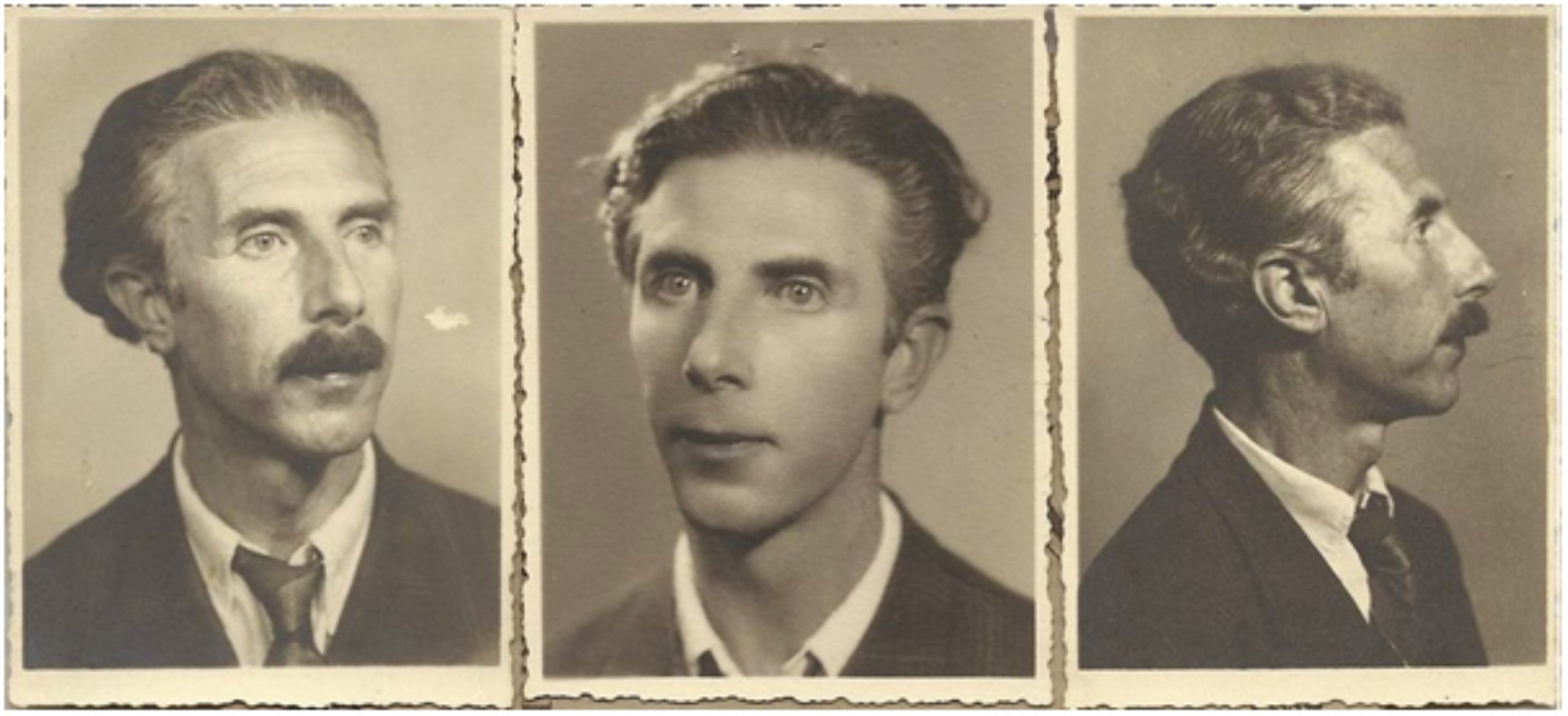
Photographs of Kerim Sadi. Source: Tüstav Archive
A HISTORIC REUNION — CHILDLIKE JOY
Meanwhile, from what Kıvılcımlı wrote, it appears that the three musketeers — who had roughed each other up considerably in the 1930s (his own words) — met after their release. The three musketeers: Dr. Hikmet, Nazım, Kerim Sadi.
In the interview Kıvılcımlı gave for the Kerim Sadi jubilee book, he "speaks of how they embraced one another with childlike, joyful laughter." He says they had learned to love each other as much as they had wounded each other.
He also advises the young socialists of the 1960s to take as their example the fraternal spirit of the old guard, rather than hatred and vendettas. I estimate that this joyful reunion (of Kerim Sadi, Kıvılcımlı, and Nazım) may have taken place in the autumn of 1950.
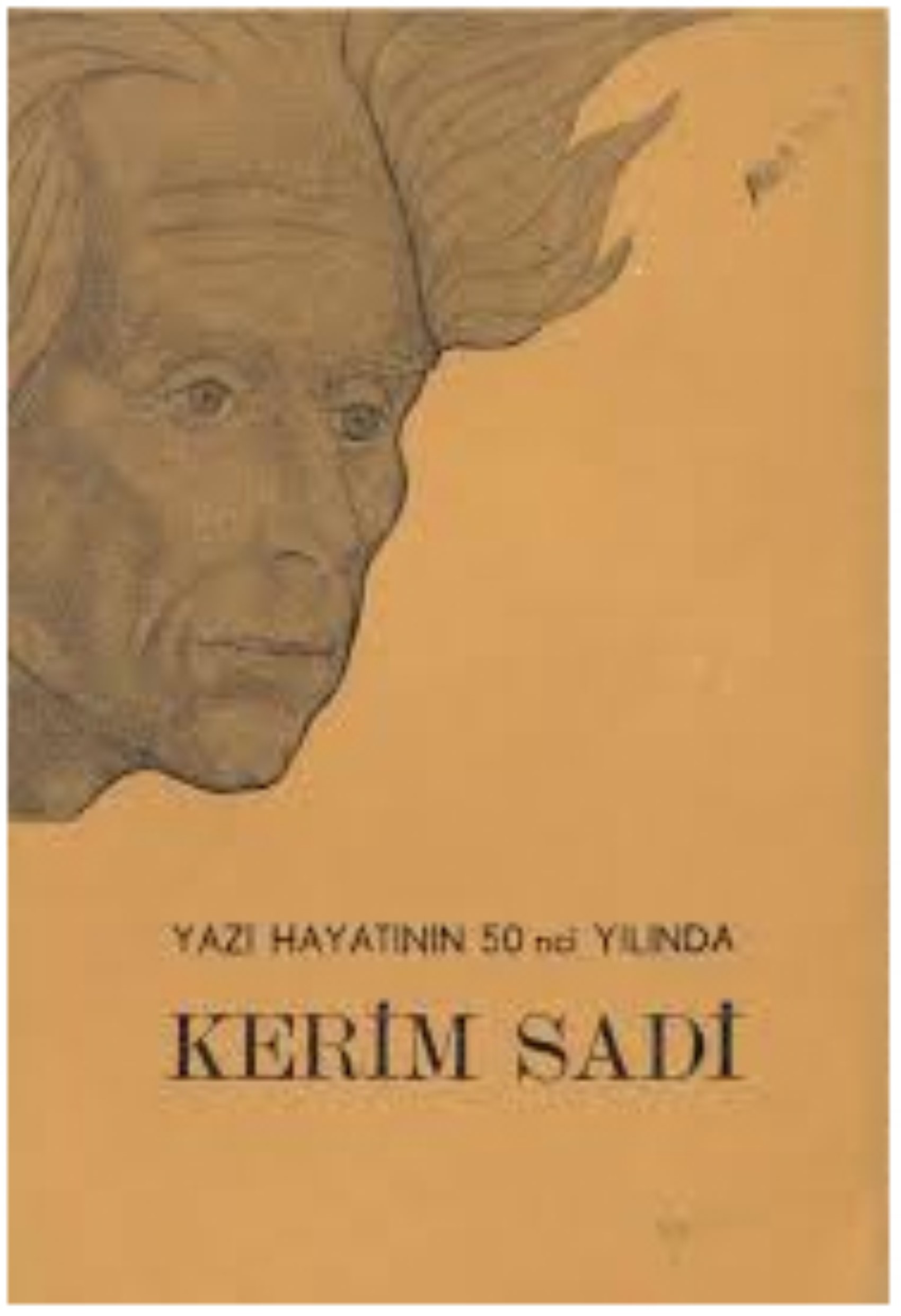 The 50th Anniversary Book for Kerim Sadi
THE KERİM SADİ INTERVIEW PUBLISHED IN PAPİRUS DERGİSİ
The relative freedom afforded by the 1961 Constitution enabled the development of left-wing thought, which had been given no room to breathe under the heavy McCarthyite conditions of the 1950s.
The founding of TİP and its entry into parliament, and the launch of Yön Dergisi, were things that could not have been imagined in the 1950s. Socialism reached a sphere of influence far exceeding the 3% of the vote it received in elections.
Intellectual dominance in political thought shifted to the left and to socialism. I would note that Yaşar Kemal, former Bar Association president Turgut Kazan, and my professor Murat Sarıca were among the founding cadres of TİP.
In this atmosphere, there was a return to the nostalgia of the 1920s TKP. People began seeking out the old guard, conducting interviews with them, and publishing those interviews. For instance, Milliyet Sanat published an extensive interview with Şevket Süreyya.
At an earlier date, Papirus Dergisi (1968) conducted and published an interview with Kerim Sadi. This conversation would form the first section of the jubilee book.
That book had been conceived on the occasion of the 50th anniversary of his writing career. The interview was conducted by Mustafa Baydar. It was quite an enjoyable conversation — one that covered roughly the last 100 years of Turkish history.
At that time, Kerim Sadi was living in Kuzguncuk. Books were stacked even under the sofas. Kerim Sadi was not merely an intellectual who read and wrote — he was also a bibliomaniac. He collected valuable books. He had a personal collection.
The presence of rare books in his library made a strong impression on the interviewer. For example, a two-volume Naima Tarihi printed by Müteferrika, preserved in its original binding, bore a seal indicating that its previous owner had been the Darüssaade Ağası.
First editions of Diderot's Encyclopédie — the intellectual foundation of 18th-century thought — the 25-volume collected works of Anatole France, and the first printed books of the German poet Heine all made their presence known from the cabinets, shelves, and even from under the sofas.
From the interviewer's account, it is possible to understand what kind of a book devotee Kerim Sadi was.
Regarding Kerim Sadi, who was a formidable polemicist, the following remark by Nizamettin Nafiz Tepedelenlioğlu (who had also been at KUTV) is significant: "Don't get into an argument with that man. He doesn't eat bread — he eats books." The fact that someone like Nizamettin Nafiz, who could easily clash with anyone, said this is a telling criterion.
A few more points were addressed substantively in the interview — for instance, the entry of socialist thought into Turkey.
Cerrahoğlu divides the history of the Turkish left into three periods. He speaks of socialism having been known since the Commune of 1848; of Namık Kemal and his associates, Şemsettin Sami, and Ahmet Mithat Efendi being aware of the First International.
During the Second Constitutional Period, socialism was more strongly under French influence. Jean Jaurès was a decisive political actor.
The October Revolution of 1917 constituted a very important turning point — for Turkey and for the global left. Kerim Sadi sees the October Revolution as the ideological and political source for his own generation, of which he was a part. He defines this period as the era of scientific socialism.
KERİM SADİ'S SOCIALISM
Kerim Sadi's works include the pamphlets he published in the 1930s under the İnsaniyet Kütüphanesi imprint, and after 27 May, the Encyclopedia of Famous Thinkers in the History of Socialism (5 volumes), Socialism in Turkey (3 volumes), and the book Contributions to the History of Socialism in Turkey. I wish to state once again that I intend to write a separate piece on the ideas expressed in these publications.
In the meantime, it is certain that what he wrote and said provoked the reaction of many people. Despite the harshness of his critiques and polemics — compared to Nazım, Kıvılcımlı, Kemal Tahir, and others — it cannot be said that he got into serious trouble very often. While his friends received long prison sentences, Kerim Sadi was always sent into exile. His books were confiscated — for instance, Interior Minister Şükrü Kaya's confiscation of the Manifesto — even though he himself had translated and published some books.
Kerim Sadi shared his exile with Aziz Nesin in Bursa, and with A. Kadir and Kemal Sülker in Konya. During his exiles, his wife was usually by his side.
The term given to exile in those days was menfa cezası — a practice that had existed since the Ottoman era, meaning compulsory residence in a given province for a set period.
During the 1950s, when the Cold War and pro-Americanism were at their peak, he retreated into silence, reading and writing. His publications from the early 1960s must have been the fruit of what he had accumulated during the 1950s.
His introduction to Marxism took place at the Haydarpaşa Military Medical School (Faculty of Medicine). He and Dr. Hikmet Kıvılcımlı were friends from there.
In the 1920s, through the TKP, he went to Moscow's KUTV University (the Communist University of the Toilers of the East) and studied there for about two years. However, I have not come across any information about his time as a student there. For instance, in Vala Nurettin's book "Bu Dünya'dan Nazım Geçti," there is a fairly extensive section on student life there — about the speeches Şevket Süreyya gave, Nazım's truant student ways, Trotsky's arrival, and other students. But I do not recall a passage that directly mentions Kerim Sadi.
After returning, up until the period of the Law on the Maintenance of Order (Takrir-i Sükun), he wrote his youthful articles in the relatively open atmosphere of the early Republic — in Aydınlık. It is possible to speak of him as a TKP member during this period.
His second trip abroad was together with Dr. Şefik Hüsnü Deymer. He spent about two years in France.
During the period when Kemalism was firmly consolidating its power, he worked alongside Nazım at Zekeriya Sertel's Resimli Ay Mecmuası. He published his 6-page story "Ansiklopedideki Vahşi" during this time. I strongly recommend that you read this story.
I am certain that, while Kerim Sadi moved within TKP circles, he was seen as "a figure who caused problems within the organization." His relationship with the party was, in my view, even more troubled than Nazım's. It is more accurate to describe him not as a party member but as a Marxist thinker who held nothing back from anyone.
We do not see his name in the "communist roundups" of the 1930s and 1950s. He is not among those convicted.
Kerim Sadi was regarded as a thinker whom the state kept under surveillance but largely left alone — someone whose writings were considered worth reading in left-socialist circles, yet with whom close association was not particularly favored. This lack of activism generally led to accusations of "passivism" against him. He was a Marxist who was known and recognized, but with whom few were on close terms.
Most Read

Striking picture for Özgür Özel's 'New Party'

The PKK opening and Özgür Özel’s path!..

How did the newspapers view Özgür Özel's farewell to the CHP?

He killed his wife by slitting her throat: Their children witnessed the moments

What did the CHP do?

Özel’s new party move in the world press

Fire at TUSAŞ engine factory in Eskişehir under control

The New CHP, against CEHAPE

From self-efficacy to despair

Kılıçdaroğlu's first message on Özgür Özel's new party announcement