



JOHNSON'S VISIT TO TURKEY AS VICE PRESIDENT
İnönü met with Lyndon B. Johnson three times, in 1962, 1963, and 1964.
In the first instance, Johnson came to Turkey in his capacity as Vice President. He met with President Gürsel and Prime Minister İnönü (August 26-30, 1962). The second time was to attend John F. Kennedy's funeral, and the third was upon the invitation of the US President to discuss the Cyprus issue.
During this period between 1961 and 1965, İnönü was the Prime Minister of Turkey. The meetings took place between 1962 and 1964. When Johnson first arrived in Turkey, İnönü had already handled Talat Aydemir's first coup attempt, enacted the law establishing the Constitutional Court, and—to some extent—overcome the difficulties of establishing the new constitutional order. However, the Justice Party had broken the coalition due to the amnesty issue: June 25, 1962.
İnönü had formed his second coalition government with the New Turkey Party (YTP) and the Republican Villagers Nation Party (CKMP). This coalition led to a split within the CKMP. The party leader, resentful that party deputies were eager to join the government, was fiercely opposed to a coalition with the CHP.
Osman Bölükbaşı was a sworn enemy of İnönü, for both historical and personal reasons. Because the party majority was in favor of joining the coalition, he resigned from his party. He re-established his party from the 50s under the same name: the Nation Party.
This was the government in office when Johnson arrived: the II. Coalition government under the premiership of İnönü.
İnönü was at the head of a triple coalition. Internally, the tension over the amnesty for former Democrat Party members remained high. In reality, this pluralism also signaled the weakness of the government.
DETAILS OF THE VISIT: AUGUST 26-30, 1962
Johnson visited Turkey for four days in 1962 in his capacity as Vice President. He was welcomed almost with festivities. This was the third time such US sympathy had been displayed. The first was the arrival of the USS Missouri battleship at the port of Istanbul in 1946. The official justification was the return of our ambassador Münir Ertegün's body. The real reason was to include Turkey in the anti-communist bloc. Turkey had already embarked on this path long ago.
The second “We Love You America Festivals” took place during the Democrat Party era. President Eisenhower came to Ankara in 1959.
Johnson's arrival was the third. The main purpose of the visit was to create the infrastructure for the “Ich bin ein Berliner” words emphasized by Kennedy in his Berlin speech. This goal was to fortify the anti-communist front.
During this trip, the aim was to lower the escalating Cyprus tension between Turkey and Greece, to satisfy both allied countries with arms and financial aid, and to isolate the pro-Soviet Ba'ath regimes in two neighboring countries (Syria and Iraq).
Johnson's trip was not planned solely for Turkey. Iran, Lebanon, the Republic of Cyprus, and Greece were also included in the program. In Greece, Karamanlis was the Prime Minister.
Johnson completed his trip by going to İzmir and Istanbul. He was welcomed enthusiastically. He crossed from Turkey to Cyprus. He met with the President of the Republic of Cyprus, Makarios.
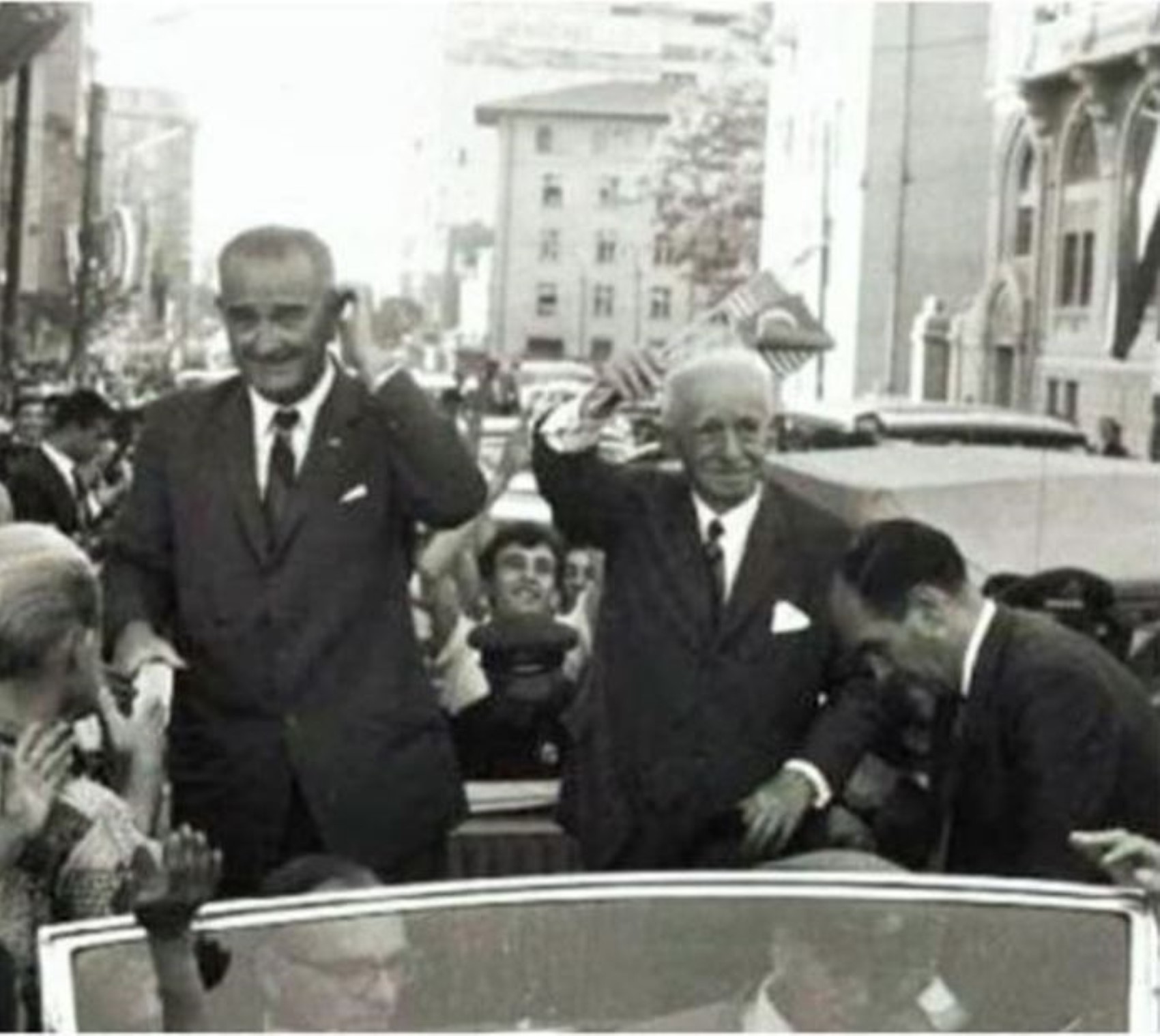
(Johnson in Ankara, 1962)
The purpose of these visits was to close ranks in the free world and to isolate Cuba, Egypt, Syria, and Iraq—which had been transferred by the Soviets—from their neighbors.
It would be accurate to say that Johnson's Eastern Mediterranean and Middle East trip was successful from the US perspective. The US had registered itself as the patron of the free world.
DEMOCRATS IN POWER IN THE US: KENNEDY AS PRESIDENT
The US had emerged from the Second World War with President Harry S. Truman. Truman was the last of the era of Democratic presidents that had continued since the 30s.
As the Cold War escalated, power in the US passed to the Republican Party. This change meant conservatism in American politics. Eisenhower, an American of German descent, served as president for two terms.
Turkey faced the escalation of the Cold War with the Democrat Party, while the US faced it with the Republican Party. In the 1960 presidential election, the situation reversed. Democrat John F. Kennedy won the election against Republican candidate Richard Nixon.
Kennedy was a politician who had drawn attention with his talents since his time as a senator. With his stormy private life and oratory, he was a good example of the charismatic leader type.
Kennedy had assumed the role of spokesperson for the free world with the speech he gave in front of the Berlin Wall. This also meant leadership. In this historic speech, he was accompanied by the mayor of Free Berlin, Willy Brant. Brant would later become Chancellor from the SPD. The following famous phrase from the speech dated June 26, 1963, has remained in minds: “Ich bin ein Berliner”
The assassination took place at the end of the same year. The presidency became vacant. When Kennedy was elected president, he had appointed Johnson as vice president. At that time, no one could have predicted that the president would fall victim to an assassination and that Johnson would become president by constitutional requirement.
KENNEDY'S FUNERAL AND İNÖNÜ'S TRIP TO THE US
The 35th President of the US, John F. Kennedy, was killed in Dallas on November 22, 1963. The assassination had a shocking effect on the international community. Many countries attended the funeral at the highest level.
Due to reasons such as President Gürsel's poor health (partial paralysis) and İnönü being in the position of political responsibility, it was decided that the Prime Minister would attend the ceremony along with his Foreign Minister. The Foreign Minister was Feridun Cemal Erkin, who had served as Ambassador to the US for many years. İnönü also took his wife, Mevhibe Hanım, with him to the funeral.
According to the US Constitution, Vice President Johnson immediately assumed presidential powers. I believe Johnson's rapid swearing-in on the plane—within two hours—was related not only to the continuity of the executive branch but also to the immediate transfer of nuclear weapon codes to their new owner.
İnönü, as is known, had known Johnson since 1962, as Vice President. It is said that he did not like this large-bodied Texan much during that visit, which could be considered long. Upon the fall of his government, he returned to the country without extending his US visit. He submitted his resignation to the President.
The funeral ceremony was held on November 25, 1963. Kennedy was buried at Arlington National Cemetery. He returned to Turkey on November 28, stopping in Baltimore, and on November 29, stopping in New York.
THE JOHN F. KENNEDY ASSASSINATION AND SOME SUSPICIOUS CIRCUMSTANCES
The fact that the person identified as the assassin (Lee Harvey Oswald) was killed in front of everyone's eyes, that Jack Ruby, who killed Oswald, had close relations with Marilyn Monroe and had dark connections, that the number of bullets fired from the weapon used in the assassination was very different from the total number of bullets pointing to Kennedy (8 vs 3), and that the statements of eyewitnesses were suspicious.
While the data pointed to an organized action involving more than one person, it is strange that it was officially accepted that President Kennedy was killed by a single action carried out by a marine who had previously fled to Russia and returned with a Russian lover.
The fact that there is a consensus in the autopsy report, the investigation commission, and judicial decisions that the assassination was planned and carried out by a single person makes me suspicious. These are, of course, secondary issues for our article.
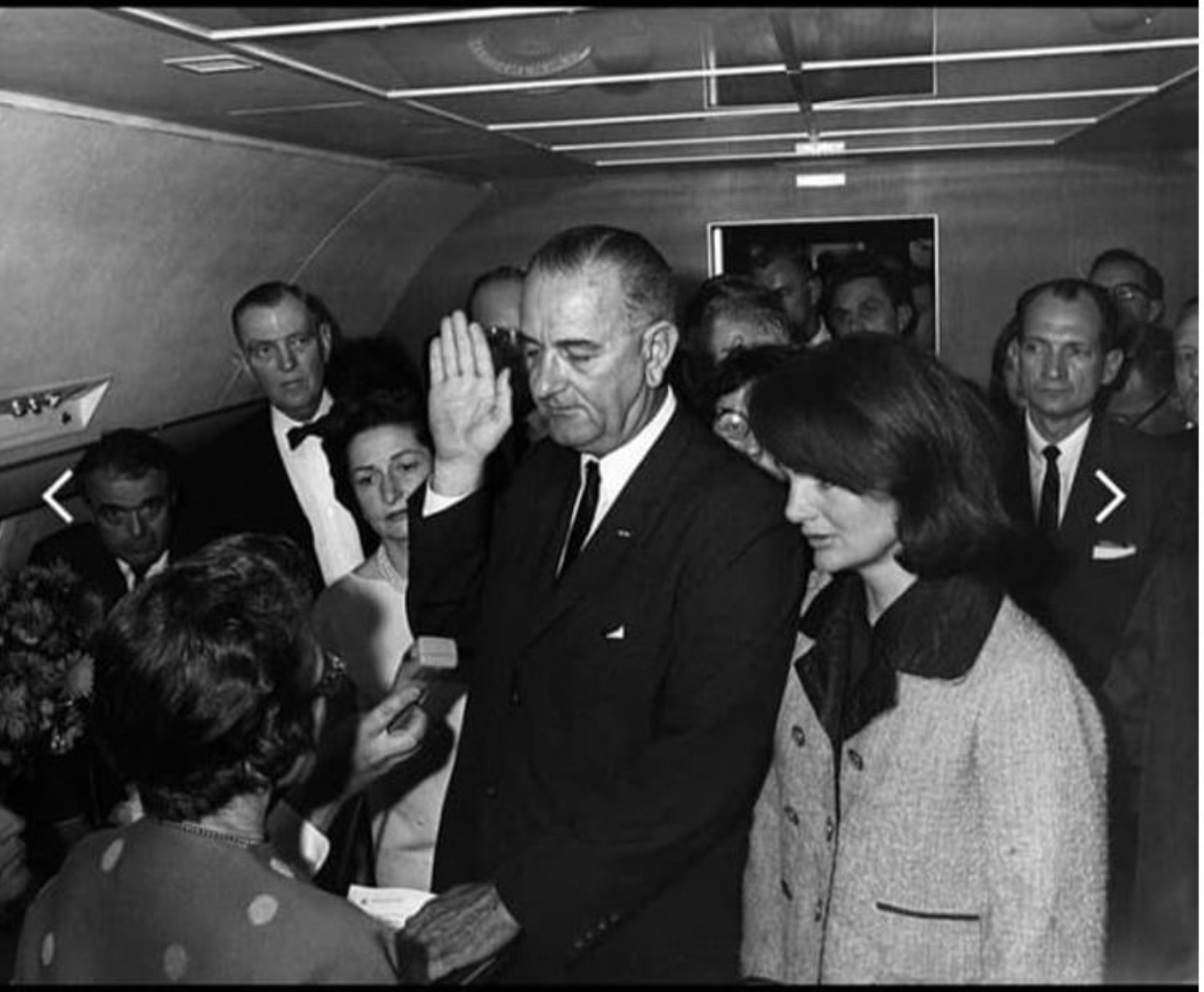
(Johnson taking the oath on the plane)
THE FALL OF İNÖNÜ WHILE AT KENNEDY'S FUNERAL
Shortly before İnönü went to the US for Kennedy's funeral, local elections were held on November 17, 1963. The CHP had regressed, and its vote share had fallen. But the real big losers of the elections were the YTP and CKMP. Their voter base had melted away. The winner of the elections was the Justice Party.
While the election results were being analyzed, the Kennedy assassination took place on November 22, 1963. Prime Minister İnönü went to the US to attend the funeral ceremony. He was accompanied by Foreign Minister Feridun Cemal Erkin and his wife, Mevhibe Hanım.
Panicked by the election results, the YTP decided to withdraw from the coalition without waiting for the Prime Minister's return. The II. İnönü government fell. In other words, when İnönü was meeting with President Johnson, he was the prime minister of a fallen government. For this reason, the meeting was a meeting with no political leverage.
İnönü was now the chairman of a party that had lost power in the elections and had fallen behind the Justice Party. The party leadership thought that remaining in the government benefited the Justice Party in the opposition. For this reason, they argued that the CHP should not contribute to the formation of a new government. İnönü was of the same opinion.
After İnönü's resignation, Cemal Gürsel gave the task of forming the government to Justice Party Chairman Ragıp Gümüşpala. He was not very eager to form the government either.
A coalition that would exclude the CHP was a good idea in theory. But the potential partners were not promising. They were rival parties. In the end, Gümüşpala returned the task of forming the government, which he had already been carrying out reluctantly.
Meanwhile, the Cyprus issue had flared up completely. The ethnic cleansing against Turks, which began with Bloody Christmas, was continuing recklessly before the eyes of the international public: December 20, 1963. The Turkish unit on the island and the United Nations force did not have the military capacity to stop the process.
THE THIRD İNÖNÜ GOVERNMENT
In such an environment, no party wanted to take responsibility for the government. Once again, the task fell to him. İnönü formed the government with 33 independent deputies to avoid leaving the country without a government. This was a minority government. It did not have enough deputy support behind it.
İnönü read the government program and addressed the parliament: “If this government does not receive a vote of confidence, you will have a hard time finding me after this.” İnönü meant this: No party wants to take responsibility. I am taking this responsibility for our country. If you do not give a vote of confidence, you will bear the burden of this.
Faced with İnönü's ultimatum, the New Turkey Party decided to vote in favor, and the III. İnönü government received a vote of confidence with 225 votes.
İnönü had barely been able to handle Aydemir's second uprising in the second coalition (May 20-21, 1963). Local elections were held in the autumn. The situation was not bright at all for the CHP. They were trying to deal with serious problems, but instead of increasing, voter support was decreasing.
In reality, what kept the coalition, which was a minority government, alive was the escalation of the Cyprus issue.
Although the Aydemir uprising had been suppressed, coup-plotting factions continued to exist.
İnönü's historical personality, stemming from the Turkish War of Independence and Lausanne, was curbing these tendencies.
It is possible to summarize İnönü's biography as follows: He served as prime minister between 1925-1937. He was president between 1938-1950. After 1950, he was the CHP chairman and leader of the main opposition party for 10 years. He became prime minister again 25 years later. He was at the head of coalition governments from 1961 to 1965.
In the 60s, if it weren't for İnönü's leadership and historical personality, it would have been very difficult for the '61 democracy to survive. Perhaps it might not have been possible, and Turkey could have drifted into other channels. İnönü brought Turkey to 1965 by overcoming all the obstacles.
THE JOHNSON LETTER AND THE INVITATION TO THE US
The Johnson Letter is an important document in Turkish political history. It was written by US President Johnson addressed to Turkish Prime Minister İsmet İnönü. We can define the letter as the Trump Letter in Cold War conditions, even if the results were different.
In his letter, Johnson asked the Turkish government to refrain from rhetoric that would lead to conflict within the North Atlantic alliance. He sternly warned that weapons granted to Turkey within the alliance system could not be used in the Cyprus issue.
The letter dealt a heavy blow to the American admiration that had continued in an exaggerated manner throughout the 50s in Turkey, with the enthusiasm of Korean War legends. It was clearly understood that the US was not concerned with the Turks, but with American interests.
Although the public was aware of the letter, its full content would be published in Hürriyet Newspaper in 1966.
Upon İnönü's response, Johnson invited him to the US to hold talks. He had him picked up by the presidential plane. The subject was, naturally, to ensure that the Cyprus issue was resolved without causing a crisis within the NATO alliance.
I think the general atmosphere of these meetings must have been “you misunderstood us. Or I was understood in a way that exceeded my intent.”
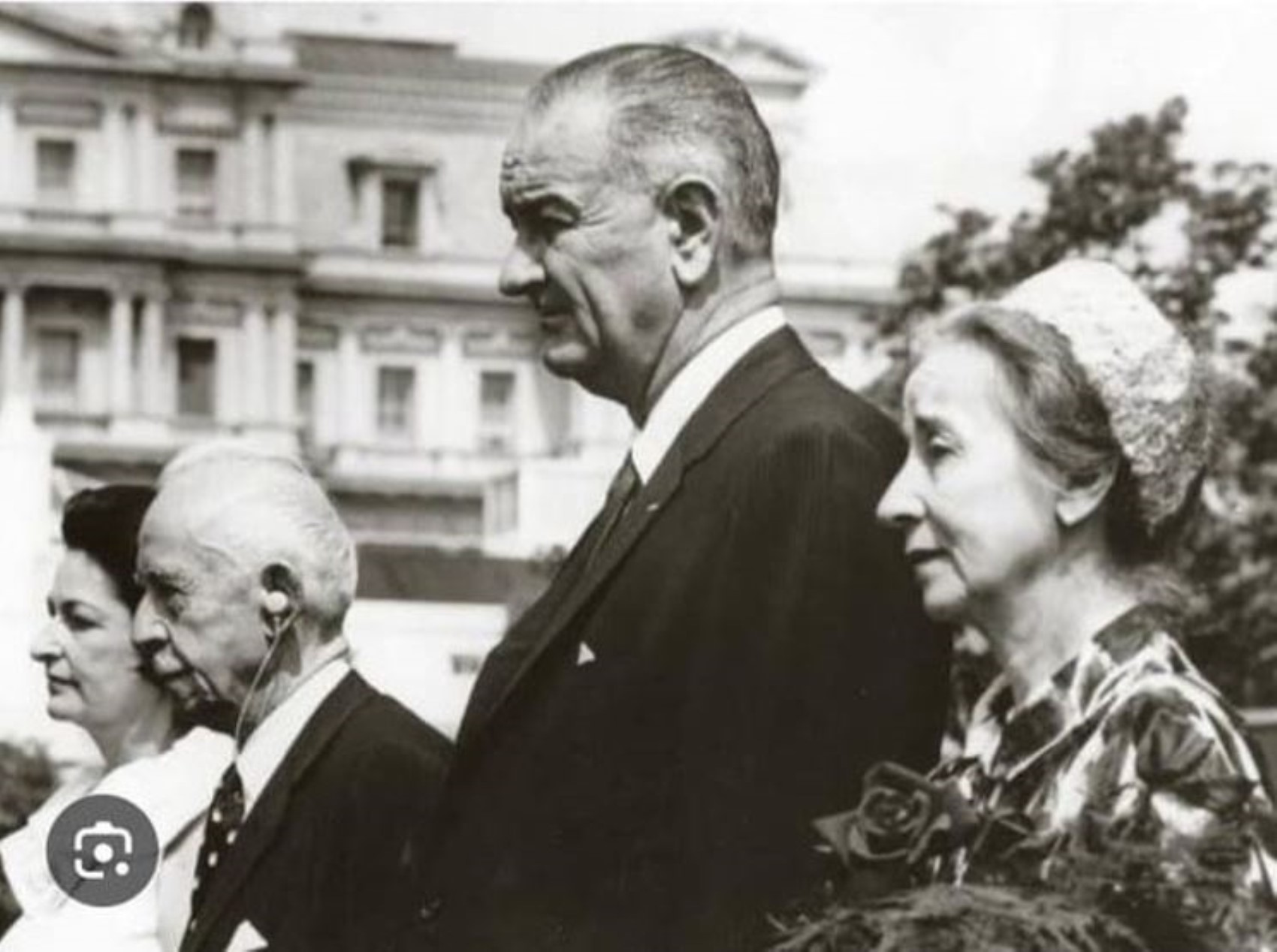
(İnönü with President Johnson in the US, 1964)
Meanwhile, Papandreou had become prime minister in Greece. He was also invited simultaneously. The President met with both sides. An İnönü-Papandreou meeting also took place. Although Johnson's attempt to restore Turkey's wounded pride was partially successful, developments on the island would change the direction of things after a while.
The famous Johnson letter was dated June 5, 1964. İnönü's trip to the US was on June 22. After the meetings ended, he stopped in London on June 28 and Paris on June 30. He met with De Gaulle. Then he returned to Turkey.
As a result, despite the positive atmosphere in the meetings, tension increased in Cyprus. Turkey even came to the brink of landing troops on the island.
After the Cengiz Topel incident (August 8, 1964), the İnönü government deported Greek nationals living in Turkey. In this regard, I would like to remind you of my article titled “What happened to the Istanbul painter İvi Stangali.”
JOHNSON'S PRESIDENTIAL PLANE GESTURES
Johnson had been welcomed with great sympathy in Turkey in 1962. After the letter incident in 1964, this sentiment turned into antipathy and even anger. Nevertheless, Johnson attached importance to Turkey and tried to appease the administrators. He was following a policy of stroking their pride.
In 1964, he was picking up his guest by sending the presidential plane to the prime minister of allied Turkey. A similar gesture was made for Cemal Gürsel when his treatment in the US came to the agenda. Gürsel was taken under treatment at Walter Reed Hospital on February 2, 1966. The treatments did not yield results. He fell into a coma in the US. He was brought to Ankara on March 26.
THE WORLD AND TURKEY IN THE 60S
An important event at the beginning of the 60s was the shooting down of a spy plane (U-2) that took off from Turkey (İncirlik Base) in Russia. A second issue was that Jupiter missiles had been deployed in Turkey against the Russians. There were also such nuclear-tipped missiles in Italy. When the presence of missiles in US bases that could trigger a World War was later criticized by TİP Chairman Mehmet Ali Aybar, the prime minister of the time, Demirel, would say, “there is no base, there is a joint defense facility.”
The US tried an operation in Cuba with collaborative forces to overthrow the Castro-Guevara administration: the Bay of Pigs invasion. The operation was thwarted. Following this development, Cuba asked for help from the Soviets. Soviet nuclear-tipped missiles were deployed a few hundred miles off the coast of Florida. A step higher had been taken in the balance of nuclear terror.
As for Turkey, there were also missiles in Turkey waiting, aimed at Soviet Russia. Doğan Avcıoğlu emphasized in “Turkey's Order” that Turkey was the country that would be sacrificed first in a possible war due to the missiles deployed on its territory.
Turkey was a US ally and NATO member in this “missile-heavy environment.”
GÜMÜŞPALA'S SUDDEN DEATH AND DEMİREL'S EMERGENCE
Two other developments in 1964 should be focused on.
Justice Party Chairman, retired General Ragıp Gümüşpala, died suddenly at the Ortaköy Lido Hotel on June 5, 1964. Gümüşpala had come to Istanbul for the Senate elections. Reports said it was a heart attack. I have my doubts about Gümüşpala's death. I will address the reasons in a separate article later.
In the Senate 1/3 renewal elections held on June 7, the Justice Party increased its strength.
The party's Grand Congress was convened for the AP chairmanship left vacant by Ragıp Pasha. At the congress, Süleyman Demirel, a civil engineer and former General Director of the DSI, who was supported by the bourgeoisie and the US, was elected chairman.
Demirel had done two things before the congress: He obtained a document from the Masonic lodge stating that he was not a mason. Yet he was a Mason. Supporters of Sadettin Bilgiç were spreading the word under the table that he was a mason. Masonry on the right was synonymous with atheism.
The second was to circulate the photo he had taken with Johnson. Demirel was a member of the general administrative board at that time. It had been taken during the meetings of the U.S. Agency for International Development, which was established by Kennedy: August 28, 1962.
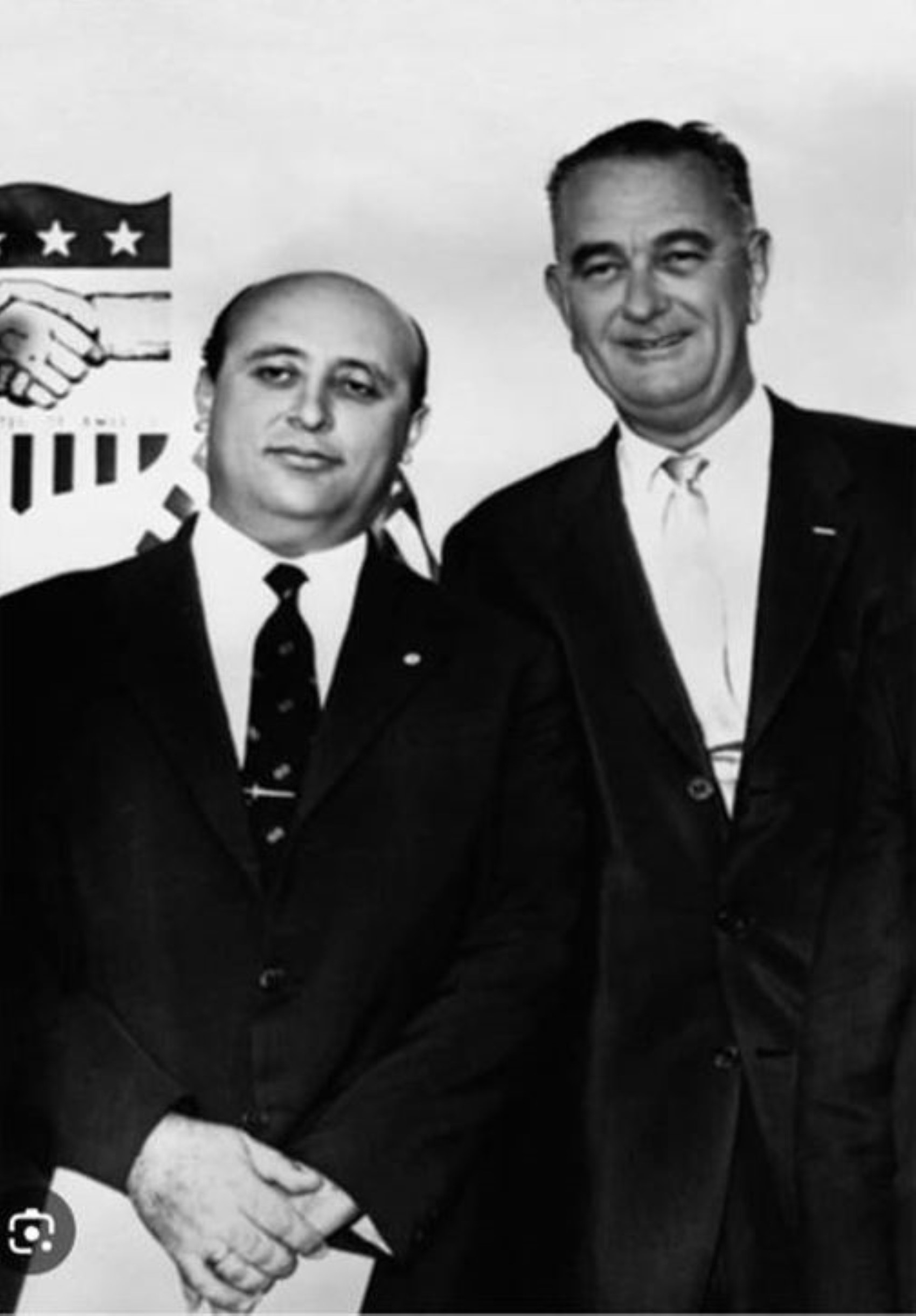
(Demirel with Vice President Johnson in 1962)
There is another sister organization from those dates: the American Peace Corps Association. In the 50s, the Democrats, and in the 60s, the Justice Party members showed very close interest in American institutions. Demirel was one of them.
Demirel wanted to influence the delegates by cropping the other figures in the photo. He was successful. Demirel's congress success, of course, cannot be attributed only to the photo and the known document (the clean record of masonry).
He crushed his rival, Dr. Sadettin Bilgiç, with his intelligence and eloquence. Dr. Bilgiç had entered the congress with the air of “you are forced to choose me,” like MDP leader retired General Turgut Sunalp. The result was that Demirel won by a wide margin. A new leader had been born on the right. A young and promising civil engineer supported by the US: Süleyman Demirel from Isparta's İslamköy.
The triangle was complete. Gümüşpala had died suddenly—in a way I find suspicious. Demirel had won the congress—Lyndon Johnson, with whom he posed, was the US president. The Demirel era was beginning in Turkish political history.
Most Read

Striking picture for Özgür Özel's 'New Party'

The PKK opening and Özgür Özel’s path!..

How did the newspapers view Özgür Özel's farewell to the CHP?

He killed his wife by slitting her throat: Their children witnessed the moments

What did the CHP do?

Özel’s new party move in the world press

Fire at TUSAŞ engine factory in Eskişehir under control

The New CHP, against CEHAPE

From self-efficacy to despair

Kılıçdaroğlu's first message on Özgür Özel's new party announcement