



A SACRED RELIC BROUGHT TO DIVANYOLU AFTER 500 YEARS
In the courtyard of the Sultan Mahmud Tomb on Divanyolu, you will encounter burials that might surprise you. Beyond members of the dynasty, you will see interesting names. One of them is Ziya Gökalp. Gökalp passed away shortly after being elected as a member of the second term of the Grand National Assembly of Turkey (TBMM) and was buried here.
Another surprising name is Sheikh Bedreddin. You might be surprised to find Bedreddin, who was executed in Serres in 1420, resting here. Bedreddin was brought here by the exchangees from Serres 500 years after his execution, in 1924.
Bedreddin was brought by the immigrants from Serres almost like a sacred relic; the remains of his body were kept in boxes at Topkapı Palace for a long time, and it was decided by the May 27 revolutionaries to transfer him here.
The irony lies here: Bedreddin lies side by side with the descendants of Sultan Mehmed I, who had him executed (Sultan Mahmud, Abdülaziz, Abdülhamid). Beside him also lie Gökalp and Sait Halim Pasha.
BEDREDDİN’S INTELLECTUAL ACCUMULATION
Sheikh Bedreddin was born in Simavne, near Edirne, during the years when the Ottoman Empire was expanding into Rumelia. Some mistakenly call it Simav. It has no relation. When speaking of him, it is most accurate to define him as “Sheikh Bedreddin, Son of the Qadi of Simavne.”
His lineage on his father's side traces back to the warriors (alps) and scholars (ulema) of Rumelia, and on his mother's side, likely to a wealthy Greek family. Let us recall that we are talking about a period when the Ottoman Empire was a principality based on the ideology of 'Gaza' (holy war).
The Eastern Roman (Byzantine) Empire was in a state of collapse. Social chaos reigned in the Balkans. In Anatolia, the institutions of the Seljuks were continuing to leave their mark. Bedreddin received his education in Konya, the most important scientific center of Anatolia, as well as in Damascus and Jerusalem. He went to Cairo. He won the appreciation of the Sultan during a debate held in the presence of the Mamluk Sultan Barquq.
In contrast to the clergy of today who struggle to understand Arabic, it is seen that Bedreddin was a theologian and a scholar of Islamic jurisprudence (fiqh) in Cairo who used Arabic with eloquence.
We see that Sheikh Bedreddin, who served as a tutor to the Mamluk Sultan's son for a time, later moved to Ardabil.
From everything written and recounted, it is understood that Bedreddin was present in the intellectual environment of Western Asia, the Eastern Mediterranean, Egypt, and Iran. Furthermore, it is astonishing that he could cope with such a vast geography, different cultures, and languages. It is truly worth researching how the financial infrastructure of this process was provided.
CLASS DYNAMICS IN THE ERA HE LIVED
The century in which Bedreddin lived corresponds to the century of the Ottoman transition from a principality to a state and the construction of its institutions.
Let us not forget that the Ottoman Empire expanded as a Balkan state.
Long before the conquest of Istanbul, its borders had reached Belgrade. In the meantime, let us not forget the existence of the principalities (small states) that continued to exist in Anatolia after the Seljuks.
In the centuries when Byzantine local governors (tekfurs) turned into feudal lords, the dynamism of the Kayı Alps changed the balance in Western Anatolia. There were tekfurs who formed alliances with Osman and Orhan Gazi.
Let us note that some of these are among the warriors (gazis) who are sanctified today as Muslims. It is known that after Murad I, the army consisted of the devshirme system, and the elite class was partially composed of Greek elites.
Such as Rum Mehmed Pasha and Rum Mahmud Pasha. Let us not forget the raider (akinci) beys like Gazi Köse Mihal and Gazi Evrenos Bey. Let us also remember that one of Bayezid I's wives was Olivera Despina. She was captured by Timur along with Bayezid and was allowed to return to Serbia after Bayezid's death.
The fact that the Greek and Serbian aristocracy were influential within the ruling class (askeri class) and the permeability in family structures through marriages are important for understanding Ottoman history. These elite elements melted into the Ottoman dynasty.
In the meantime, it is certain that there were marriages between the military leaders who participated in the conquest of Rumelia and the daughters of local elite families. Sheikh Bedreddin's family is one such family. The probability of his mother's side being Greek is high.
Bedreddin's mixed lineage, his education spread over a wide geography, his tutoring of the Mamluk Sultan's son, the superiority (faikiyet) he showed in the debates held in the presence of the Sultan in Cairo, and his brilliant successes in the discussions held in the presence of Timur show that he was one of the elites of his era. Both as a theologian and as a thinker.
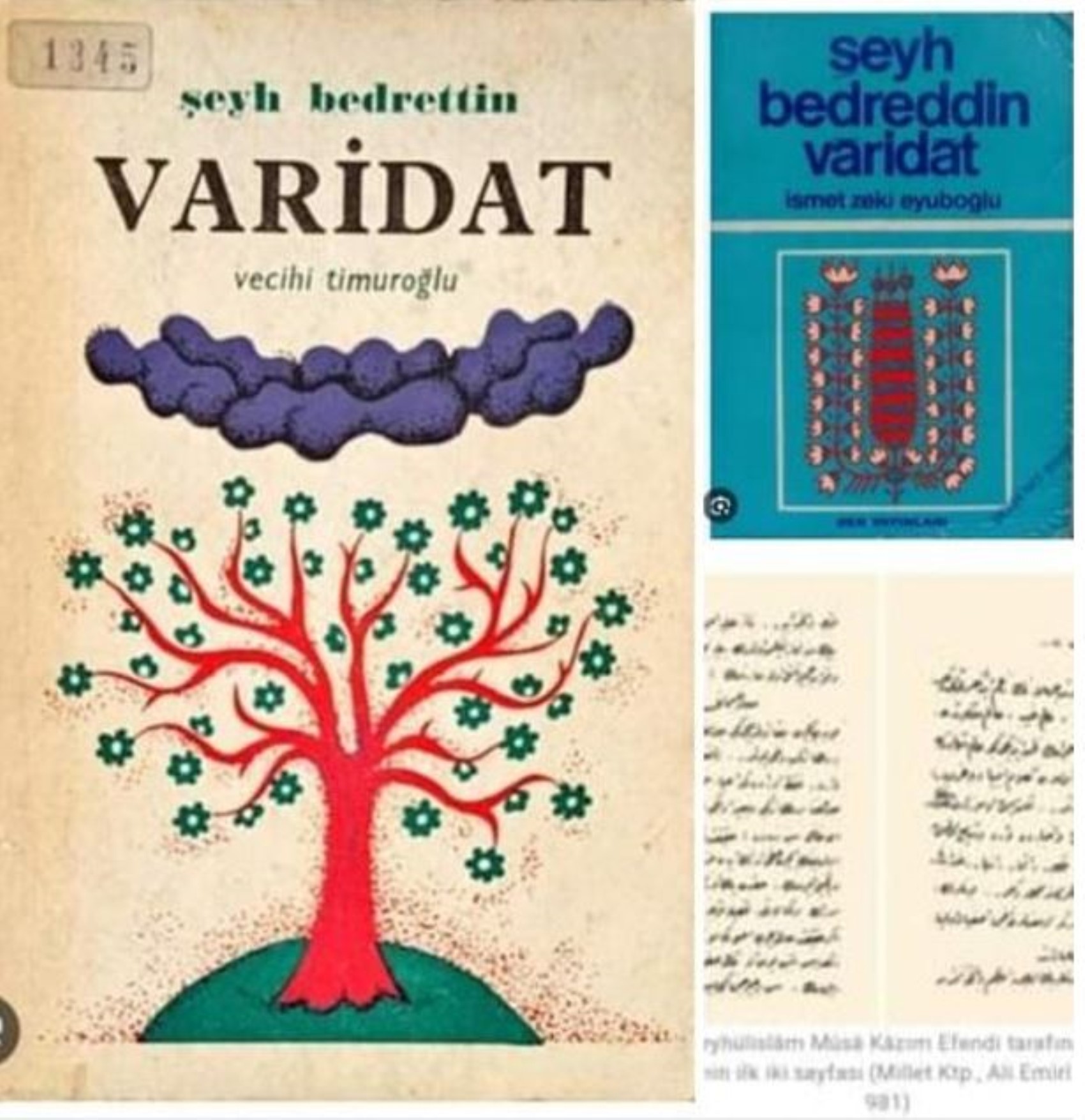
WHAT IS VARIDAT?
I have conducted sufficient research regarding Bedreddin's thought. I have looked at some theses and articles. I have especially examined the Sheikh's 'Varidat' thoroughly. I must state that I have not seen any evidence in Bedreddin's thought that can be directly associated with socialism.
Varidat is a compilation of speeches, inferences, and the thinker's Batinist (esoteric) thoughts regarding the theology of creation. Perhaps they are information notes gathered after Bedreddin's execution. Varidat is—in all likelihood—words attributed to Bedreddin.
If one evaluates Varidat in terms of its main outlines, a serious deviation from Sunni Islamic doctrine is immediately noticeable. There is an epistemological break. The message given by Varidat, in my opinion, is pantheism. It is the doctrine of Wahdat al-Wujud (Unity of Existence). We can interpret this as the manifestation of God's existence in every form of existence, in every object.
In Orthodox Islamic doctrine, the handling of motifs such as heaven, hell, reward, and punishment makes the author of Varidat a heretic. There is no need to delve further into this subject. The problematic of the subject we are dealing with is different.
HIS POSITION AS KAZASKER AND EXECUTION DURING THE INTERREGNUM
Although it is possible to concretize his views around the thought of Wahdat al-Wujud, it is a fact accepted by everyone that Sheikh Bedreddin was a great scholar of Islamic jurisprudence. Together with Molla Fenari, he is considered the greatest theologian of the age in which he lived.
He served as Kazasker (Chief Military Judge) under Musa Çelebi, the ruler of Rumelia. He was the Sheikh-ul-Islam of Musa Çelebi's state.
When the conflict between the rulers of Anatolia and Rumelia was resolved in favor of Mehmed I, Sheikh Bedreddin was ordered to reside in Iznik. This was an exile.
It is significant that his disciples (kethüdas) Börklüce Mustafa and Torlak Kemal, who were with him until that moment, went to Karaburun and Manisa to lead a revolutionary organization. They were likely both loyal to Sheikh Bedreddin for at least 10 years.
Börklüce was of Chios or Samos island origin. The communal order he established on the Karaburun Peninsula was protected by an armed force of between 4,000 and 10,000. The forces of Torlak Kemal, a Jewish convert from Manisa, were weaker. The main large force was Börklüce's forces on the Karaburun peninsula.
In the meantime, it is certain that Bedreddin left Iznik under the pretext of pilgrimage, passed through Sinop to Wallachia, and from there went to the region where the Deliorman Turks lived, forming a community loyal to him.
Bedreddin attempted to establish a social order here within the framework of his own principles. He established and distributed new timar (fief) lands. My teacher Ahmet Güner Sayar, in his book titled “Velayetten Siyasete Şeyh Bedreddin” (From Sainthood to Politics: Sheikh Bedreddin), interprets this initiative as transforming the timar system into small land ownership.
In other words, he means that Bedreddin opened state-owned (miri) land to private ownership. He also has an interview on this subject. Ahmet Güner Sayar was my professor of the History of Economic Thought at Istanbul Faculty of Political Sciences. I would like to note this.
As stated, Bedreddin's actions are based on political economy. They relate to administration, politics, production, and taxation. Unlike his disciples, I could not see any evidence of socialism in Bedreddin's attitude in Rumelia.
These developments can be interpreted as follows: While Çelebi Mehmed, as Sultan Mehmed I, was reviving the Ottoman realm, he faced a severe threat from the Balkans and Anatolia—especially Karaburun.
In the meantime, Mehmed I, who was dealing with the danger of the Pretender Mustafa in the Balkans, gave Bayezid Pasha the task of suppressing the Karaburun and Manisa rebellions together with his son Murad (Murad I). Both rebellions were suppressed in a bloody manner. After this, the establishment of peace and tranquility in Rumelia depended on the elimination of the Bedreddin danger.
Bedreddin was apprehended without being able to show serious military resistance. He was brought before the Sultan's Divan (Imperial Council) in Serres.
In the Divan, there was a trial committee composed of Sultan Mehmed I's ulema. Bedreddin was sentenced to death not for religious reasons, but on the charge of disobedience to the 'ulu'l-amr' (the ruler). This is an important point.
In clearer terms, Bedreddin was not convicted on a charge related to religious doctrine, but on a charge of revolution/rebellion. The accusation was entirely political.
INTELLECTUAL LEGACY
Bedreddin's execution left deep marks on Batinism, Rumelian Alevism, and Bektashism. This is the reason why he was brought to Turkey with the exchangees from Serres 540 years later. Bedreddin holds the value of a sacred relic in terms of Rumelian Turkishness.
It is understood from his story that he was not only giving a theological message but also pursuing a political cause. However, considering that his action was not long-lived and his measures did not show characteristics aimed at eliminating ownership, we can conclude that a profile of a leader similar to Thomas Müntzer (the Protestant reformer whom Engels discussed in the Peasants' War in Germany) or Mazdek, who rebelled to establish a 'communal/communist' order in the Persian lands, cannot be drawn from him.
Undoubtedly, the first reason I reached such a conclusion is that he was a very important figure among the ulema of the founding era. Even after his execution, his books on fiqh continued to be taught in madrasas.
Although a strong call for a classless society is seen in the discourses of the leaders of the Karaburun and Manisa revolution, there is no evidence that Bedreddin adopted such a discourse in Rumelia. He has an attitude like being fair in the distribution of timars. This can very well be interpreted as a social democracy initiative 500 years ago.
However, one thing is certain: Bedreddin entered into a power struggle. He was defeated and executed. We can interpret his timing as a search for a new order organized around himself.
This would have meant the end of the Ottoman dynasty and the establishment of a new state similar to the Qadi Burhan al-Din State established in the Sivas region. Let us also note that Idris Bitlisi, who pledged allegiance to Yavuz Selim a century later, mentions that Bedreddin appeared with claims of Mahdiism and a new state.
TIMUR'S ARRIVAL IN ANATOLIA
In my opinion, Timur's place in world history is like Genghis Khan's. He left destructive effects everywhere he went. At the time Timur turned toward Anatolia, the Ottoman Empire under the reign of Bayezid I was largely dominant in the Balkans. It was a state with relations based on tense negotiations with Byzantium.
Bayezid's decision to risk war with Timur is a subject worth writing about separately.
It is interesting that after the Battle of Ankara, Timur established a suzerain-vassal relationship and returned to Samarkand instead of establishing a deep-rooted order in Anatolia.
His advance by burning and destroying many city centers from Sivas to Izmir in Anatolia has to do with Mongol traditions. After having Izmir looted as well, Timur returned, taking Bayezid's captured son with him.
This situation caused the beginning of an interregnum period for the restoration of the pre-Timur status quo in Anatolia.
Who were the parties here? At the head of these are the princely dynasties. Some of these are local dynasties that have been the masters of Anatolia for a long time and thought they could cope with the Ottomans.
Byzantium, of course, was pleased with this tension. The struggle for dominance among the principalities was postponing the threat that could come from Anatolia.
As for the Ottomans, to state it clearly, if Timur had been thinking of establishing another order in Anatolia, there would be no such thing as the House of Osman, on which exaggerated TV series are now being filmed. The House of Osman would have been erased from history.
THE TRAUMA CREATED BY TIMUR
It is possible to compare the effect Timur created in Anatolia to the effect the Germanic peoples created on the Roman Empire. Ultimately, the Germanic expansion caused the fall of Rome.
One must also look at the issue from this aspect: While the Germanic (barbarian) invasions were destroying the old order on one hand, they also led to the establishment of new balances on the other, and the structure of Europe changed.
It is possible to summarize the post-Timur situation in Anatolia as follows: In addition to the Anatolian beys inherited from the Seljuks, Bayezid's princes who were not captured by Timur established regional sultanates in Rumelia and Anatolia.
After Timur left Anatolia, the princes entered into a struggle to revive the dynasty in their own names. Musa Çelebi eliminated Süleyman Çelebi, and Çelebi Mehmed eliminated Musa Çelebi. The Ottoman dynasty was re-established. With Mehmed I.
In the re-establishment of the state, the suppression of the Sheikh Bedreddin incident is as important an event as Mehmed Çelebi's elimination of all his brothers. Thus, Mehmed I stood the Ottoman Empire back up—on the ancient order.
ECONOMIC AND DEMOGRAPHIC PROBLEMS IN ANATOLIA
Timur's march into Anatolia, his looting of cities, and even burning them, caused great demographic mobility. After the withdrawal of the Mongol armies, deep problems were experienced in Anatolia for a long time. Production fell. Economic balances were turned upside down.
This period of chaos shows characteristics close to the 'Great Flight' (Celali rebellions) period that Professor Mustafa Akdağ worked on. Undoubtedly, the Great Flight was a much larger-scale event. It emerged after the empire saw its peak. When examining the process, it is necessary to carefully consider many factors. Including the opening of the Atlantic trade route.
What I want to say here is the fact that a small-scale version of the upheaval created by the Great Flight was experienced in Anatolia after the Timur invasion. During the Celali rebellions (17th century), all balances were disrupted, and the order could only be restored after a long-term struggle with severe measures (military, political, and economic).
Here, the determining factors were smaller in scale. Nevertheless, if it were not for Çelebi Mehmed's victory, a different Anatolian and Rumelian geography could have been in question.
What needs to be explained here first is this: What kind of order was the disrupted order? This is a very important question. First, this needs to be defined.
Whether we accept it as feudal, the Asiatic Mode of Production (ATÜT), or pre-capitalist production relations, production and distribution relations are based on land. Power relations are also provided by the order established on the land.
In Rome, Byzantium, the Seljuks, and the Ottomans, the basic class relations were established in this way.
In the words of Professor Ömer Lütfü Barkan, the Ottoman State was a military land state. The disposal of land was dependent on the timar system. The socio-economic status quo was provided through the sipahis (cavalrymen). Timur's attack turned this order upside down.
Social chaos, the decline in production, and the arbitrariness of taxation led to the questioning of the order and a search for a new status quo. The order had been disrupted.
It would be correct to evaluate the actions of Sheikh Bedreddin and his disciples within the framework of this socio-economic context.
A SACRED RELIC OF THE LEFT:
NAZIM HİKMET’S EPIC OF SHEIKH BEDREDDİN
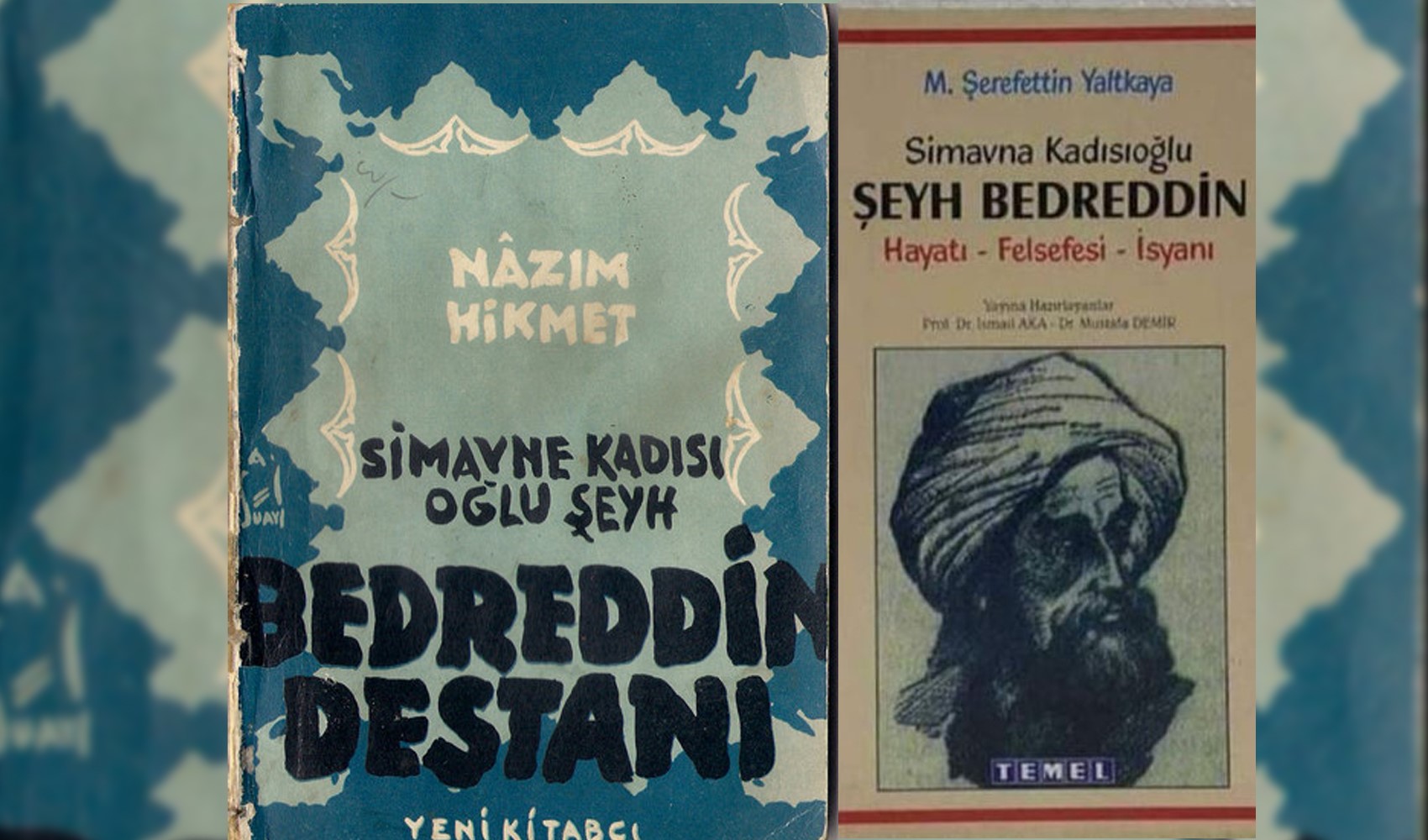
The Turkish left sees the Sheikh Bedreddin incident as an early-period communist uprising. Bedreddin and his disciples are remembered with sadness. The main reason for this perception is Nazım Hikmet's 'Epic of Sheikh Bedreddin'.
In the epic, Nazım describes an organized socialist uprising. Börklüce Mustafa, one of Bedreddin's disciples, rebelled in Karaburun, and Torlak Kemal in Manisa.
After troubling the Ottoman pashas of the period quite a bit, they were defeated, the rebellion was suppressed, and the leaders and over 10,000 disciples were severely punished.
Nazım Hikmet’s “Epic of Sheikh Bedreddin, Son of the Qadi of Simavne” was published in 1936. There is no doubt that the work is one of the masterpieces of Turkish literature. It is understood that the idea of writing this epic came to Nazım in an early period of his prison life.
This idea came to his mind while reading a treatise by Şerefeddin Yaltkaya, a professor at the Faculty of Theology of Istanbul University (Darülfünun at that time). Let us remember that Yaltkaya was the President of Religious Affairs after Börekçizade and the theologian who led the funeral prayer of Atatürk.
The treatise is dated 1924, was printed at the Evkaf-ı İslamiye printing house, and bears the title 'Sheikh Bedreddin, Son of the Qadi of Simavne'. After reading Yaltkaya's 112-page treatise, Nazım became convinced that the event was a socialist revolution (with the dream of establishing a communal society) that took place 500 years ago. The epic is entirely based on this conviction. What brought Nazım to this thought is Yaltkaya's interpretation. Yaltkaya also interpreted the Karaburun rebellion based on the words of the Byzantine historian Doukas. The poem focuses especially on Bedreddin and Börklüce. And it reaches its peak as a complete epic of sadness.
Since the poem was published in 1936, I became curious about which prison period of Nazım it was. In the booklet, Nazım mentions the cliffs from under the iron bars of the prison where he was staying, from where the sound of the sea came. But they cannot see the sea. This is the kind of prison where the 'Epic of Sheikh Bedreddin' was written.
Nazım was imprisoned in Ankara, Istanbul, Toptaşı, Paşakapısı, Sultanahmet, Bursa, and Çankırı prisons. There is no such prison where cliffs descend to the sea. The epic may have been written during a relatively short period of detention in Istanbul between 1928 and 1936. I found Nazım's revolutionary conviction in the preface explaining the epic to be very high. His morale is very high. There is no state of mind of someone who has been in prison for a long time. I wonder where this prison could be, where the clanking of chains of the death-row inmates on the floor above could be heard?
Utilizing Professor Yıldırım Koç's long article on the 'Epic of Sheikh Bedreddin', I would like to provide a small bibliography: Enver Behnan Şapolyo, 'Mezhepler ve Tarikatlar' (Sects and Orders); Bezmi Nusret Kaygusuz, 'Şeyh Bedreddin'; Firuzan Hüsrev Tökin, 'Türkiye’de Halk Hareketleri' (Popular Movements in Turkey); Dr. Hikmet Kıvılcımlı, 'Tarihin ilk sosyalist devrim hareketinin lideri' (Leader of the first socialist revolutionary movement in history); Mustafa Akdağ, 'Türkiye’nin İktisadi ve İçtimai Tarihi' (Economic and Social History of Turkey); Ahmet Yaşar Ocak, 'Osmanlı Toplumunda Zındıklar ve Mülhidler' (Heretics and Atheists in Ottoman Society), 'Şeyh Bedreddin', 'Varidat'.
MY FINAL VIEW ON SHEIKH BEDREDDİN
Sheikh Bedreddin was one of the greatest scholars of Islamic jurisprudence of his era. The age he lived in corresponds to the period of the disintegration of Byzantium and the establishment and state-building of the Ottomans. However, the great trauma created by Tamerlane in Anatolia not only turned the socio-economic order that had existed since the Seljuks upside down but also led to new political and social searches in the Anatolian geography.
Bedreddin's message basically has a theological (concerning existence) content. I did not see a definitive reference he preached regarding the social order. However, there is the idea of socialism (communal life) in his followers Börklüce Mustafa and Torlak Kemal. It is understood that Börklüce established a communal society in Karaburun, even if for a short time. He also has armed forces to defend this. We can characterize the Börklüce Mustafa and Torlak Kemal rebellions as a socialist uprising. Yes, it is utopian. But there is an attempt.
There is no evidence that Bedreddin imagined such a social order in the Black Forests.
Of course, I also feel very emotional when reading the “Epic of Sheikh Bedreddin” by our language's great poet Nazım Hikmet. I almost live inside the epic.
But I am not of the opinion that the Turkish left agrees on, that Bedreddin was a 15th-century socialist; a Thomas Müntzer or Mazdek who appeared in Ottoman lands.
Most Read

Striking picture for Özgür Özel's 'New Party'

The PKK opening and Özgür Özel’s path!..

How did the newspapers view Özgür Özel's farewell to the CHP?

He killed his wife by slitting her throat: Their children witnessed the moments

What did the CHP do?

Özel’s new party move in the world press

Fire at TUSAŞ engine factory in Eskişehir under control

The New CHP, against CEHAPE

From self-efficacy to despair

Kılıçdaroğlu's first message on Özgür Özel's new party announcement