



THE IMPORTANCE OF THE SOVEREIGN APPEARING AT THE PROCESSION ON HORSEBACK
It was customary for the Friday Procession (Cuma Selamlığı) to be held at the imperial mosques (Selatin mosques) as a state ceremony.
The mosques where the procession took place included, primarily, Hagia Sophia, as well as Eyüp Sultan, Kılıç Ali Pasha, Beşiktaş Sinan Pasha, Üsküdar Mihrimah Sultan, Atik Valide, Selimiye, and Ayazma mosques.
In later centuries, mosques built along the Bosphorus shores—such as Aziziye and Mecidiye—also began to be preferred.
The procession not only allowed the subjects to see their sovereign but also served as an opportunity for the distribution of justice. Reaching the Caliph with petitions continued until the time of Abdulmecid Efendi.
The Sultan would set out from Topkapı Palace on horseback to go to the mosque. As noted in Koçi Bey's treatise, the Friday Procession was, in fact, a ceremony that strengthened the bond between the "Caliph of the face of the earth" and his subjects. It was possible to see the state during this magnificent journey on horseback under heavy security measures.
There was a detailed ceremonial protocol, from the Sultan's boots being removed and his slippers being put on as he entered the imperial loge (hünkar mahfili). This task was performed by the Agha of the Janissaries. It was carried out by the most elite soldiers of the Kapıkulu corps (the left-handed guards, or 'solaklar') and the 'zülüflü baltacılar' (halberdiers with side-locks) in the service of the palace.
This ceremonial tradition continued with minor changes until the end of the reign of Sultan Aziz. II. Abdulhamid changed this order. Using an illness he suffered in the early days of his reign as an excuse, he stopped riding horses. He began to go to the procession by carriage.
The Sultan's appearance at the procession on a magnificent horse was reminiscent of the eras of holy war (gaza). This decision weakened the entire splendor of the ceremony. The passage of the sovereign, which formed the essence of the procession, was radically altered. The Sultan was in his place, but he was now sitting.
THE FRIDAY PROCESSION AS A STATE CEREMONY
That the Friday Procession was essentially a magnificent state ceremony is easily seen when one examines the flow of the program.
The state dignitaries who accompanied the Sultan in the procession were: the Sheikh-ul-Islam, the Minister of Pious Foundations (Evkaf Nazırı), the Marshal of the Imperial Guard (Hassa Müşiri), the Minister of War (Serasker), the Minister of Police (Zaptiye Nazırı), the Governor of Beşiktaş, and those bearing the title of 'Yaver-i Ekrem' (Chief Aide-de-Camp).
The presence of the Grand Vizier at the procession was not mandatory. This may have been related to the idea of not leaving the state leaderless during Friday prayers.
In principle, it was free for the public to watch the procession and pray with the sovereign. However, as one might imagine, eager believers could only reach the vicinity of the Hamidiye Mosque after being questioned, starting from the Beşiktaş Sinan Pasha Mosque.
It was free for foreigners to watch the procession. It could even be said that it was encouraged. Because the Friday Procession was a state ceremony. There, a small-scale show of force of the state's organization and combat power took place.
It is observed in Western travelogues that the procession was a public event watched with admiration.
An interesting historical event that took place during the procession is that a Swede was able to deliver a petition of complaint against Nevşehirli Damat Ibrahim Pasha, who was causing him trouble, to Ahmed III by bypassing the Kapıkulu barrier.
The era of II. Abdulhamid is a modern period in many respects. In the capital, there was a significantly large foreign population occupied with international trade, including ambassadors and Levantines.
In the 19th century, transportation to the Ottoman Empire had become easier in every sense thanks to steamships and railways. Istanbul was a cosmopolitan city. It had become the focus of Orientalist interest.
A grandstand had been built in front of the Great Mabeyn (Büyük Mabeyn) to host the diplomatic corps and their families who wanted to watch the procession. There was also an official in charge of protocol for foreigners. The landscape painter Hoca Ali Rıza. The art teacher at the military schools.
Military units stationed in the imperial capital would set out from their barracks toward Yıldız with their most impressive soldiers. For example, those coming from the Bab-ı Seraskeri (Ministry of War) would set out from the Mercan Gate and reach Beşiktaş via the Galata Bridge and Tophane road. A small unit would join them as they passed in front of the Tophane Marshal's office. The battalion coming from the Imperial Shipyard (Tersane-i Amire) would reach Beşiktaş via Şişhane, Cadde-i Kebir (Beyoğlu), and Maçka Barracks. The assembly point was in front of the Sinan Pasha Mosque.
Additionally, the Yıldız Battalion, the Plevna Battalion, the Arab Zuhaf Battalion, and the Albanian Battalion, which emerged from the Orhaniye and Ertuğrul barracks responsible for the palace's security in Yıldız, would form a ceremonial line from the Sultanate Gate toward today's Barbaros Boulevard. The most special unit was the Ertuğrul Regiment (from the Karakeçili tribe) with their white horses.
There is a point I would like to draw your attention to here. The Ertuğrul Regiment was a regiment that Sultan Hamid attached great importance to. With this, a nostalgic bond was established between the dynasty and the Kayı Tribe. I would like to remind you of Fausto Zonaro's painting of the Ertuğrul Regiment's passage.
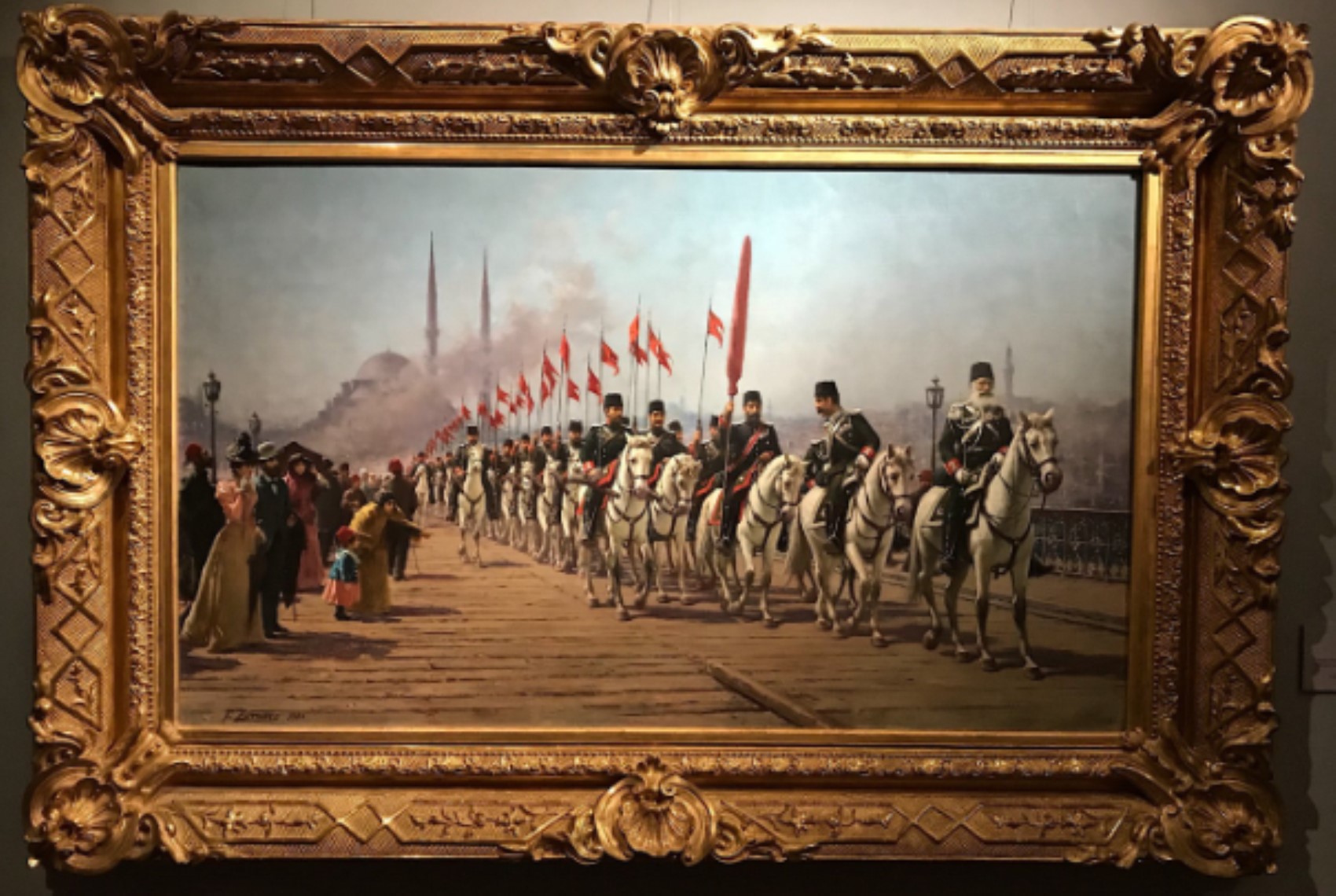
(Painting of the Ertuğrul Regiment crossing the Galata Bridge)
ZONARO'S ERTUĞRUL REGIMENT PAINTING
The palace painter Fausto Zonaro had painted the Ertuğrul Regiment's crossing of the Galata Bridge in 1896. When Kaiser Wilhelm first arrived, he liked the painting very much, and it was gifted to him. Upon this, the painting was redone in 1901 with minor changes. The painting we know is the second one.
I have seen the Kurdish battalion mentioned in several articles. If this is true, I think it was a representative unit from the Hamidiye Regiments established to "quell the Armenian commotion" in the Six Vilayets (Vilayat-ı Sitte). The Six Vilayets is the region called the 'Six Armenian Vilayets' in Western literature.
With the Arab and Albanian units, the unifying nature of the Caliph was emphasized, despite the Ottoman Empire being based on "diverse elements" (anasır-ı muhtelifeye).
We know that Abdulhamid had many high-ranking Albanian bureaucrats. In fact, the Grand Vizier Ferit Pasha of Vlorë and Esat Toptani Pasha were Albanian. The leaders of the Albanian independence movement emerged from among the relatives of these people. For example, Ismail Kemal Bey.
SOME RITUALS IN THE PROCESSION
Before the Hamidiye Mosque was built, Sultan II. Abdulhamid would have one of Eğinli Sait Pasha, Gazi Osman Pasha, or Serasker Rıza Pasha sit next to him while going to the Friday Procession.
As he left the Sultanate Gate, he would be sent off with the applause and prayer of "Do not be proud, my Sultan, there is Allah greater than you." Let us also say that this ritual has nothing to do with today's applause. The applause and prayer can be likened to the welcoming and farewell rituals in the West, similar to 'Hoch hoch', 'viva', or 'rach rah' (German, Italian, Swedish).
NOTES ON YILDIZ PALACE
The Great Mabeyn (Büyük Mabeyn) right across from the Hamidiye Mosque had been built by the Balyans during the time of Sultan Aziz. The hero of Plevna, Gazi Marshal Osman Pasha, had a study office here. The Pasha was the Sultan's most trusted marshal. He had voted for the execution of the death penalty given to Mithat Pasha. Along with Ahmet Cevdet Pasha. It is worth remembering. The fact that the sentence was given in an extraordinary court, as well as the formation of an appeals board for its approval and the voting process, is significant in terms of showing the conflicts within the ruling elite class of the Abdulhamid era.
Buildings such as the Small Mabeyn (Küçük Mabeyn), the Chalet (Şale), the Çit Pavilion, and the Set Pavilion were included in the Yıldız palace complex over time. The Chalet Pavilion was expanded with additions made from 1877 until 1889. The pavilion is a place where Kaiser Wilhelm was hosted.
I cannot pass without mentioning a historical reminder: The Chalet is the place where Cemal Gürsel invited Professor Ali Fuat Başgil after May 27 to warn him about his writings.
After the Republican revolution, the book and painting collections in the palace were sent to the Darülfünun Library upon the instruction of President Atatürk. These works are in the Rare Books Collection today.
In the Republican era, the inner buildings of the palace, protected by a second wall, were used by the War Academies for many years. Some buildings were allocated to the İDMMA (Yıldız Technical University) and IRCICA.
SULTAN HAMID'S WESTERN AND EASTERN SIDES
As one of the princes, Abdulhamid participated in the Egypt and Europe travels of his uncle, Sultan Abdülaziz. Although he increasingly shut himself in Yıldız during his reign, he was someone who had been to Europe. Just as he followed Europe very closely through magazines and newspapers, he was on the same page as European monarchs in terms of the furnishings in the pavilions and mansions he had built, and in his consumption tastes.
He only drank rum as an alcoholic beverage. He had developed an argument that legitimized this for himself. As is known, rum is made from sugarcane. He argued that what was forbidden in the Quran was wine (hamr) made from grapes.
According to the 7th article of the Kanun-ı Esasi (Basic Law), he was the one in whose name the sermon (khutbah) was read, in whose name coins were minted like his ancestors, and he was the one who both convened and dissolved the Chamber of Deputies (Mebusan Meclisi), which he had promised to the reformist faction that brought him to the throne.
THE SULTANATE CARRIAGE-THEATER-OPERA
I think it is important that Abdulhamid stopped riding horses in the Friday Procession. He began to ride in a sultanate carriage pulled by four horses when going to the procession and two when returning.
I think this has to do with modernization. In all European metropolises, transportation was provided by landau or coupe horse-drawn carriages. Very luxurious vehicles had begun to be produced for the aristocracy and the bourgeoisie.
The Sultan's fundamental contradiction was this: On one hand, he was trying to modernize administration and education. This was concretely visible. But on the other hand, he viewed the state with the "state as property" (mülk devlet) perception like his ancestors.
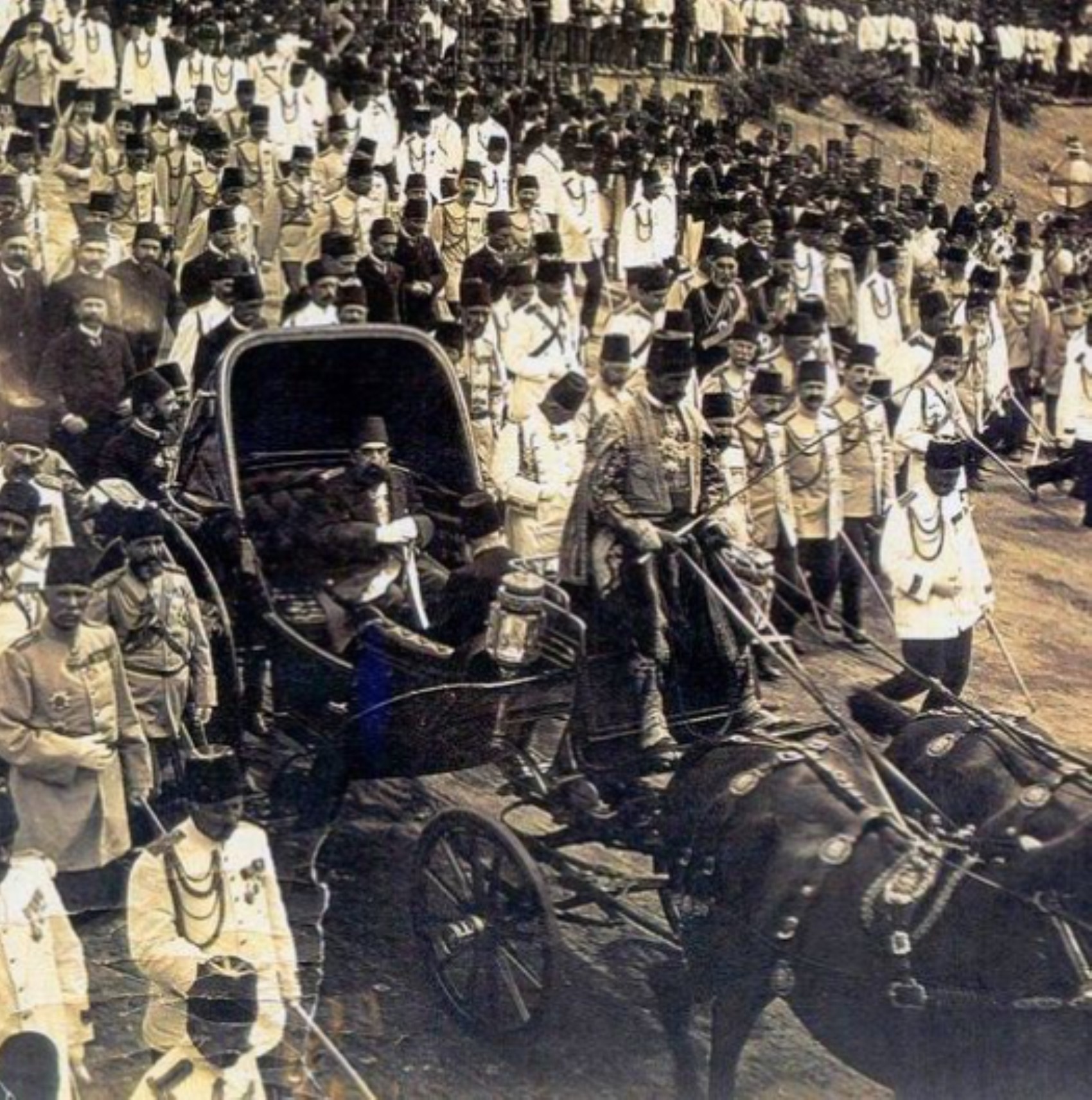
(Sultan II. Abdulhamid at the Friday Procession)
He wanted to continue his reign as an absolute monarch. He was in pursuit of enlightened absolutism like the Prussian King Frederick the Great or the Russian Tsar Peter the Great.
When the Kaiser, who saw the halberdiers (baltacılar) kept as a nostalgic unit in the parade, while the Sultan was having him watch an opera in his theater, asked if they were executioners, the Sultan felt like a medieval king and was embarrassed. He closed the guild of halberdiers, who had been performing services requiring physical strength in the palace for hundreds of years.
French and Italian artists perform works such as Aida, Carmen, Faust, and Il Trovatore in the Yıldız Theater. But the same modernizing sultan who did all this could have Mithat Pasha, who brought radical changes in the fields of politics and administration, sentenced to death. While serious financial support was provided for the Servet-i Fünun magazine, heavy censorship was applied to newspapers.
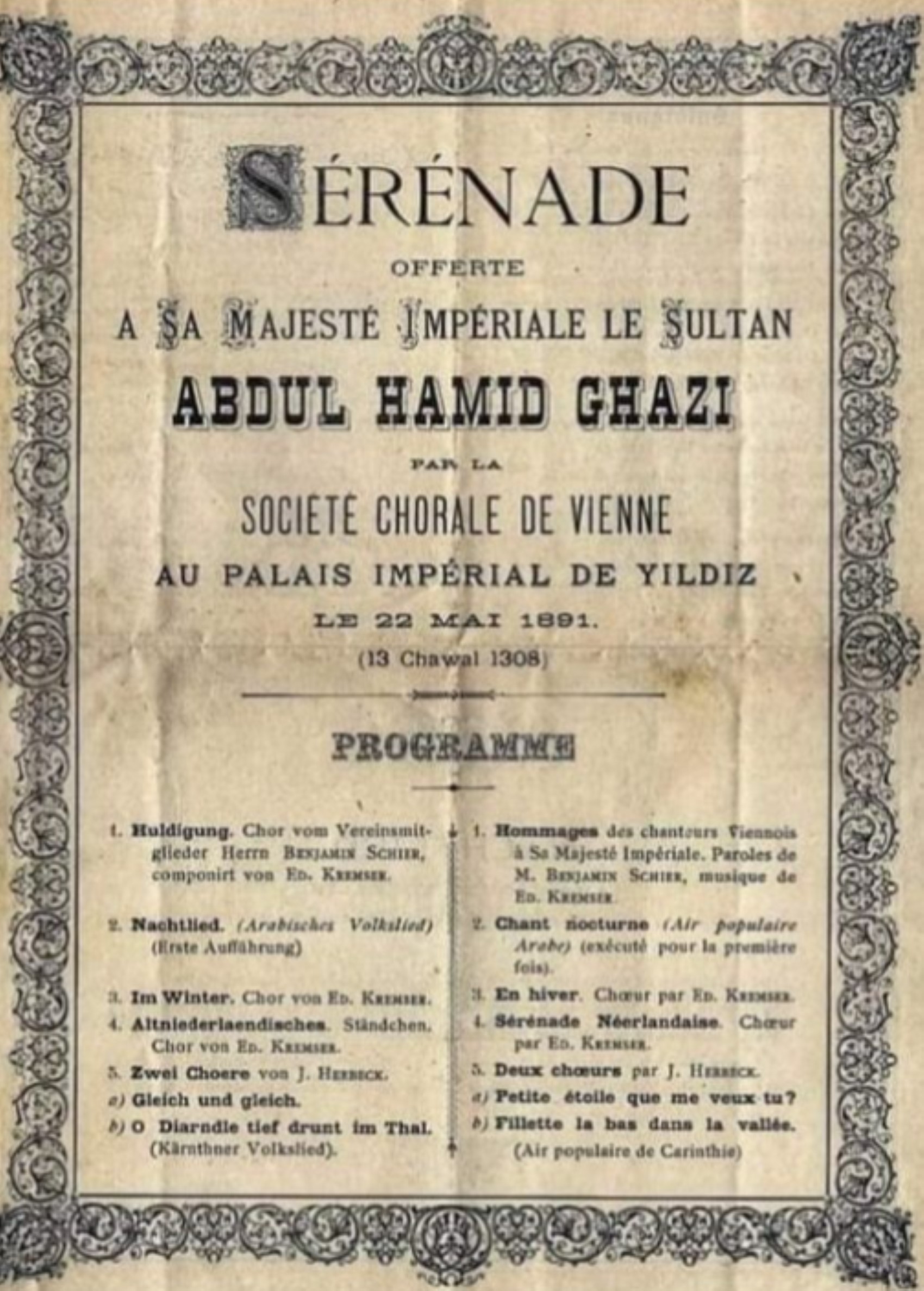
(The Vienna Choir watched at the Palace on May 22, 1891)
THE SULTAN HAMID REGIME
Abdulhamid's reign significantly changed the path taken in state administration after the Tanzimat.
Once he dissolved the Chamber of Deputies and made the decision to "follow the path of my ancestor Sultan Mahmud," he took the power that was sliding toward the Sublime Porte (Babıali, meaning the Grand Vizier and the ministers). If this process had continued, the Ottoman Empire would have transitioned to a constitutional regime similar to the British Empire. From there, a democracy that was not a republic could have been reached.
Sultan Hamid did the exact opposite. He turned the constitutional monarchy into an absolute monarchy. The sultanate law, which had loosened and regressed during the Sultan Aziz era, was reclaimed and consolidated.
It would probably not be wrong to put forward such a thought. The entire military and civil administration gave a braided, medaled, modernized appearance. Except for the fez. That was also the difference of the Ottomans. The elite class was in clothes reminiscent of the Prussian, Russian, and Austro-Hungarian empires. The procedures and bureaucracy looked modern. But when one looked closely at the functioning of the system, it was understood that it had returned to a regime of subjects (kul). The bureaucracy had become 'kapıkulu' (slaves of the Porte), and everything had become dependent on the Sultan's appreciation, approval, and favor.
A SMALL-SCALE KREMLIN
Sultan Hamid built a new state center. This was Yıldız Palace.
At the beginning of the 19th century, Yıldız was a private promenade area with its pavilions and mansions. Throughout his 33-year reign, it became a campus protected by high walls with new buildings (including a carpentry shop, theater, repair workshop, and Yıldız porcelain) built according to the Sultan's needs and demands. Abdulhamid turned this area into a Kremlin protected by high walls.
The Orhaniye Barracks were built on the side of the palace facing the Jewish Cemetery. A strict security system was established.
This completed a centralized communication and network where the telegraph networks of all Anatolia and Rumelia were connected to the Yıldız telegraph office.
In this way, the sovereign could monitor and supervise the entire property without ever leaving the palace. He had catalogs prepared consisting of the pictures and biographies of the officials serving in the farthest corners of the empire. He held the bureaucratic apparatus in his hands.
He could reach everywhere and everyone with photography, telegraph, and railway. He had connected everything to Yıldız.
An important development that further reinforced this safe but isolated life was the construction of the Hamidiye Mosque.
A mosque was built a few hundred meters away from the Sultanate Gate for the Friday Procession, which was the sovereign's only contact with his subjects. The Hamidiye Mosque, along with its clock tower. The carefully decorated mosque was planned for the Sultan's Friday Procession.
He had reduced the tradition his ancestors carried out on horseback to a short and narrow-staffed ceremony.
A sultanate carriage pulled by four horses when going and two when returning began to be used. The imperial loge was turned into a space where only 3 rows of state dignitaries could pray. There was a special place for the Sultan.
In this way, Sultan Hamid (in his capacity as 'ülü'l-emr' - the one in command) minimized the contact with the subjects required by custom and Sharia. He had petitions collected by his private secretaries. He gave instructions to the Grand Vizier for the necessary actions.
After 1890, the Ottoman Sultan turned into a monarch seen from afar by the public only during a journey of a few hundred meters. Perhaps this is the reason why the expressions 'Red Sultan' and 'Yıldız Owl' entered the opposition literature until the Young Turk revolution.
Abdulhamid had established a system of favor, grace, and office, and over time, a chain of pashas who profited from this was born. The most famous among these are Eğribozlu Sarıca Ragıp Pasha and Arab Izzet Holo Pasha.
ASSASSINATION ATTEMPT ON ABDULHAMID
On July 21, 1905, a bomb assassination attempt was made on Sultan Abdulhamid as he was leaving the Friday Procession.
A very powerful explosive was used in the assassination; 26 people died and 58 were injured.
In the incident, the Sultan was saved thanks to an unscheduled meeting of a few minutes with Sheikh-ul-Islam Cemalettin Efendi.
The Armenian Revolutionary Federation (Dashnaktsutyun) claimed responsibility for the assassination.
Since the 1896 Ottoman Bank raid, Armenian separatism had been organized intensively in Russia, Europe, and the USA. The organization was affiliated with the Second International: the Socialist International. It claimed to blend Armenian nationalism and socialism.
It was also related to anarchist circles. It was understood that the perpetrator was a Belgian anarchist who had contact with the organization. Edward Joris.
The Sultan was protected by 7,000 soldiers. Behind high walls. The existence of an intelligence network supported by a wide network of spies and informants should not be forgotten. Extremely strong measures were taken during the Friday Procession.
Despite this, there were a few things that explained how such a powerful bomb could be placed. First of all, the Sultan's intelligence organization had been focusing on the Young Turks who had been opposing from abroad since 1889. Measures regarding foreigners were weak. Conditions made it difficult to take measures against foreigners. The reason can be explained as follows:
Capitulations, the existence of foreign post offices, the development of the railway network, and the increase in passenger volume of Europe-connected maritime lines. Factors such as the fact that controls other than passports for foreigners—especially Europeans—in the port of Istanbul were met with dissatisfaction made it impossible to establish a serious control mechanism on those coming to the capital.
The perpetrator responsible for the assassination, Edward Joris, was tried. He was sentenced to death. Sultan Hamid commuted the sentence to life imprisonment.
A wide campaign was launched in Europe to "save Joris from the Sultan's dungeon." A broad anti-Abdulhamid propaganda platform, which generally received support from leftist circles, was established. It was also effective.
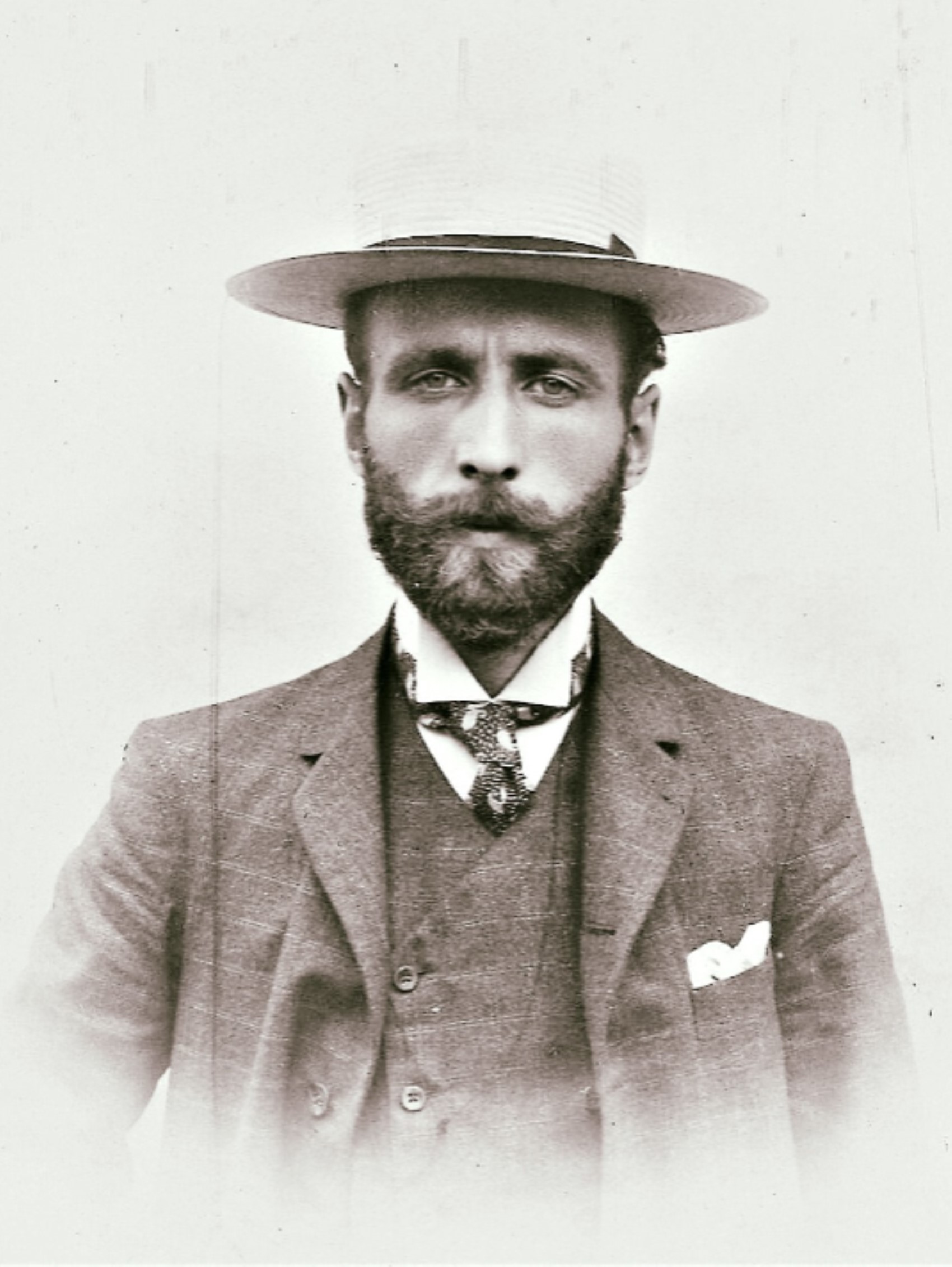
(Assassin Edward Joris)
The Belgian government—incredibly—was able to argue that Joris could not be tried in Ottoman courts, citing judicial capitulations as a reason. As you can see, according to the Belgian government, the person caught as the person responsible for the assassination of the Sultan of the Ottoman property on Ottoman lands could not be tried in an Ottoman court. In the meantime, let us not forget that dozens of people died. I think this might be the simplest answer when asked what imperialism is.
The anarchist Joris had started working in Istanbul some time ago. He was working in secretarial jobs at the Singer Factory.
But interestingly, Sultan Abdulhamid, unable to withstand the pressure from Europe, released the assassin two years later. The incident was actually a 'Pastor Bronson' incident. But today, Islamist circles explain the background of the Sultan pardoning Joris with "big picture theories."
According to the Islamist narrative, Sultan Hamid sent Joris to Europe as his own agent. The assassin was accepted into the palace, given a gift of 500 gold coins, and sent to Europe by putting him on a train from Sirkeci.
Naturally, I wonder: What services could Joris have performed in Europe as the Sultan's agent? I would have liked to hear a few examples, honestly.
I would like to end my article by making a comparison. Another assassination attempt during the Friday Procession took place against Selim III at Hagia Sophia: July 10, 1792. The Moorish attacker was caught and executed immediately at the Bab-ı Hümayun gate.
Most Read

Striking picture for Özgür Özel's 'New Party'

The PKK opening and Özgür Özel’s path!..

How did the newspapers view Özgür Özel's farewell to the CHP?

He killed his wife by slitting her throat: Their children witnessed the moments

What did the CHP do?

Özel’s new party move in the world press

Fire at TUSAŞ engine factory in Eskişehir under control

The New CHP, against CEHAPE

From self-efficacy to despair

Kılıçdaroğlu's first message on Özgür Özel's new party announcement