



TAKSIM SQUARE WHAT COMES TO MIND
Images from childhood and youth are important in the human mind. For me, Taksim, Republic Monument aside, is the Palace of Culture (now the AKM) and right in front of it The May 27 revolution symbolized by olive leaves wrapped around a bayonet statue and the early days that I could not make sense of the Inönü statue pedestal.
MY DISCOVERY OF THE EQUESTRIAN INÖNÜ STATUE
In the mid-70s while I was still a high school student, I encountered a statue pedestal with inscriptions on its sides at the top of the Gezi Park stairs. For a long time, I could not fully grasp its nature.
I was unaware of the great battles that had been fought over it. In the past, learning something was not very easy. Even if you proceeded through the right connections, it would take quite a long time. Now, the moment you type 'Taksim statue pedestal' into a search engine, you can instantly learn what you are curious about.
KIRDAR'S GOVERNOR-MAYORSHIP
During the Atatürk era, the Governor of Istanbul was Muhittin Üstündağ. Under the municipal law, he also held the position of Mayor of Istanbul simultaneously. Üstündağ governed Istanbul for a long time.
He was removed from office after Atatürk's death. Dr. Lütfi Kırdar was appointed in his place. Dr. Kırdar had previously served as the Governor of Manisa and was an extremely capable administrator. His family roots traced back to Kirkuk. I should mention that I have read some articles claiming he was a cousin of İhsan Doğramacı.
He was a physician known for his administrative skills since the years of the Committee of Union and Progress. He had specialized in ophthalmology in Germany and was elected as a deputy from Kütahya in 1936. He was elected.
During the Atatürk era, he decided to implement the plan of Henri Prost, who was invited to transform Istanbul into a modern city. The plan envisioned large park areas in two central districts of the city.
The plan had envisioned large park areas in two central regions of the city.
One of these was in the Walled City, the second would be parks connected through gradual transitions starting from Taksim to the present-day Maçka Park. The starting area was Taksim Gezi.
In the place known today as Gezi Park, there was an Artillery Barracks built in the 19th century in an eclectic style (with onion domes) that
was in a semi-abandoned state at the time of the republic. had been transferred. See Burhan Felek's writings. In Turkey's largest city (the former capital), it served as a stadium.
Including matches held by famous boxers brought from abroad. there was no other venue for all spectator sports. Dr. Kırdar rolled up his sleeves for a new Istanbul. Let us also remember, in the meantime, that he had the Dolmabahçe Stadium built. in the meantime.
During his tenure as governor and mayor, Dr. Kırdar provided an example of destructive-constructive action. He both destroyed and built. Menderes continued this path. The late Adnan Bey viewed Istanbul as a medieval city and wanted to weave it with asphalt boulevards. And he did just that.
The years Kırdar was in office were the years of the Second World War. Although resources were limited, he continued development activities very skillfully. He expropriated the area from Taksim to Harbiye (including Armenian cemeteries). The Muslim cemeteries up to Gümüşsuyu were also part of the new development was expropriated to open up areas. Dr. Kırdar expropriated many parts of
Istanbul, which had turned into layers piled on top of each other over centuries. He demolished them. He rebuilt them according to the plan.
THE STATUE WAS DR. KIRDAR'S IDEA
The idea of building an Inönü statue in Taksim Gezi Park belonged to Dr. Lütfi Kırdar. belonged to. It was decided that the statue would be commissioned to Rudolf Belling, head of the Sculpture department at the Academy of Fine Arts. Belling had previously worked on the Ziraat in Ankara. He had made an İnönü statue for the faculty garden. He had made it.
Belling and his assistants would also work together on the Anıtkabir reliefs in the 50s.
Given the financial conditions of the 40s, the implementation of Henri Prost's Istanbul plan was truly a massive step.
For this reason, the urban development initiatives of Dr. Kırdar and Menderes the infrastructure of the central districts of modern-day Istanbul was established.
Kırdar's commissioning an Inönü statue from Rudolf Belling in the attempt is not surprising. What is surprising is the size of the statue and the place where it was intended to be placed.
During the production process of the statue, National Chief Inönü visited the workshop. It is understood from the photographs of the day that he was quite pleased with the creation of his statue.
The pedestal of the statue another project regarding was carried out. It was completed. Ultimately, the statue was finished in 1944 and could have been placed in its intended location.
But by then, the conditions had completely changed. In my opinion, the colossal size of the statue and the location chosen for it must have dampened Inönü's initial enthusiasm.
In the meantime, in 1946, the transition to a multi-party political system took place. The Democrat Party grew rapidly. As an opposition party, it increased its influence. Following the July 12 declaration, Inönü moved away from being a partisan president. rather adopted a position of "neutrality."
In 1949, Dr. Ord. Prof. Dr. was appointed as the Governor of Istanbul, replacing Lütfi Kırdar. Fahrettin Kerim Gökay was brought in. Gökay, during the Menderes governments period also continued his duty for a long time.
The dimensions of the statue and to be placed my opinion regarding the desired location is not positive. I do not find the idea of a statue large enough to overshadow the Taksim Republic Monument to be correct. The chosen location was also not correct. The reason for this choice, in my opinion, was the “zeitgeist” and what defined this spirit was The Second World War and the dominance of the National Chief concept.
For the statue, a reasonable location within Gezi Park would have been more appropriate. For instance, placing it towards Taşkışla or Halaskar Gazi Street would not have been bad. In terms of size, it should also have been smaller than the Republic Monument.
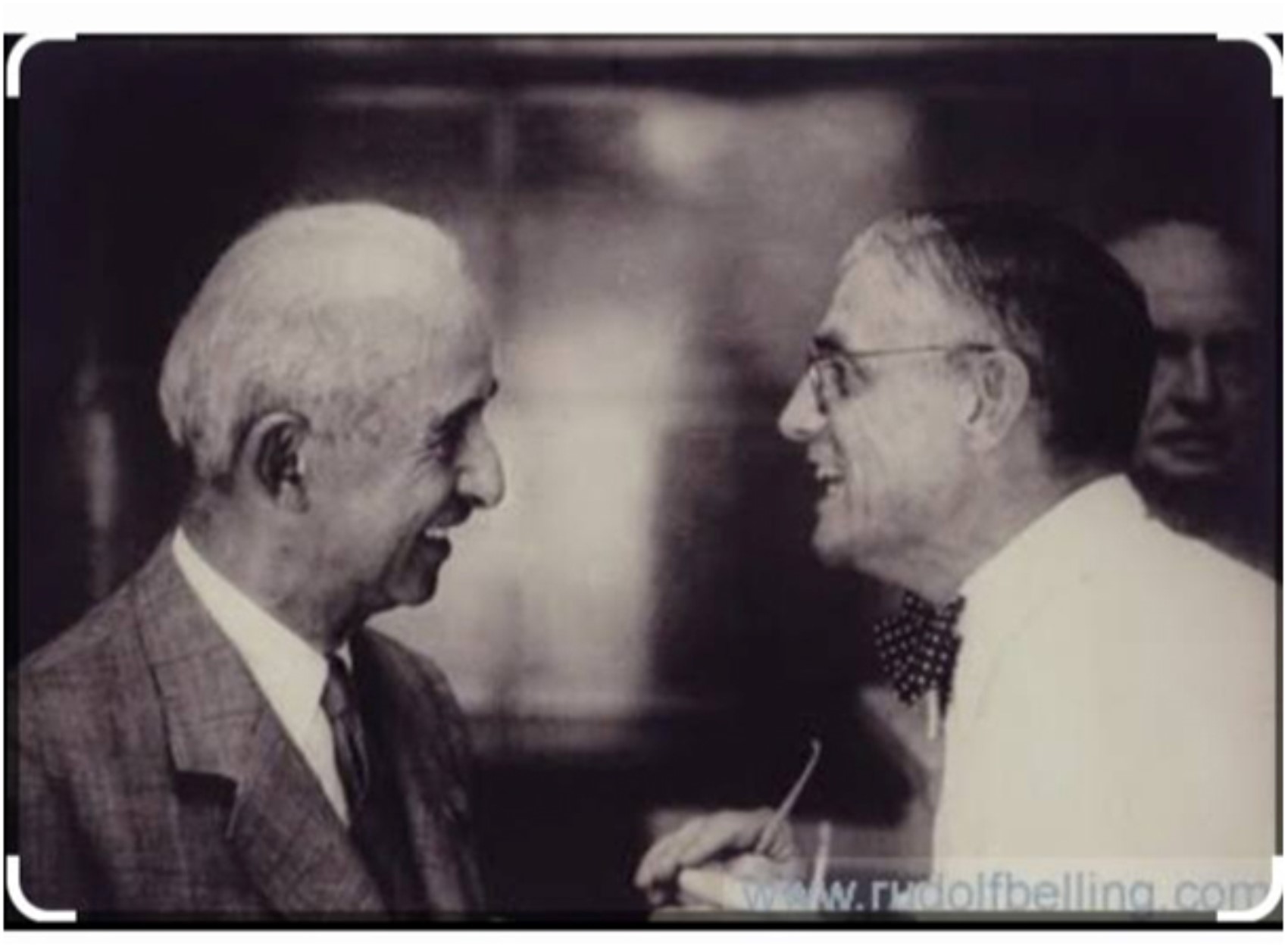
(İnönü with Belling)
THE STATUE HOW DID THE CREATOR RUDOLF BELLING COME TO TURKEY?
The reason for Rudolf Belling's arrival in Turkey is different from the other German professors.
The other names were of Jewish descent they were dismissed from their jobs. Due to safety concerns in the face of German fascism, they were in other countries work were looking for. They even formed a committee for this purpose. Jewish professors expelled from their countries sought employment in an organized manner. A significant portion of them would come to Turkey. Turkey had a need for such high-caliber scientists. For those arriving, Turkey was also a safe island. Especially after the war intensified, for the scientists leaving Europe, Turkey was the safest became one of the places.
Belling, was not Jewish. He had married a Jewish artist. The couple had divorced some time ago. However, they had a son: Thomas.
Belling's views were at odds with the rising new regime. Against National Socialism or German fascism. After the Weimar Republic was established (1919), in Germany, social and political in every field conflicts and disputes had already begun to be experienced. The fields of literature and art were also included in this. The Nazis accused everyone except themselves of treason and corruption, starting with the communists.
Belling, until the 30s, was part of the November Group, which addressed painting, sculpture, and architecture together. had taken part in it. In 1919, he created his first non-figurative work (meaning abstract sculpture), titled 'Triple Harmony'.
According to the Nazis, this approach was degeneration in art. Fascism took all necessary measures to establish its own indigenous and national artistic understanding. began. This meant the purging of all artists who were not in their own ranks. purging meant.
Belling was dismissed from his duties. He stayed in the USA for a while. But the real issue was his ex-wife being Jewish because of his son It was Thomas's personal safety.
Meanwhile, following the sudden death of Namık İsmail, the founding director of the Academy of Fine Arts, from a heart attack (on the Kadıköy ferry), Burhan Toprak was appointed to the Academy's administration. Toprak wanted to implement reforms within the State Academy of Fine Arts.
As a result of the contacts, Rudolf Belling was invited to the sculpture department, Bruno Taut to architecture, and Leopold Levy to painting department and were appointed as heads of their respective departments.
Let me remind you: Belling became the teacher of Mari Gerekmezyan. During the same years, İvi Stangali was also a student in the Bedri Rahmi workshop within the painting department, where Leopold Levy was the head.
At the Academy of Fine Arts, while this period of progress was being experienced, a hell of war was unfolding around our country.
INÖNÜ'S STANCE
National Chief Inönü was initially against the erection of his statue quite pleased, although due to the reactions he lost interest over time, and did not take any initiative. He was unaware of the statue incident like began to behave. Consequently, with the start of multi-party political life, the statue was left in limbo.
DEMOCRAT PARTY AND INÖNÜ THE STATUE
After 1950, it had become certain that the statue could no longer be placed on its pedestal in Taksim. The Democrats had fallen from power, and Inönü's statue of course they would not place it there. They could not explain this to their own voters.
Beyond that, the inscriptions on the pedestal praising Inönü were disturbing the party elite, DP voters, and standard Inönü detractors.
At the same “The Savarona is too expensive, it reminds us of the single-party reign. Let's sink this ship,” said those who were present, of the statue pedestal there were also those who wanted it to be blown up. This thought has always reminded me of the Unionists blowing up the Ayastefanos Russian Monument.
The Bayar-Menderes duo of that much they must have thought it would be shameful, so the statue pedestal was covered with a wooden screen.
As you can see, with the transition to Turkish democracy, the Inönü statue pedestal was covered with the "shawl of the Democrats." The shawl was, in fact, draped over the man who established democracy. The shawl was actually draped over the man who established democracy. Thus, İsmet Pasha was erased from the square.
The Democrats also changed the name of the Dolmabahçe Stadium, which was built during the time of Dr. Kırdar and named Inönü Stadium. They renamed it Mithat Pasha Stadium. I remember the time when this name was in use.
Because they established a connection between Mithat Pasha's struggle against despotism and their own political struggles. In fact, Bayar had Mithat Pasha's grave brought from Taif to Istanbul in 1951. At the Hill of Liberty was buried in its current location.
I have an article on this subject. If you would like to take a look, the citation is as follows: “Was it Mithat Pasha who was tried at the Yıldız Tent Court? Or was it the Kanun-ı Esasi (Basic Law)?”
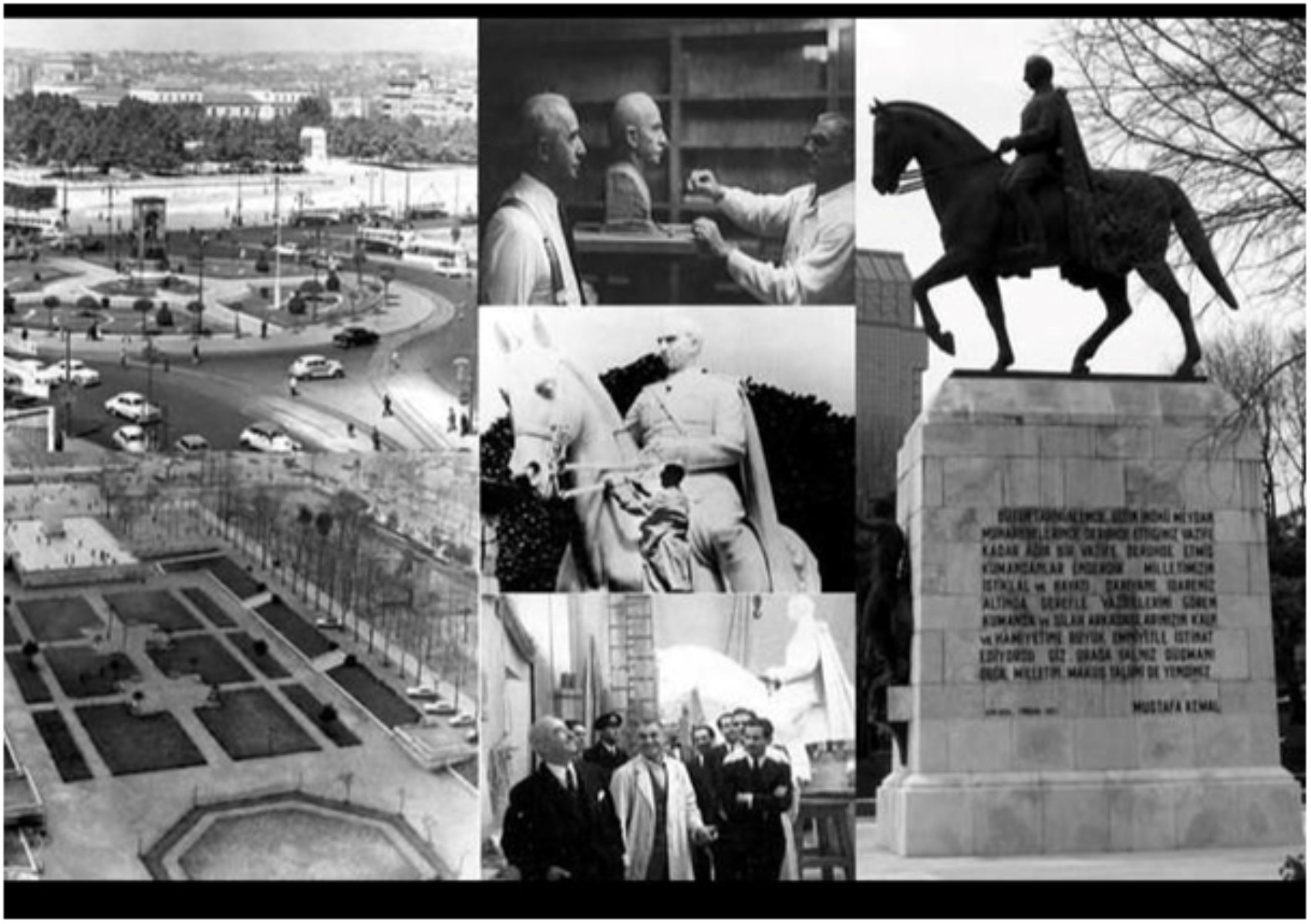
THE STATUES OF ISTANBUL
Dr. Kırdar, in terms of his working style, of the single-party elite typical was an example of. When we look at the works he signed, it is a very successful example.
At the CHP's First Extraordinary Congress (1938), the title of National Chief was given to the president He was of the opinion that a statue of İnönü should be erected in Istanbul. Construction work was underway at Gezi Park, which was considered the most suitable location. In my opinion, it was the right idea.
In the 1940s, there were a limited number of statues in Istanbul. Apart from the Atatürk statue made by Heinrich Krippel in 1926 at Sarayburnu, there was the Taksim Republic monument, a work by Pietro Canonica that symbolized the republican revolution. (1928)
Both monuments emphasized the Turkish War of Independence, the revolution, and the new regime. The War of Independence and the founding leader of the republic was being highlighted. But Atatürk was no longer there.
There was İsmet Pasha, who was governing the country while surrounded by a ring of fire. Although a project competition for Anıtkabir had been held for Atatürk and implementation had begun but the country the National Chief was managing.
The Prost plan was, in terms of urbanization, a very revolutionary concept. Achieving this in 1940s Turkey can be explained by Dr. Kırdar's skillful administration.
Regarding the idea of the statue, I do not see any error. However, the dimensions of the statue the political [context] of the era spirit has a connection with: The statue reflects the image of the National Chief in a cape on horseback. If it had been placed in its spot. Very multi-party political on the eve of its realization, it would have been a monument-statue larger than the Republic Monument dominating the elevation in Taksim. This statue would have been the dominant element of the square. Now there is a completely different Taksim Square. DR. KIRDAR'S
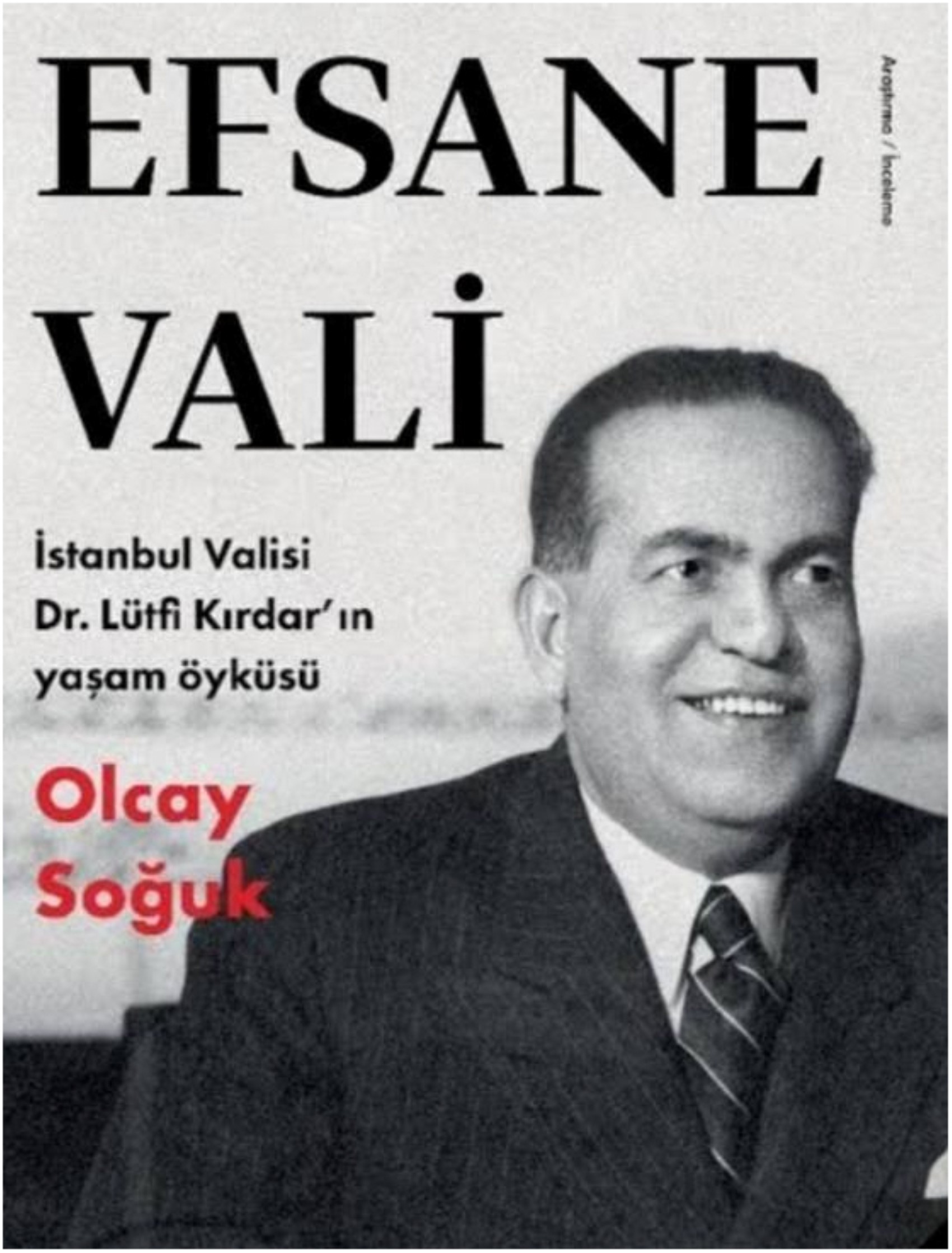
DR. KIRDAR'S HIS DEATH ON YASSIADA
In my opinion, Dr. Lütfi Kırdar was not a figure with party affiliations. What mattered to him was public service.
He worked with the Committee of Union and Progress during the Constitutional Era, and with Atatürk and the National Chief during the early republican period. In the daily sense, he was concerned with politics was not. In every period he was praised for his work.
He served as a member of parliament from the CHP. Later he became an independent member of parliament from the Democrat Party list. Halide Like Edip and Ali Fuat Cebesoy.
After the 1957 elections, in the Menderes Government Health Ministry was appointed.
Dr. Kırdar was, after May 27, along with all the ministers of the deposed government, arrested. He was tried on Yassıada. In February 1961, he could not withstand the mistreatment by the judges of the High Court of Justice. While presenting his defense, he suffered a heart attack and passed away.
This death for me, in Turkey, marked the end of "politics of 'contamination' is an important event that shows what kind of risks it means to take. And it is very painful.
As in his testimonies to the High Investigation Board, in order to provide better service, the ruling party's parliamentary membership and ministry had accepted the proposal.
A FEW NOTES ON THE PERCEPTION OF GOVERNOR DR. LÜTFİ KIRDAR
In the early period of the current administration, a policy of silence regarding the founding leaders was adopted. was watching. After 2007, however, an offensive against the symbols of the revolution was launched. The Fethullahists and the Second Republicans were on the front lines.
This offensive also had a dimension carried out through symbols. For example, the Gülhane Military Hospital was renamed the "Sultan Abdülhamid Han Training and Research Hospital." Many institutions had the name Atatürk removed under the pretext of construction and renovation. Yeşilköy Atatürk Airport was destroyed.
The name of Dr. Lütfi Kırdar was also instrumentalized for AKP policies. The name of Dr. Lütfi Kırdar was given to certain places. For example, the Kartal Training and Research Hospital.
Dr. Kırdar is an important figure who served this country. His name could certainly have been given to some institutions. It should have been, too. But the intention was different. The reason for this was Dr. Kırdar's legacy. Yassıada trials during his death. They saw him on their own front.
However, anyone who examines Dr. Kırdar's biography even slightly will see that he was an administrator during the Atatürk and Inönü eras. Kırdar's primary identity is that he was a successful administrator of the single-party era.
He was not politically a member of the Democrat Party. In terms of his thoughts and beliefs, he was also was by no means close to the current government. It was Dr. Kırdar who had Gezi Park built, which is still on the government's agenda. He is the one who had the Artillery Barracks demolished and replaced with Gezi Park, the Istanbul governor. Kırdar also commissioned the Sports Exhibition Palace, the Open-Air Theater, and the Dolmabahçe Stadium. Kırdar
Kırdar also commissioned the Sports Exhibition Palace, the Open-Air Theater, and the Dolmabahçe Stadium. Kırdar his actions have significantly altered the silhouette of our city in terms of modernization. Menderes also continued this line in his own style.
It is understood that Kırdar had a special relationship with Inönü. What I mean is that Dr. Kırdar historically was an Ismet Pasha supporter. He appointed him as the governor of Istanbul and municipality is the one who made him mayor.
The conditions in the 50s led him to join the DP. What happened to him was a great misfortune. What determined his ill fate was that on May 27, 1960, he was caught as a minister from the DP. Where he was on the day of the coup the location was wrong.
What I mean is, the government's Kırdar narrative is incorrect. Perhaps the government's advisors, regarding our political history, without gathering sufficient information, have taken a superficial generalizations in making they see no harm.
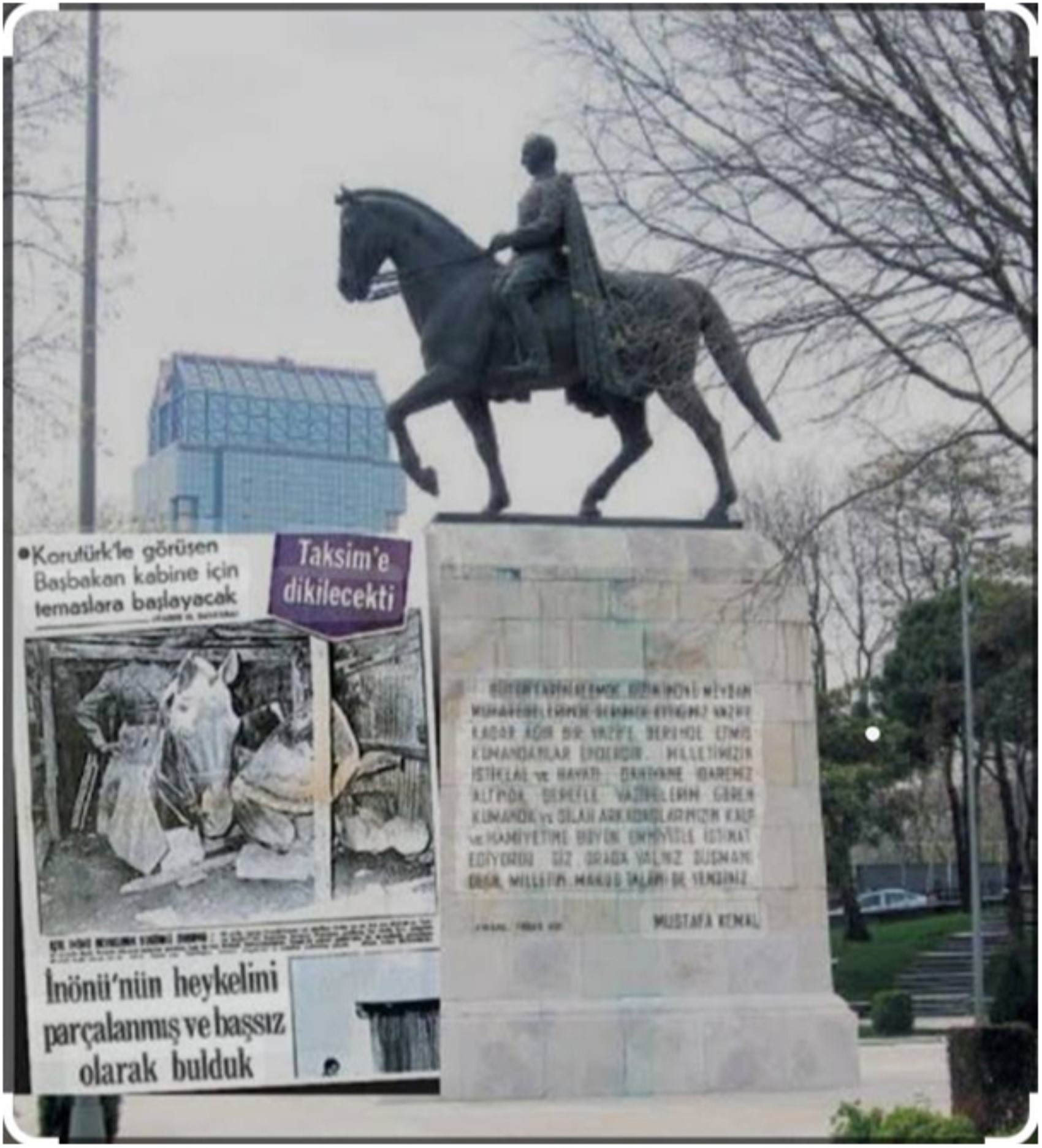
HOW AND WHY WAS THE STATUE BROUGHT TO MAÇKA PARK? THE STORY
By the time I discovered Taksim Square, the wooden screen covering the monument's pedestal had been removed. The May 27 revolutionaries a DP They removed the wooden screen because they considered it a cost-saving measure.
The statue was found in 1973 in one of the municipality's warehouses, left to rot. It must have been during the mayoral term of Ahmet İsvan.
Finally 40 years later, it was placed in the location where it stands today, in the park in front of the Inönü house in Maçka. July 24, 1982. The September 12 administration continued was doing. In the video of the opening, Consultative Assembly President Ord. Prof. Dr. Sadi Irmak (Acul Sadi) and Mevhibe Hanım can be seen.
The military regime's decision to place it in a park area away from public view is as follows in terms of maintenance is significant. For one, the monument's pedestal is being removed from Taksim Square, and the Inönü Statue debate was brought to an end with such a formula.
The statue was practically hidden from view as if it had been brought here. Indeed, this was the indirect goal. Today, those who go to Maçka Park feel this.
The statue here the September 12 administration that brought it on one hand while preaching "Atatürkism", on the other hand, I would remind you that he had closed Atatürk's party. In the meantime, let us not forget that SODEP, to which Erdal İnönü was elected as chairman,
was vetoed because it might win the election. Mr. Erdal, despite martial law restrictions, continued his efforts. did not comply on the grounds that he was tried in the Ankara Martial Law Military Court. He was acquitted in the case filed. But after the elections were held and everything was over and done with. (1983)
The May 27 coup plotters did not want to appear too close to İnönü. The radical group within the National Unity Committee was already against Inönü. The NUC viewed Inönü not as the Western Front commander, chief delegate at Lausanne, or the 'Second Man,' but rather as one of the political party leaders. one took care to treat him as. Without any lack of respect. In fact, Cemal Gürsel, in the event of the CHP winning the election, Inönü's president the possibility of being elected was also not very pleased. Justice Party chairman retired General Ragıp Gümüşpala with distance equality was trying to ensure.
The leaders of the September 12 coup had already shut down the CHP. They were imposing something called "National Security Council Atatürkism." They were actively working against İnönü. of course they could not be. But they were not in favor either.
The reason for the official and limited ceremony held on the anniversary of the Treaty of Lausanne after the restoration of the Inönü statue was completed was this.
Most Read

Striking picture for Özgür Özel's 'New Party'

The PKK opening and Özgür Özel’s path!..

How did the newspapers view Özgür Özel's farewell to the CHP?

He killed his wife by slitting her throat: Their children witnessed the moments

What did the CHP do?

Özel’s new party move in the world press

Fire at TUSAŞ engine factory in Eskişehir under control

The New CHP, against CEHAPE

From self-efficacy to despair

Kılıçdaroğlu's first message on Özgür Özel's new party announcement