



A COMMEMORATIVE ARTICLE BY YUSUF ZİYA ORTAÇ
Yusuf Ziya Ortaç, the owner of Akbaba Magazine, published a commemorative article in the magazine in 1956. The article spoke of a smiling young man who had graduated from the engineering branch of the Naval Academy 34 years prior to the article's publication. This young man was Prof. Muhittin Emin Etingü. He had graduated from the Naval Academy in 1922.
This elegant man was more than just one of the illustrators for Akbaba Magazine; he was a naval architect. Towards the end of the 1940s, he was appointed as a professor at ITU (Istanbul Technical University).
Four years before Yusuf Ziya Bey's article, he had been the target of a horrific assassination. (1952)
ITU RECTORATE'S OBITUARY
It is possible to learn the details of Professor Etingü's identity and the sequence of events from the announcement by the ITU Rectorate. The announcement indicates that Prof. Muhittin Etingü passed away in a tragic manner at his home on the evening of 13.10.1952, and that his funeral was held at the Bayezid Mosque on October 15th and he was buried in the Edirnekapı Martyr's Cemetery. It was also mentioned that his uncle was Refik Halit Karay and his father was Emin Bey, one of the clerks of the Imperial Secretariat (Mabeyn-i Hümayun).
WHO KILLED PROFESSOR EMIN AND WHY?
At the time of the incident, Professor Emin Etingü had been a professor in the Naval Architecture department of the ITU Faculty of Mechanical Engineering for 4 years. He was the founder of the department alongside Ata Nutku. According to the news published in Vatan Newspaper, the professor lived in a place close to ITU, in Taksim. He lived with his wife, Münevver Hanım, and his son, Ali, in the Hava Apartment on Abdülhak Hamit Street (no. 72). His apartment was on the fourth floor. The building was located across from what is now Habertürk, where the Havaş buses depart.
The family had been receiving threats for some time from Rıza Gerede, who had come from Bolu and opened a flower shop.
The reason was as follows:
Rıza the Florist had fallen madly in love with Ayşe, a relative of the Etingü family. When Münevver Hanım learned of Rıza's alcohol addiction and his thuggish demeanor, she became uncomfortable with his interest and suggested that he give up his pursuit.
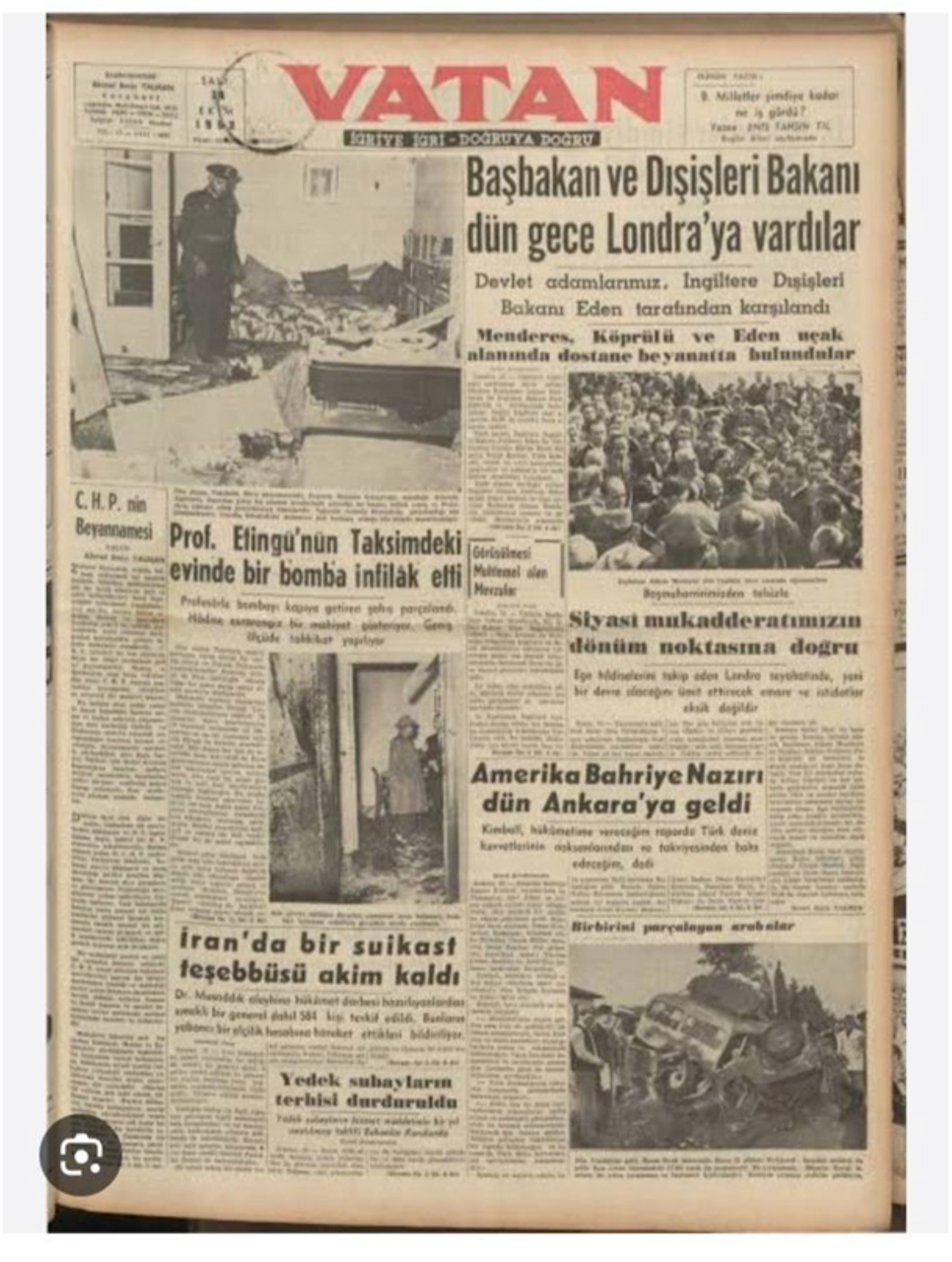 Rıza the Florist from Bolu, unable to reach Ayşe, to whom he was pathologically attached, resorted to a horrific act. He prepared a package full of dynamite. He went to the apartment building where the professor lived and, pretending to deliver a package, asked the professor's neighbor, Salomon Mordo, for the professor's apartment number.
When Professor Etingü opened the door, he detonated the package full of dynamite. A terrifying explosion was heard in 1950s Istanbul. The intensity of the sound must have indicated the destructive power of the package.
Rıza from Bolu carried out an act similar to the suicide bombers that Turkey has witnessed in recent times. Professor Emin Etingü and the perpetrator Rıza both lost their lives in a tragic manner in the incident.
HOW WERE TWO NAVAL COMMANDERS APPOINTED AS PROFESSORS AT ITU?
Engineering and medical education in Turkey began in military schools. The Hendese-i Mülkiye (Civil School of Engineering) was opened as a civilian engineering school after separating from the military engineering school established in 1795. This institution was transformed into the School of Engineering (Mühendis Mektebi Alisi) in 1909, the Higher School of Engineering (Yüksek Mühendis Mektebi) in 1928, and finally into Istanbul Technical University with a law enacted in 1944.
Naval Architecture Engineering at ITU was established as a department within the Faculty of Mechanical Engineering. It was only possible for it to become a separate faculty in the 1970s.
The two doyens of Turkish naval engineering, Ata Nutku and Muhittin Etingü, had graduated from the Heybeliada Naval Academy as Naval Construction Officers (1920s).
While Professors Ata Nutku and Muhittin Etingü were continuing their education as hardworking students at the Naval Academy, they must have encountered Nazım Hikmet and Necip Fazıl, whose grades were not very brilliant, in the garden of the school in Heybeliada, even if they were in different classes.
Professor Muhittin received specialized training in the USA (at MIT) and Lubeck, Germany, between 1923 and 1925.
Then, he was assigned to Italy for 2.5 years. The subject of the assignment was to oversee the construction of the Sakarya and Dumlupınar submarines. After working at the Gölcük Naval Shipyards for a while, Etingü was assigned to Kiel this time (1937). That is, the early period of Hitler's Germany. Turkish submarines were being built at the Kiel Krupp Germaniawerft shipyards: the Saldıray, Batıray, Atılay, and Yıldıray submarines. Etingü was on the commission overseeing the construction of these submarines. The names of the submarines were dictated personally by President Atatürk to Prime Minister Celal Bayar.
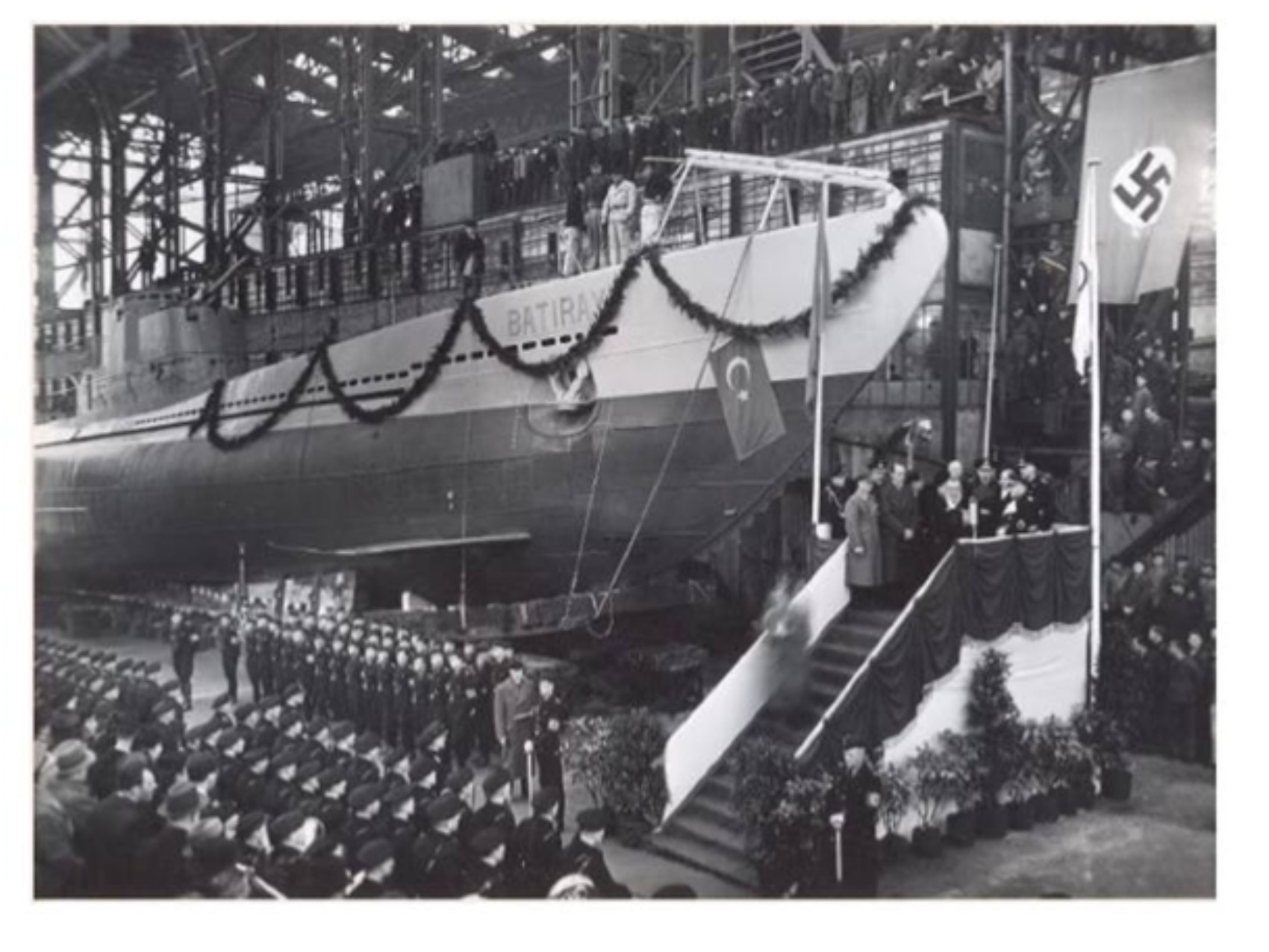 The Batıray is being launched in Germany. Image source: Osman Öndeş
While Etingü continued his duty as a military engineer at the Taşkızak Shipyard alongside Ata Nutku in the Navy, he began giving lectures at the Higher School of Engineering starting in the 1940s. Most likely, Professor Ata Nutku did as well. They served as lecturers upon the request of the Ministry of National Education and the approval of the Ministry of National Defense.
In the meantime, the Higher School of Engineering was transformed into ITU. As of 1948, Nutku and Etingü held the rank of naval engineer commander. To be more precise: Naval Construction Commander.
These two naval engineer officers were appointed as professors to the Istanbul Technical University Faculty of Mechanical Engineering upon the proposal of the ITU Senate, the approval of the Inter-University Board, the decision of the Council of Ministers, and the approval of President İsmet İnönü.
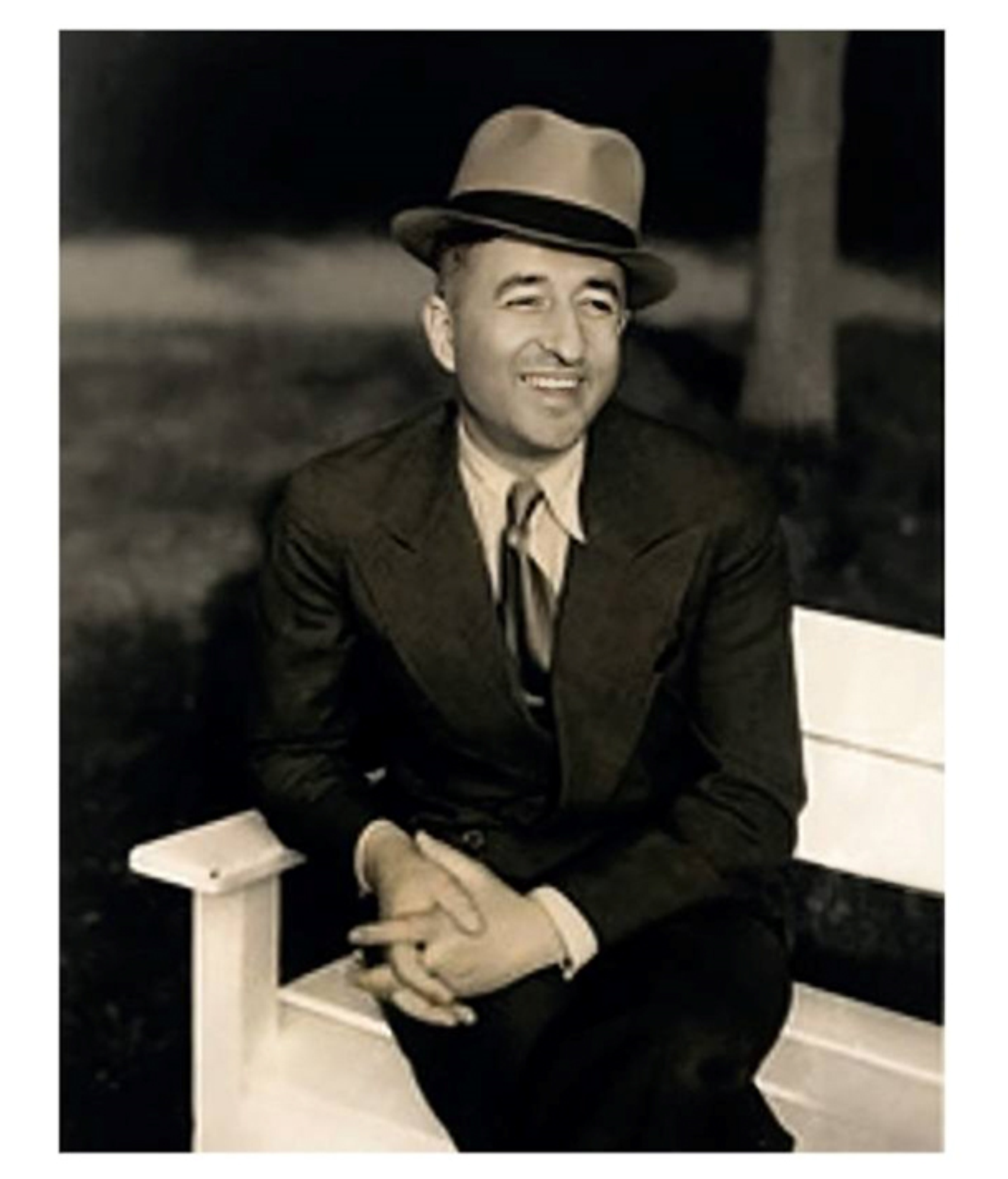 Prof. Muhittin Emin Etingü, image source: Emin Necdet İşli
In the 40s, such appointments were possible. They were even common. To give an example, Dr. Adnan Adıvar and Halide Edip Hanım were appointed as faculty members at Istanbul University after returning to the country in 1939. Dr. Adnan Bey became a professor of the history of science, and Halide Edip Hanım became a professor of English language and literature. Mina Urgan was also brought in as Halide Edib's assistant.
Neither of them had titles that are valid in today's academia. The doctoral degree-thesis was not yet something known in the Turkish academic community. Professorship and associate professorship were titles equivalent to the professorship (müderrislik) and assistant professorship (müderris muavinliği) at the Darülfünun.
In the meantime, let us also remind you that Prof. Teoman Özalp and Prof. Kemal Kafalı were students of Muhittin Etingü.
WHAT THE MURDER OF PROFESSOR MUHİTTİN ETİNGÜ REMINDS ME OF
The murder of Professor Muhittin Etingü with such a horrific thought reminds me of the loss of Onat Kutlar and Yasemin Cebenoyan in the bombing at The Marmara Cafe (1995) and Kerem Yılmazer, who lost his life due to a bombing carried out while waiting at a red light in front of the Levent HSBC building (2003).
These events make me think that many variables, dynamics, and coincidences surrounding human life determine its course, and that the way one says goodbye to life is also unpredictable.
THE TRAGIC LOSS OF PROFESSOR MUHİTTİN ETİNGÜ AND ERICH FROMM
When I was studying at Istanbul Political Science (in the 80s), I would mostly walk down to the pier via Cağaloğlu. On the way, I would often stop by the Payel Bookstore. In those years, Payel was publishing translations of Wilhelm Reich and Erich Fromm. I got bored with Reich's books. I couldn't finish them. I read Fromm with pleasure.
This incident reminded me of two of Fromm's books: The Anatomy of Human Destructiveness and The Source of Love and Violence. Indeed, the urge for revenge is inversely proportional to an individual's creativity. Those who feel powerless and whose self-respect has been wounded may resort to a major act of violence to repair their ego. Rıza the Florist's act confirms this.
A FEW WORDS ON PROFESSORS ETİNGÜ AND NUTKU
The fact that one of the founders of the ITU Naval Architecture Department was taken from life in a tragic incident during the years when it was being newly established is extremely sad in terms of our country's history of science.
Professor Etingü was an extremely knowledgeable engineer and faculty member, in addition to being an artist strong enough to have his drawings published in Akbaba Magazine, as he was beautifully described in an article.
There is no doubt that he was one of the most distinguished figures of the Ottoman and Republican periods he lived through.
He was also so by virtue of his family. He came from a family belonging to the Ottoman ruling class. His father was Emin Bey, one of the clerks of the Imperial Secretariat. He was also the nephew of the famous figure of Turkish Literature, Refik Halit Karay.
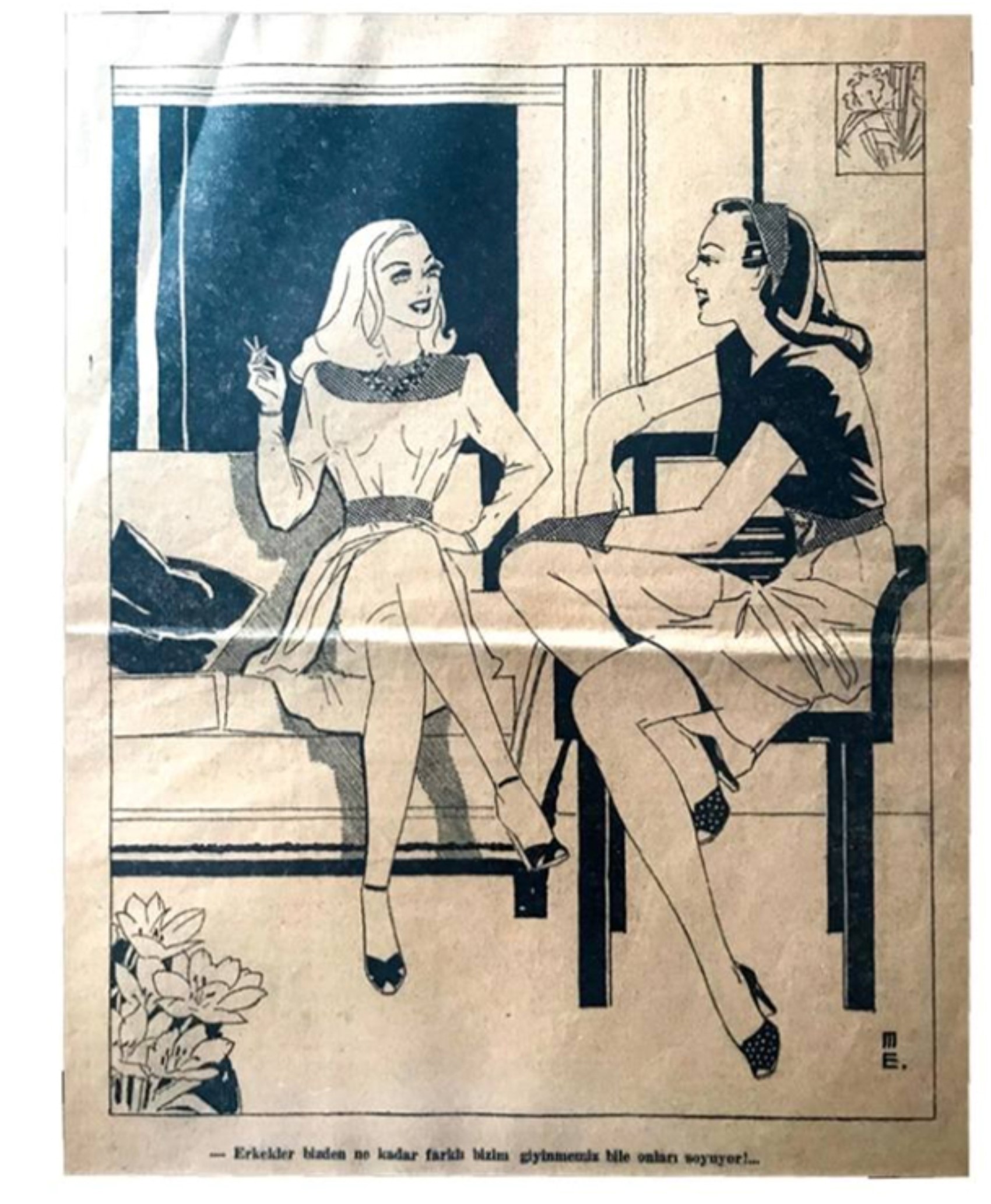 An example of Muhittin Etingü's drawings published in Akbaba Magazine
Muhittin Etingü, who was a young naval construction officer during the founding years of the Republican navy, had received specialized training in the USA (MIT). He had personally taken part in the boards overseeing the construction of Turkish submarines in Italy and Germany.
With this experience and knowledge, while contributing to the development of the Turkish navy, he was appointed as a professor - together with Ata Nutku - upon the request of the authorized boards of Istanbul Technical University and the Decision of the Council of Ministers; together, they founded the naval architecture department.
Ata Nutku rose to the rank of Ordinary Professor and became one of the symbolic names, even an icon, of Turkish maritime.
How sad it is that,
Of these two valuable professors raised by our country, Muhittin Etingü became the victim of a crazy act of violence at a young age. (1952)
The name of Professor Ata Nutku, on the other hand, was the subject of a press scandal that leaves one astonished. (1999)
Namely,
After the professor passed away in 1994 at the age of 90, a ferry that was being built at that time was named Ord. Prof. Ata Nutku. This was a nice gesture by the Turkish maritime industry to the professor's memory. The ship is still operating on the Eskihisar-Topçular line.
But unfortunately, a publication (newspaper) unaware of our history thought the ship's name was related to Atatürk's "Nutuk" (The Speech) and mockingly published the news with the headline "The final point in sucking up to Atatürk."
Most Read

Striking picture for Özgür Özel's 'New Party'

Özgür Özel gives a dated response regarding the number of resignations

Forest fire in Antalya brought under control

The PKK opening and Özgür Özel’s path!..

Houthis strike Saudi-owned tanker

How did the newspapers view Özgür Özel's farewell to the CHP?

What did the CHP do?

Özel’s new party move in the world press

The New CHP, against CEHAPE

From self-efficacy to despair