



A STONE IS HEAVY IN ITS PLACE-144. LET US NOT FORGET, LET US NOT LET BE FORGOTTEN
It is not right for historical artifacts to be removed from where they were produced and taken to other lands; this is a common problem for humanity.
Before the Pergamon Altar and historical artifacts of Bergama were moved to Germany starting in 1864, another significant smuggling operation carried out from within the Ottoman borders of those years was the theft of the works known as the 'Elgin Marbles' from Ottoman lands.
These works are the friezes, sculptural reliefs, and statues decorated with various depictions on the pediment of the 'Parthenon Temple' in Athens, Greece, which was built of marble and dedicated to the Goddess Athena.
The person responsible for this smuggling, who likely inspired German Imperialism to plunder the historical artifacts of Bergama, is Thomas Bruce, Lord Elgin, who served as the British Ambassador to Istanbul between 1801 and 1802.
***
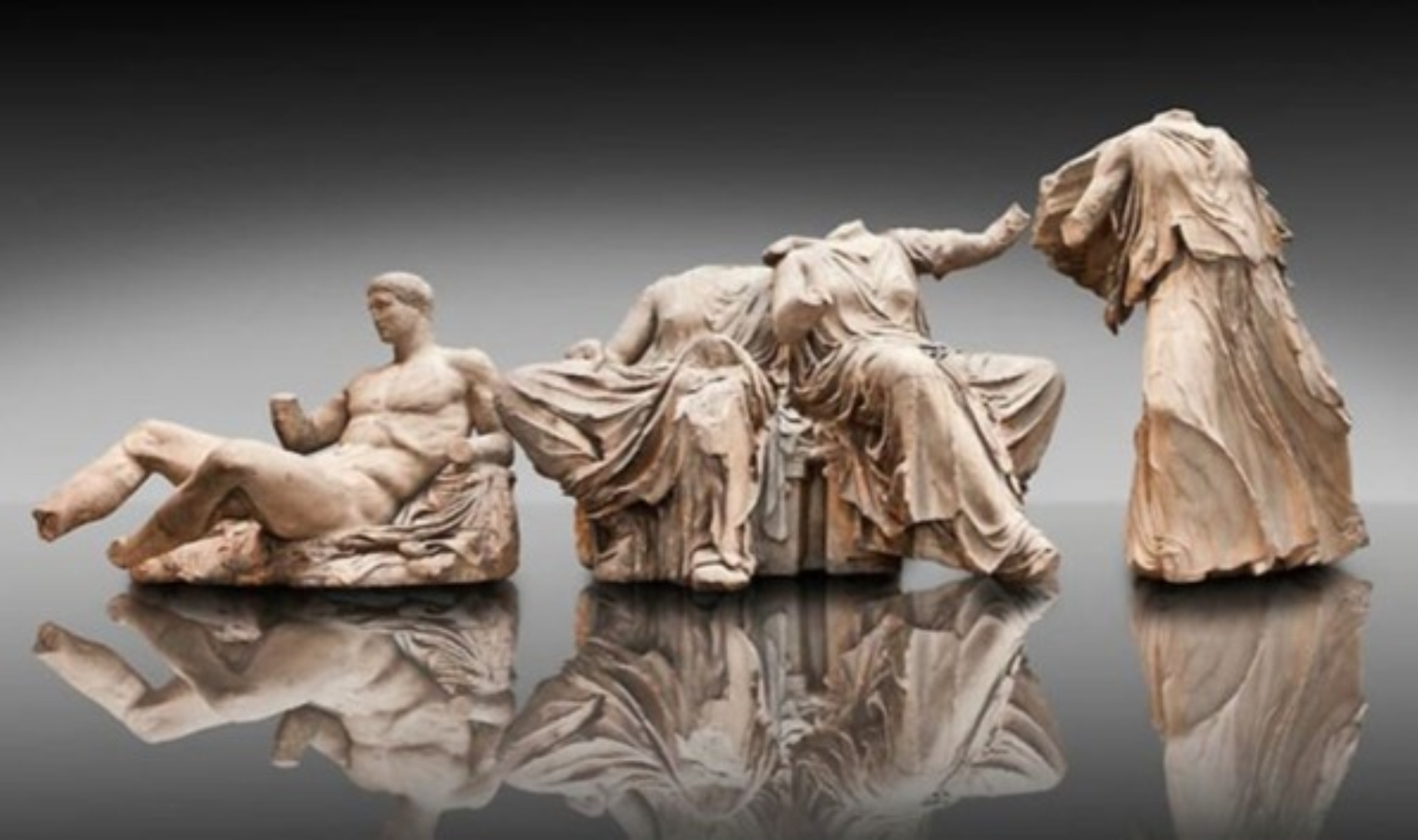
(A portion of the Parthenon friezes smuggled by Lord Elgin)
It is reported that the Parthenon in Athens was built between 446-438 B.C. by architects named Ictinus and Callicrates. It is also said that the famous sculptor Phidias supervised the creation of the surrounding statues.
Parthena means "virgin" in Greek, and this epithet was attributed to Goddess Athena, who was considered the protector of the ancient city of Athens and was believed to have emerged from Zeus's forehead, thus being regarded as the goddess of wisdom.
According to legend, Athena also won the hearts of the people by gifting them the olive tree, which is why the city was named Athens.
Perhaps Parthena was the name of the "leopards" standing on either side of the Mother Goddess figurines in the beliefs of the indigenous people who lived in Anatolia before the Hellenes/Greeks.
The temple had a magnificent location built on the Acropolis of Athens, situated on the highest hill of the city.
Most of it was likely destroyed by fanatical Christians, much like those in Anatolia.
Nevertheless, the Parthenon could not be completely destroyed, with its main structure, beautiful friezes, and sculptures remaining intact.
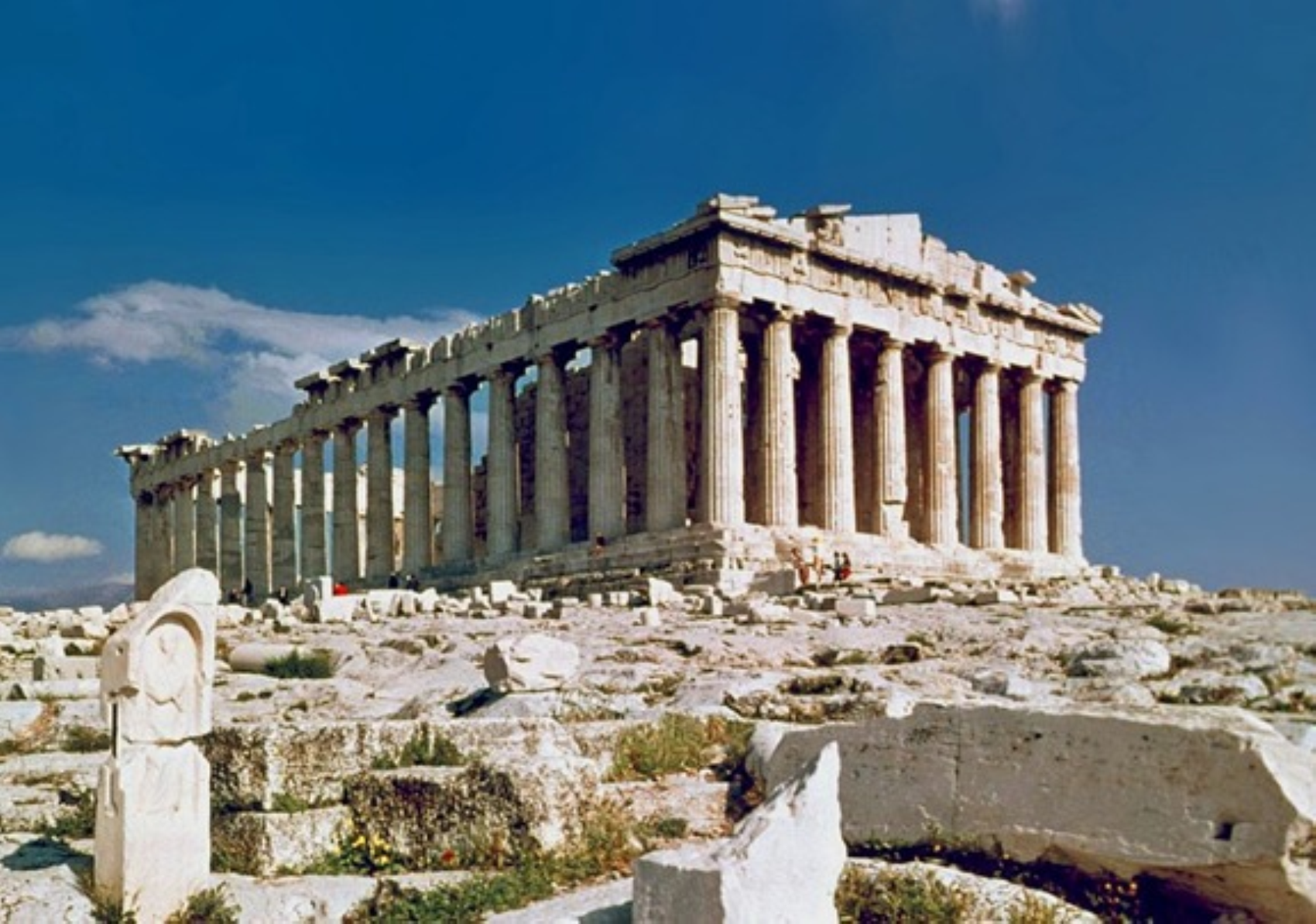
(The Parthenon of Athens)
***
Athens came under Ottoman rule in 1456 during the time of Fatih Sultan Mehmet.
The Parthenon on the Acropolis was converted into a mosque, another sacred space, and was referred to as the “Castle Mosque.”
During the Ottoman-Venetian War in 1687, Athens briefly fell into the hands of the Venetians.
During this war, after being struck by cannonballs fired by the Venetians, the ammunition stored in the Parthenon exploded, causing great damage to the temple.
The “noble” Venetians Without even saying "historical artifact, shmistorical artifact" they had bombed the Acropolis of Athens.
After separating from the Ottoman Empire in 1821 and the establishment of the Greek State, Athens became the capital of this new state in 1833.
***
European culture had known about Athens' historical past and its monuments since the Renaissance.
During that period, in the 19th century, the era was transitioning from colonialism to imperialism.
The powerful British Empire was looting the historical artifacts of every place it occupied, seeking a foundation for its own rootless and cultureless past.
When the rapidly enriching European bourgeoisie looked back, they saw nothing but swamps and wild forests.
Lords and barons were decorating their mansions and villas with stolen historical statues made of Aegean marble.
In this context, Thomas Bruce, the Lord of Elgin, who was the British Ambassador to Istanbul between 1801 and 1802, became aware of the friezes of the Parthenon Temple in Athens and set his sights on them.
Bruce asked the Italian painter G.B. Lusieri to draw pictures of these friezes.
The drawing was just an excuse, of course!
And the looting began.
With the guidance and incitement of the Italian Lusieri, Lord Elgin began to dismantle, excavate, and remove the works of the Parthenon, smuggling them out with the help of the British State.
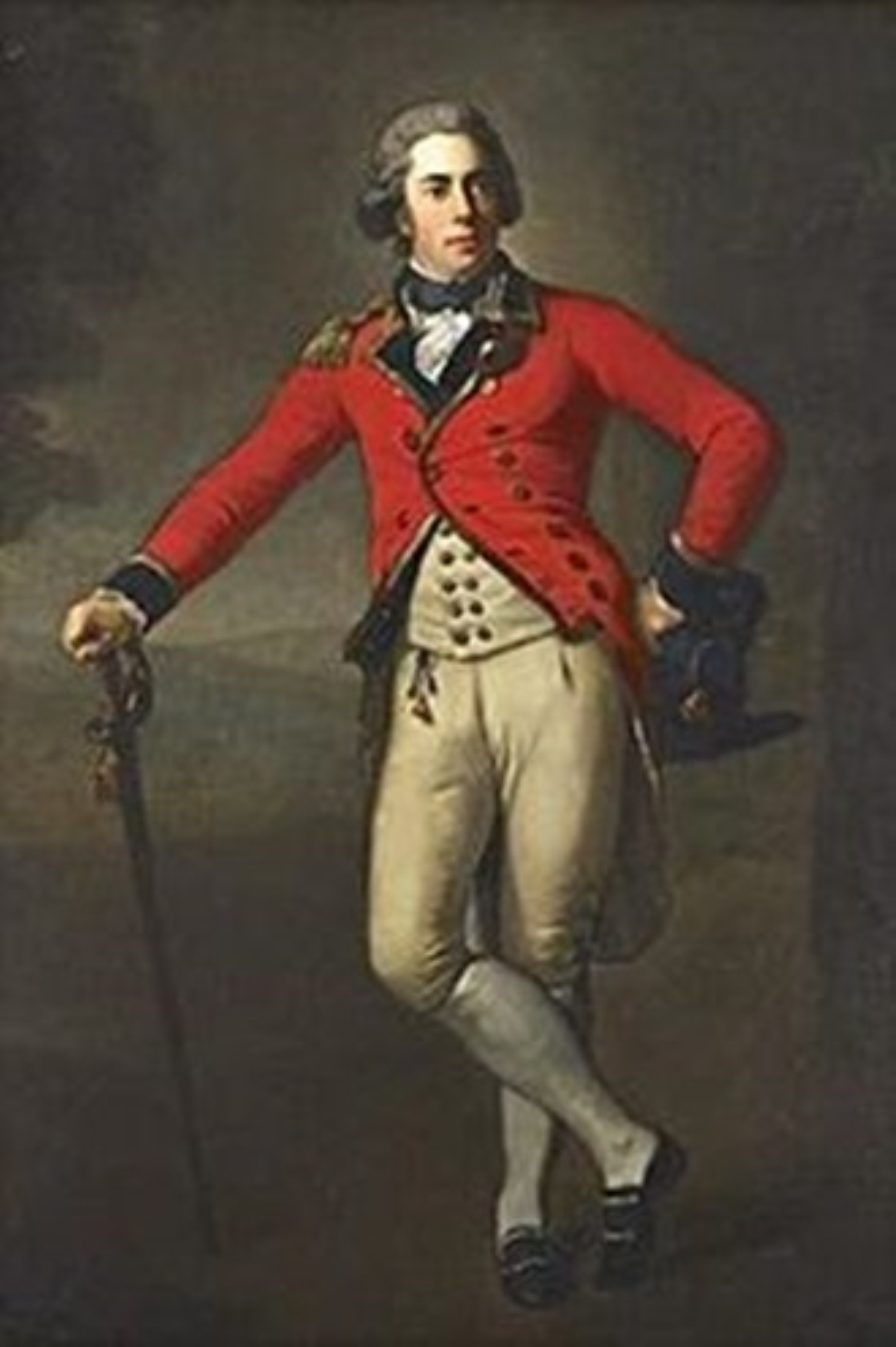
(Lord Elgin, who smuggled the Parthenon marbles from lands that were part of the Ottoman Empire at the time)
The Ottoman Sultan was Selim III.
Through the skill of the thief Lusieri, Lord Elgin requested a decree/permit to remove these works from Ottoman borders, but he did not receive it; he was only granted permission to excavate for the purpose of gathering information.
The decree belonged to the Sultan. It was absolute!
In other words, it was legally impossible to remove the works from Ottoman borders. Only excavation was permitted.
The removal of the Parthenon friezes and sculptures from the borders of the Ottoman Empire, which was the owner and administrator of the region at the time, was clearly an act of smuggling and theft.
Lord Elgin sold the works he smuggled to the British Parliament in London in 1816 for 500,000 dollars in today's currency.
And they did it through a vote!
So, the smugglers and thieves were also making money off the Aegean marbles!
Who knows how happy those British "nobles" must have been—those who called themselves "Lords" or "Masters" and had no culture other than barely tilling the wet British soil, engaging in piracy on the seas, practicing colonialism in distant lands, and oppressing the peasantry!
Like a weed that has found soil!
They were going to use the magnificent culture of the Aegean and Mediterranean coasts as a mask for their colonial ugliness!
Then these unique works were given the smuggler's name, called the "Elgin Marbles." They are still referred to as such!
Today, they are exhibited as prisoners in a special section of the "British Museum/Prison" in London.
For years, the Greek State has rightfully been demanding these works back from the British Government.
These are both a part of their capital, Athens, and works created by artists who spoke the same language as them hundreds of years ago.
In 1981, the Greek Minister of Culture, Melina Mercouri, who was also a famous film actress, launched an initiative for the return of the Elgin Marbles. The British State turned a deaf ear.
In 2014, the attempt by the "Syriza" government of Greece, led by Alexis Tsipras, to reclaim the Elgin Marbles sparked major controversy.
While the British claim they took the historical artifacts with the permission of Ottoman Empire officials, research by Greek archaeologist Tatiana Poulou revealed that there is no document in either Ottoman or British archives authorizing the removal of the Elgin Marbles from Athens.
In other words, this smuggling, carried out in these lands which were Ottoman territory at the time, was a clear case of theft.
Greece's demands also found resonance in the UK.
In a statement made in June 2016, the British Labour Party and the then-Leader of the Opposition, Jeremy Corbyn, declared that the marbles were "stolen."
He announced that if the Labour Party came to power, the "looted and smuggled" artifacts would be returned.
In 2023, Lina Mendoni, Minister of Culture in the Mitsotakis government of Greece, announced: "The United Nations Educational, Scientific and Cultural Organization (UNESCO)
has taken an important decision to request the return of the Parthenon Marbles from the British Museum."
(United Nations Educational, Scientific and Cultural Organization - UNESCO)
In the turbulent political climate, the British State has once again turned a deaf ear.
It is known today that the Greek government continues to demand the return of the Elgin Marbles at the highest level.
The theft of these works from Athens, which was Ottoman territory at the time, and their smuggling to London bears a striking resemblance to the smuggling of Pergamon's historical artifacts to Berlin.
The same similarity is seen in the Schliemann treasure of Troy being held in Moscow, the pieces of the Mausoleum of Halicarnassus and the Lion of Knidos-Datça being smuggled to and kept in England, and in many others.
All these facts show that Western colonialism and its subsequent imperialism were actually trying to steal the roots of a culture they could never possess.
They were registering their own rootlessness.
And what about now?
It is now understood that all countries whose historical artifacts have been plundered and looted must oppose this cultural pillage, and they are doing so.
This opposition is legally and morally justified and legitimate.
Zeynep Boz, Head of the Anti-Smuggling Department of the Turkish Ministry of Culture and Tourism, also announced that their examinations of Ottoman archives revealed no document permitting the removal of the historical Athenian artifacts known as the "Elgin Marbles" from Ottoman territory. (05.06.2024)
How wonderful!
In this context, historical artifacts removed from their countries, whether with or without permission, should be reclaimed through international solidarity.
"A stone is heavy in its own place!"
Turkey, Greece, and other countries adorned with the historical artifacts of antiquity must fight together, without any ifs or buts, for their historical artifacts to return home.
All intellectuals of the world who respect their homelands, their history, and their countries' cultural heritage should join this demand and provide their support.
There is a brotherhood of ants!
Why shouldn't there be solidarity among the oppressed?
THE HISTORICAL ARTIFACTS OF TURKEY, GREECE, AND THE MIDDLE EAST DO NOT BELONG IN COLD AND FOGGY BERLIN, VIENNA, LONDON, OR PARIS, BUT TO THE COUNTRIES WHERE THEY WERE PRODUCED. WHY SHOULDN'T THEY BE RETURNED?
(Source: https://melinamercourifoundation.com/en/the-parthenon-marbles/the-parhenon-marbles/https://melinamercourifoundation.com/en/the-parthenon-marbles/the-parhenon-marbles /// https://www.arkeolojikhaber.com/haber-yunan-arkeolog-tatiana-poulou-casus-lusieri-olmasa-elgin-mermerleri-kacirilamazdi-39085/#google_vignette /// https://www.reuters.com/article/world/greece-wants-parthenon-marbles-back-tsipras-tells-may-idUSKBN1JM2VL /// https://www.theartnewspaper.com/2018/06/04/labour-leader-jeremy-corbyn-pledges-to-return-parthenon-sculptures-to-greecehttps://www.gazeteduvar.com.tr/ankaradan-atinaya-parthenon-destegi-yunanistan-beklenmedik-bir-muttefik-buldu-haber-1696215#google_vignette /// Encyclopedia of Islam /// Various articles)
Sefa Taşkın
07.07.2024
Bergama-Dikili/İzmir
Most Read

Striking picture for Özgür Özel's 'New Party'

Özgür Özel gives a dated response regarding the number of resignations

Forest fire in Antalya brought under control

The PKK opening and Özgür Özel’s path!..

How did the newspapers view Özgür Özel's farewell to the CHP?

Houthis strike Saudi-owned tanker

What did the CHP do?

Özel’s new party move in the world press

The New CHP, against CEHAPE

From self-efficacy to despair