



A STONE IS HEAVY IN ITS PLACE-155. LET US NOT FORGET, LET US NOT LET BE FORGOTTEN.
An altar is a religious structure from antiquity where sacrifices were made and offerings were presented to the gods, as well as the cylindrical or rectangular cut stones upon which these rituals were performed.
The most famous of such structures is the Altar of Zeus in Pergamon/Bergama, a magnificent architectural work whose inner and outer perimeter walls are adorned with unique sculptural reliefs and friezes.
Altars are not temples or places of worship, but rather places where gifts such as food and drink are offered to the gods in order to have requests fulfilled.
To ask for something from the gods, you must give something in return!
Beyond magnificent structures like the Altar of Zeus, there are votive stones that have been used for animal sacrifice and offering gifts since ancient times.
These are also called 'altars'.
The sanctity of the act of sacrifice, which aims to establish communication with the divine, is the reason why these stones/altars were specially designed.
One of these is a cylindrical marble altar stone, which is one of the simplest and most beautiful works found on the Acropolis of Pergamon/Bergama.
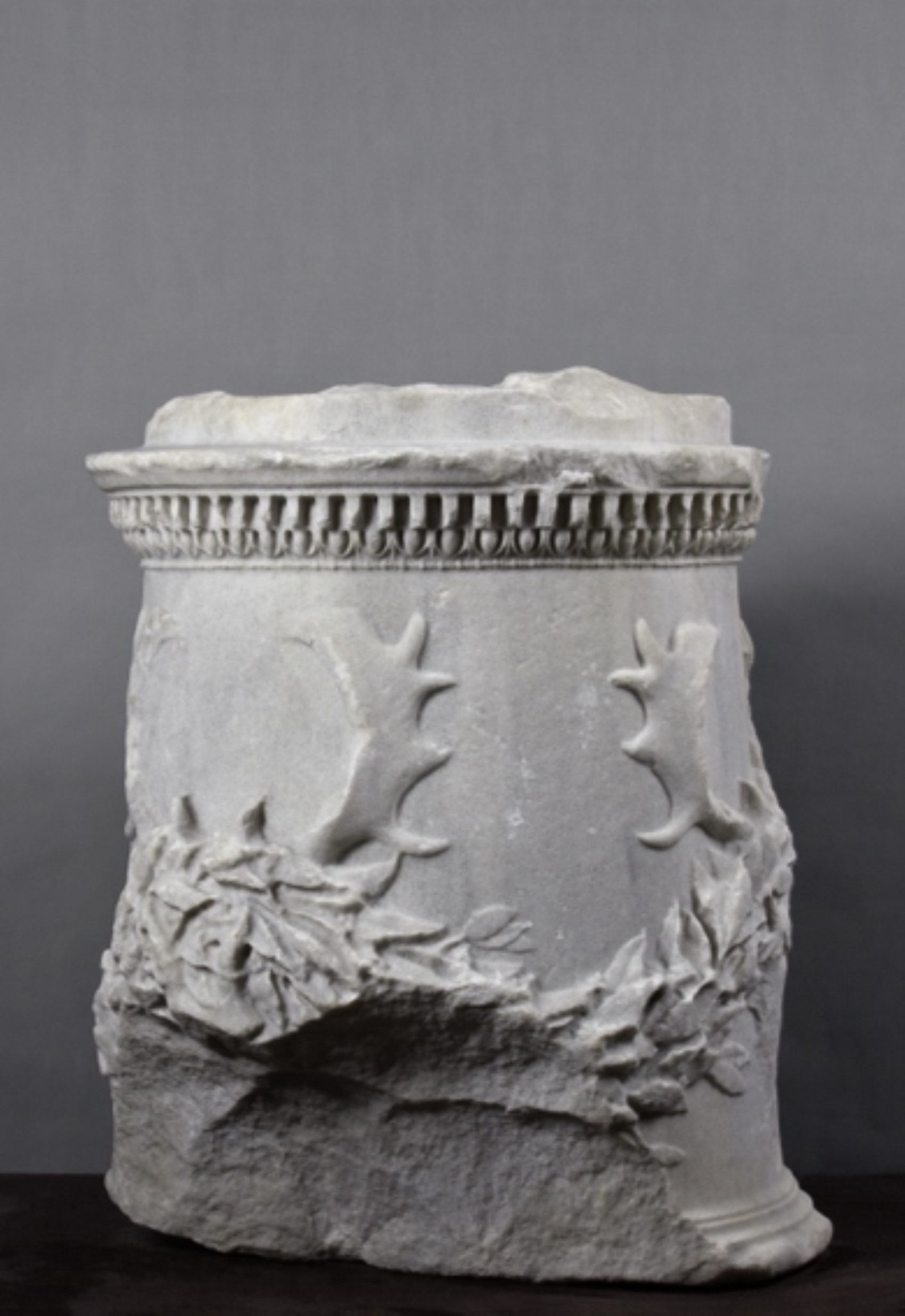
It was found and seized by German looters who took Bergama's historical artifacts to Berlin between 1864 and 1878, and even up to 1886, through illegal and dubious permits.
Its identification number in the Berlin Museum/Prison where it is currently held is 'AvP VII 419'.
Although the so-called Museum/Prison records state that the artifact was found in Bergama, they do not specify what kind of excavation it was, when it was found, who found it, or how it fell into the hands of the looters affiliated with the German State.
It is clear that, like many others, it was stolen from Bergama and secretly smuggled to Germany.
This cylindrical marble altar stone, with its wonderfully intricate carvings, is a unique example of such works.
This is a deer stone!
Don't just call it a deer stone, 'it' is Anatolia!
This artifact was unearthed during so-called excavations at the Pergamon Acropolis, in the area where the royal gardens were located.
The elegant and meaningful marble altar is eye-catching in terms of its 'design and execution,' along with the shaping of the reliefs upon it.
The upper part of the altar, which sits on a simple convex base, is surrounded by a protruding and wavy cornice (cyma).
The bed of the cornice is decorated with an oval-profiled string of pearls (astragal). Below that, there is a small strip (dentil) made as an ornament.
While this form alone makes the altar attractive, the decorations on the body of the cylindrical marble add another layer of beauty and meaning to the work.
A wreath of equal width made of laurel leaves wraps around the cylindrical surface of the marble altar.
The wreath is carried by deer, found on three sides of the altar, whose two horns resemble tree branches. This creates a pleasant undulation in the wreath and makes the altar appear more attractive.
Since the lower part of the marble is damaged, the heads of the deer are not visible.
In Hellenic mythology, the "deer" is associated with Artemis, the protective goddess of the countryside and hunters. Artemis, who once had a magnificent temple in Ephesus, is also accepted as the goddess of fertility.
With the attributes of "Deer God," "Deer Father," and "protector of the countryside," and with a "deer-antlered appearance," it was worshipped in Anatolia under the name "Kurunta" during the Hittite/Luvian era, hundreds of years before the Hellenes.
This altar with deer antlers wearing a wreath, found in Pergamon, resembles the decorative stones in the Temple of Artemis located in our ancient city of Magnesia on the Maeander in Ortaklar, Germencik, Aydın.
Magnesia on the Maeander was also stripped bare through dubious permits by the engineer-thief Carl Humann, an official of German Imperialism who also stole the works of Pergamon, and his network, with many historical artifacts taken to Germany.
These works are now, like the Pergamon Altar, imprisoned in a museum-like prison in Berlin, built on a swamp, which is sinking day by day and for which it is said that 1.5 billion Euros will be spent for so-called repairs.
This ugly structure, sinking into the mud, is being desperately saved from demolition under the fanfare of "renewal=innovation."
There is no hesitation in leaving Anatolia's historical artifacts under a thousand and one risks.
Dating back to the early Hellenistic period, the elegant altar from Pergamon, adorned with garlands and deer antlers, stands 62.5 cm tall with a cylinder diameter of 50 cm.
While this magnificent work from Pergamon screams out, "I am Anatolian, I am from Pergamon," those who seized this altar do not hesitate to label it as "Prussian (the former name of Germany) Cultural Heritage: PrussiaKulturbesitz" without ever looking in the mirror.
Historical artifact smuggling is a black mark on the forehead of the thief.
THE ZEUS ALTAR AND THE PERGAMON ARTIFACTS DO NOT BELONG IN COLD AND FOGGY BERLIN, BUT IN BEAUTIFUL PERGAMON. THEY MUST ABSOLUTELY BE RETURNED; THEY MUST COME HOME.
(Source: http://www.smb-digital.de/eMuseum, Database-Antikensammlung),
https://arachne.dainst.orgn/entity/1123973 )
Sefa Taşkın
02.23.2025
Karşıyaka/İzmir
Most Read

Striking picture for Özgür Özel's 'New Party'

Özgür Özel gives a dated response regarding the number of resignations

The PKK opening and Özgür Özel’s path!..

Forest fire in Antalya brought under control

How did the newspapers view Özgür Özel's farewell to the CHP?

He killed his wife by slitting her throat: Their children witnessed the moments

What did the CHP do?

Özel’s new party move in the world press

The New CHP, against CEHAPE

Fire at TUSAŞ engine factory in Eskişehir under control