



A STONE IS HEAVY IN ITS PLACE-170. LET US NOT FORGET, LET US NOT LET BE FORGOTTEN.
Very ancient sculptures and artifacts found at Göbeklitepe and the Stone Hills (Taş Tepeler) in Anatolia are being promoted by the Republic of Türkiye Ministry of Culture through an exhibition now opened in Berlin, following its run in Rome.
The exhibition, which opened on February 10, 2026, was attended by the Republic of Türkiye Minister of Culture and Tourism Mehmet Nuri Ersoy, the German Federal Minister of State for Culture and the Media Wolfram Weimer, the Republic of Türkiye Ambassador to Berlin Gökhan Turan, President of the German Archaeological Institute Friederike Fless, exhibition photographer Isabel Muñoz, Head of the Stone Hills Project Necmi Karul, and Director of the Museum of the Ancient Near East in Berlin Barbara Helwing. The exhibition will remain open until July 19, 2026.
Theme of the exhibition: “Discovery of Society: Göbeklitepe, Stone Hills and Life 12,000 Years Ago”.
In his speech at the opening of the exhibition, Turkish Minister Ersoy emphasized that “archaeology is a tool not for separating humanity, but for uniting it by removing the dust and soil from our shared memory.”
German Minister Wolfram Weimer also “expressed his satisfaction that the exhibition is being held in Berlin, on Museum Island, outside of Türkiye; he emphasized that the works featured in the exhibition have extraordinary importance in terms of the history of humanity and civilization, and stated that these findings have opened a new horizon in the field of archaeology.”
How wonderful!
The display is being held at the “James-Simon-Galerie,” one of the additional museums on the Spree River flowing through the middle of Berlin, which is said to be sinking into the mud, though it has not yet sunk.
This gallery is located on the island where the Pergamon Museum, which houses thousands of artifacts smuggled from Pergamon and Anatolia, is situated; it is connected to it and is approximately 150 meters away.
This building, which was constructed as an addition to the Pergamon Museum, is named after James Simon, who financed the excavation that removed the famous masterpiece, the Bust of Nefertiti, from Egypt. The archaeologist who conducted the excavation was the German Ludwig Borchardt.
As is known, the Turkish and German ministers who opened this exhibition right next to the Pergamon Museum, which also houses the Altar of Zeus smuggled from Pergamon, did not mention at all the artifacts smuggled from Pergamon, Gaziantep, and many other parts of Anatolia right next to them.
They acted as if they did not exist.
As if they had not been smuggled from Anatolia.
As if the warehouses on this island were not packed full of Anatolian artifacts.
However, the Turkish guests must surely have felt a pang of sorrow!
Moreover, the oldest and most meaningful Stone Hill artifacts in human history are being exhibited in a so-called gallery named after James Simon, a donor whose name is associated with cultural heritage debates.
I hope that our Minister of Culture Mehmet Nuri Ersoy, who works intensively to bring many of our smuggled historical artifacts back to our country, will not give up on our smuggled artifacts in Berlin either.
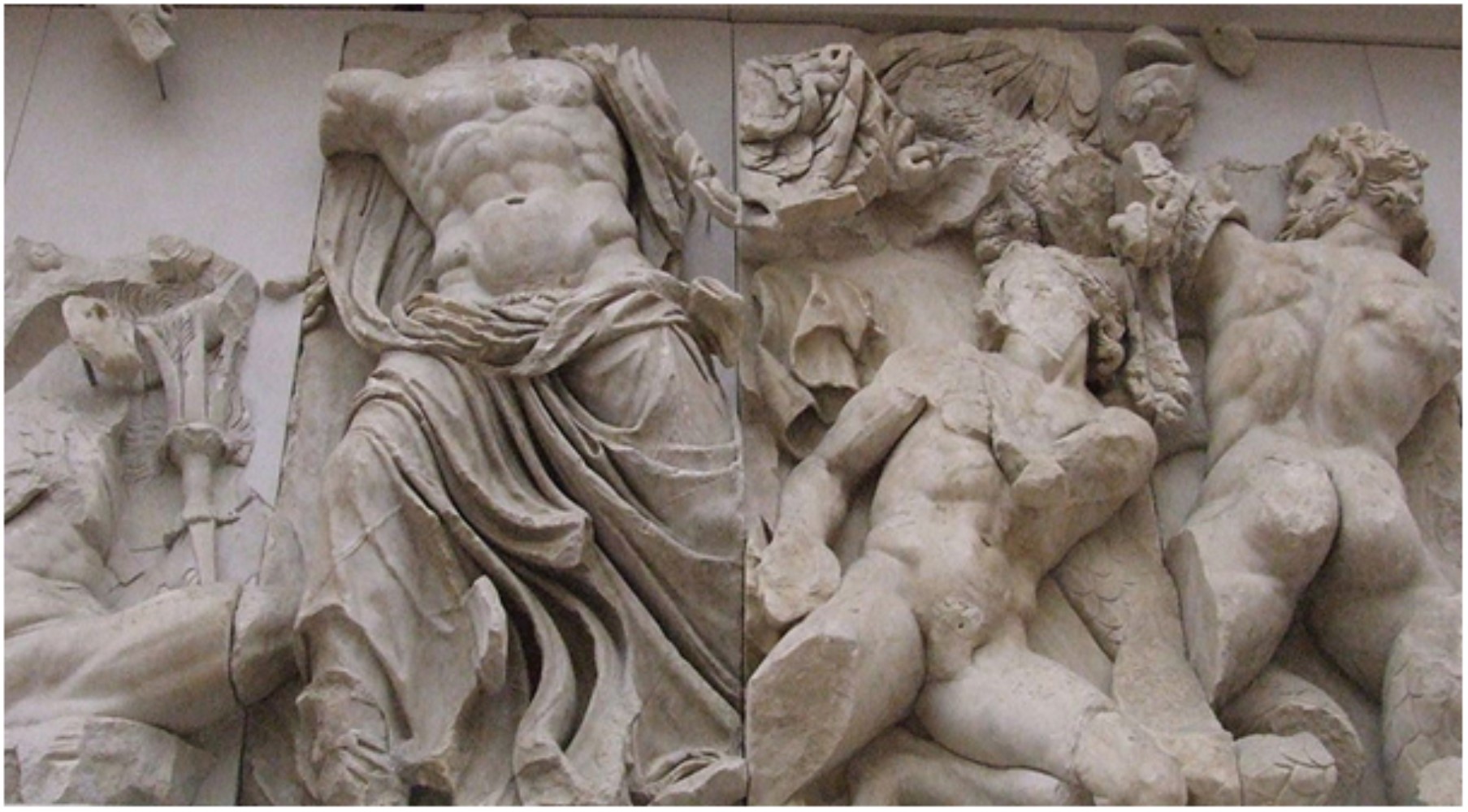
(A frieze from the marble sculpture-like reliefs surrounding the Altar of Zeus smuggled from Pergamon, showing the supreme god of that era, Zeus, fighting against giants/titans)
The free sculptures from Göbeklitepe, brought temporarily from Türkiye, must have surely brought a bundle of greetings and love to the captive Anatolian artifacts here in Berlin!
So, let us see what the recent past says?
How were the Altar of Zeus from Pergamon and Anatolia's historical artifacts smuggled?
Silence is not an option!
Today in Berlin, humanity's oldest stone memory is being told under the lights.
On the same island, just a few steps away, stones torn from their places stand silently with bowed heads.
While words of “common heritage” echo in the exhibition halls, the shadows of the exiled artifacts fall upon the walls.
Stone speaks, it does not hide traces. The earth does not forget.
That is why we are turning our faces back to Pergamon now.
Because what is being told there is not just an excavation — it is the story of displaced memory, dismantled history, and truth forced into migration along with the stone.
The journey of the Altar of Zeus is a question asked not only to the past but also to the present.
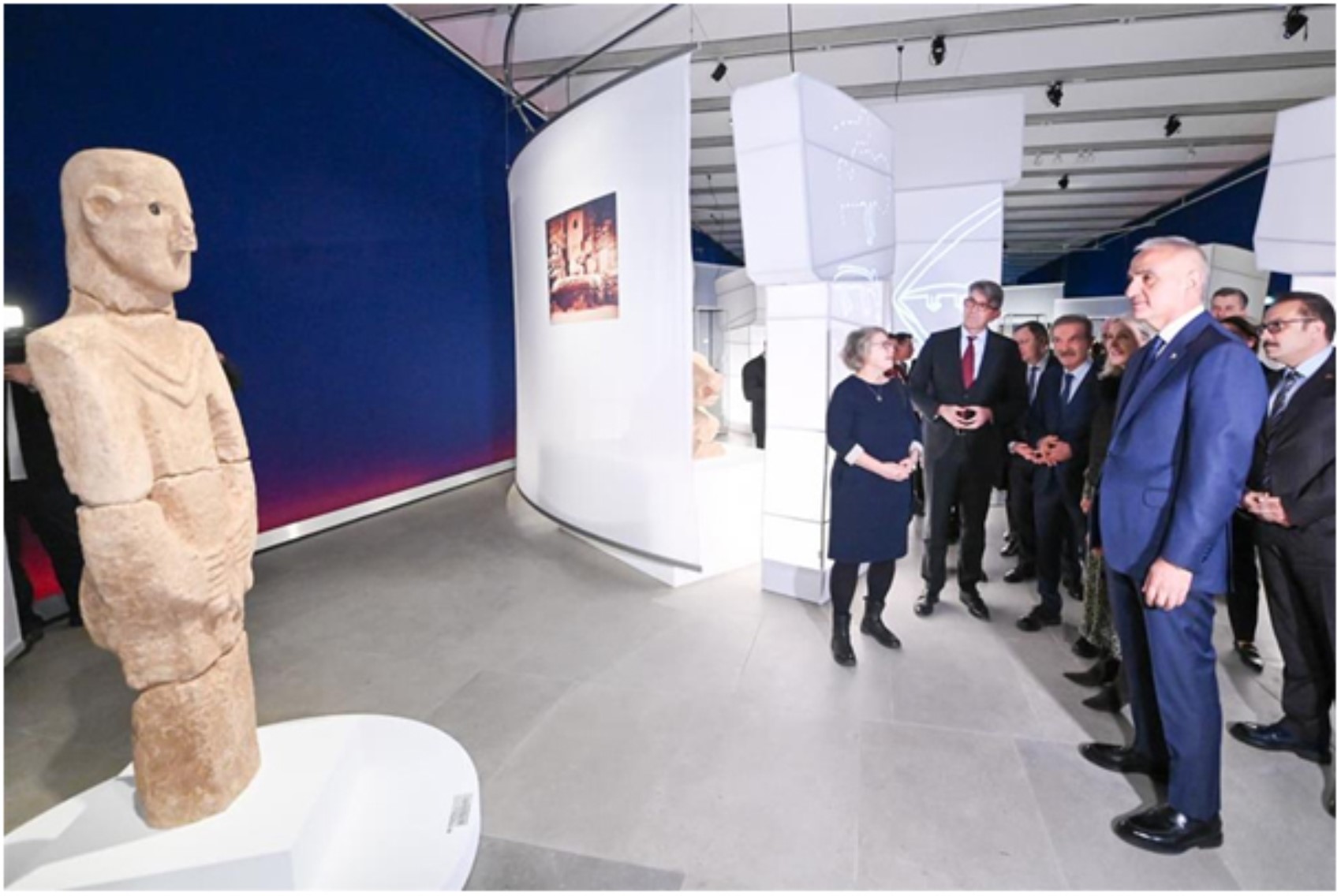
(Turkish and German ministers at the opening of the Göbeklitepe and Stone Hills exhibition in Berlin)
**
The Altar of Zeus in Pergamon is one of the most unique works ever created in human history.
It is a marble structure the size of a three-story apartment building, built in the 2nd century BC by the Pergamon kings who ruled a large part of Western Anatolia.
This structure is not only a monument but also a concrete expression of the political power and aesthetic understanding of the period.
Its outer and inner walls are covered with sculptural marble reliefs called friezes.
Each of these friezes is a masterpiece of art.
The sculptures are like living beings. They all have a story. It is as if a world of movement and emotion bursting from within the stone has been created.
***
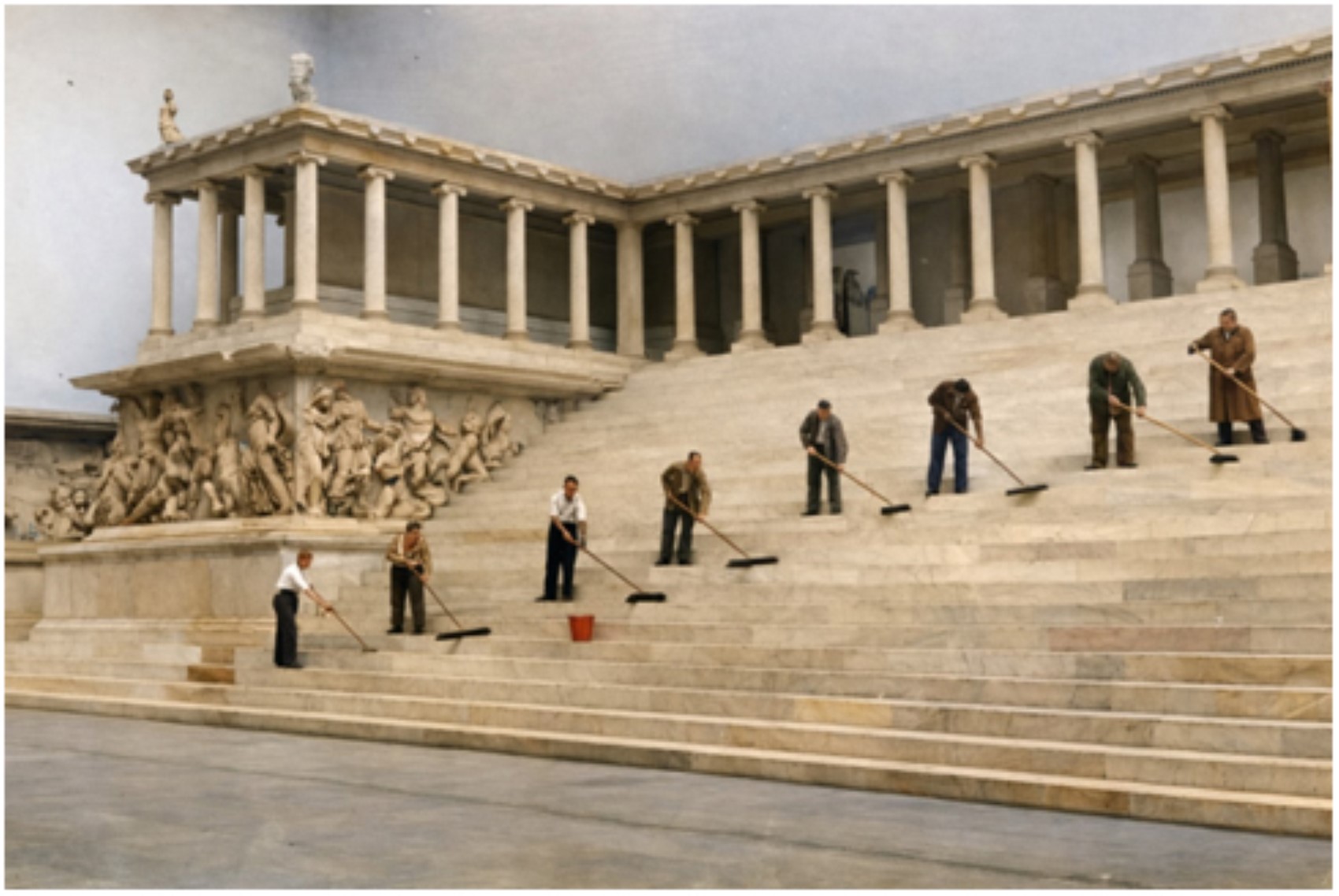
(1930 Berlin Museum/Prison-Pergamon/Zeus Altar. Colorized image)
This magnificent structure, built by Pergamon architects and sculptors, was destroyed over time for various reasons and fell asleep in the bosom of history.
In the acropolis/hill city of Pergamon, some of the friezes and sculptures were inside the fortification walls where they had been placed for reinforcement; some were scattered around like individual monumental marbles; and some were under the mound and soil where their foundations were located.
These pieces, which waited silently for centuries, were like a memory waiting to be rediscovered.
In 1864, a German engineer named Carl Humann, who came to Pergamon to build a road, was dazzled by the beauty of the friezes scattered here and there on the walls of the acropolis, which the people of Pergamon called the Castle.
This encounter was not just a discovery, but also the beginning of a long and controversial process.
A process of injustice, lawlessness, and suspicion!
C. Humann rented a house in Pergamon, established a relationship with the Prussian/German state, and with its help, sent the artifacts he collected to Dikili, the port of Pergamon, then to İzmir, and from there to Berlin. These shipments, despite the occasional objections of the local people, often took place with a speed that they could not fully understand.
According to the Ottoman Empire's 1869 Regulation on Antiquities (Âsâr-ı Atîka Nizamnamesi), this was completely forbidden. It was smuggling.
***
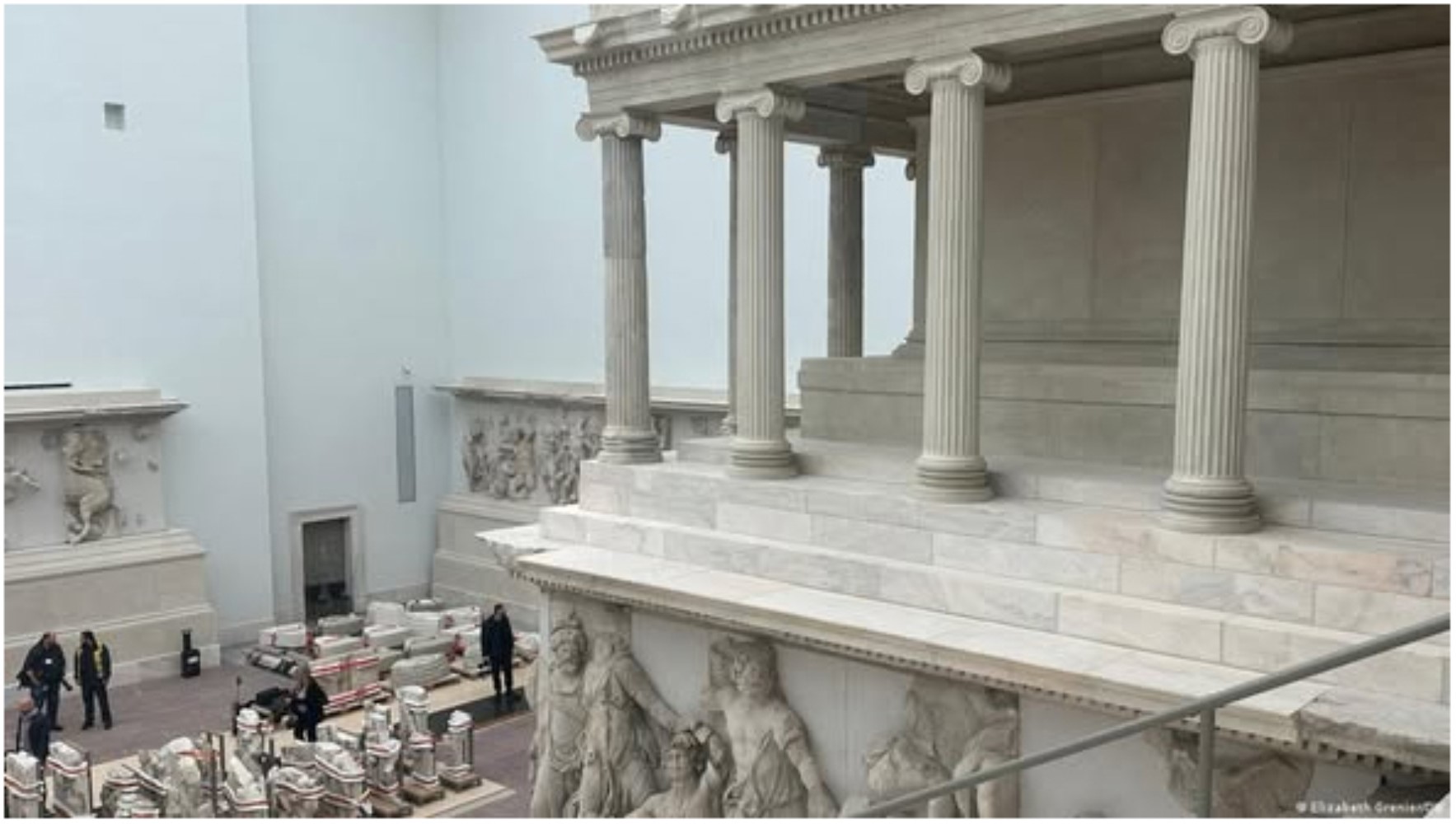
(The Altar of Zeus, which is being dismantled and reassembled today to save it from the swamp-Berlin. December-2025)
The new law enacted in 1874 under the pressure of the Prussian/German state on the Ottoman Empire gave the Germans the right to take some artifacts out of the country; however, the patriotic officials of the Ottoman Empire and Sultan Abdülaziz did not implement this law, which they were forced to enact. This resistance gradually weakened due to power struggles at the center.
After the death of Sultan Abdülaziz in 1876 (perhaps as a result of a conspiracy), Sultan Abdülhamid II, who came to power, was defeated in the 1877-78 Russo-Turkish War, known as the 93 War. While the Ottoman Empire lost many of its important territories, the 1874 law was implemented under the pressure of the German state, which helped with the peace treaty; artifacts began to be taken abroad with meager donations and dubious permits.
Thus, activities carried out under the name of archaeology gradually took on a political shadow.
During this process, the main supporter of the smuggler Carl Humann was the German Prince/King Friedrich.
What marbles didn't go?
***
The Ottoman Empire had already surrendered to the Germans in almost every field.
This rapprochement, which extended from military consultancies to economic agreements, also showed its effect in the field of cultural heritage.
Even the Ottoman Museum Director Anton Dethier, who prepared the final capitulatory law, was a German.
When Dethier died in 1881, Osman Hamdi Bey, the son of the former Grand Vizier Sakızlı İbrahim Ethem Pasha, became the Museum Director. He was very close to Abdülhamid II. He was considered an expert on the subject and his word was heeded.
The new Regulation issued in 1884, which Hamdi Bey also spearheaded, supposedly prohibited the removal of artifacts abroad; however, with a 32nd article added to the agreement, it gave Osman Hamdi Bey almost unlimited powers to allow artifacts to be sent abroad. This article became one of the most debated regulations in the following years.
Meanwhile, with the permission of Hamdi Bey, the Museum Director of the Ottoman Empire, excavations and looting had also begun in Zincirli, Gaziantep, through the efforts of the smuggler Carl Humann.
Crates of Antep artifacts were being taken to Berlin, being smuggled. These shipments were not only archaeological but also like a show of political power.
Anatolia was being plundered by German Imperialism in plain sight.
Carl Humann had established a close relationship with Hamdi Bey, who was also a painter, and by paving the way for one of his paintings to be purchased by the German state, he ensured that Hamdi Bey applied the 32nd article of the Regulation generously, and Hamdi Bey, using the broad authority he possessed, helped Humann take many artifacts abroad.
This network of relationships is remembered as one of the most controversial and unseemly pages of the history of museology of that period and today.
This also caused serious suspicions to arise regarding Hamdi Bey, a state official during the reign of Sultan Abdülhamid II, concerning the smuggling of Pergamon and Gaziantep artifacts abroad.
***
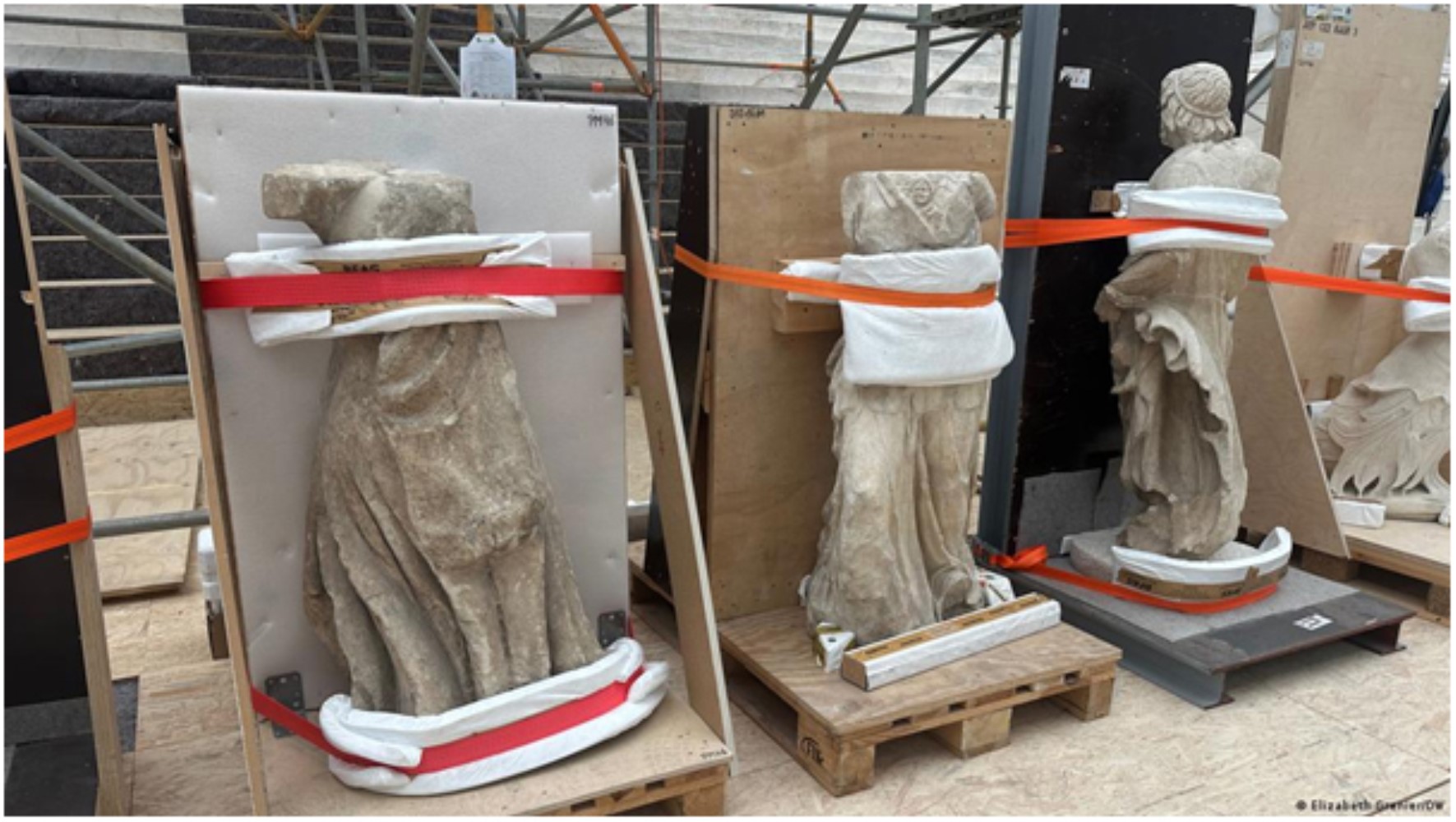
(Pergamon sculptures being dismantled and reassembled in the Berlin Museum/Prison, which is sinking into a swamp. Unique works like a puzzle. December 2025)
A museum/prison had been built between 1910 and 1930 according to the plans of architect Alfred Messel on the island on the Spree River flowing through the middle of the city of Berlin by the German Emperor Wilhelm II to house the historical artifacts smuggled from Pergamon and Gaziantep to Berlin.
According to some critics, this structure was more of a symbolic showcase for artifacts torn from Anatolia than an exhibition space.
The prison, called the Pergamon Museum, opened in 1930 and was heavily damaged by air raids and artillery fire during World War II.
Moreover, after the war, the Altar of Zeus and the artifacts in the museum were taken to the Soviet Union—Leningrad/Petersburg—as if they were war booty, and were later brought back.
In other words, it was as if they had been smuggled a second time!
Without the knowledge of Pergamon and the people of Pergamon, who are the true owners of the artifacts!
Later, East Germany, the owner of the land where the Museum/Prison was located in Berlin, left many parts of the building in ruins because it did not have the necessary funds to properly renovate the building.
Of course, the new unified Federal Germany was now the boss of Europe and had a lot of money.
During this process, it was seen that the island where the Museum/Prison building was built has a swampy ground and the building is slowly sinking into the mud.
The metal components of the artifacts are rotting from the humidity of the river.
This situation is interpreted by some commentators as a historical irony:
They supposedly smuggled them to protect our artifacts, but they caused them to perish!
Recently (in December 2025), Federal German Minister of Culture Wolfram Weimer held a press conference in the Museum/Prison where the stolen historical artifacts are located. According to his report, the hall containing the impressive Pergamon Altar of this Museum/Prison, which has been closed since 2014, is planned to be opened in 2027.
***
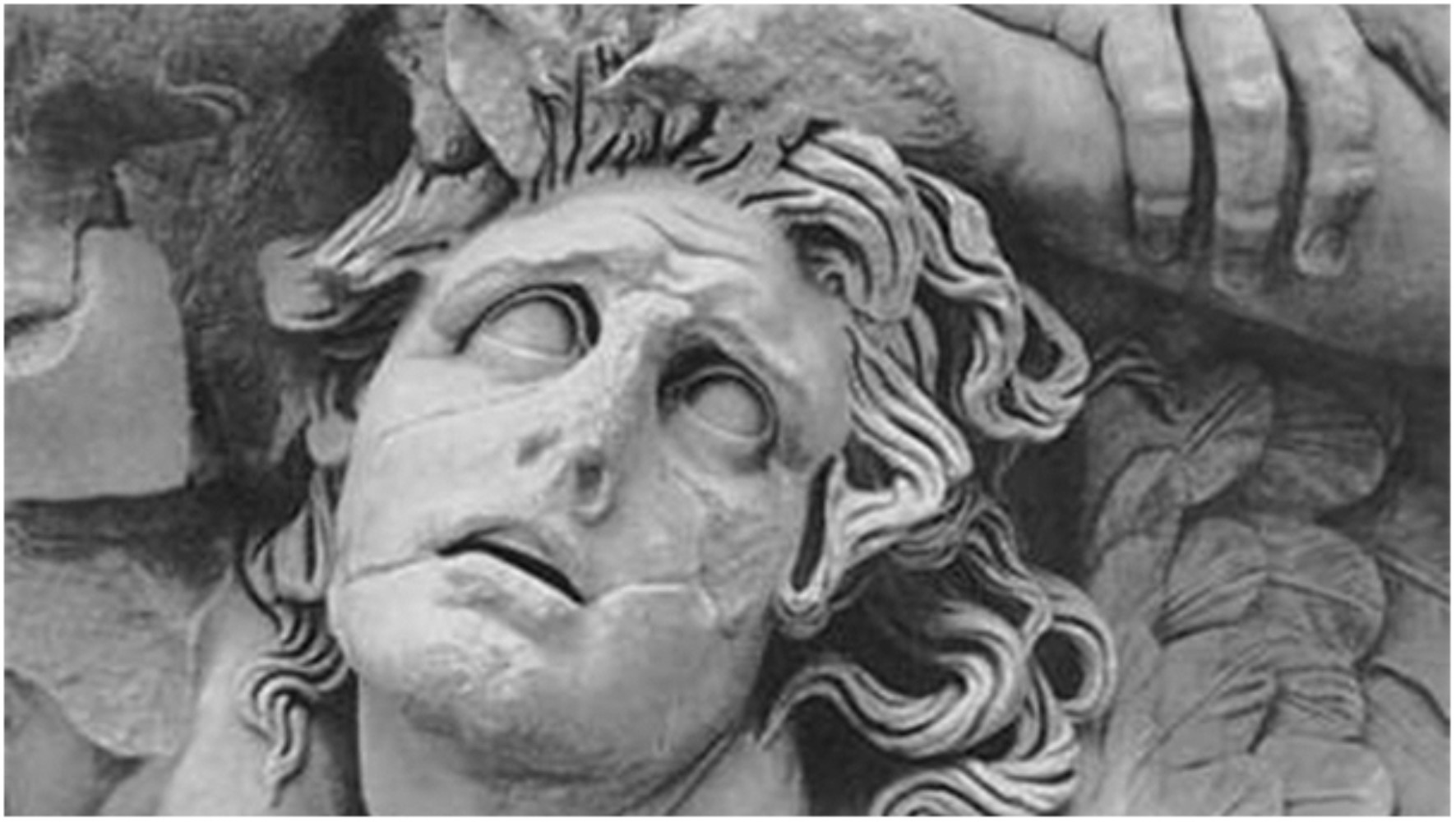
(From the marble friezes surrounding the Altar of Zeus smuggled from Pergamon, probably Alkyneus, the greatest of the giants/titans. These emotional expressions in the Pergamon sculptures are later accepted as the source of Baroque and Gothic art in Europe.)
Along with all this, while German Minister Weimer speaks of this world masterpiece as if it were their own property, he does not even mention how it was brought from Pergamon to Berlin and under what conditions. This silence stands like a short footnote added to one of the most controversial pages of history.
It cannot show the controversial aspect of German imperialism and colonial heritage.
Yet, the first condition of being cultured and intellectual is to say what one knows and what one sees!
No silence!
How can a historical artifact that is part of a city — the Altar of Zeus — be removed from the land where it was produced by foreigners, with or without permission?
How can a cultural heritage be moved to the showcase of another geography by circumventing laws, forcing the helpless to bow down, and providing benefits to those in authority?
How are the activities carried out by great states under the name of archaeology legitimized within the power balances of the period?
Who benefits from the gaps created by political weaknesses and how?
These questions are directed not only to the past but also to the conscience of today. Because the issue is no longer just history; it is about what values the common heritage of humanity will be protected with.
This long journey from Pergamon to Berlin, while telling the political realities of the 19th century, also brings with it the ethical questions of the 21st century. Perhaps what needs to be done today is not to defend the past, but to be able to face the past.
History sometimes falls silent, but stones do not.
That great narrative frozen in the friezes of the Altar of Zeus still gains meaning today with the light of the geography where it was born.
Therefore, the issue is not just where an artifact is exhibited, but with the meaning of which land it exists and where justice stands.
One day, the hope that these stones will return to the sun where they were born will continue to live in the wind of Anatolia.
THE ALTAR OF ZEUS AND PERGAMON ARTIFACTS DO NOT BELONG TO COLD AND FOGGY BERLIN, BUT TO BEAUTIFUL PERGAMON. THEY MUST DEFINITELY COME BACK, THEY MUST RETURN HOME
(Sources: https://basin.ktb.gov.tr/TR-447583/romadan-sonra-bu-kez-berlinde
https://www.dw.com/de/pergamonmuseum-berlin-das-ist-der-stand-der-sanierung/a-75035570
https://www.academia.edu/105150005/ZEUSUN_%C3%96ZLEM%C4%B0_TA%C5%9E_YER%C4%B0NDE_A%C4%9EIRDIR_1_ZEUS_DESIRE_THE_STONE_IS_HEAVY_IN_PLACE_1
https://www.academia.edu/145035390/ZEUSUN_%C3%96ZLEM%C4%B0_TA%C5%9E_YER%C4%B0NDE_A%C4%9EIRDIR_2_ZEUS_DESIRE_THE_STONE_IS_HEAVY_IN_PLACE_2)
Sefa Taşkın
22.02.2026
Karşıyaka/İzmir
Most Read

Striking picture for Özgür Özel's 'New Party'

Özgür Özel gives a dated response regarding the number of resignations

Forest fire in Antalya brought under control

The PKK opening and Özgür Özel’s path!..

How did the newspapers view Özgür Özel's farewell to the CHP?

He killed his wife by slitting her throat: Their children witnessed the moments

What did the CHP do?

Özel’s new party move in the world press

The New CHP, against CEHAPE

Fire at TUSAŞ engine factory in Eskişehir under control