



CYANIDE DIARIES FROM BERGAMA-26
The value of gold has increased incredibly, especially over the last year.
From ordinary individuals to companies and states, everyone is chasing after acquiring gold.
Look at where gold prices have come from in the world and in Turkey.
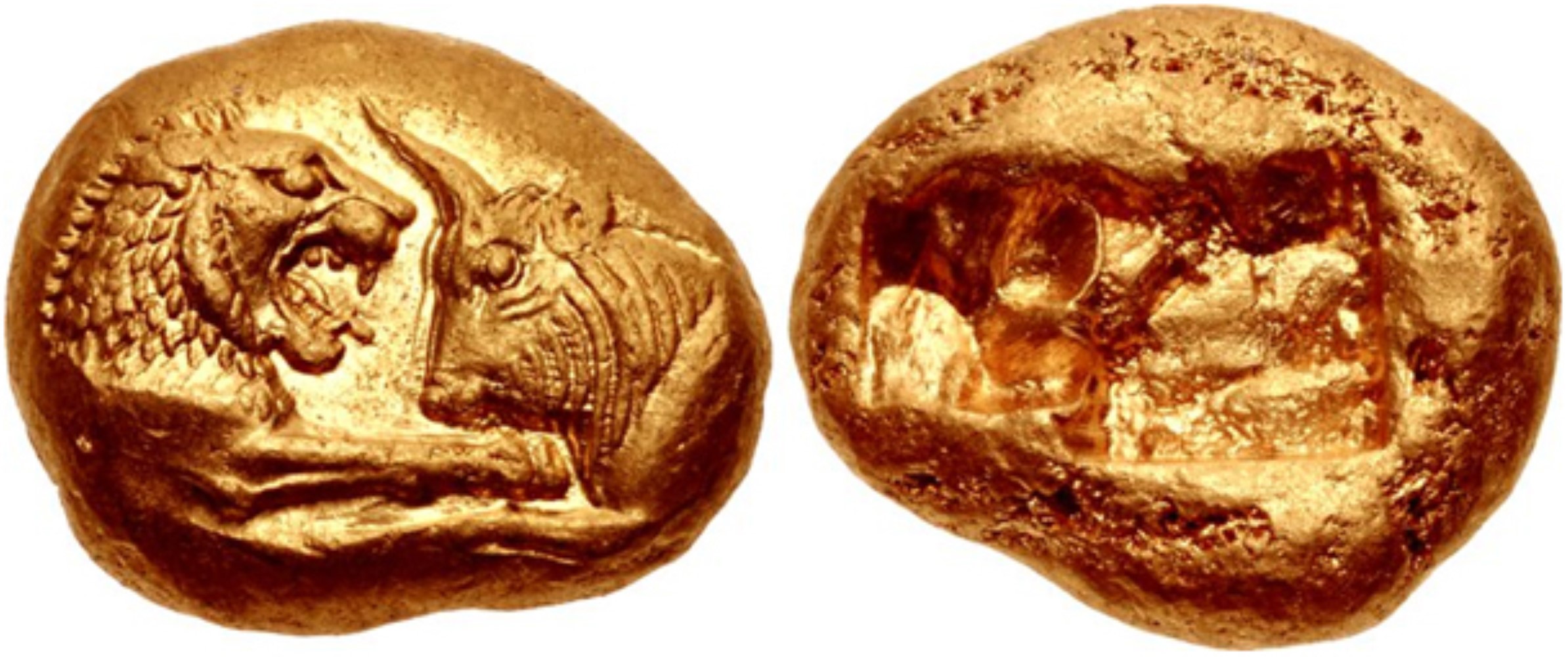
(The first “pure gold” coin was minted in the mint of Sardes -Salihli/Manisa- in Western Anatolia, during the reign of the Lydian King Croesus. 550 B.C.)
Below are the rise of gold in dollars and the increase rates over the last five years.
2021 › 2022 $65 › $70 ~+8%
2022 › 2023 $70 › $75 ~+7%
2023 › 2024 $75 › $90 ~+20%
2024 › 2025 $90 › $110 ~+22%
2025 › 2026 $110 › $177 ~+61%
The global gram price of gold showed a total increase of nearly 150% between 2021 and 2026, in the range of $89 to $176.
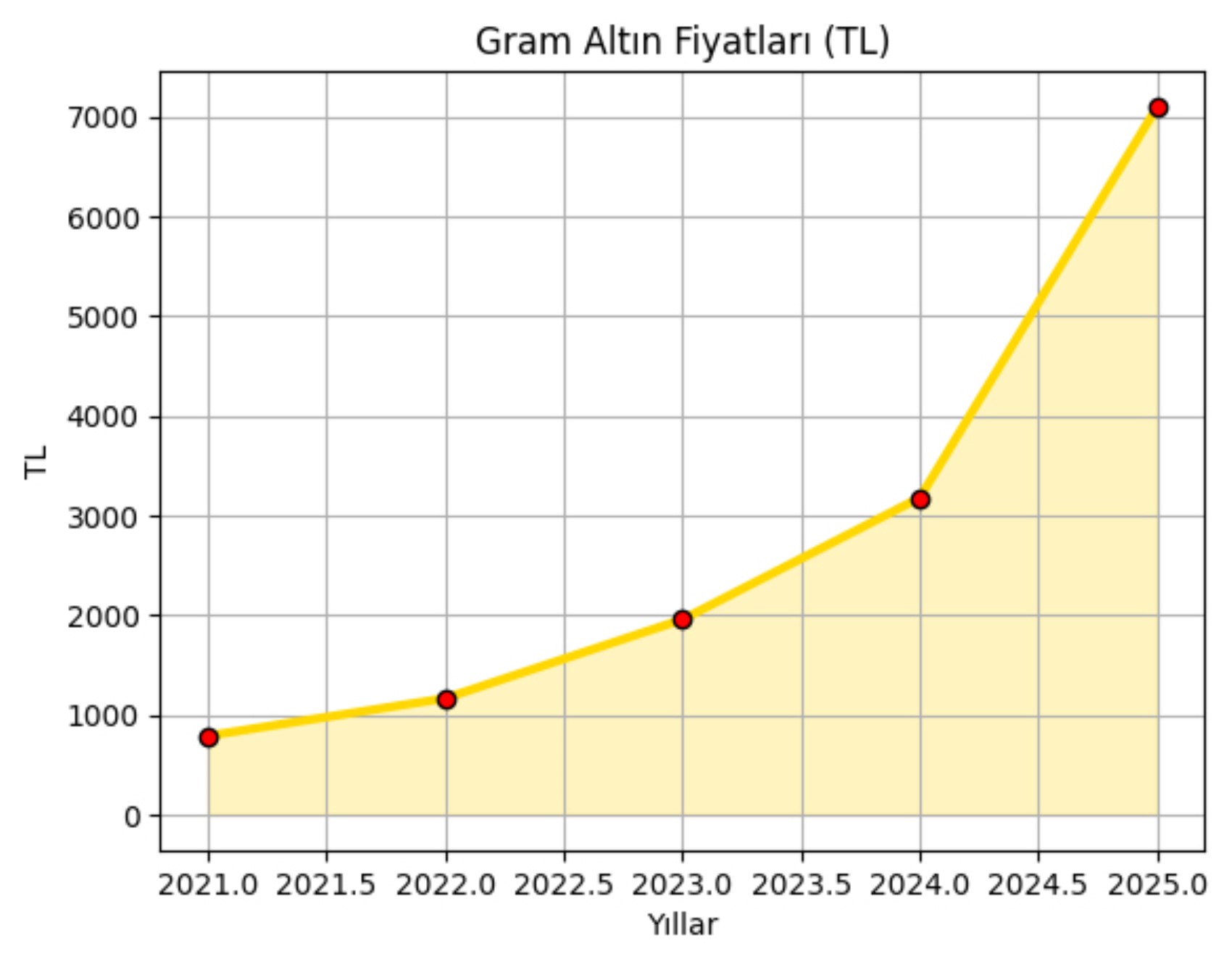
In Turkey, gram gold prices increased depending on both the price of gold and the exchange rate fluctuations of the Turkish Lira.
Below are the approximate annual percentage changes based on January 2026 prices:
Year Range TL/gram (approx.) Annual % Increase
2021 › 2022 442 › 789 TL ~+78%
2022 › 2023 789 › 1,165 TL ~+48%
2023 › 2024 1,165 › 1,956 TL ~+68%
2024 › 2025 1,956 › 3,178 TL ~+62%
2025 › 2026 3,178 › ~7,100 TL ~+123%
The increase in Turkey between 2025 and 2026 was the highest (over 120%). The reason for this is both the rise in the price of gold and the acceleration of the depreciation of the TL.
Between 2021 and 2026, the gram gold price in Turkey increased approximately 5–6 times in TL terms.
Of course, in the era of New Imperialism we live in, the economic and political behaviors of the large companies that control the financial world—the so-called “free market”—and the states they influence can create fluctuations in these prices.
***
Seeing the rising values, individuals who own gold say, “Oh, how nice, our assets have increased, we have become rich,” while those who have savings but no gold lament, saying, “Oh, we missed out.”
Those with some savings are queuing up in front of jewelers to buy gold.
Those who have neither gold nor savings, while waiting in lines at dawn to buy cheap bread, worry, saying, “Let’s see what other troubles this rise will bring upon us.”
Because they know from their experience that there is something fishy behind this rise!
Why is it like this?
How is gold a safe haven in unreliable market conditions?
This noble metal is not widely used in industry like other metals.
Gold is both a measure of value used since ancient times, a medium of exchange, and an object of savings!
Along with the limited quantity of gold, silver and copper have also been tasked with these roles.
When the circulation of all these metals in the economy became difficult, humanity invented paper money.
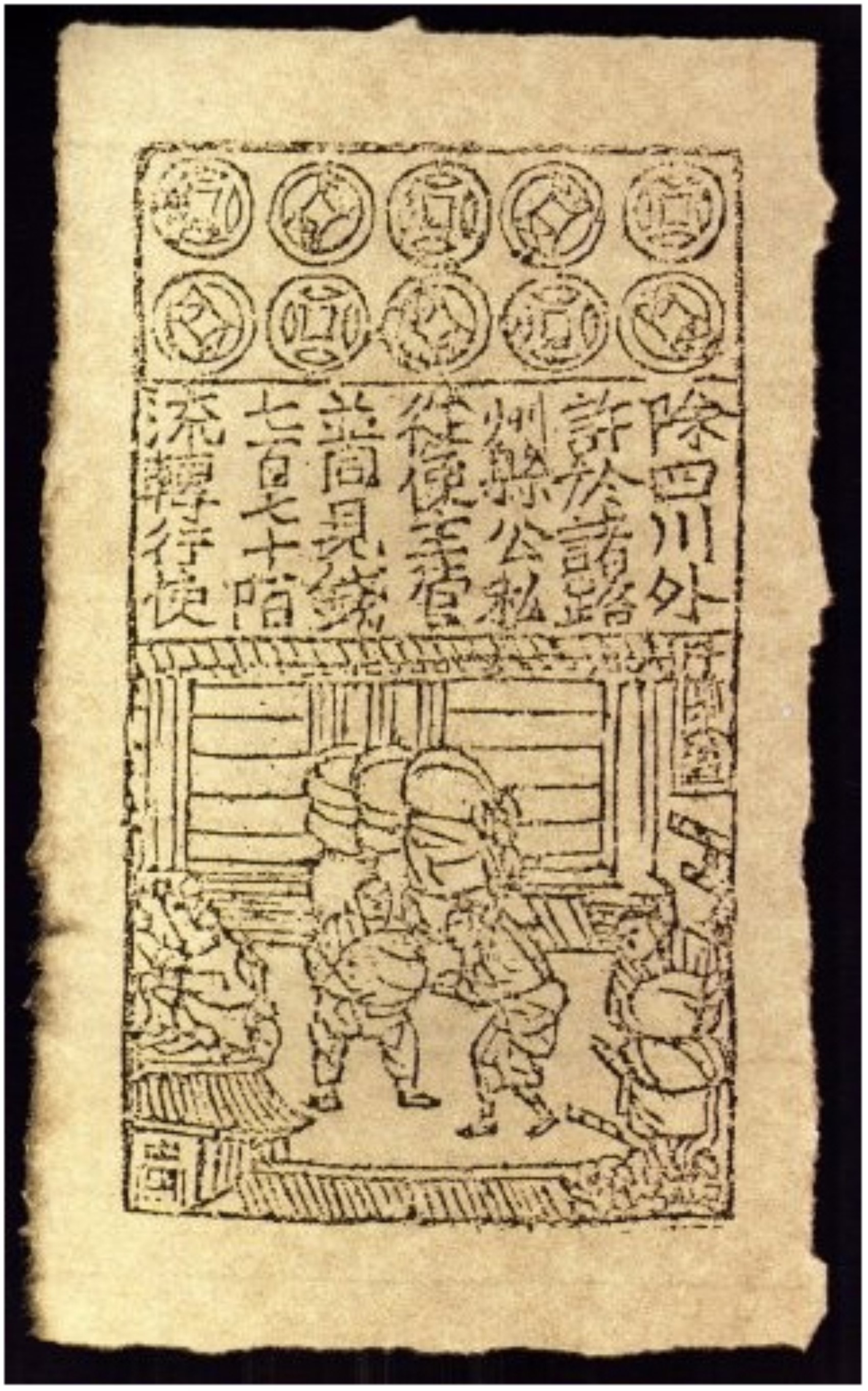
(Early Chinese money: Jiaozi. 10th-11th century. Song dynasty period. Sichuan region.)
Paper money appeared in China in the 11th century and in Europe, in Sweden, in the middle of the 17th century.
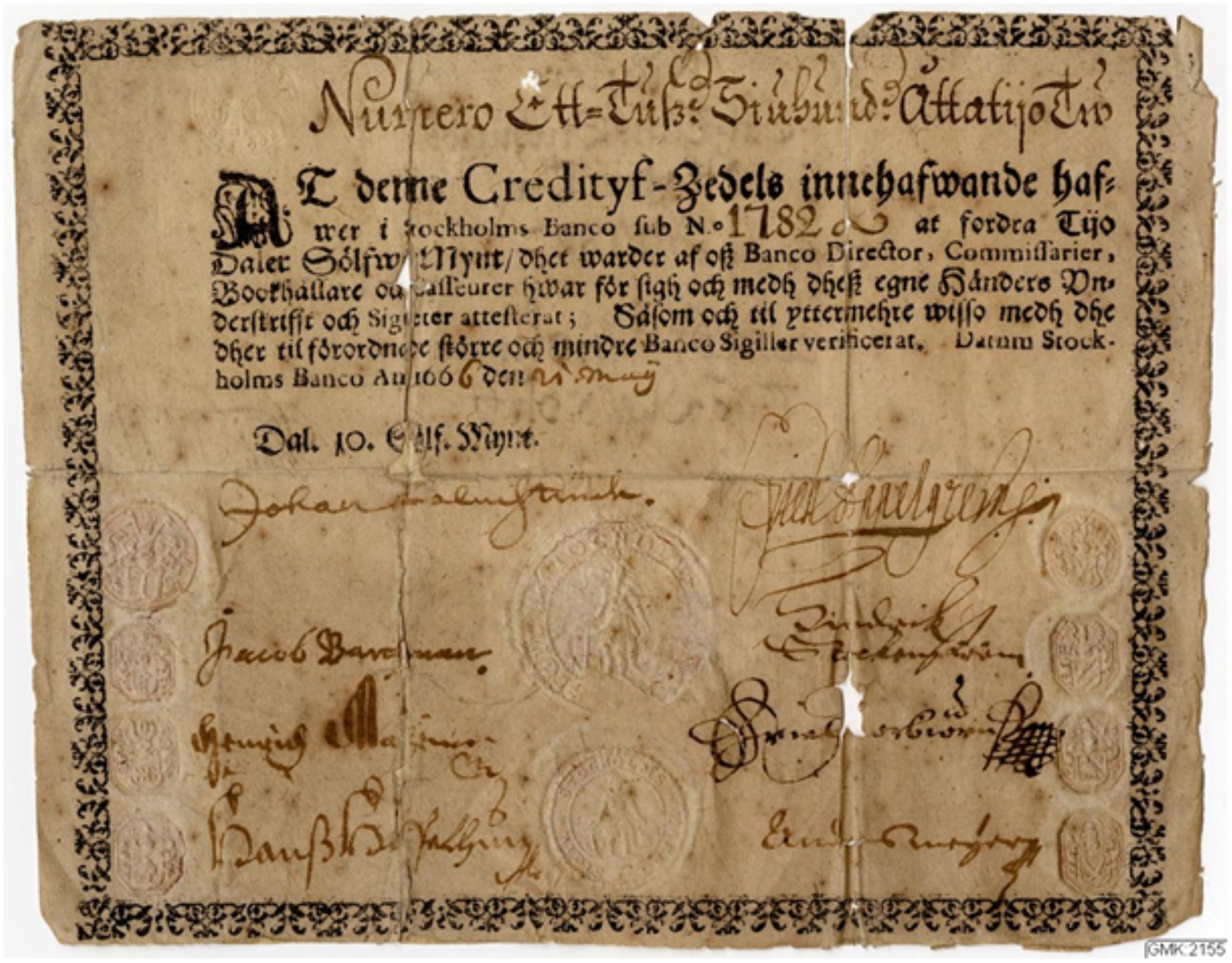
(Europe’s first paper money was issued in 1661 in Sweden by StockholmsBanco.)
In the Ottoman Empire, the first paper money was printed in 1840 by Sultan Abdülmecit I, son of the reformist Sultan Mahmud II, under the name “Kaime-i Nakdiye-i Mutebere.” The name of the paper money became “kayme” in the vernacular.
However, paper money and banknotes are, in the end, just paper.
If you strike a match, it burns!
Its existence depends on the trust placed in the issuer—the state.
In an environment of distrust, such as wars or crises, and sometimes due to states printing excessive amounts of paper money, the usage and savings value of such money sometimes falls slowly, sometimes rapidly.
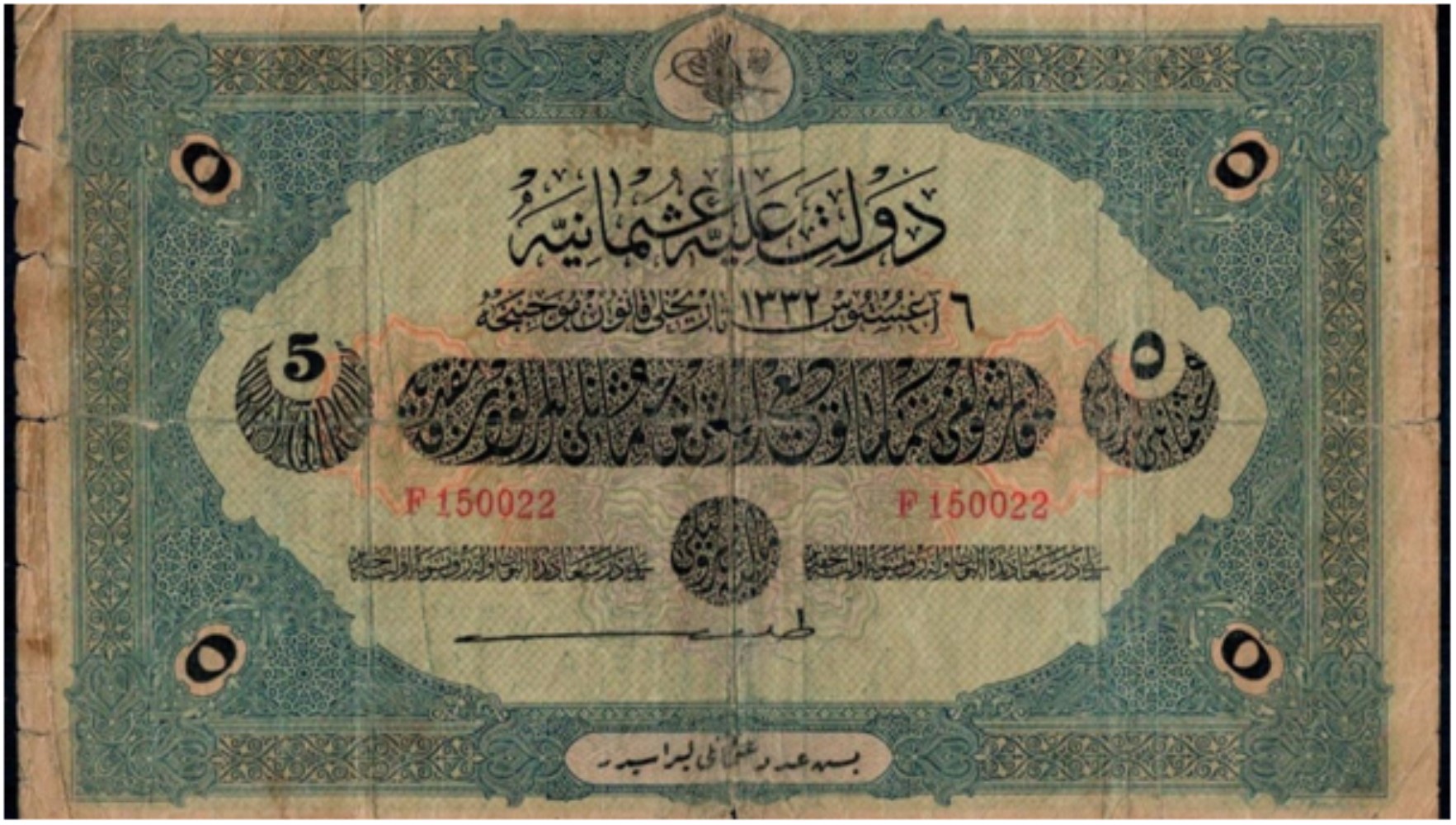
(The first Ottoman paper money: Kaime-i Nakdiye-i Mutebere.)
Of course, gold has been an unchanging measure of value.
During the discovery of the Americas in the 15th–16th centuries, its value fell due to the gold the Spanish brought to Europe during the process of plundering these lands, and severe inflation was experienced, but it recovered itself immediately afterward.
In the USA, with the measures attempted to be taken in 1933–34 under the administration of President Franklin D. Roosevelt to overcome the “Great Depression/Crisis” that began in 1929 during the term of President Herbert Hoover, the price of gold in dollars increased by 69.33% (20.67 › 35).
The dollar’s gold backing (gold content) decreased by 40.94% (meaning the dollar was devalued by approximately 41% against gold).
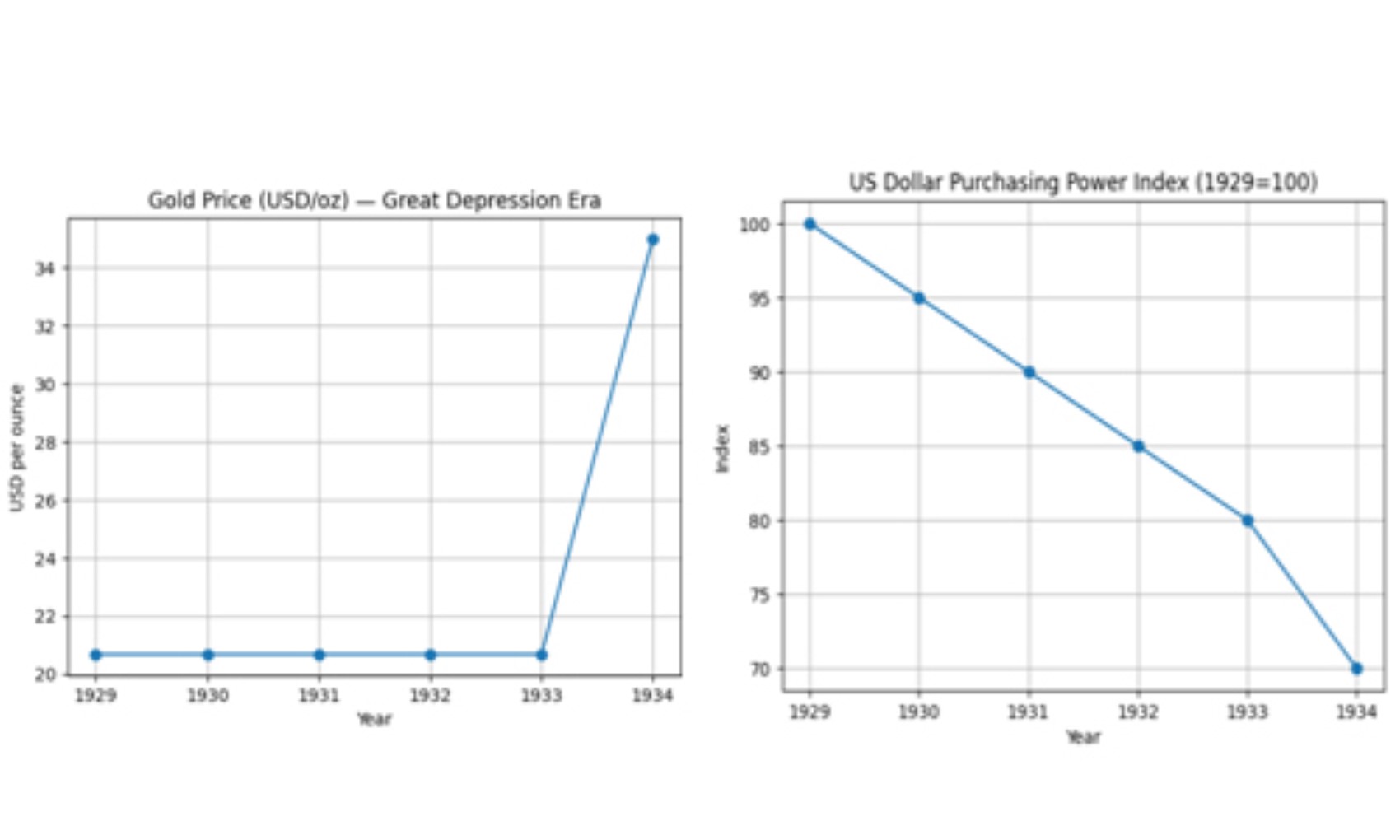
(In the USA, during the Great Depression of 1919-1933, the increase in the ounce of gold and the decrease in the dollar’s purchasing index.)
Paper money and the paper values in the stock market tied to it became worthless.
Such depressions are generally accepted as one of the cyclical crises produced by the internal contradictions of capitalism.
It emerges as a blockage of the “Accumulation Regime,” which is considered the totality of the production structure + wage relations + state policies + monetary/financial order + international relations that allow capital accumulation to continue for a long period without producing crises (or by making crises manageable).
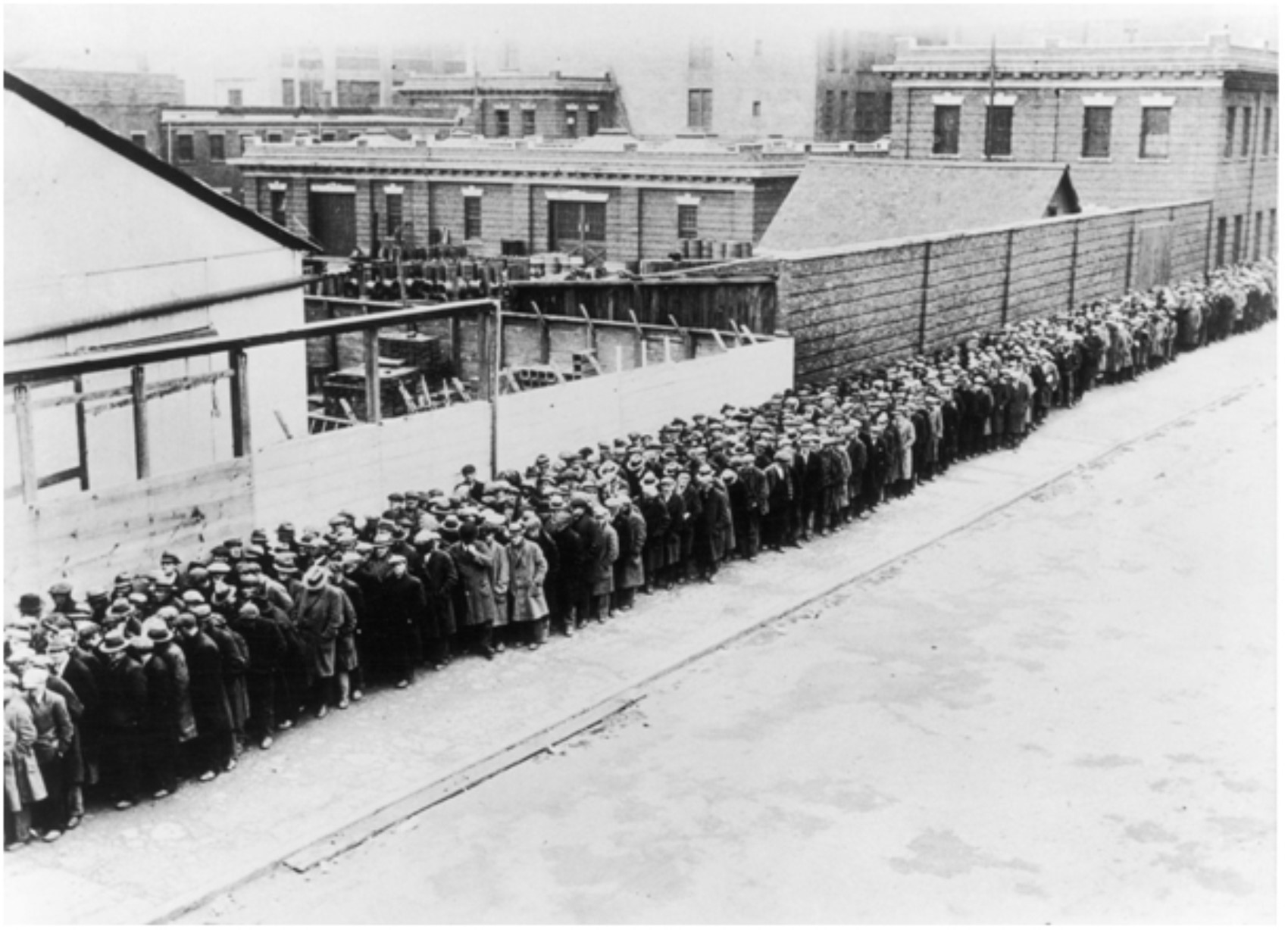
(Unemployment lines during the Great Depression in the USA)
The deterioration of these relations disrupts the environment called the “money market,” where paper money is involved.
Of course, the bill for these crises is paid by the people.
Wage pressure is applied to workers. Wages are not increased.
Labor is precarious. Unemployment runs rampant.
The abundance or scarcity of money is at an extreme level. Debt increases.
Speculation is at the forefront.
An organized society that would object to these conditions is not desired. Unions are weakened.
Thus, an attempt is made to forcibly create a balance in the market.
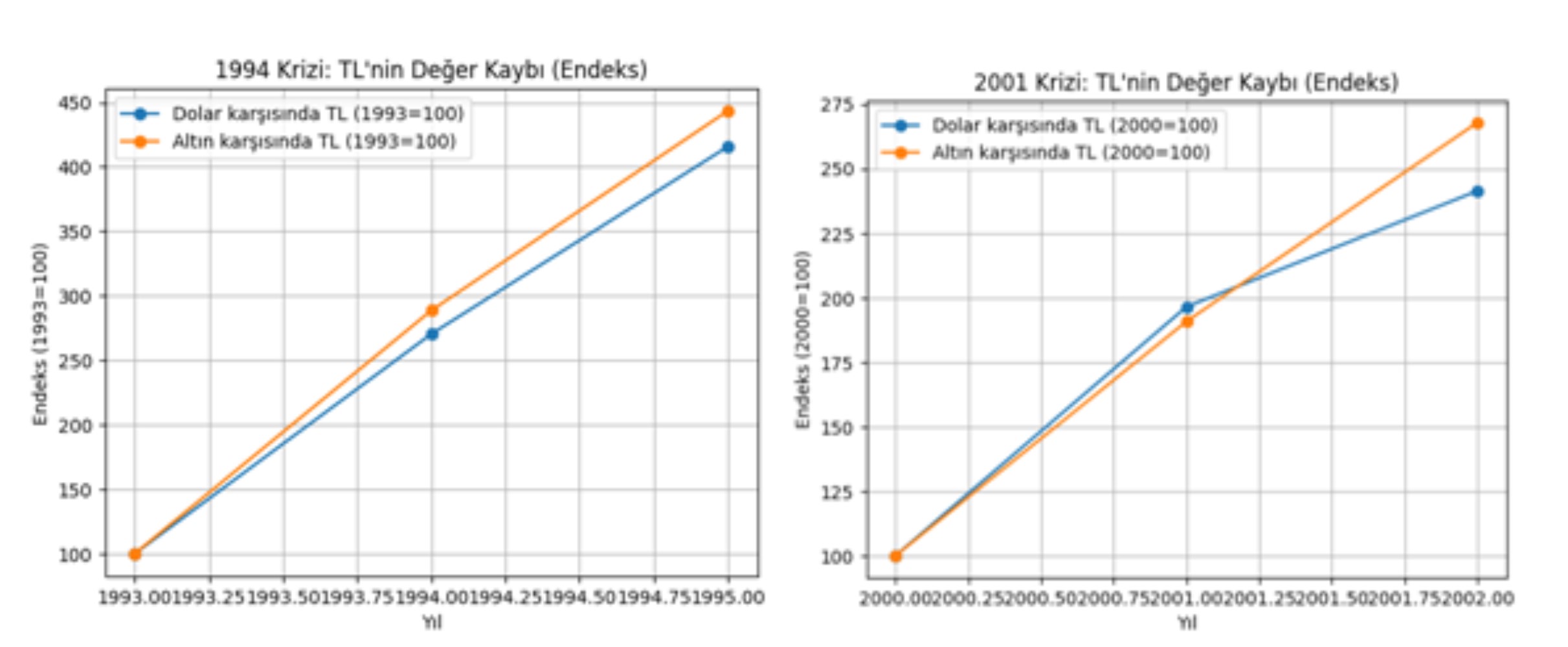
(In the 1994 crisis, gold gained 4.5 times its value against the TL, and 2.75 times in 2001)
Turkey experienced such environments during the periods called the Tansu Çiller crises in 1994 and the Kemal Derviş crises in 2001. And now: in 2024-2026.
The people were crushed, and the capitalist economy the country was plunged into was saved until the next crisis.
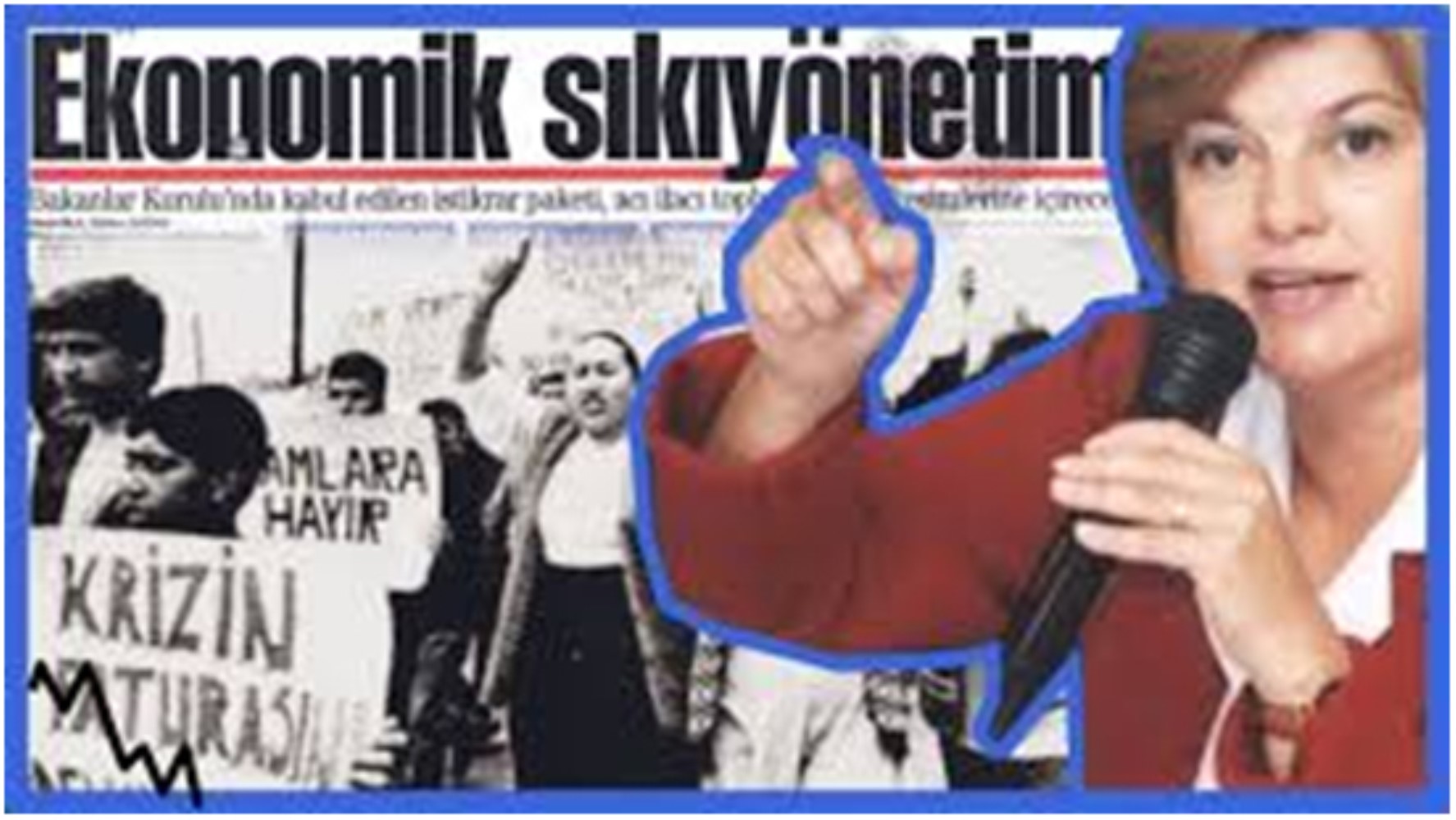
(The 1994 Çiller crisis in Turkey)
***
Another way to solve the severe crises of capitalism is war.
In wars, factories are destroyed, infrastructure disappears, but capital stocks are wiped out, and the workforce is disciplined. No one inside can ever raise their head!
Thus, the excess accumulation in the hands of capitalists is forcibly liquidated, profit rates rise again from a zeroed base, and a new wave of accumulation becomes possible.
However, major wars are not the cause of capitalism’s crises; they are one of the historical results of its inability to cope with crises.
Or, to put it more harshly, capitalism sometimes solves its crises with reform, sometimes with fascism, and sometimes with war.
And the king of all these periods as a measure of value is “gold.”
“Gold is a safe haven!”
For individuals with assets, as well as for capitalists and states!
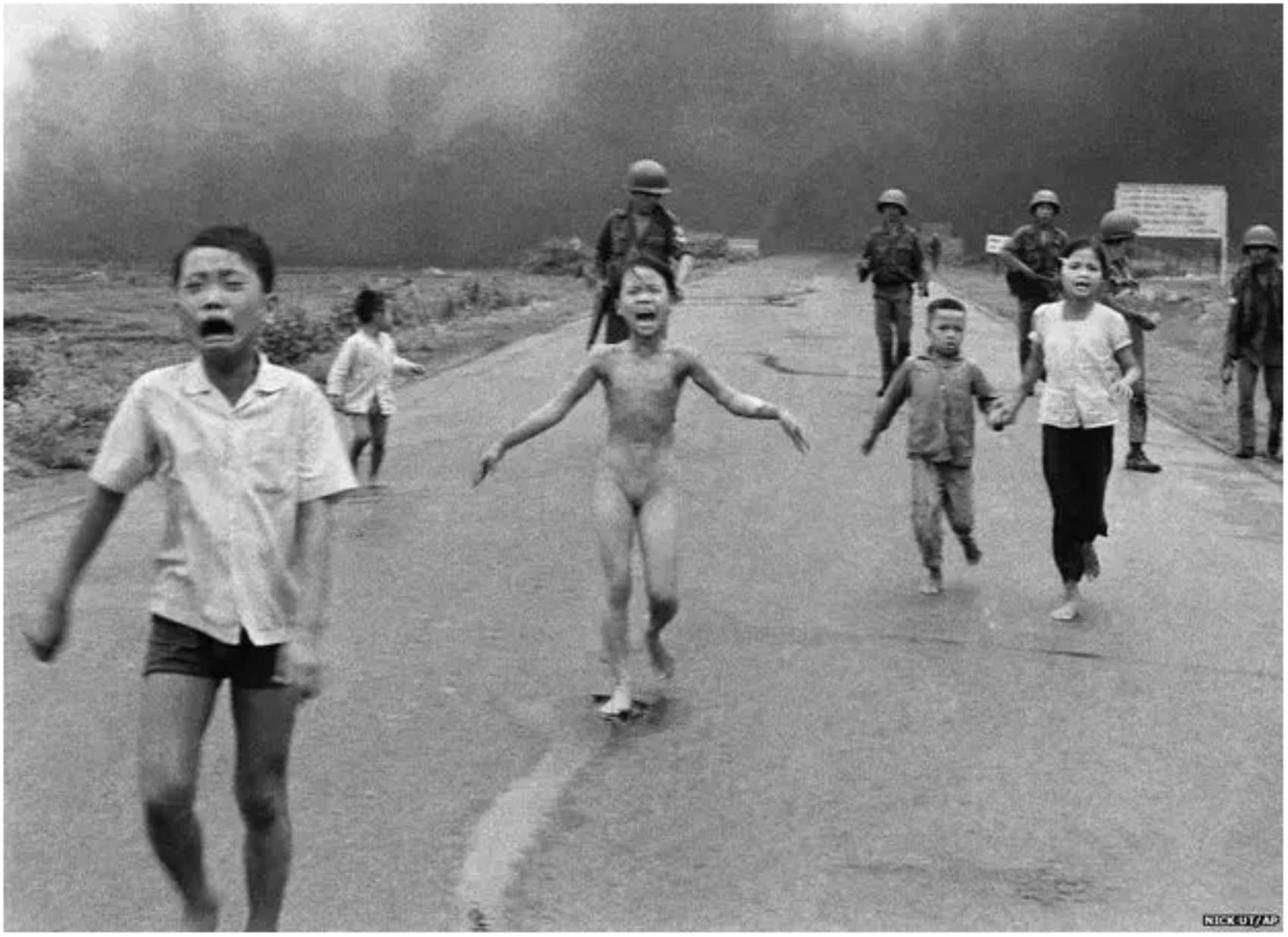
(Vietnam and war. 1965)
***
Along with all this, in the conditions of the recent period the world is experiencing, the incredible success achieved by the People’s Republic of China in economic and social development and technological progress is severely shaking the throne of the US dollar, which is the master of the world regarding paper money.
The development of the trend of countries trading with each other using their own currencies instead of the dollar, the increase in China’s weight in the global economy, and the spread of the use of virtual money like Bitcoin are shaking the throne of the US dollar.
Paper money melts away with a crisis, can be burned by fires, and blown away by storms.
But gold is eternal!
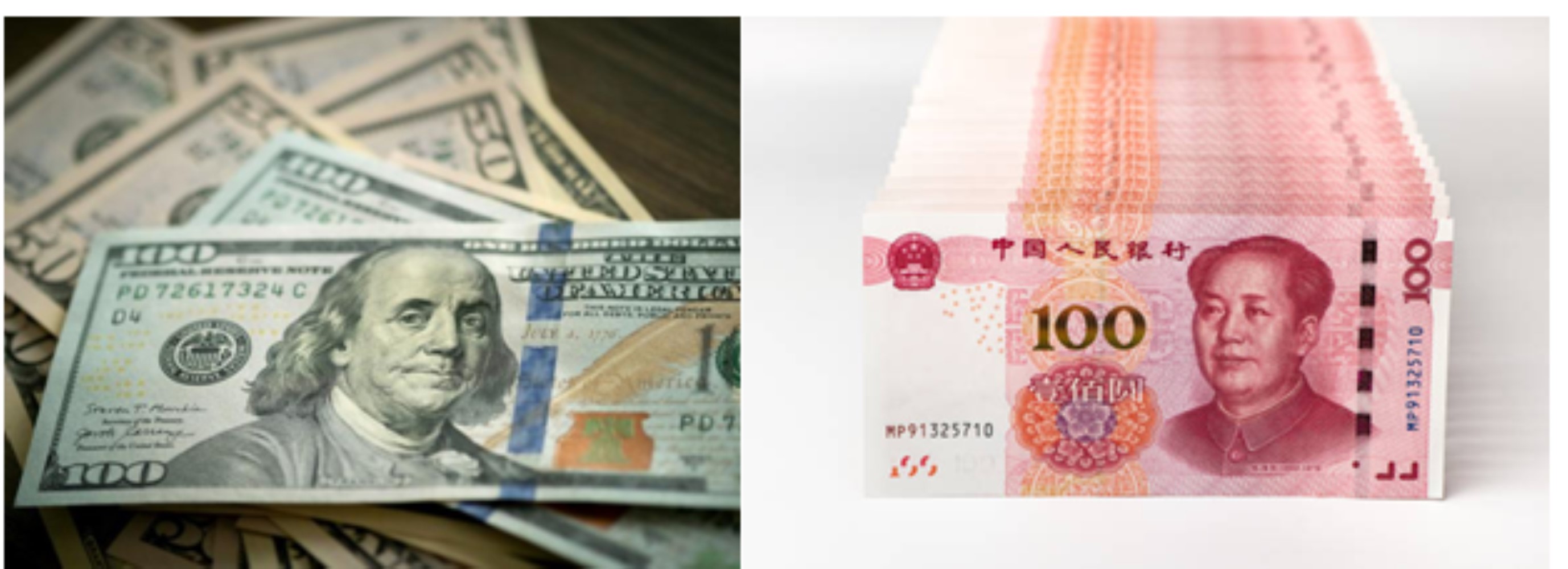
(Two paper currencies fighting for dominance in the world today: The US Dollar and the Chinese Yuan)
***
In Turkey, the vast majority of the public who have savings keep their savings as “gold” because they do not trust the financial policies of the administrators and know from their own experience that the monetary policies of those who dominate the economy harm them.
Of course, they see that the result of these policies always serves to increase the savings of capitalists, and that the state collects more indirect/direct taxes from the people with inflationary decisions.
Financiers call the gold that individuals hide from the state and keep off the books “under the pillow.”
They frequently set their sights on this gold that does not enter economic circulation and try various methods to record it. The public, having been burned badly before and having seen their savings evaporate, does not look favorably on proposals in this direction.
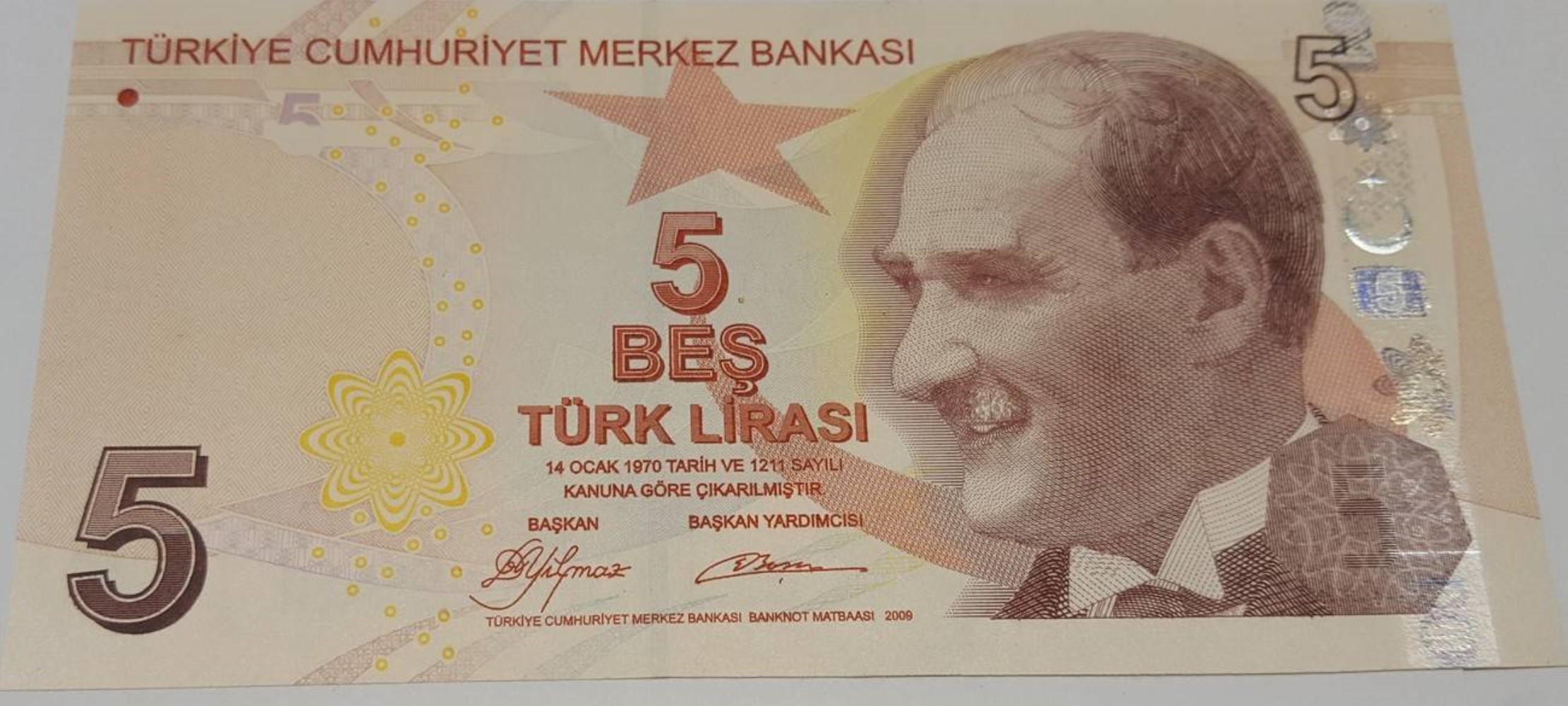
(5 Turkish Lira. Very few people left who use and remember it)
Those who squander the country’s resources say, “Oh, if only we could reach those under the pillow,” in order to use the people’s gold, estimated to be around 400–450 tons, for their own interests and to benefit from it under the economic conditions they have determined.
The public who has gold does not look at crises; they supplement their savings with gold if necessary, sell it when they need it, hold weddings, and buy houses and cars.
They say, “Even if the crisis wounds me, let them solve this situation the same way they created it,” and “Let them not set their sights on my gold.”
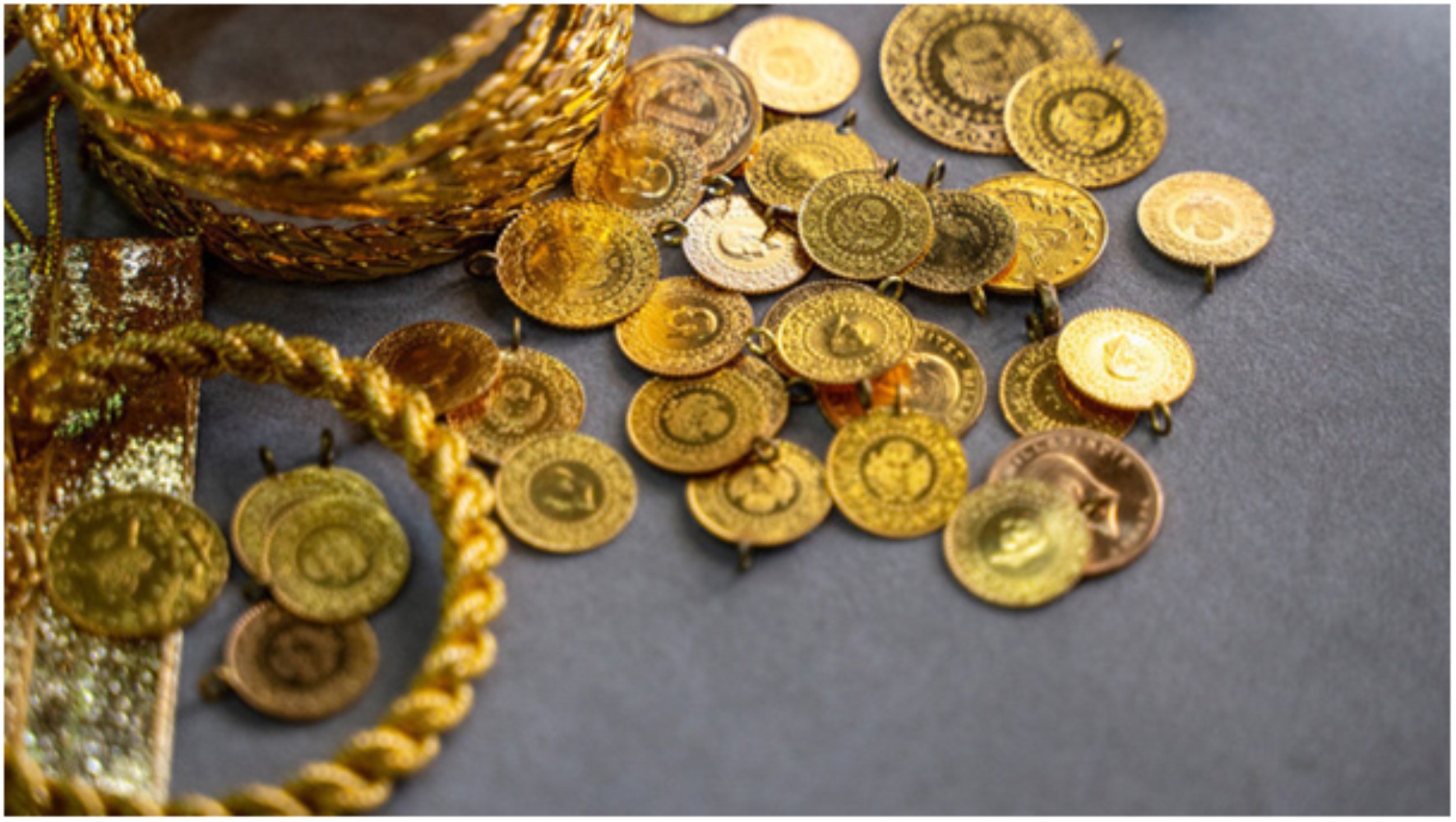
(Gold going under the pillow)
**
This recent unpredictable rise of gold in world markets coincides with the debates in our country regarding businesses called gold mines.
The events experienced in our country over the last 30 years regarding “cyanide gold” or “open-air chemical mining,” the steps taken, the practices implemented, and the gold obtained make the mouths of foreign and domestic capital water even more with the rise in gold prices in recent years.
“There is gold in our soil!”
“The reserve is 400–600 tons. There could be more!”
“If only we could extract them!”
“If only we could add wealth to our wealth!”
“If only we could make our country (actually our capitalists) leap into the future!”
“Well, a piece will fall to the man on the street too!”
“Foreign companies brought this method, we learned from them, now it’s okay if we send them away, we can do this job too, it’s local and national!”
How beautiful!
What a broad horizon!
Are we not tired of being the poor guards of our rich mines?
The public, who will be left alone with thousands of tons of poison after taking the gold from the soil with such bright words and then leaving, is being forced to agree to live under these conditions.
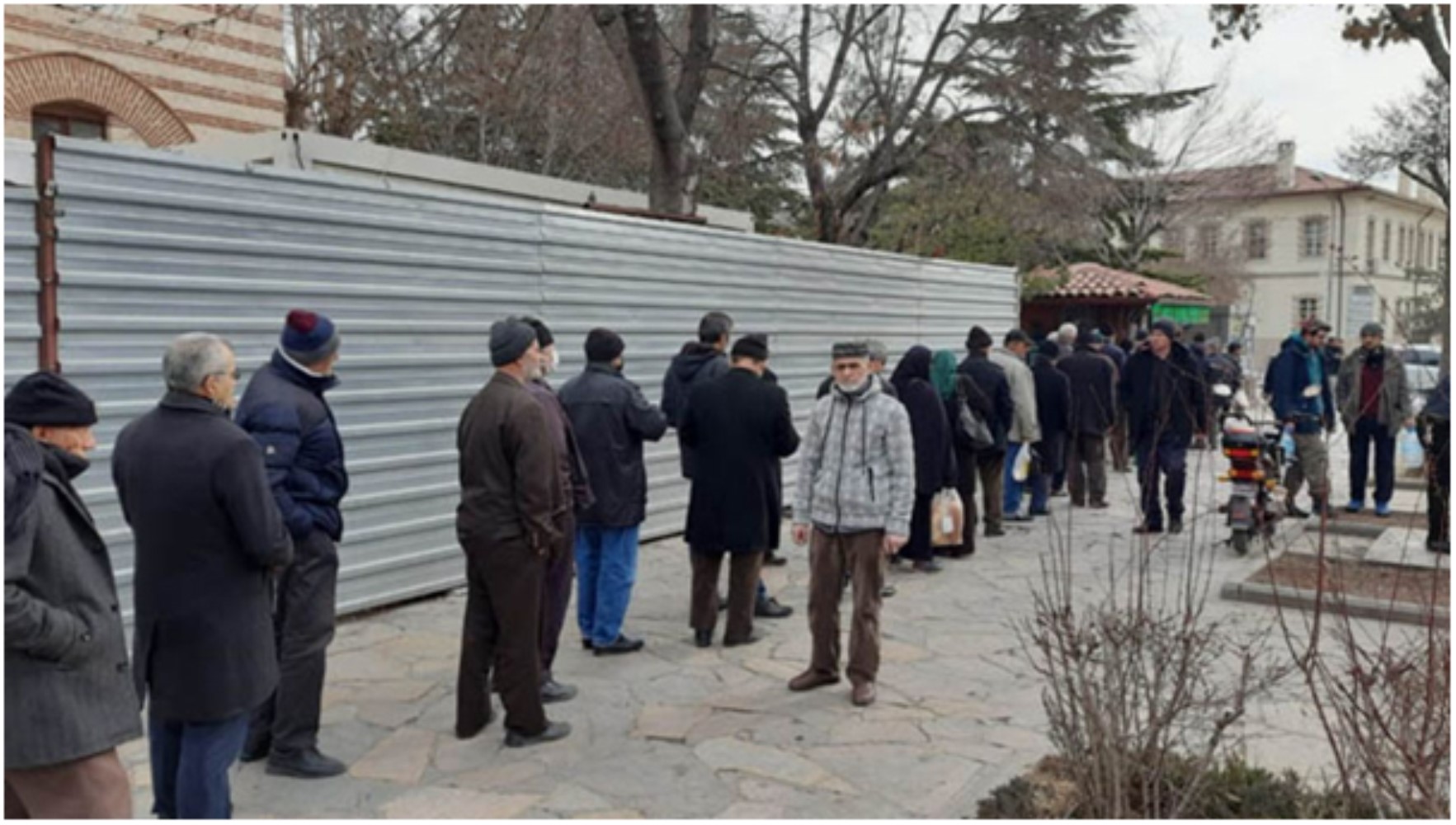
(People in the cheap bread line during the economic crisis in Turkey today. Tele-1)
***
So, is that how it really is?
In the world, the situation of gold being found in stream beds or rocks in the form of grains or veins has largely ended.
What is in the hands of states and the public is the result of hundreds of years of accumulation.
Today, in places considered mines, gold is found in the soil or inside rocks in the form of dust.
To get this gold, soil or ground rock is washed with cyanide; cyanide, due to its chemical property, separates the gold from the ore. The separated gold is collected.
Well, what’s wrong with that?
Even if there is 0.2–0.3 grams of gold in 1 ton of ore, this land is considered a mining site. That is, it is said that even if it is very, very little, the soil can be poisoned and the gold inside can be taken.
To separate this gold, 1 ton of soil/ore is processed with at least 1 ton of cyanide.
Of course, this much poison is a terrifying amount.
Afterward, toxic wastes formed by heavy metals such as arsenic and cadmium found with gold in the cyanided soil, both on their own and in compounds they make with cyanide, are released into nature.
A sea of poison covers the area.
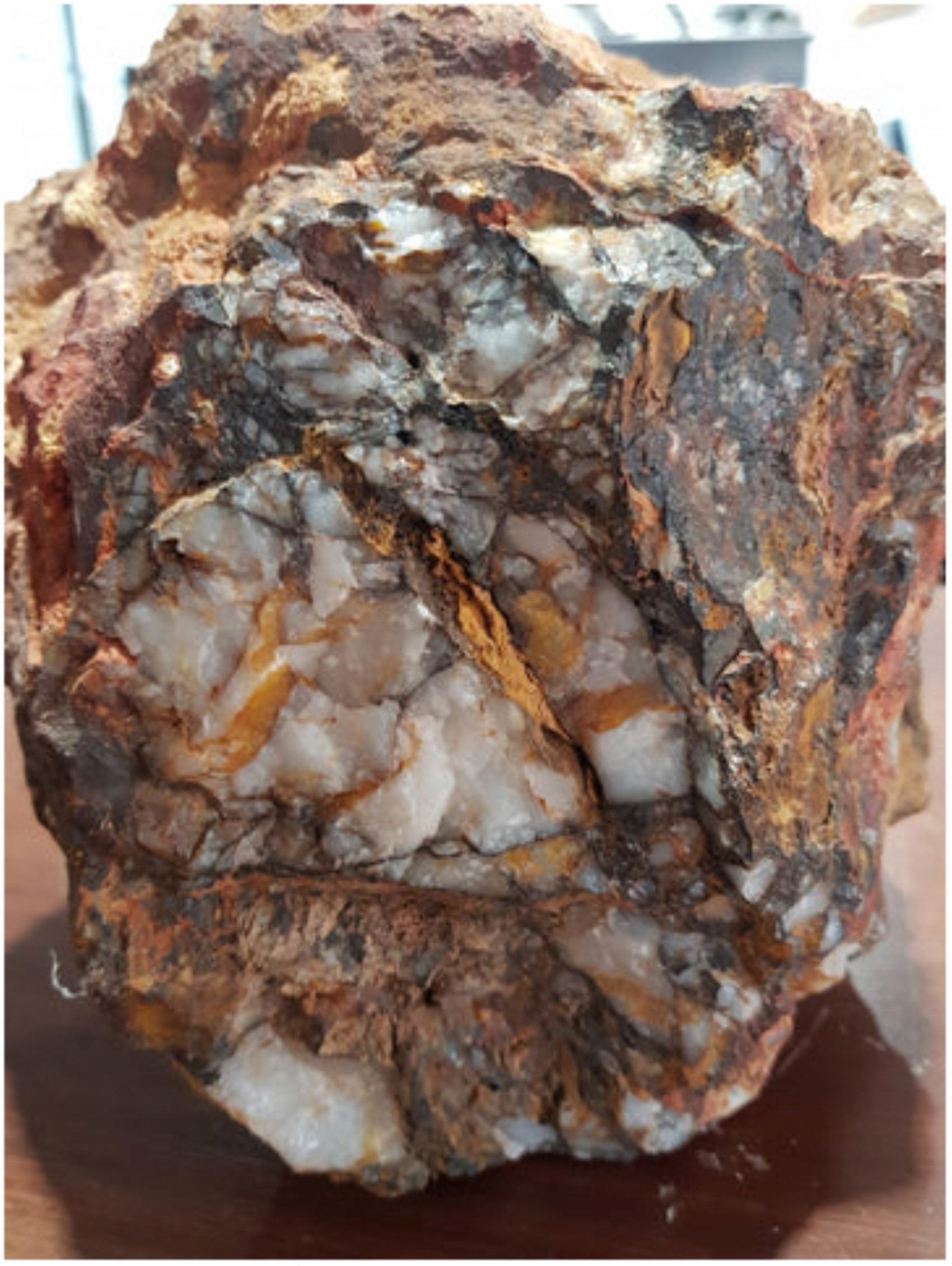
(Gold masses in quartz veins)
***
An example:
In the İvrindi district between Balıkesir–Ayvalık–İzmir–Bergama, in the soil of the cyanide gold mine operation that was started on a small scale before and is now wanted to be expanded much further, there is 0.39 g/ton, and for silver (Ag) there is 0.83 g/ton.
That is, one ton of soil will be poisoned with cyanide and less than 1 gram of gold and silver will be obtained. As in many places, gold and silver are found together here as well.
Today, due to the appreciation of gold and silver, this amount looks like a lot of money, but in terms of weight and quantity, it is almost like dust.
For this, 201.5 million tons of soil will be excavated in İvrindi, 155.3 million tons of which will be cyanided.
According to public statements, it is planned to obtain 34 tons of gold in 9 years. These operations will cover an area of 1287 hectares. (https://www.egedesonsoz.com/155-milyon-ton-lic-depolanacak-izmir-sinirindaki-zehir-madeninde-kritik-tarih)
That is, an area the size of approximately 1800 football fields will face cyanide and its companion, arsenic, the world’s most dangerous poisons.
Cyanide does not disappear immediately in the natural environment. There is a possibility of it reaching living things at any moment.
Arsenic from the waste is what we know as “rat poison.”
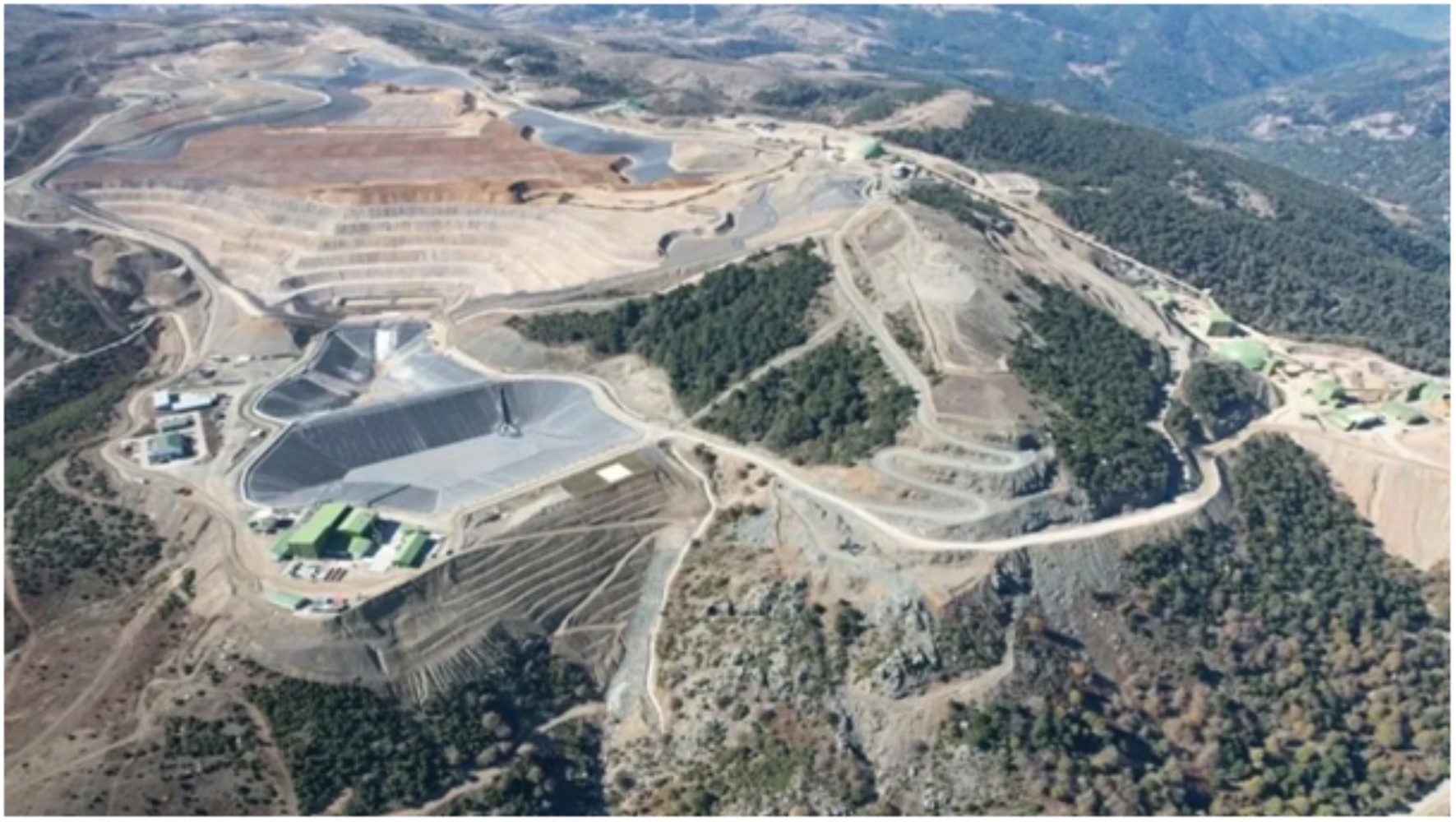
(İvrindi cyanide gold mine)
Tons of toxic compounds that these make with other metals found in the ore are released/will be released into nature.
Toxic wastes will be accumulated either in the open or in a dam or pool officially called a “waste storage area.” It is possible for toxic waters to pass into groundwater, or for the dam to collapse or overflow.
In such operations, 1–3 tons of gross water are used for 1 ton of ore. Approximately 60% is recovered.
This means tons of groundwater and surface water are used in these operations.
It is reported that one such toxic mine uses as much water as the water needs of a city where one hundred thousand people live.
Moreover, in these years of drought!
Attempting to obtain gold and silver with such a method is a deadly threat in itself for humans and all living things.
When it comes to İvrindi–Balıkesir, the mining site where toxic wastes will be accumulated is 58–60 km away from the neighboring Sındırgı, where there have been very severe earthquakes in recent days, and where it is even being considered to abandon the city.
That is, the frequently occurring Sındırgı earthquakes cause major tremors here as well.
The sites where cyanide mines are located in other parts of our country are also shaking like a cradle.
It is a very high probability that these earthquakes will open cracks in the ground in these areas and that the poisons in the waste will mix into the groundwater.
Operating a cyanide mine here is, in a sense, a situation like playing with poison in nature.
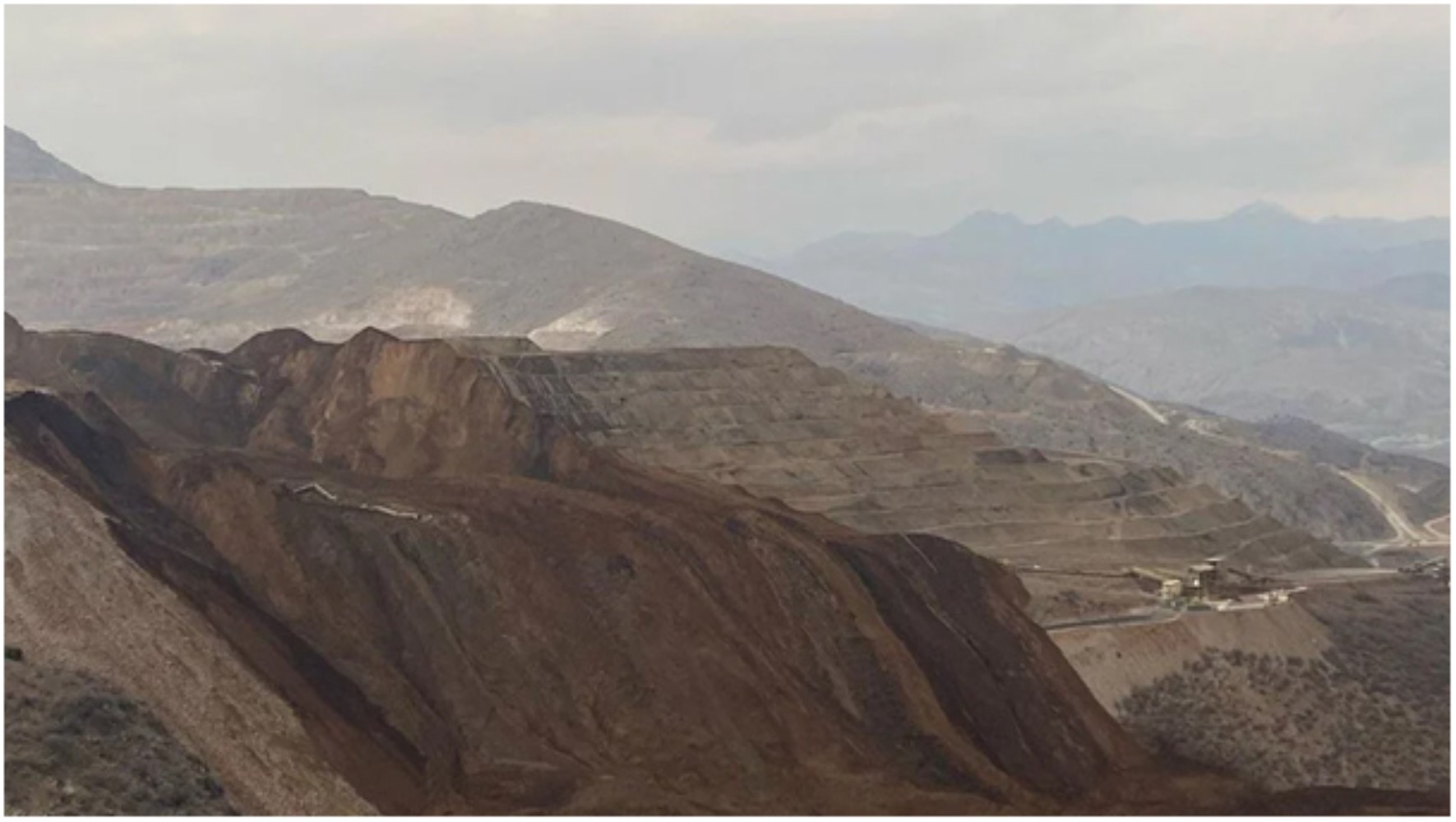
(Erzincan-İliç-Çöpler cyanide gold mine: Bed of disaster)
As has been seen in various corners of the world for years, the environmental disasters experienced in recent years in “cyanide gold mines” in our country are the herald of this.
The death of 9 people as a result of a faulty project and application at the cyanide mine in Erzincan–İliç, the explosion of the waste dam in Şebinkarahisar–Giresun, the flood in Gümüşköy–Kütahya, and similar events that occurred in the Ayvalık-Balıkesir Iron mine waste pool are evident.
And this is despite all the warnings made in advance!
The mine in İvrindi is operated by a company called TÜMAD, and it now wants to spread to a much larger area.
TÜMAD belongs to the NUROL Holding, which is owned by the Çarmıklı family, who carry out major projects such as the Gebze–Orhangazi–İzmir Highway and the Bosphorus sub-sea crossing, and who do extensive business with the state.
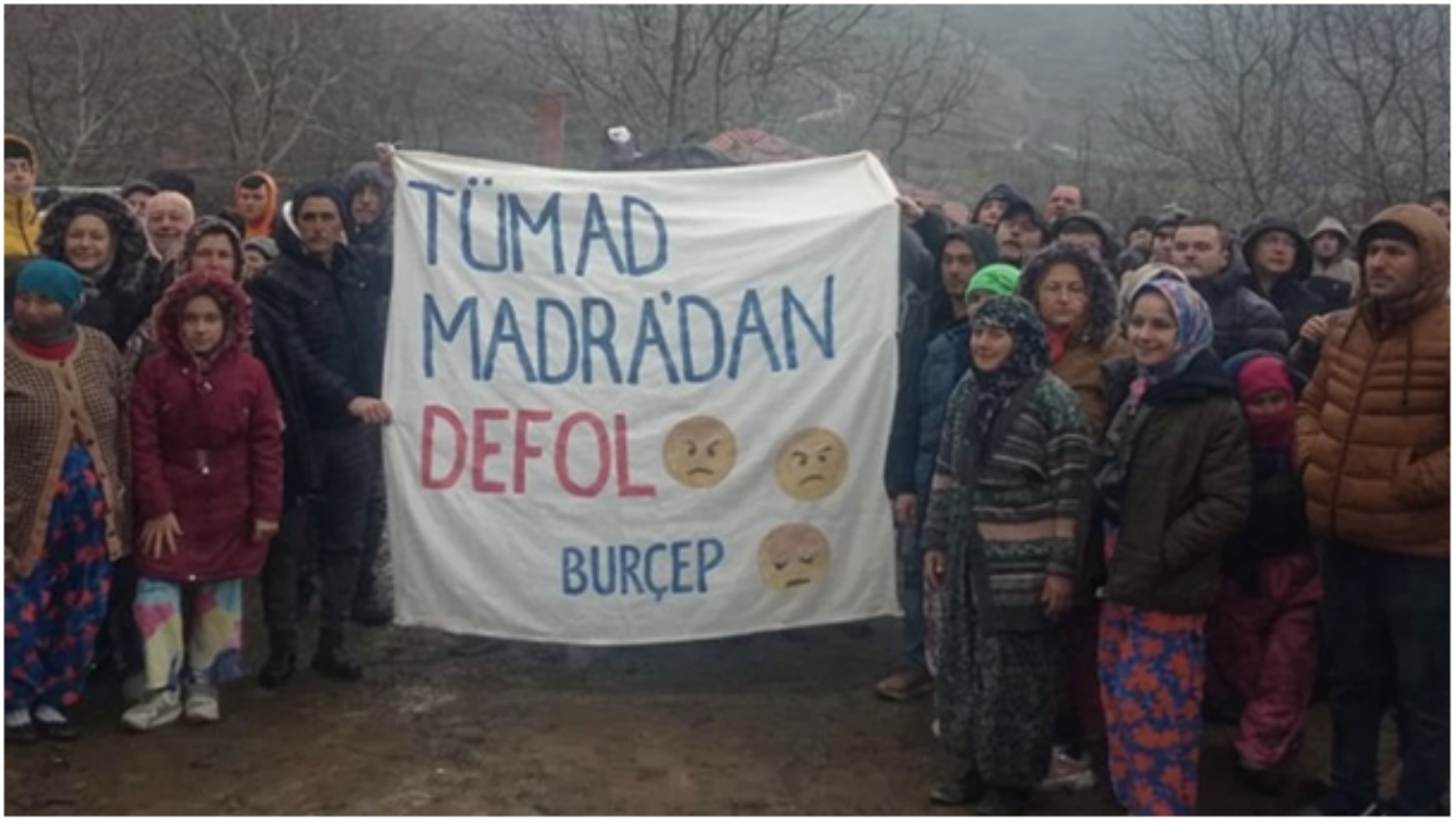
(The request of the Balıkesir Madra Mountain villagers against the İvrindi cyanide gold mine)
***
As of 2025, there are a total of 2,822 general mining license areas in Turkey; 541 of these are operating licenses. (https://www.mapeg.gov.tr/Sayfa/Madenistatistik?)
In 2019, the Ministry of Energy and Natural Resources announced that there were a total of 133 gold mining licenses in Turkey. (https://www.birgun.net/haber/ulke-genelinde-133-altin-madeni-ruhsati-verilmis-331971)
According to 2020 reports, 18 cyanide gold mines are currently operating. (https://www.aa.com.tr/en/energy/energy-security/turkeys-gold-production-set-to-break-records-in-2021/31539?)
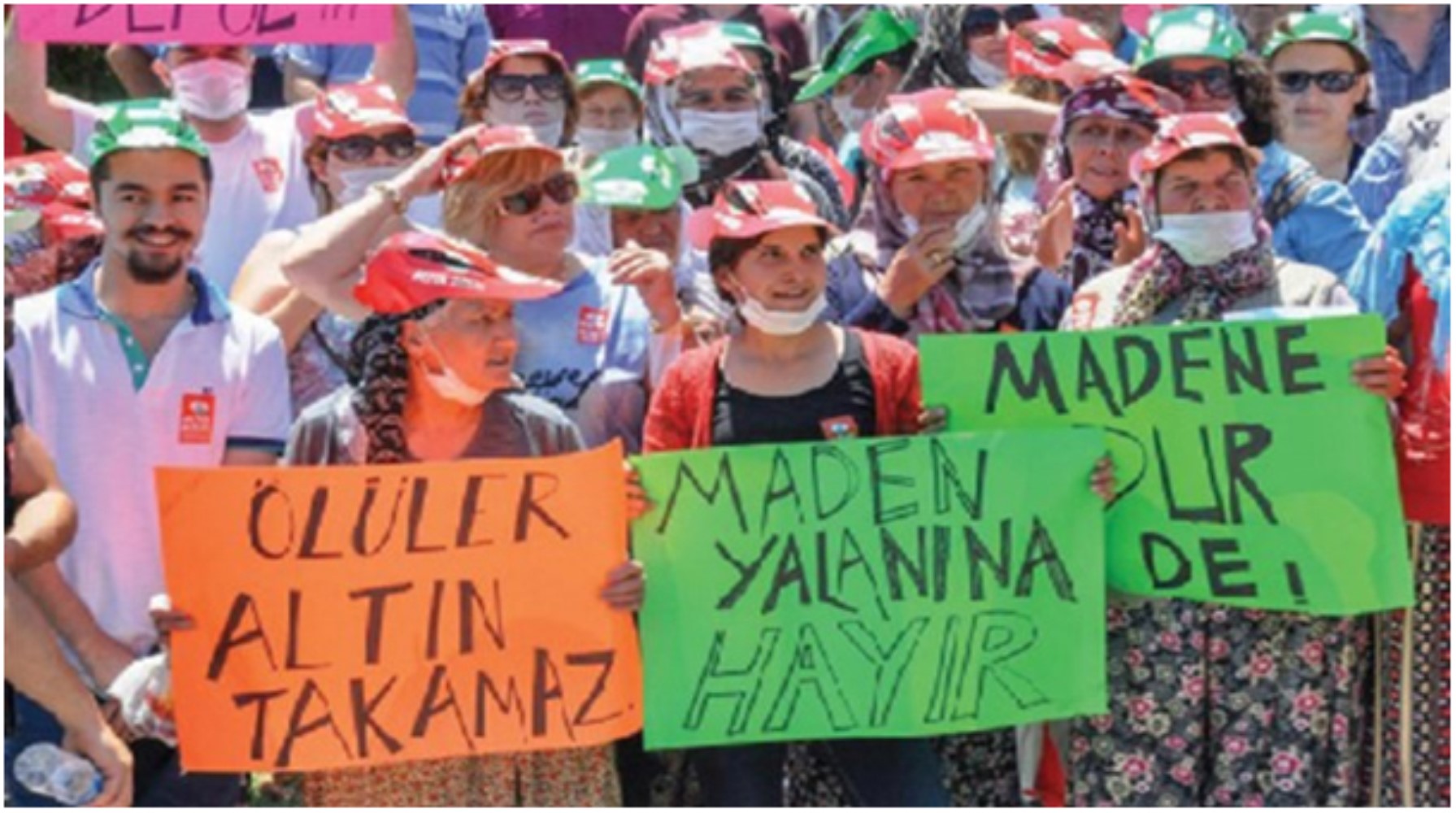
(Demonstration in Balıkesir-Burhaniye city center against the İvrindi cyanide gold mine)
As is known, with the “Mining Law” numbered 3213, accepted by the TBMM on June 4, 1985, foreign companies were invited to the country and the doors to our underground wealth were opened wide to imperialist companies.
Today, the gold mine operated by the Canadian-origin company TÜPRAG in Uşak–Eşme Kışladağ, using the open-air cyanide leaching method for ore piles, is responsible for releasing thousands of tons of toxic waste into nature.
The waste and tailings of the cyanide mine operated by the same company in İzmir–Efemçukuru are also stuffed into tunnels opened into the heart of the mountain to extract the ore.
Another Canadian company, ANAGOLD–ANACER, caused the death of 9 workers in the toxic gold mine it operates in Erzincan–İliç–Çöpler, where massive cyanide waste piles are accumulated. Its executives are still on trial.
This company has now set its sights on the “Kartaltepe” mining site, located approximately 5 kilometers away from the İliç–Çöpler Gold Mine. It is trying to extract permission from the state with intense propaganda.
May God protect the Euphrates River and its people!
The partner of this company in Turkey is “Çalık Holding.” The General Manager of this famous company was once Berat Albayrak, who later became the Minister of Energy and the Minister of Treasury and Finance.
The British–Australian joint company “Rio Tinto,” which is said to be related to the famous Rothschild family, had also made an attempt to poison the Tunceli–Munzur Mountains, which have unique nature. (https://bianet.org/haber/ovaciklilar-siyanurlu-altin-arama-istemiyor-132400)
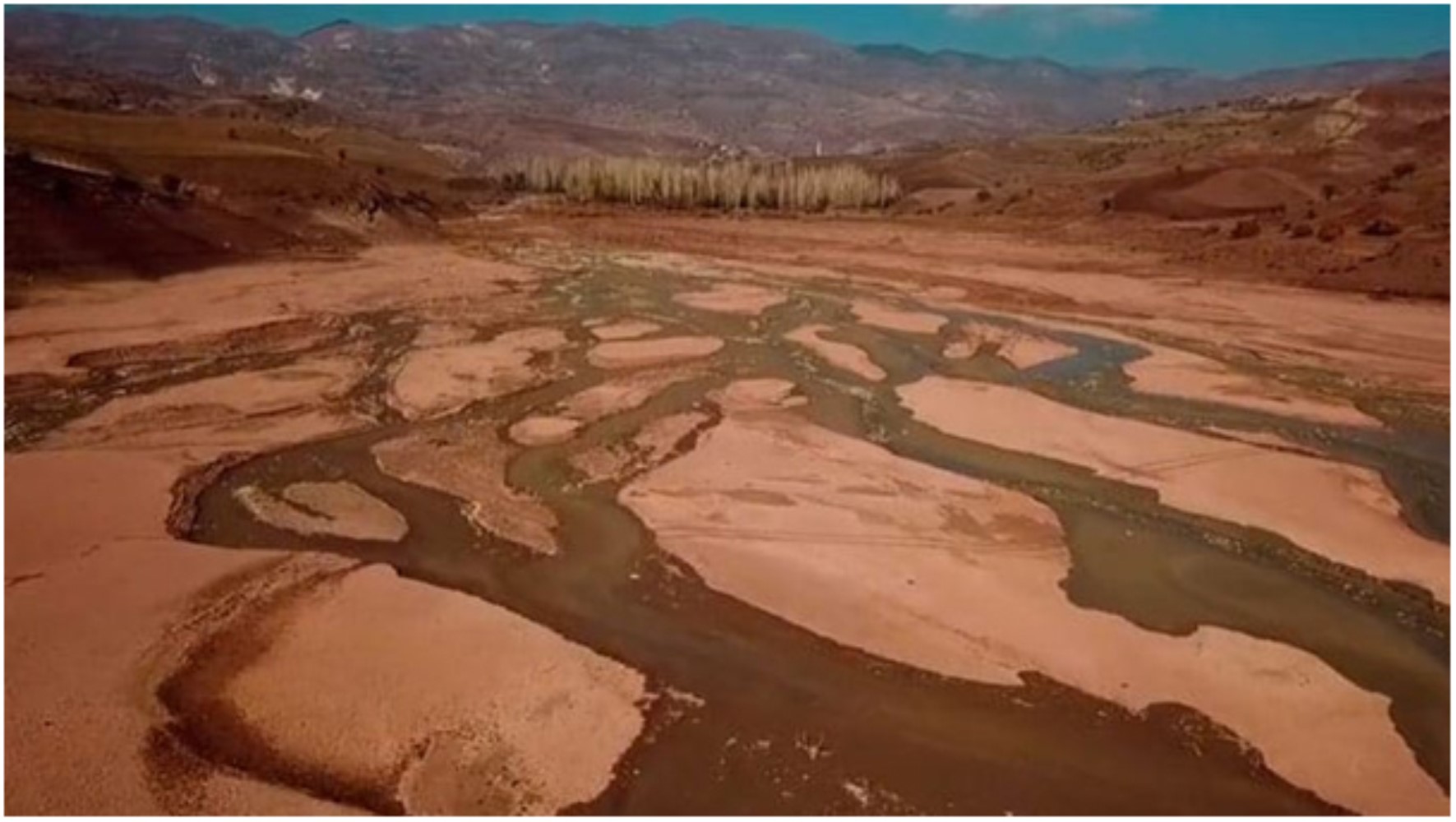
(Disaster at the Giresun-Şebinkarahisar cyanide gold mine: Poisons mix into streams as a result of the explosion of the toxic waste dam)
***
Gold prices are rising. Charts are climbing. Markets are applauding. Companies are chasing new licenses. States are calculating reserves.
But the real question still stands: Who is paying the real price of this gold?
While one ton of soil is washed with cyanide, and valleys, pastures, and water resources are put at risk for one gram of gold, it is not possible to call this development.
The profit increase seen in financial tables cannot hide the loss in nature’s balance sheet. What is presented as “national wealth” today can turn into an environmental debt that does not return tomorrow.
Gold has been a safe haven in times of crisis throughout history. But security produced with poison is not real security for society. It should not be that a few companies win and an entire geography loses.
The real issue is not how many dollars gold is—but how it is extracted and whose life it affects. A model of enrichment that puts soil, water, and air at risk is not sustainable.
Gold may have gone crazy.
We need not lose our minds.
Sefa Taşkın
Karşıyaka/İzmir
15.02.2026
Most Read

Striking picture for Özgür Özel's 'New Party'

The PKK opening and Özgür Özel’s path!..

How did the newspapers view Özgür Özel's farewell to the CHP?

He killed his wife by slitting her throat: Their children witnessed the moments

What did the CHP do?

Özel’s new party move in the world press

Fire at TUSAŞ engine factory in Eskişehir under control

The New CHP, against CEHAPE

From self-efficacy to despair

Kılıçdaroğlu's first message on Özgür Özel's new party announcement