



STONE IS HEAVY IN ITS PLACE-171. LET US NOT FORGET, LET US NOT LET BE FORGOTTEN.
There are no other regions in Anatolia whose historical artifacts have been plundered as ruthlessly as those in Bergama and Gaziantep.
Moreover, it is irrational to dig up, dismantle, and carry away the remains of a massive part of the city, such as the Altar of Zeus in Bergama.
What kind of ambition is the product of this act!
It is incomprehensible that dozens of marble friezes, which adorned and gave meaning to the massive structure measuring approximately 35*33*10 meters, were taken from Bergama to Germany 120 years ago despite the risk and danger of destruction, and were left to face the risk of disappearing many times over there.
The colonialist, imperialist Prussian/German state of the 19th century managed to do this.
Bergama architects and sculptors had adorned the edges and corners of the roof of this magnificent three-story structure with statues of gods, horses, and creatures called Griffins.
Griffins were hybrid creatures generally accepted in ancient Hellenic belief to have lion bodies and eagle heads and wings. Their claws were large enough to carry a human.
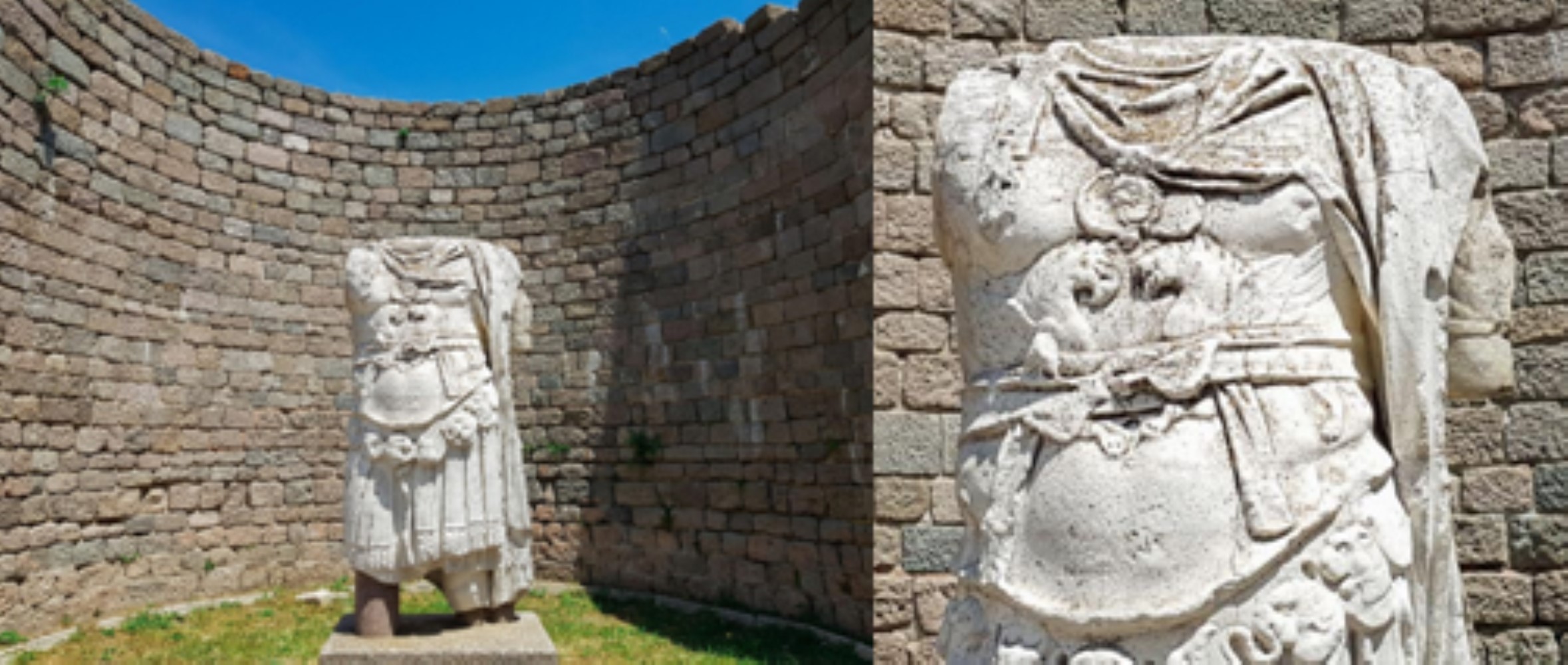
(Statue of the Roman Emperor Hadrian, found in the excavations of the Temple of Trajan, built in the 2nd century A.D. on the Bergama Acropolis, which could not be smuggled by the German smuggling network and is now still in Bergama. Protective Griffins on the armor on his chest. This means historical artifacts can also be protected in their original locations.)
They were believed to be very brave and proud.
With their lion bodies, they symbolized power and sovereignty.
With their eagle heads and wings, they were accepted as celestial authority with the ability to watch over.
For this reason, the Griffin was a powerful symbol representing the union of earth and sky.
It guarded treasures, sacred places, and gold mines.
That is why it was considered a protective entity in most cultures.
At the same time, in the statues made, they were depicted as guardians of city assets and sacred areas.
***
The Kings of Pergamon/Attalid dynasty, who built the unique Altar of Zeus, were presenting this magnificent structure not only as a religious center but also as a universal message.
According to their own understanding, they were "order-builders" and representatives of "civilization against barbarism."
The massive pictorial friezes surrounding the altar told this ideology through the war between Gods and Giants.
They represented the gods, and the giants represented the enemy.
Hybrid power symbols like the Griffin were also part of this royal-divine language of legitimacy.
In other words, this figure carried not only mythological but also political symbolic expression.
The Griffin motif was a figure widely used as an architectural ornament and threshold guardian in the art traditions of Anatolia, Ancient Egypt, Mesopotamia, Iran, and the Hellenistic world.
In temples, altars, and palaces, it was utilized as a corner element, on top of railings, or as filler between friezes.
Perhaps due to the pride they felt in creating this magnificent Altar of Zeus and because they fought courageously against their enemies, the people of Pergamon had placed statues of these interesting creatures on the roof of this magnificent structure.
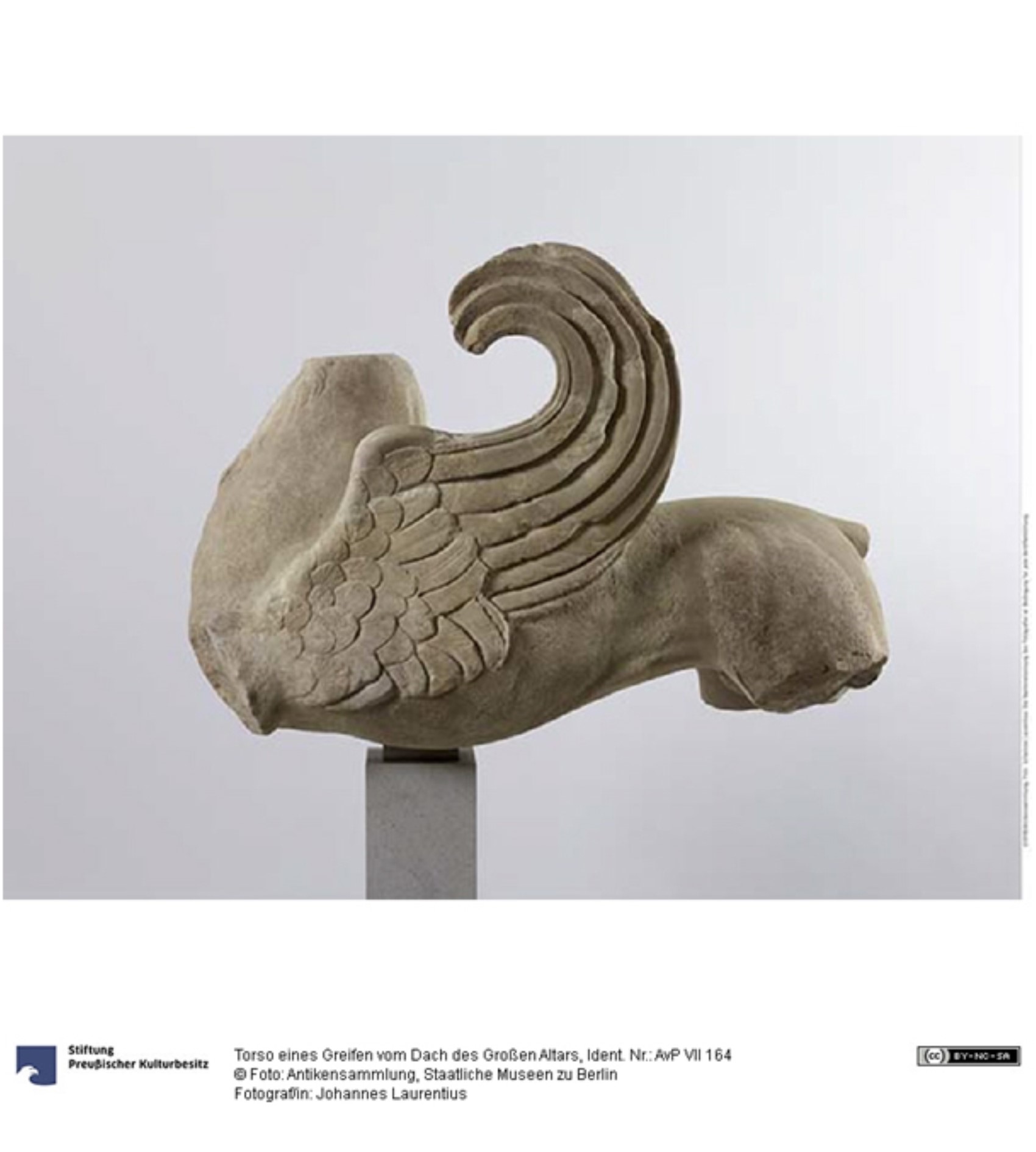
(One of the Griffin statues taken from Bergama to Berlin between 1874-1906 through smuggling and dubious permits. Now in the crumbling Berlin-Pergamon Museum/Prison.)
The marble Griffin statue, located in the Berlin Museum/Prison with the identification number "AvP VII 164," dates back to the second half of the 2nd century B.C., around 160 B.C.
Its dimensions are 132 x 51 x 110 cm.
It was found by German smugglers on the terrace where the Altar of Zeus was located.
Carl Humann and his gang dug it out from the hill/mound here before discovering the Altar.
Of course, it is not disclosed in which year or how they smuggled it.
Most likely, it was taken to Berlin with sleight of hand.
Or with dubious permits!
They still do not neglect to call this beautiful Bergama artifact "Preußischer Kulturbesitz" (Prussian Cultural Heritage).
What a shame!
***
The representation of concepts such as power, sovereignty, protection, and legitimacy by Griffin symbols lasted for centuries.
Culture does not die as long as it remains in memory and is carried!
Griffin symbols, whose origins are largely based on Eastern Mediterranean and Anatolian art, have been used very widely in European coats of arms since the Middle Ages.
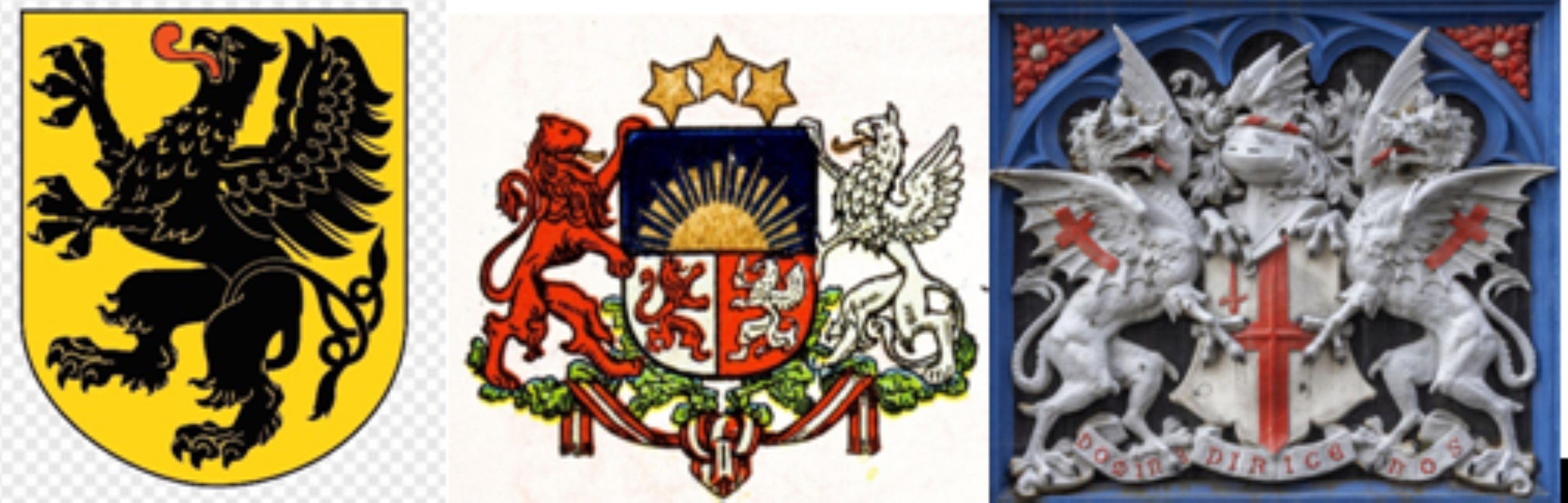
(Coats of arms with Griffins from Latvia, Pomerania (Western Poland), and London.)
It is seen that the Hellenistic art style continues in the characteristics of these coats of arms.
Over time, it spread to the European geography through the Roman Empire.
It became popular again with the Crusades and Byzantine influence.
Pergamon (Bergama) is one of the strongest centers from which the Griffin motif originates.
There is a strong iconographic link between the origins of the Griffin in European coats of arms and the Griffins in Bergama art.
However, those proud Griffins of Bergama, which connected the sky to the earth, were made to protect the magnificent Altar of Zeus and the city of Bergama; not to protect the museums of those who are alien to its nature.
These stone guardians exhibited in Berlin today actually still seem to stand at the gate of Bergama.
Because stone has a memory, and every Griffin whispers the same wish silently:
"My homeland is Anatolia, my place is Bergama."
THE ALTAR OF ZEUS AND BERGAMA ARTIFACTS DO NOT BELONG TO COLD AND FOGGY BERLIN, BUT TO BEAUTIFUL BERGAMA. THEY MUST DEFINITELY COME BACK, THEY MUST RETURN HOME.
(Bibliography: Smith William (2007): A Dictionary of Greek and Roman Biography and Mythologhy, Vol I-II-III/I. (London: B.Tauris)
… http://www.smb-digital.de/eMuseum, Database-Antikensammlung),
Sefa Taşkın
15.03.2026
Karşıyaka/İzmir
Most Read

Striking picture for Özgür Özel's 'New Party'

The PKK opening and Özgür Özel’s path!..

How did the newspapers view Özgür Özel's farewell to the CHP?

He killed his wife by slitting her throat: Their children witnessed the moments

What did the CHP do?

Özel’s new party move in the world press

The New CHP, against CEHAPE

Fire at TUSAŞ engine factory in Eskişehir under control

From self-efficacy to despair

Kılıçdaroğlu's first message on Özgür Özel's new party announcement