



A STONE IS HEAVY IN ITS PLACE-148. LET US NOT FORGET, LET US NOT LET BE FORGOTTEN
What is this masked theater, this masked smuggling?
What is this veiled lack of culture: appearing multicultural while being involved in negative activities?
The answer is in Berlin.
***
In the history of Western Anatolia, during the 3rd and 2nd centuries B.C., the city of Pergamon/Bergama was a metropolis and a capital under the rule of its wise kings.
Its lands extended from the Sea of Marmara to Antalya, and from the Aegean Sea to Eskişehir.
The Attalid dynasty, which settled in Pergamon/Bergama, ruled Western Anatolia for approximately 150 years.
Then, like the known world of that time, the Kingdom of Pergamon also fell into the hands of the Romans.
For a long time, this city served as the capital of the 'Asia Province' of the Roman Empire.
It maintained its glory.
The culture created in Pergamon left magnificent marks on humanity.
***
In those times, Pergamon/Bergama was also a city of theater.
During the Hellenistic period, there were theaters with a capacity of 15,000 on the city's Acropolis (hill city) and 3,500 at the Asklepion hospital.
When the city descended from the hill and spread to the plains during the Roman period, an amphitheater with a capacity of 50,000 and another theater with a capacity of 30,000 were built.
And many more monumental structures...
The heart of the theater beat in the Pergamon Acropolis, where culture was accumulated and passed down.
When Pergamon's savvy king, Eumenes II, built a temple next to the Acropolis Theater in the name of Dionysos Karthagemon (the Leading God)—one of their most important deities, the god of vineyards, wine, and also artists—the city transformed into a true center for theater during this period.
Moreover, Eumenes II would continue the initiative of his father, Attalus I, and complete the magnificent Altar of Zeus.
***
When the theater artists organized around the great Temple of Dionysus in Teos (Seferihisar-Izmir) were expelled from Teos on the grounds that they were making too much noise, Eumenes II invited them to Pergamon.
He had living quarters built for these artists right next to the theater stage, at the foot of the Temple of Dionysus.
King Eumenes II, who was as thoughtful and fond of art as his wife, Queen Stratonike—who made perfume from the pink grapes of the Edremit Plain (then known as Thebe)—also knew well how theater could be used for his own political interests.
Thus, masks were among the primary tools used in such theatrical plays.
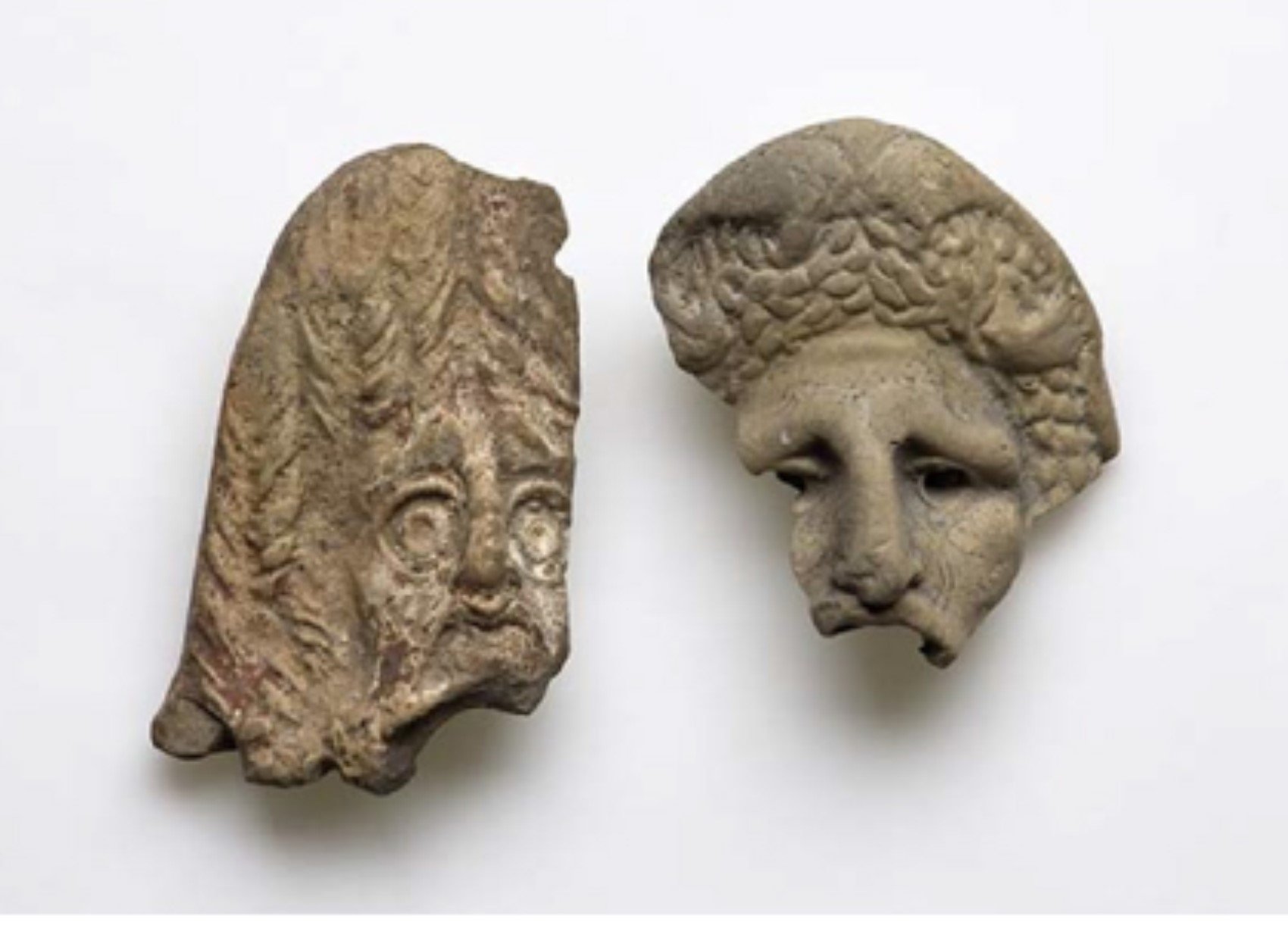
(Pergamon masks with identification number 'Ident.Nr. P- 768' in the Berlin Museum/Prison)
In prehistoric times and the early ages, humans would wear masks resembling the animals they were hunting.
They believed that by wearing them, they would attain the power of that animal.
In later ages, they were also used in wars for protection or to frighten the enemy. they used masks.
The masks used in ancient theaters allowed actors to portray multiple personalities, both male and female.
With the smiling or angry human expressions on the masks, the aim was to better reflect the actor's emotions and expressions, and for the audience to adopt these expressions as their own thoughts.
It is natural that masks, one of the most important tools of the theatrical art that began to develop in Athens in the 6th century BC, were also used in Pergamon, the brilliant city of the 3rd and 2nd centuries BC.
Among the primary traces demonstrating the love for theater in Pergamon—which possessed the world's steepest theater like the Acropolis Theater, a magnificent Temple of Dionysus, and an Artists' Union complex—are the clay masks found on the Pergamon Acropolis.
***
As is known, many historical artifacts were taken from Bergama to Berlin through smuggling between 1864 and 1878, through dubious permits until 1886, and later through blatant theft.
It is clear that the officials of German Imperialism continued this smuggling in subsequent years.
Two clay tragedy masks, which were reported in records to have been found before 1913 and have some damaged parts, are very elegant.
Their small size of 5 cm does not detract from their beauty, and the expression given to the faces and the craftsmanship are unique.
It is believed that one of these represents Heracles (Hercules), the father of Telephos, who is considered the founder of Pergamon, while the other represents a hero or an ancient king.
The large size of the eyes on one, the dull gaze of the other, and the hairstyles of both are striking.
There are traces of red paint on the clay masks. This means it is understood that the masks were originally painted.
They are dated to the 2nd or 1st century BC. To the years when the city of Pergamon was at its most brilliant.
***
Today, these interesting clay masks are unfortunately kept in Germany, in the Berlin Museum/Prison, just like the Pergamon Altar and other sculptures from Bergama.
Museum/Prison registration number: “Ident.Nr. P- 768”.
It is likely that these charming theater masks of Bergama were hidden in pockets, stolen, and smuggled out along with the Pergamon Altar and other historical artifacts taken to Berlin by Engineer Carl Humann and his gang, who were supported by the German State at the time.
Given that their discovery date is cited as 1913, it appears that a sustainable form of smuggling took place in Bergama during a period when it was prohibited.
This occurred despite the fact that the Ottoman Empire had strictly forbidden the removal of historical artifacts from the country in the Antiquities Regulations (Asarı Atika Nizamnameleri) of 1869 and 1884.
Through the hands and pressure of the German director of the Imperial Museum (Müzeyi Hümayun), Philip Anton Dethier, the 1874 Regulation was enacted, which partially allowed for the removal of historical artifacts abroad Despite the existence of a decision, Ottoman patriotic officials did not grant permission to German smugglers and prevented their departure.
Given that the Pergamon masks were reported to have been found in Pergamon in 1913, it is clear that they were among the artifacts smuggled out secretly during the period when such exports were prohibited.
Perhaps they were purchased from a thief, making the buyers complicit in the theft!
It is obvious that there is some hanky-panky going on!
European masters, who grew rapidly wealthy in the 19th century, used the culture-laden artifacts of the ancient world as a mask to cover up the lack of culture in their own pasts, and for this, they plundered Anatolia.
The German Imperialism of that time openly robbed Pergamon and many other parts of Anatolia through its officials disguised as archaeologists.
Hundreds, thousands of artifacts...
Among them were these unique theater masks, which were smuggled out through trickery and deceit, and which reflect the cultural life of Pergamon and the world's artistic heritage.
They are now far from the Pergamon/Bergama Acropolis where they were crafted and used.
Who knows how many characters they brought to life in the steep theater of Bergama's wind-swept Acropolis.
The fact that they were smuggled from Bergama, where they were made, and are now held in foreign lands in Berlin is a great shame for the world's theater artists and the world of theater.
In terms of universal rights and law, this is a crime!
It is a duty to humanity to put an end to such a shame and crime.
It is time to put a stop to this theater of smuggling that has been playing out between Bergama and Berlin for 150 years.
The veils must be lifted from the truth, and the masks of those who smuggled them must finally fall.
THE ZEUS ALTAR AND THE ARTIFACTS OF BERGAMA DO NOT BELONG IN COLD AND FOGGY BERLIN, BUT TO BEAUTIFUL BERGAMA. THEY MUST DEFINITELY BE RETURNED; THEY MUST COME HOME!
(Source: http://www.smb-digital.de/eMuseum, Database-Antikensammlung), http://www.my-favourite-planet.de/english/middle-east/turkey/pergamon/pergamon-photos-01-007.html, https://www.deutsche-digitale-bibliothek.de/item/4UJ2U6UWMTHZRTKLMTLGCPCXFPRKS2CK)
Most Read

Striking picture for Özgür Özel's 'New Party'

Özgür Özel gives a dated response regarding the number of resignations

Forest fire in Antalya brought under control

The PKK opening and Özgür Özel’s path!..
Houthis strike Saudi-owned tanker

How did the newspapers view Özgür Özel's farewell to the CHP?

What did the CHP do?

Özel’s new party move in the world press

The New CHP, against CEHAPE

From self-efficacy to despair