



The word "muhtar," which has passed into our language from Arabic, means "chosen person," and as Nazım Hikmet said:
"Everyone is a muhtar (free) to say what they wish,"
it also means "autonomous, free":
Provided, of course, that the person is not under heavy political and social pressure!
On the other hand, the office of the Muhtar is the smallest administrative unit of the Republic of Turkey in city neighborhoods and villages.
They are people elected directly by the public, along with their council of elders or members.
They can be members of a political party, but they cannot be nominated by a party.
At the same time, they are direct representatives of the people.
They have high prestige among the public.
They are people known, loved, and respected by everyone.
The Muhtar system, which is the smallest social/political unit managed by people directly elected by the public, does not exist in any other country in the world.
It is unique to Turkey.
***
The Muhtar system was effectively established in the Ottoman Empire by Sultan Mahmud II in 1829, after the abolition of the Janissary Corps, to fill the security vacuum that could arise at the local level.
Legal regulations were also made in 1864 and 1876.
With the practices sometimes continuing and sometimes stopping, the Muhtar system took its current form in the Republican era with the Village Law enacted in 1924, followed by the regulation issued in 1945. This situation was legalized on 05.04.2004.
****
In our country, Muhtars, who fulfill the duties assigned to them by the State, are of two types: Village Muhtars and Neighborhood Muhtars.
Village Muhtars possess legal personality regarding the village's assets and property.
They carry out and manage the common affairs of the village, which are to be done either ex officio or through the collective labor method (imece), by the hands of the Muhtar and the council of elders.
The majority of Muhtars and the members of the council of elders who assist them come to office through elections.
Public officials such as teachers and imams are also natural members of the councils of elders.
The members of the councils of elders come to office through elections in a number determined according to the population.
Neighborhood Muhtars in cities, on the other hand, carry out the duties assigned to them by law by the State in their regions.
However, as they do not have property, they can only solve the actual problems of their neighborhoods through municipalities and can only follow up on this.
They are almost dysfunctional.
Municipalities do not ask them much either!
With the Metropolitan Law enacted in 2012 and the regulations made in 2014, villages in districts within the boundaries of Metropolitan Municipalities were converted into neighborhoods, and their legal personalities were abolished.
In other words, all villages within Metropolitan Municipalities became neighborhoods of the districts they are attached to, and apart from the State duties they are obligated to perform, the actual affairs of their villages were transferred to District and Metropolitan Municipalities.
With these practices, a monthly salary was tied to the muhtars of all villages and neighborhoods. Later, this allowance was increased to the level of the Minimum Wage.
According to the 2019 elections, a total of 50,249 muhtars are serving in our country, including 31,912 neighborhood and 18,337 village muhtars.
Of these 50,249 muhtars, a total of 640 are women, 593 in neighborhoods and 47 in villages.
This is a great potential for developing democracy and creating a participatory democracy!
Of course, if the rule of the people is truly desired!
***
As can be seen, the "Muhtar institution," which has a 180-year history in our lands, is a legal formation that is the smallest unit of the State in villages and cities, but which the public elects and assigns to duty directly.
Although different responsibilities have been loaded onto them over time, they have almost never been made direct decision-makers and have not had a budget.
Although they were quite functional at the beginning, they remained a supportive, observer subsidiary of the Central State in the process.
Although they are invited to general "consultative" meetings of institutions such as the Governorate, District Governorship, and Municipality, their position has not gone beyond conveying problems, conveying the State information given to the public, and conveying the complaints of the public to higher authorities.
For this reason, the situations of individuals "becoming a Muhtar" or "being elected as a muhtar" have moved away from being attractive among the public over time.
***
However, the Muhtar office is a unique institution that provides opportunities for democratic practices and making the right decisions for the city and society.
Ensuring that Muhtars, who are in daily and one-on-one contact with the public, participate in decision-making processes can pave the way for correctly determining priorities in practices, increasing their benefits, and using resources more appropriately.
Citizens who cannot find the opportunity to reach high-level officials of the State can be ensured to reach the State in the shortest way through the presence of Muhtars.
In the eyes of the citizen, the State is an effective decision-maker and implementer for the solution of their problems.
For problems to be solved, the State needs to know them and allocate resources.
Since the Muhtar office is an elected element of the State, the State is actually as close to the citizen as it can reach out through muhtars.
The Muhtar is also someone the citizen directly elects, and because there is an opportunity to reach them very easily, the State can also become citizen-friendly through the Muhtar.
Their decisions can be the voice of the people rather than being prescriptive.
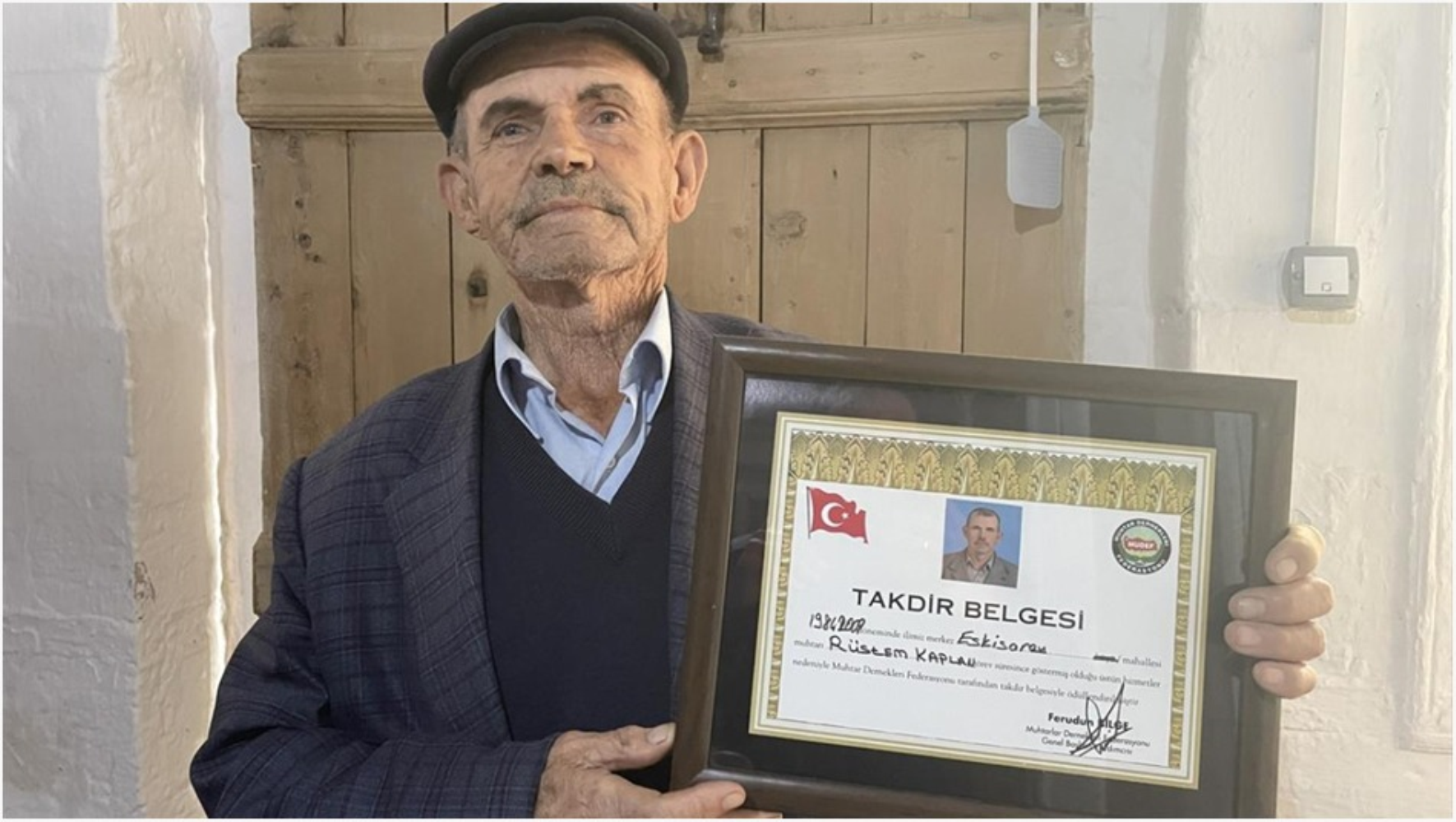
(Rüstem Kaplan, Muhtar of Niğde Eskisaray Neighborhood)
***
Thus, Village and Neighborhood Muhtars provide unique opportunities for the urgent and easy resolution of local and regional problems.
In the environment we live in, where the current political power governing the country and even some opposition parties are not very willing for democracy to take root and spread, the existence of Muhtars is an asset.
Especially in recent years, the provision of an individual monthly salary/allowance to Muhtars, and this being at a level like the minimum wage, is creating a new situation.
Offering an additional income to people, most of whom are retired and make a living with their own businesses, when they become Muhtars in return for their effort and time, makes the Muhtar office a center of attraction for citizens.
The fact that an unprecedented number of candidates applied and competed for the Muhtar position in the last elections created an interesting democratic environment in villages and neighborhoods.
Even if it is said that this willingness has increased because there is money at the end of it, and even if there is a grain of truth in this, the fact that those who aspire to be a Muhtar go door to door asking for votes and concretely introducing themselves is a gain for democracy.
The fact that the voter can touch the person they will give authority to, evaluate the candidates by comparing them, know that they will be in front of their eyes after electing them, and make their choices according to these are very positive democratic phenomena.
****
There is no other way for the progress of societies than democracy.
For democracy to be realized, it is necessary for the public not only to vote but also to participate in the administration.
The opportunities provided by technology, easy access to information; the diversification of methods of choosing between candidates and parties with public opinion polls, the internet, and the opportunity to vote at home almost force this phenomenon.
Otherwise, a democracy without "participation" can turn into a crooked form of government, no matter how well-intentioned one may be.
Instead of the rule of the people, it can evolve into the rule of "single men" or "oligarchies."
No matter how much one tries to fix a stagnant democracy, it cannot fully fulfill or meet the interests and expectations of society.
The democratic form of government of the coming and future days that will meet the welfare and freedom demands of societies can be none other than "Participatory Democracy."
***
Village and Neighborhood Muhtars are very important institutions for democracy to be strengthened by "Participation."
Instead of harboring anti-democratic views such as closing them down or reducing their powers, Muhtars should be valued even more, their powers should be increased, and they should be given a budget.
Legal regulations should be made for them to be in a decision-making and implementing position within Municipalities and District Governorships.
The last local elections have shown how willing citizens are for the Muhtar position, with the attractiveness of the salary given to this office, even if it is small, in the country's economic crisis environment.
In this context, a "Muhtar" should be "truly free" within the State hierarchy in a way that befits their name.
They should participate in the administration effectively, not just for show.
Democracy starts from the grassroots.
Otherwise, only the people who make up the "narrow cadres" or "oligarchies" change!
Otherwise, one "single man" leaves and a new one comes in its place!
Sefa Taşkın
10.05.2024
Karşıyaka-İzmir
Most Read

Striking picture for Özgür Özel's 'New Party'

The PKK opening and Özgür Özel’s path!..

How did the newspapers view Özgür Özel's farewell to the CHP?

He killed his wife by slitting her throat: Their children witnessed the moments

What did the CHP do?

Özel’s new party move in the world press

The New CHP, against CEHAPE

Fire at TUSAŞ engine factory in Eskişehir under control

From self-efficacy to despair

Kılıçdaroğlu's first message on Özgür Özel's new party announcement