



(Continued from New Imperialism-1)
In the historical period we are currently in, the immense developments in technology, the transformations in productive forces, and the deep-seated changes in politics make it increasingly difficult to grasp the world.
In our previously published article titled "New Imperialism-1," we outlined the conceptual framework. Now, we are looking at the most concrete and controversial example of this framework.
There is a concept you will encounter frequently in this article: the algorithm.
Let us define it briefly: an algorithm is a set of mathematical rules that produce data-driven decisions.
It is an invisible decision-making machine that determines which news you see, which advertisement appears before you, and even who is targeted.
Today, the algorithm is not just a technical tool; it is power itself.
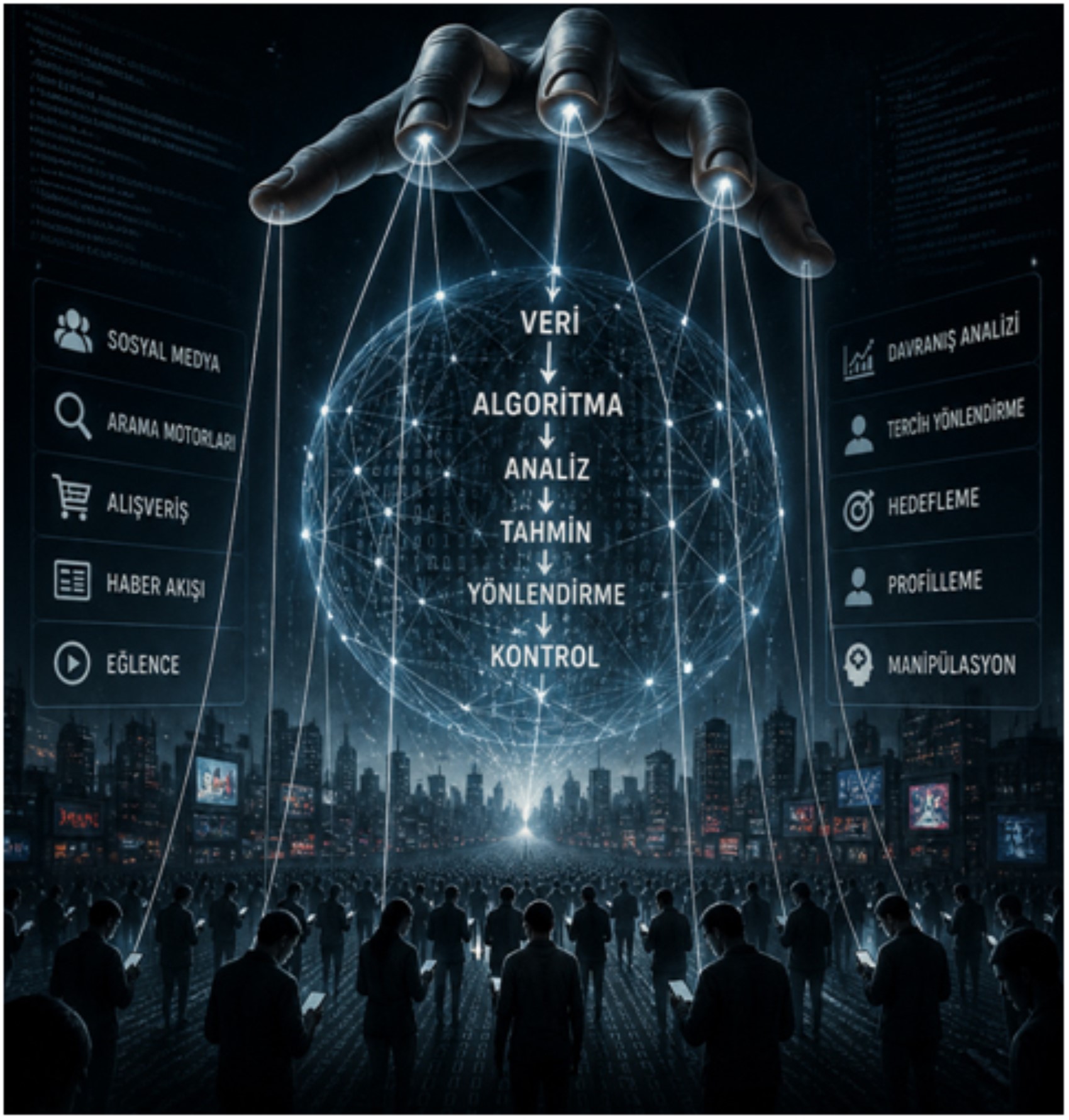
(Digital decision chain)
***
To understand where this power is heading, one must first ask the right question.
Quo Vadis? Where is the world going?
This question takes its name from the novel "Quo Vadis" by Polish author Henryk Sienkiewicz.
Born from the conflict between the absolute power of Rome and the resistance of faith, this question is being asked again today.
But this time, the answer is not sought in the maps of empires, but in the invisible world built by data and algorithms.
Once upon a time, power was measured by land. Then by steel, then by oil, then by money.
Today, however, power is measured by data.
And data is no longer just information—it is power itself.
Who develops the technology, who finances it, and who it serves—that is the real question.

***
Capitalism, built on the exploitation of labor, monopolized at the beginning of the last century by combining industrial and financial power; with its outward-expanding capital and the military power protecting it, it created the structure we call "imperialism."
In the second half of the century, monopoly capitalism, which used technological developments for its own benefit, grew and grew; it transformed into a global power through capital integrations.
With the leap in the fields of informatics, artificial intelligence, and robotics, this power gained a new dimension: capitalism also became digital.
The algorithmic power order added digital exploitation to physical labor exploitation. The monopoly structure turned into digital network monopolies, and the export of capital turned into the export of data and algorithms.
Labor did not remain outside this transformation either: it spilled from the factory and the field to the screen, to social media. A human is no longer just a producer, but also a laborer who leaves behind data.
In this new order, while dependence on digital platforms, data infrastructures, and algorithmic systems increases, market logic does not disappear; on the contrary, a new control layer operating with data and algorithms is added on top of it.
"Techno-feudalism" describes exactly this: that the system is not just a competitive market, but a relationship of dependence established through access and data.
This situation shows that digital capitalism has gained a new "imperial" form in the age of data, intensifying and harboring feudal tendencies within itself.
As a result, power is concentrated in the hands of those who control data and decision-making processes beyond the means of production.
***
The famous scene from the 1968 science fiction film "2001: A Space Odyssey," directed by American filmmaker Stanley Kubrick, carries a metaphor about the "human condition."
In the "Dawn of Man" section of the film: A primitive human (actually a pre-human hominid) picks up a bone, uses it as a weapon/tool for the first time, kills a rival, and throws the bone into the air in triumph.
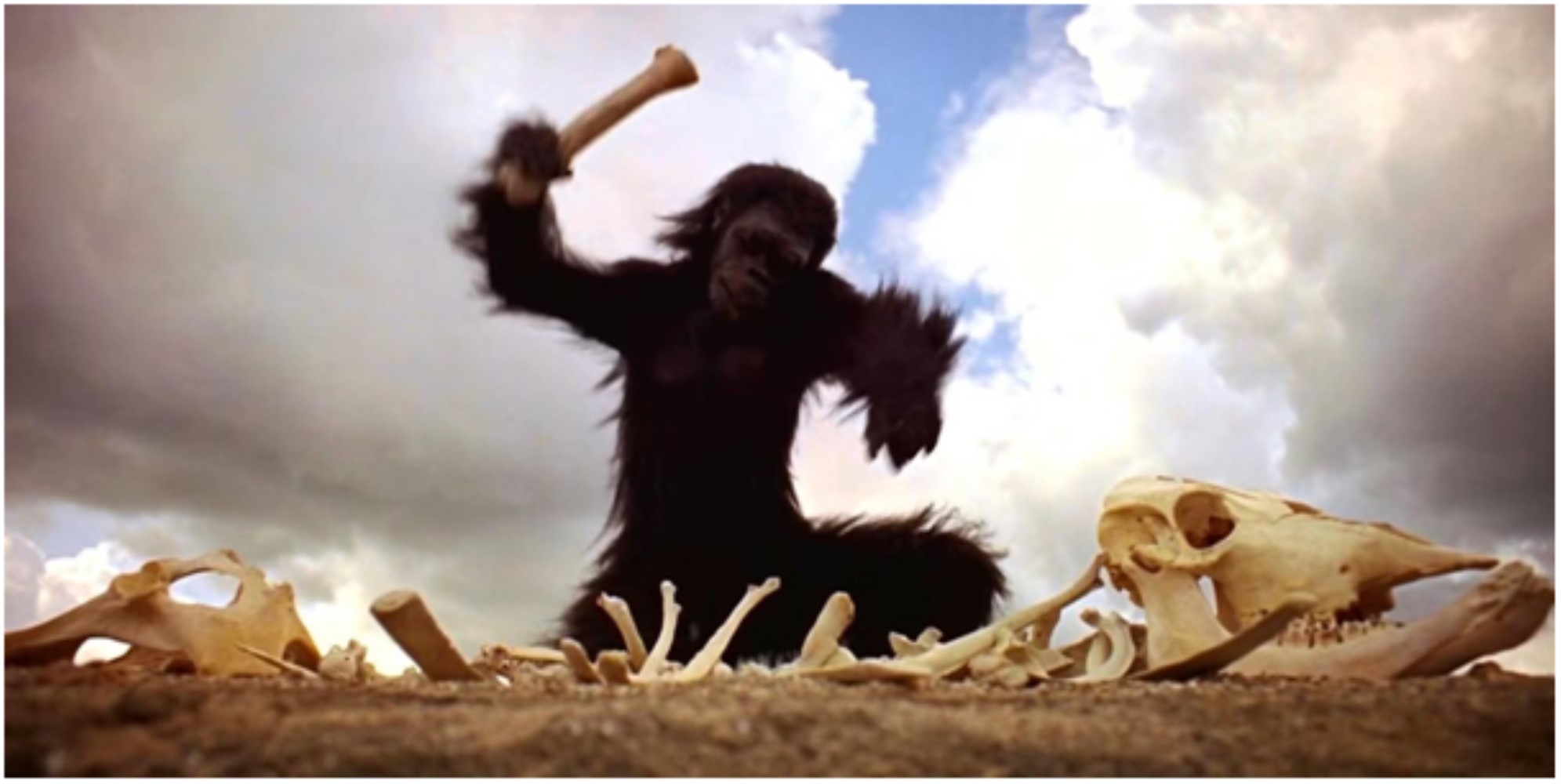
(A hominid-humanoid ape with a piece of bone as a weapon, according to Kubrick)
And then comes one of the most famous scenes in cinema history: As the bone spins in the air, the scene changes: it transforms into a satellite spinning in space with the same motion. A single cut, four million years.
With this scene, Kubrick explains this: The bone is the first weapon, the satellite is modern technology—the instrument of violence in human hands has only changed form. The bone has left its place to metal and the algorithm.
But the bond humans have established with violence, the desire to seize power, and the fear of losing it have remained the same.
That is why war is not a deviation that falls outside of history; it is a phenomenon that accompanies the social story of humanity, shaped within the tools and conditions that change over time.
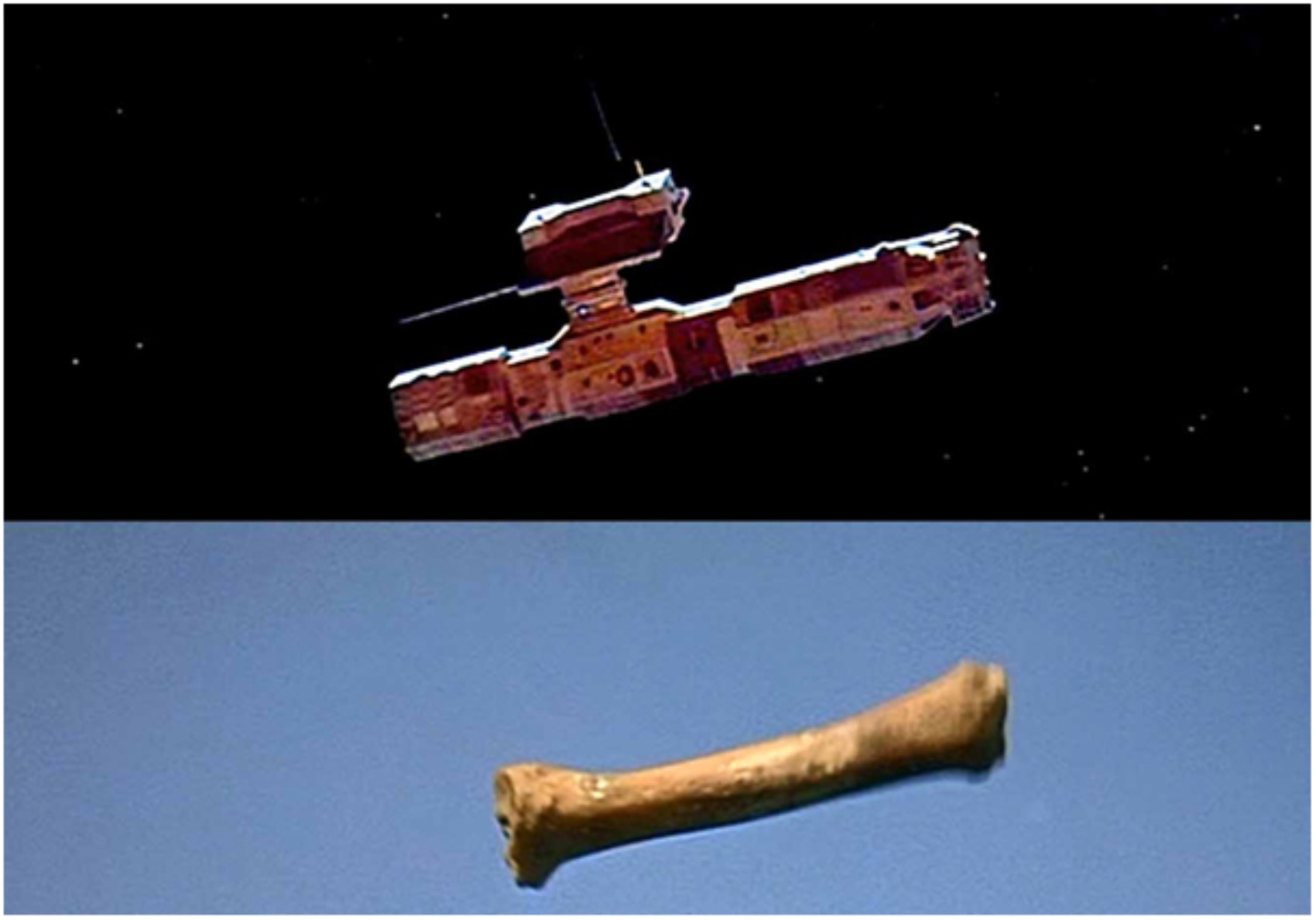
(The first weapon is a bone - the last weapon is a satellite in space, according to Kubrick)
***
War means killing people.
And killing is a phenomenon contrary to life.
Why does a human, who is a social being, attempt to destroy their own kind when they can only exist together and in solidarity?
There is no single cause for wars; they are usually seen as a result of multiple factors overlapping.
Economic pressures, protecting and securing spheres of influence, and security fears were the causes of the first wars.
Later, political and ideological factors came into play.
In the last century, the crises of capitalism, imperial market competition, and the struggle for division became one of the important causes of wars.
The fact that war becomes possible is also a factor.
New weapons, logistical capabilities, and technological superiority make the decision for war more "feasible."
Today, the nature of war has changed. It is no longer just tanks and rifles; data, algorithms, and the cyber domain are also part of the war.
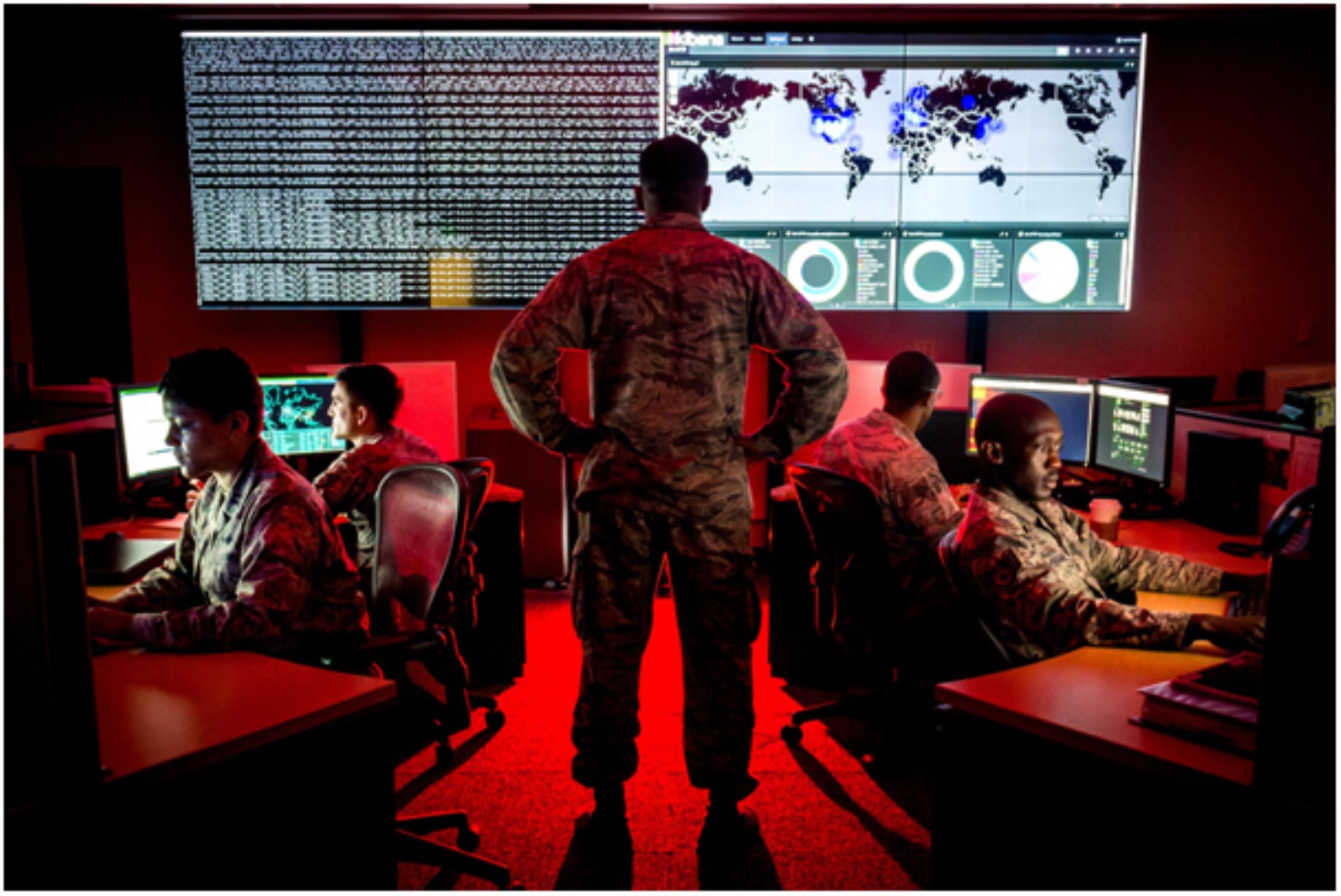
(US Armed Forces' use of artificial intelligence)
***
Our age is the age of algorithms that teach machines not what to do, but how to do it.
The person who writes the algorithms is a human with a certain quality, belief, and social position—or one directed by a social power.
Now, the machine also writes the algorithm; but it is still the human who decides what that algorithm will serve.
For this reason, every algorithm is not just a technical tool; it is a preference, a priority, and a worldview.
That preference is no longer hidden: Technology is not neutral; it is in the service of a new civilization being born, of specific interests.
***
The world's first war industry companies emerged after the industrial revolution.
Initially, arms manufacturers like Krupp in Germany, Colt and Remington in the USA, and Vickers in England were joined over time by chemical and steel companies like IG Farben and DuPont, as well as financial and technology organizations.
Today's global defense system was built on these early examples.
What emerged was not just arms production; it was the cooperation established by the state, industry, finance, and technology on this scale for the first time in history.
In his farewell address in 1961, US President Dwight D. Eisenhower pointed to the risks of this union: "We must guard against the dangerous effect of the close relationship between the state and the arms industry on democracy," he said.
Giant structures we know today, such as the US-based Lockheed Martin, Raytheon Technologies, Northrop Grumman, and the British BAE Systems, whose roots extend to before or during World War II; today produce aircraft, missiles, radars, satellites, and heavy military systems and enter into large-scale contracts directly with states.
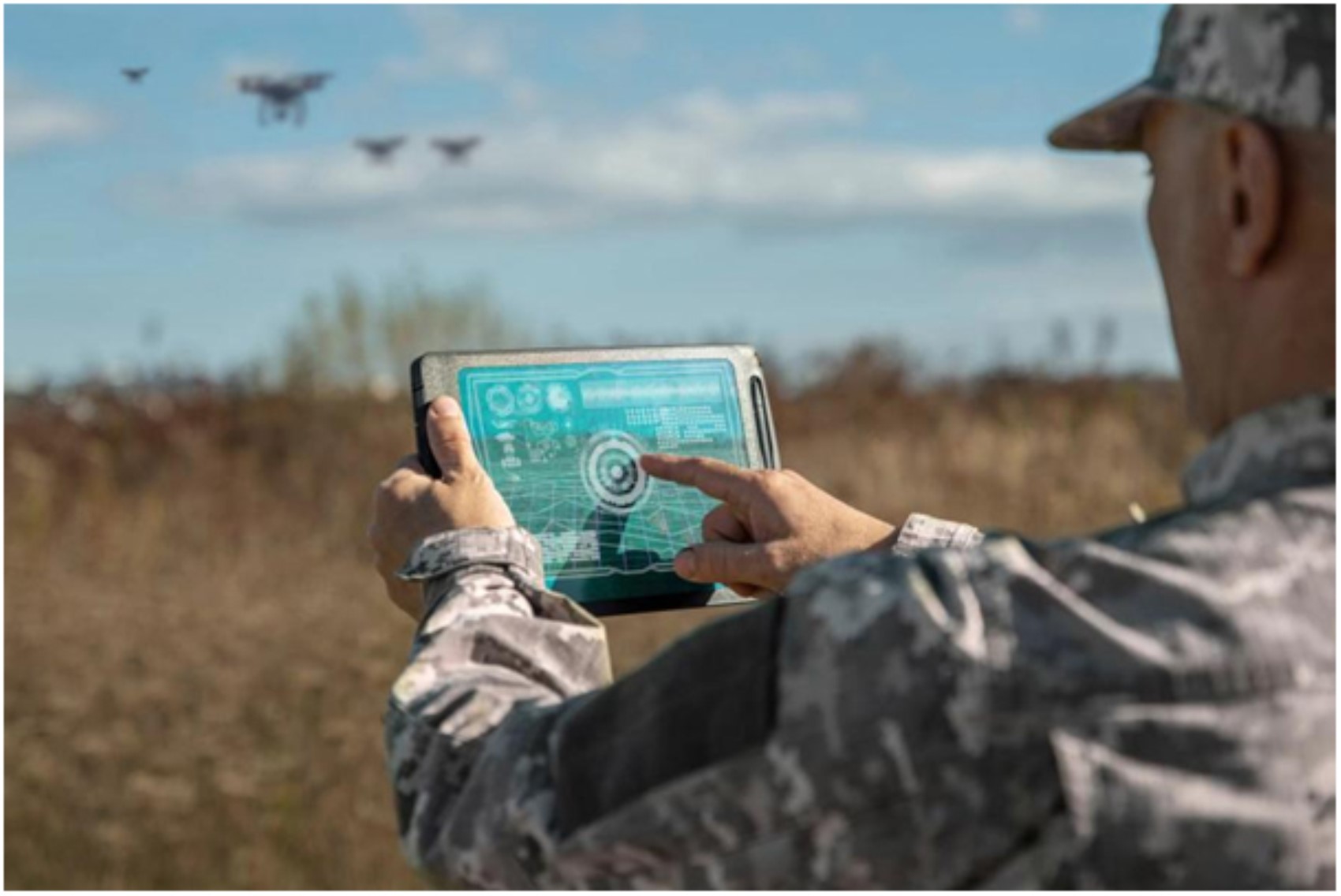
(Use of algorithms in war)
***
In the context of transforming production relations in our age, the rise of "digital capitalism," which also includes techno-feudalism, and the encirclement of the world by "new imperialism" bring a new generation of war concepts to the agenda.
New kings and emperors conduct war with data, software, and artificial intelligence.
American companies such as Palantir Technologies, Anduril Industries, and SpaceX, which provides military communication via Starlink; form the core of the new universe called "algorithmic war" with data-driven battlefield management, target detection, intelligence analysis, and autonomous systems.
Although BlackRock and Vanguard Group do not produce weapons directly, they are major shareholders of defense companies; they create indirect influence by directing capital flow.
Microsoft, Amazon's cloud infrastructure, and Google's artificial intelligence and data analysis systems provide the background infrastructure for modern armies.
All of these are technology giants.
Their owners or managers are also the new kings, the new emperors.
Those who decide on war and those who provide the tools for war are now the same people.
Wars that were fought with cannons, rifles, and tanks in the past are today using data, algorithms, networks, finance, and classical military power as weapons.
The war industry is no longer just factories that produce; it is a system consisting of software that produces decisions, funds that direct capital, and networks that provide communication.
(Data centers and algorithms)
***
While the "military-industrial complex" grew through companies in the West, the process followed a different but similar path in the East.
There were no private companies in the Soviet Union; tanks, missiles, nuclear weapons, space technology—all were produced through state planning.
The system collapsed in 1991, but this capacity did not disappear; it continued to live under state control within giant holdings like Rostec and Almaz-Antey.
China tried a different path: it opened the economy to the market, kept the defense industry under the state. AVIC, NORINCO, and CASC are the main actors in this field.
China, which is rising rapidly in the fields of artificial intelligence, drones, and cyber warfare today, is pursuing a "fusion" policy (combining civil and military technology in one hand) between its civilian technology companies and the military field.
The model is no longer limited to these three major states.
"The state directs, companies produce, technology is fed by external partnerships"—this formula is valid in most countries.
In Turkey, Baykar, ASELSAN, Roketsan, and Turkish Aerospace Industries have provided successful examples of this model in the last twenty years.
Global visibility was gained with the Bayraktar TB2; 5th-generation fighter jet projects like KAAN are being carried out.
Similar works are seen in Europe, India, Israel, and even Iran. Weapons are no longer the monopoly of only the great powers. This multiplies the danger of the equation.
***
For the digital bourgeoisie, technology is a profit tool; for the working classes, it is merely a condition for living better.
The data-based algorithmic world puts users in this position: you constantly offer labor, data, and behavior to platforms like Facebook, Instagram, and X; in return, you do not get any real ownership or control rights.
Capital, on the other hand, gets stronger as it is empowered by technology; it produces new kings, new emperors from within itself.
This system, which wraps the whole world like an octopus with its arms, also gives imperialism a new form with the possibilities of cognitive applications.
Technology is for the benefit of humanity, it is neutral, it is shaped in the hands of the user—this fairy tale no longer holds up.
War means the death of people, the destruction of decades of labor.
And this destruction is left to the mercy of technology growing in the arms of unlimited power and the new imperialism that possesses it.
The disasters that the new imperialism, which holds this great power, is preparing for humanity are no longer hidden; they are voiced loudly by the spokespeople of the new imperialism and the suppliers of war materials themselves.
***
In this new environment, the role of informatics in the fields of economy, politics, and war is being discussed more intensely.
At the center of these discussions is the US-based Palantir Technologies; an advanced software company that develops data-based decision systems for states and large institutions.
The company's CEO, Alex Karp, published the book "The Technological Republic: Hard Power, Soft Belief, and the Future of the West," which he wrote with Nicholas Zamiska, on February 18, 2025.
The book attracted attention; but the real echo was created by the 22-point summary text published on the company's X account on April 19, 2026.
The US-Venezuela tension that occurred shortly after the publication of this book; and the style and violence of the subsequent Israel-Palestine, US+Israel-Iran, Israel-Lebanon, and Ukraine-Russia wars revealed the role of algorithms in war.
The recklessness of US, Israeli, and Russian leaders made Karp's theses a key to understanding today.
Humanity was struggling to grasp the conditions in which situations that had never been experienced before were emerging and it was understood that this would go even further.
Such a war, a period where informatics and communication affect life to this extent, had not been seen before.
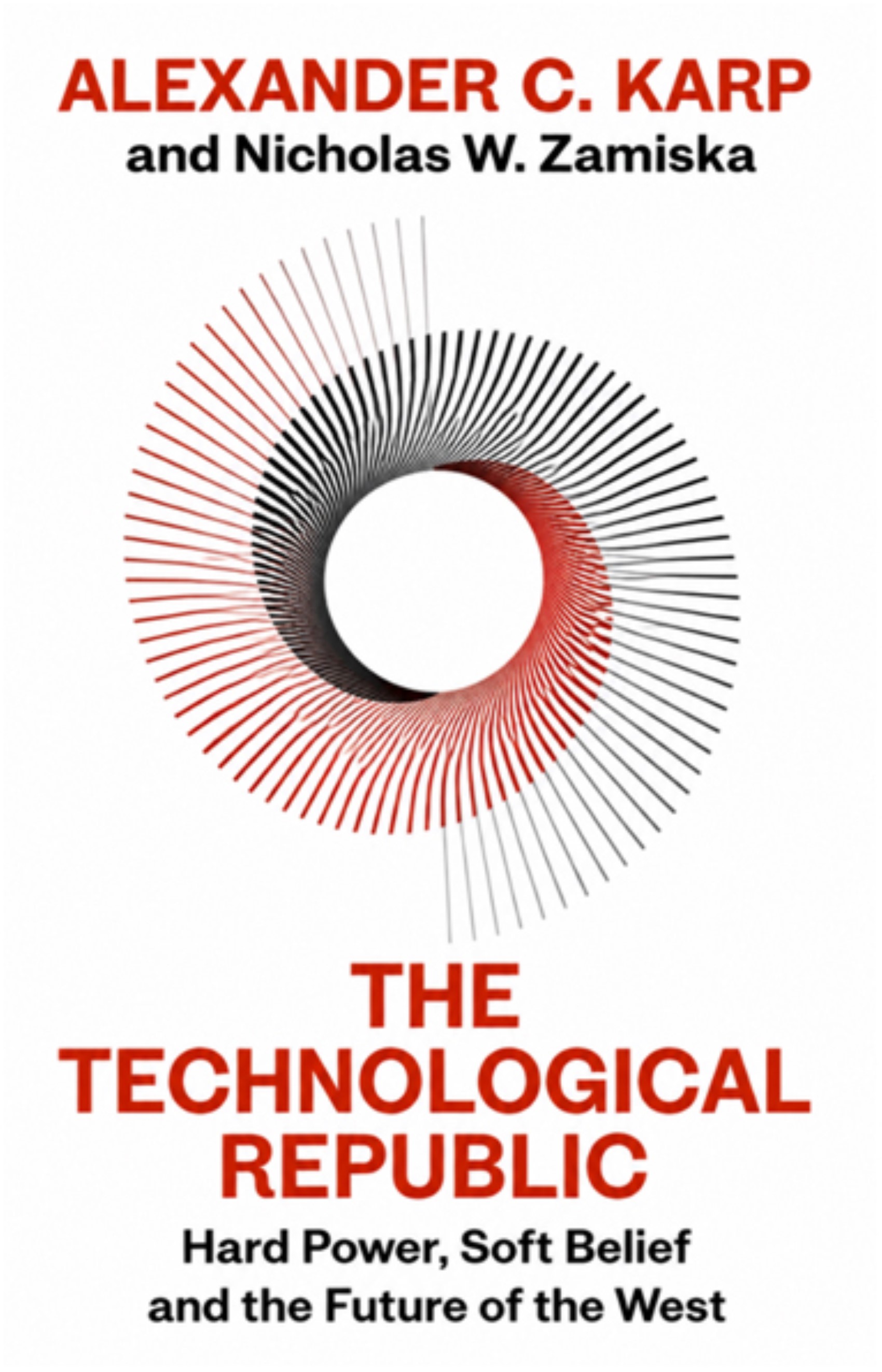
(The cover of Alex Karp's controversial book "The Technological Republic")
***
What was this Palantir?
Who were its owners, its managers; what were they aiming for?
Palantir Technologies was founded in 2004 by Peter Thiel and Alex Karp.
Thiel was an entrepreneur-investor who was born in Frankfurt, Germany, in 1967, moved to the USA at a young age, and studied philosophy and law at Stanford University.
Karp, on the other hand, was an academic born in New York in 1967, who received his undergraduate degree at Haverford College and his doctorate in social theory and philosophy at Goethe University in Germany.
These two different intellectual backgrounds intersected in the early 2000s and were institutionalized with the founding of Palantir in 2004.
The mental basis of the partnership is based on PayPal, which Thiel founded in 1998.
The goal was simple: to digitize money to establish a global payment network as an alternative to banks, to turn finance into software. Thiel sold PayPal to the global e-commerce giant eBay in 2002.
With Palantir, this vision expanded and deepened. The processing, analysis, and use of data in the security, intelligence, and war decision-making processes of states became the goal.
While Thiel represented capital and strategic direction, Karp provided this structure with an ideological framework and management.
This is how the transition from a venture that transforms financial flows to a global power that influences data flows and geopolitical decision-making mechanisms was achieved.
(Palantir's logo)
***
The new forms of power that emerged with the rise of artificial intelligence technologies coincide with the definition of new imperialism.
Karp's work creates a new framework around the security-freedom balance, the relationship of technology companies with the state, the concept of techno-bourgeoisie, and "techno-fascism" discussions.
The fact that artificial intelligence is not just a technical tool, but also an ideological and geopolitical power element, is now becoming a reality of our day.
This reality is further concretized by the financial and ideological support Thiel gives directly to political actors.
A pessimistic picture—but the appearance is becoming increasingly clear.
***
In the first quarter of the 21st century, artificial intelligence technologies began to transform political decision-making processes by going beyond economic means of production.
This transformation becomes visible through the relationships that companies developing big data analysis and security applications establish with states.
Palantir Technologies is the most striking example of this transformation.
Even the company's name gives away this function: "Palantir" is the magical ancient sphere in J.R.R. Tolkien's Lord of the Rings universe used to see distant distances and communicate.
The company claims to see the invisible through data and to predict the future.
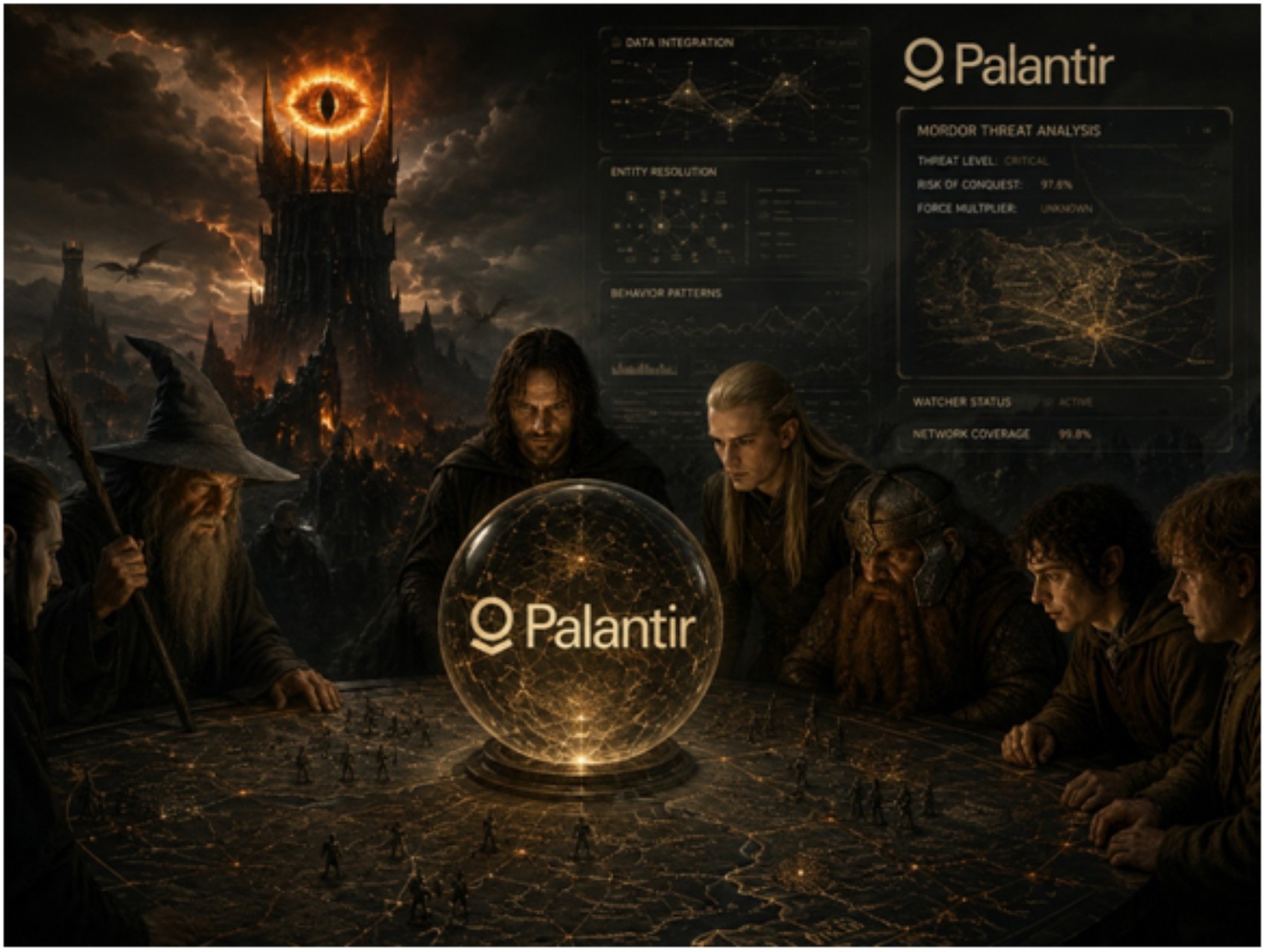
(Palantir in Tolkien's Lord of the Rings universe — the magical sphere that sees the invisible. Palantir Technologies took its name from here: the claim to see everything, to analyze everything through data. Artificial intelligence-generated image)
***
According to Karp, one of the ideologues of the new imperialism, technology is not neutral; it should be positioned in the service of Western capitalism and a specific political order.
The classical liberal approach defines technology as a neutral tool.
This view is becoming indefensible.
Karp's approach is the radical expression of this questioning: The US technology hub, Silicon Valley in California, bears responsibility to the national interests to which it owes its rise and must play an active role in the field of defense and security.
Thiel did not leave this view in discourse; he put it into practice. He openly supported Trump in the 2016 presidential election and gave a speech at the Republican National Convention.
In the 2022 elections, he provided approximately 10 million dollars in support to J. D. Vance, who would later become the US Vice President.
The support given to Blake Masters afterward also shows the continuity of this model. The technology elite no longer just influence political cadres; they create them directly.
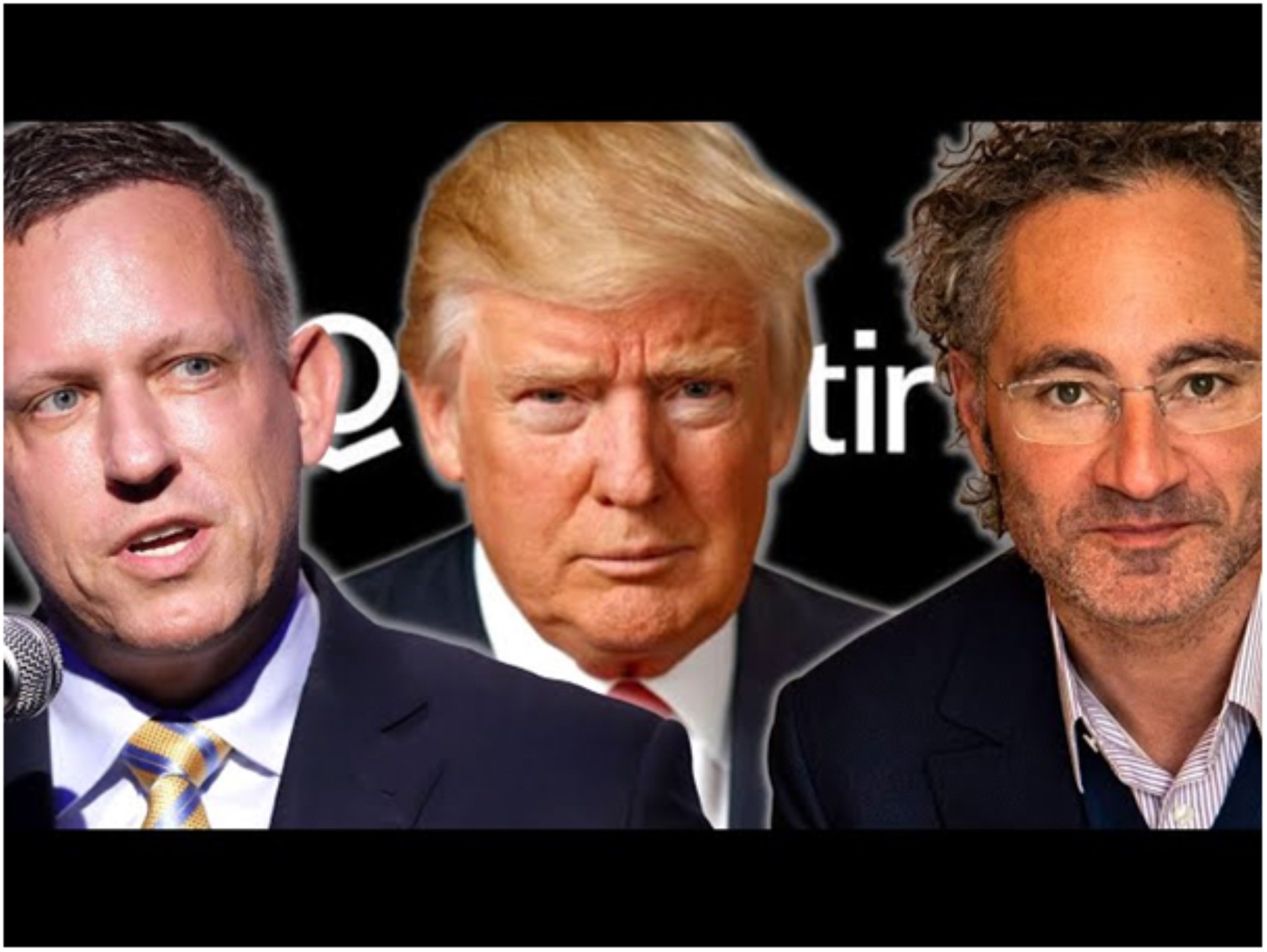
(Peter Thiel, Donald Trump, and Alex Karp. New Emperors)
***
Thiel's defense of state-technology cooperation explains why Palantir is not an ordinary company. Technology is ceasing to be an economic commodity and is becoming a strategic and ideological tool.
This situation is different from the indirect political influence of the classical bourgeoisie through economic power.
The same actors both finance political representatives and produce war technologies.
This is the digital-age equivalent of the finance capital-state integration discussed at the beginning of the last century.
The concentration, monopolization, and export of capital emphasized in the classical definition of imperialism are being reproduced today through data and algorithm monopolies.
The most concrete example of this bond is the relationship Palantir established with the Israeli army. It is known that after 2024, the company established a "strategic partnership" with the Israeli Ministry of Defense and provided intelligence, target identification, and data analysis services.
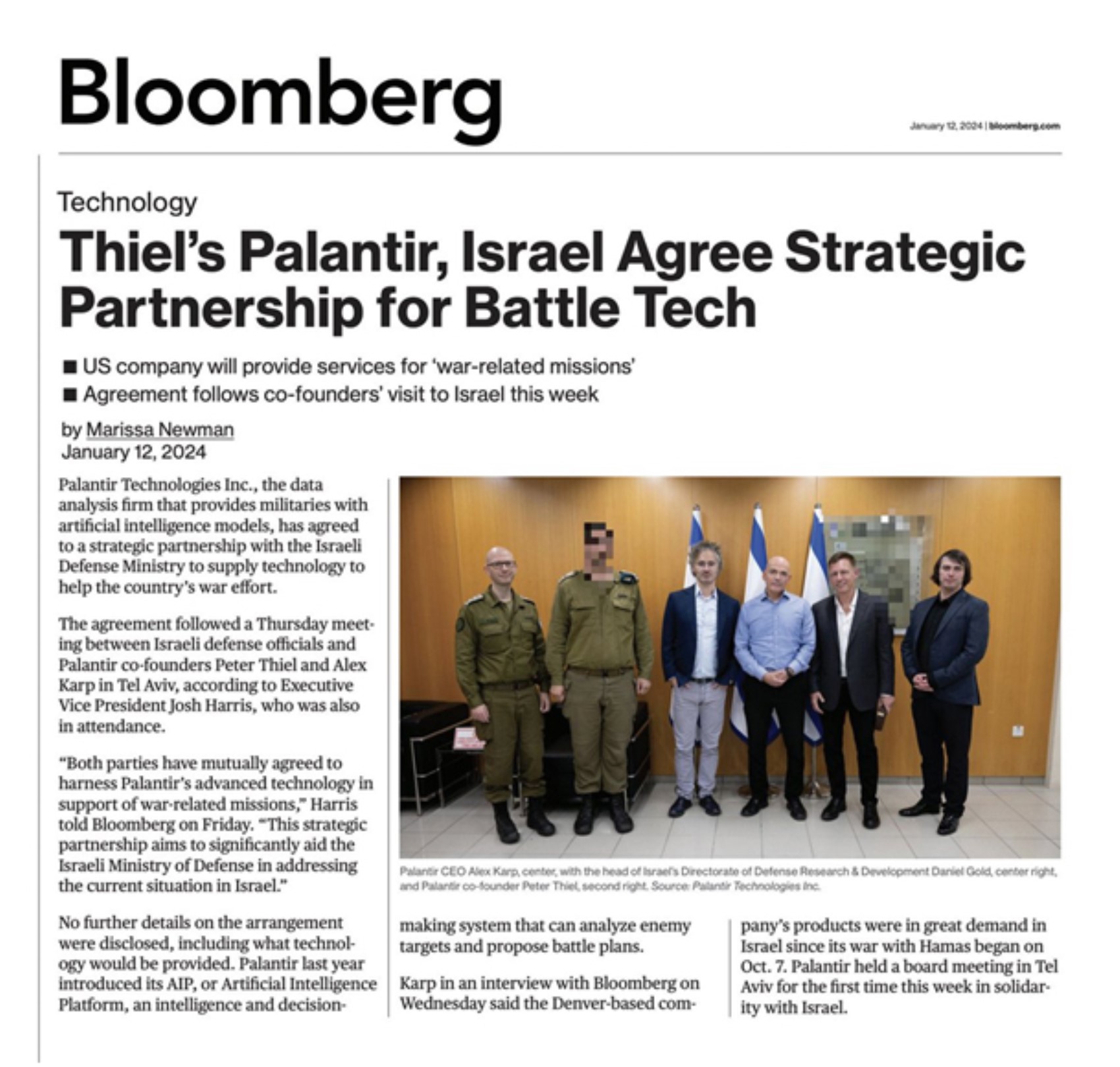
(Palantir-Israel strategic partner in war technology-Bloomberg news. 12-01.2024)
***
One of the fundamental functions of modern states is to ensure security.
However, with artificial intelligence, the understanding of security is undergoing a radical transformation.
According to Karp, traditional "soft power" tools are insufficient; they are being replaced by software-based "hard power."
This transformation also brings a boundary problem with it: where does the state end, and where does the private technology company begin?
Companies like Palantir are no longer just service providers; they are actors that shape security policies.
It is known that Palantir and similar companies play an active role in the military coordination centers established in Gaza, and that operational decisions are directed by analyzing data collected from the field with artificial intelligence systems.
Security is no longer the monopoly of the state; it is a field shared with companies acting with a profit motive.

(Protest demonstrations against Palantir in the USA)
***
Artificial intelligence is also transforming the nature of war. The fact that the political preferences of technology elites can directly affect military strategies makes the technology-politics-war triangle intertwined in a way never seen before.
According to Karp, the issue is not whether artificial intelligence-based weapons will be developed; it is by which actors and for what purpose they will be used.
The nuclear age is closing; the new deterrence regime is being built on artificial intelligence.
Software is no longer a supporting element; it is the determinant of war capacity.
It is stated that in the 2025–2026 period, artificial intelligence systems were used directly in the US and Israel's operations against Iran for target identification, prioritization, and testing war scenarios in a virtual environment; and that the war was conducted at "machine speed" for the first time.
Those who write and use the algorithm are no longer just calculating the future; they are determining it—they are also deciding who will live and who will die.
And what about humans?
(To be continued — New Imperialism-3: Techno-Fascism, Resistance, and Quo Vadis)
Sefa Taşkın
10.05.2026
Karşıyaka/İzmir
Most Read

Striking picture for Özgür Özel's 'New Party'

Özgür Özel gives a dated response regarding the number of resignations

The PKK opening and Özgür Özel’s path!..

Forest fire in Antalya brought under control

How did the newspapers view Özgür Özel's farewell to the CHP?

He killed his wife by slitting her throat: Their children witnessed the moments

What did the CHP do?

Özel’s new party move in the world press

The New CHP, against CEHAPE

Fire at TUSAŞ engine factory in Eskişehir under control