



CYANIDE DIARIES FROM BERGAMA-11
Knowledge and living together are humanity's most important strengths.
With the intelligence it has possessed since the beginning, humanity has accumulated and interpreted what it has learned, made new inferences, shared them, and passed them on to one another,
And in this way, despite its limited physical abilities in the wild, it has succeeded in surviving and maintaining its existence.
In the age of modernity, when the poison of "cyanide," which could threaten their existence, arrived at their doorsteps, people's first reaction was to try to learn about this substance.
There were numerous rumors, allegations, and concerns regarding the harm that the "gold mines" where cyanide would be used cause to humans and the environment.
However, this situation could be overcome with accurate information, or one could act accordingly.
While the ordinary person faced daily fears, some wanted to add wealth to their wealth.
Moreover, these companies that would use poison were foreign.
Their tracks and traces were nowhere to be found!
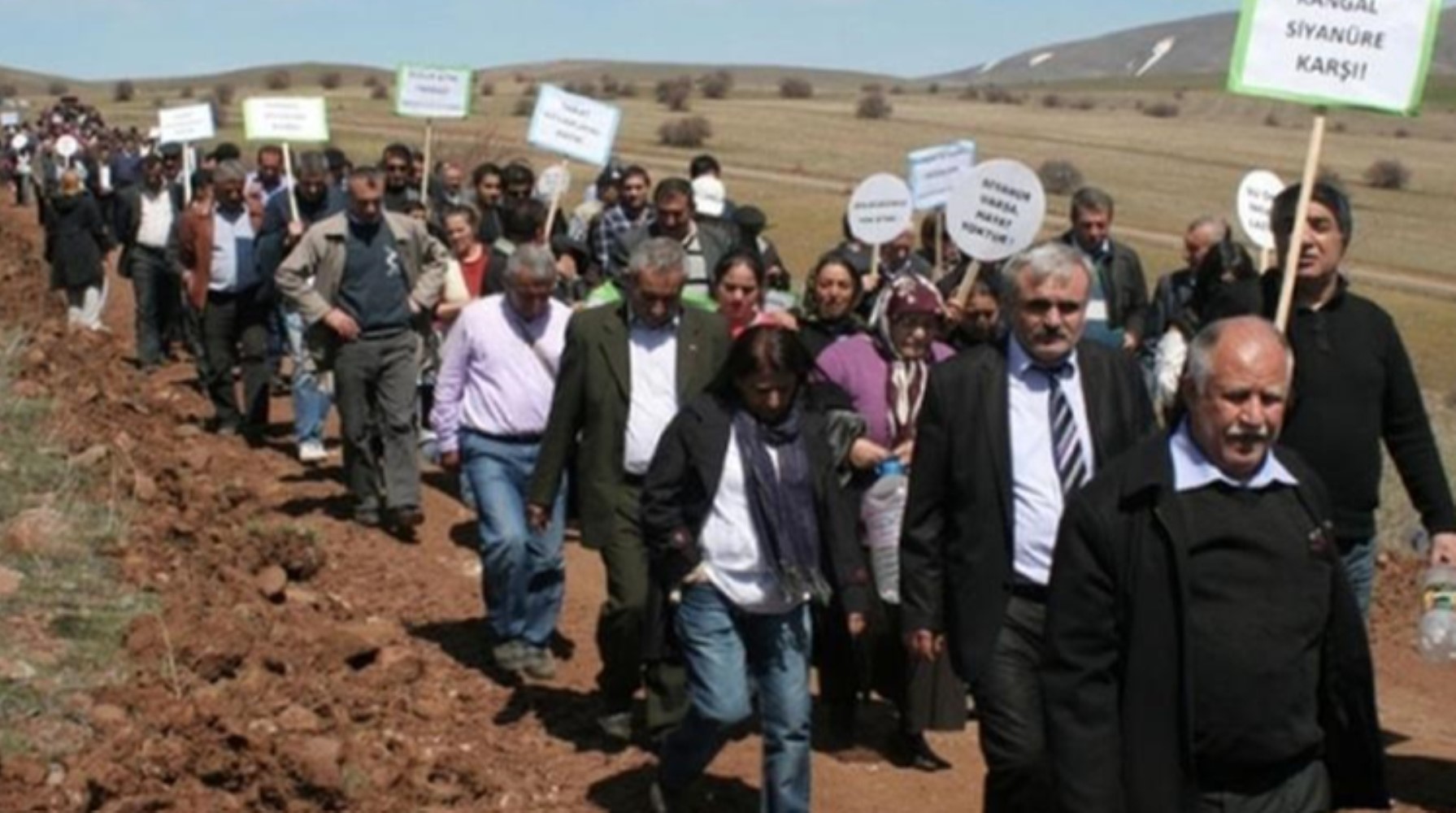
(People in Sivas-Kangal against "cyanide")
Giant companies wanting to extract gold by using poison and spreading toxins into the environment had very powerful propaganda tools and personnel to persuade the local people to accept this disaster.
It was not enough for them to profit locally; they were trying to reach every inch of the country's land, and the contribution that "cyanide-extracted gold" would make to the national economy was being exaggeratedly touted.
"Opposing cyanide mines meant harming the country's economic development."
"One could not be the poor guardian of rich mines."
"Other states that are jealous of us did not want us to extract gold and become wealthy."
In the face of such misleading statements, the local people, concerned for their life and property, were in need of information.
The Chambers of Engineers in İzmir had warned Bergama environmentalists about the risks associated with such an operation, but the information they provided was insufficient.
They did not have comprehensive information either. The technology was complex. The subject was new to the country.
People needed accurate data to defend themselves against the toxic propaganda of the poisoners; only information could protect them.
****
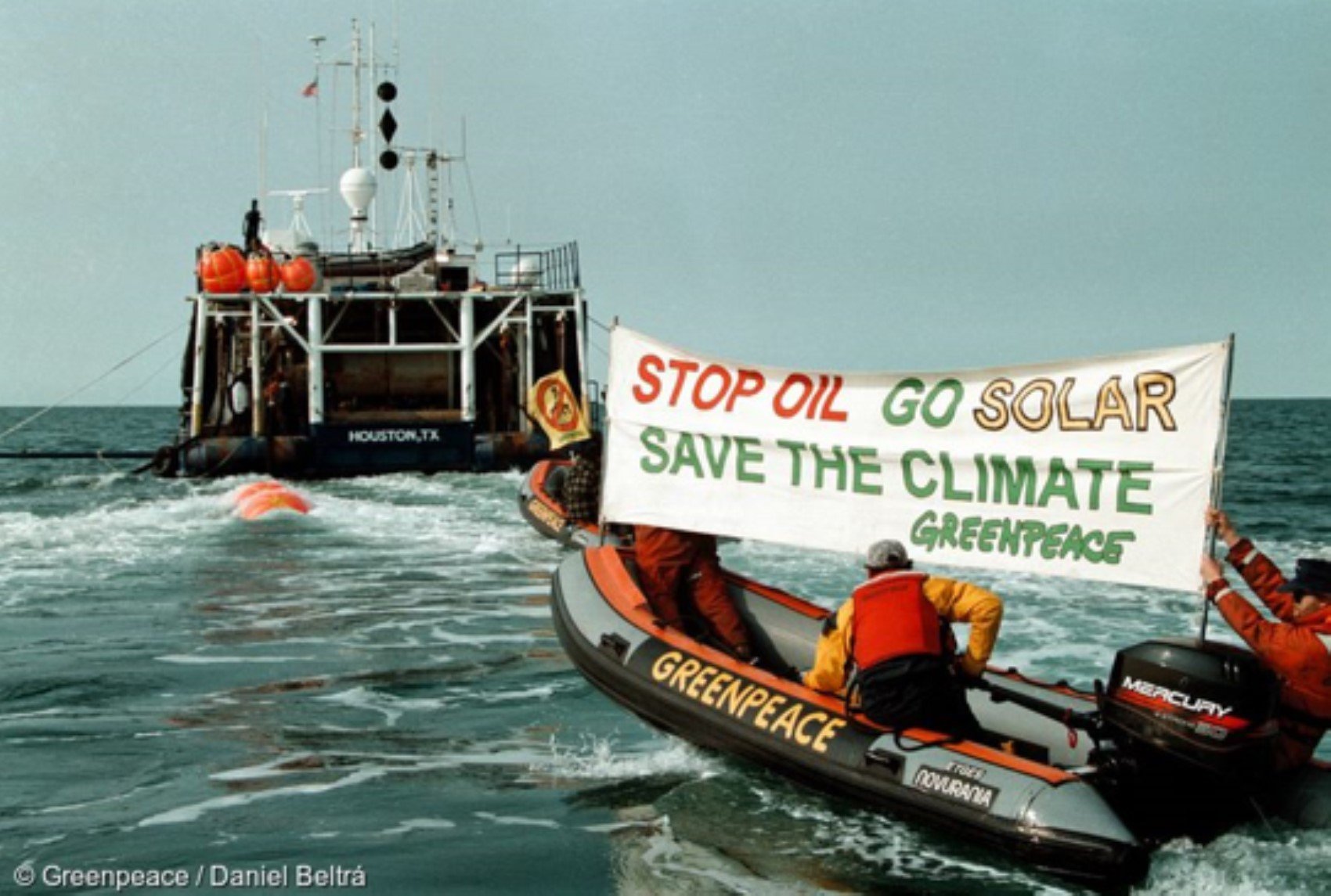
(Greenpeace in action against the use of oil that causes climate change)
Meanwhile, it was learned that the "Sirius," a ship belonging to the world-renowned environmental organization "Greenpeace," had arrived at the port of İzmir.
Founded on September 15, 1971, in Vancouver, Canada, the organization known as Greenpeace was recognized worldwide as a respectable "environmental protection" group due to its striking actions.
It was known as a civil society movement established to draw attention to environmental issues and create awareness on a global scale.
Greenpeace officials stated that they covered their expenses through donations!
Actions such as using a boat to write on the sides of whaling ships, chasing oil tankers at sea, and climbing walls to protest nuclear power plants were met with global sympathy, despite being harsh and risky.
What they were doing was the first universal and action-oriented sensitivity regarding environmental protection. It was making a lot of noise.
In an environment where societies and political movements were ignoring or acting slowly, the masses were naturally concerned with the protection of nature and the prevention of environmental pollution.
"Protecting the environment" was not just about picking up cigarette butts on beaches or making students collect trash in the streets!
Greenpeace was a very insular civil organization!
The issues they focused on regarding environmental problems were limited.
They were traveling the world on their ship, which they named after a star, "Sirius," and were trying to raise awareness on environmental issues of their own choosing.
On September 1, 1992, they arrived in Turkey, first in Istanbul.
The ship was visited by Minister of Environment Bedrettin Doğancan Akyürek from the DYP and Minister of Tourism Abdülkadir Ateş from the SHP.
After Istanbul, the Sirius stopped in Izmir. It anchored at the city's elegant Kordonboyu.
Greenpeace representatives held a press conference against "Nuclear Power Plants" and conducted a symbolic march with those who joined them.
They even planted a memorial tree, a palm, in Karşıyaka together with the then-Mayor of Karşıyaka, Cihan Türsen, who was known for his environmental sensitivity.
All of this demonstrated the interest of citizens in Turkey regarding environmental pollution and the protection of nature.
In this context, the Mayor of Bergama, the Council Members, and the local village headmen went to Izmir to meet with Greenpeace representatives unannounced, both to obtain information and to find international support for their cause.
After all, the world-renowned Greenpeace could not simply ignore Turkey's first "peasant environmentalists"!
The delegation from Bergama arrived at the Kordonboyu in Izmir, approached the Sirius ship docked at the pier, climbed the stairs, and boarded the famous vessel.
However, when the door to one of the living quarters inside the ship opened, they were met with a situation they had not expected at all.
One of the local chief executives of the cyanide-using Eurogold company—whom the Bergama villagers knew very well, and who had been trying to persuade them not to oppose the "cyanide mine" while distributing handouts—was walking out the door with his assistants. A Greenpeace official was seeing them off.
The minds of the Bergama environmentalists, who were fighting against the world's giant cyanide companies, were completely thrown into confusion!
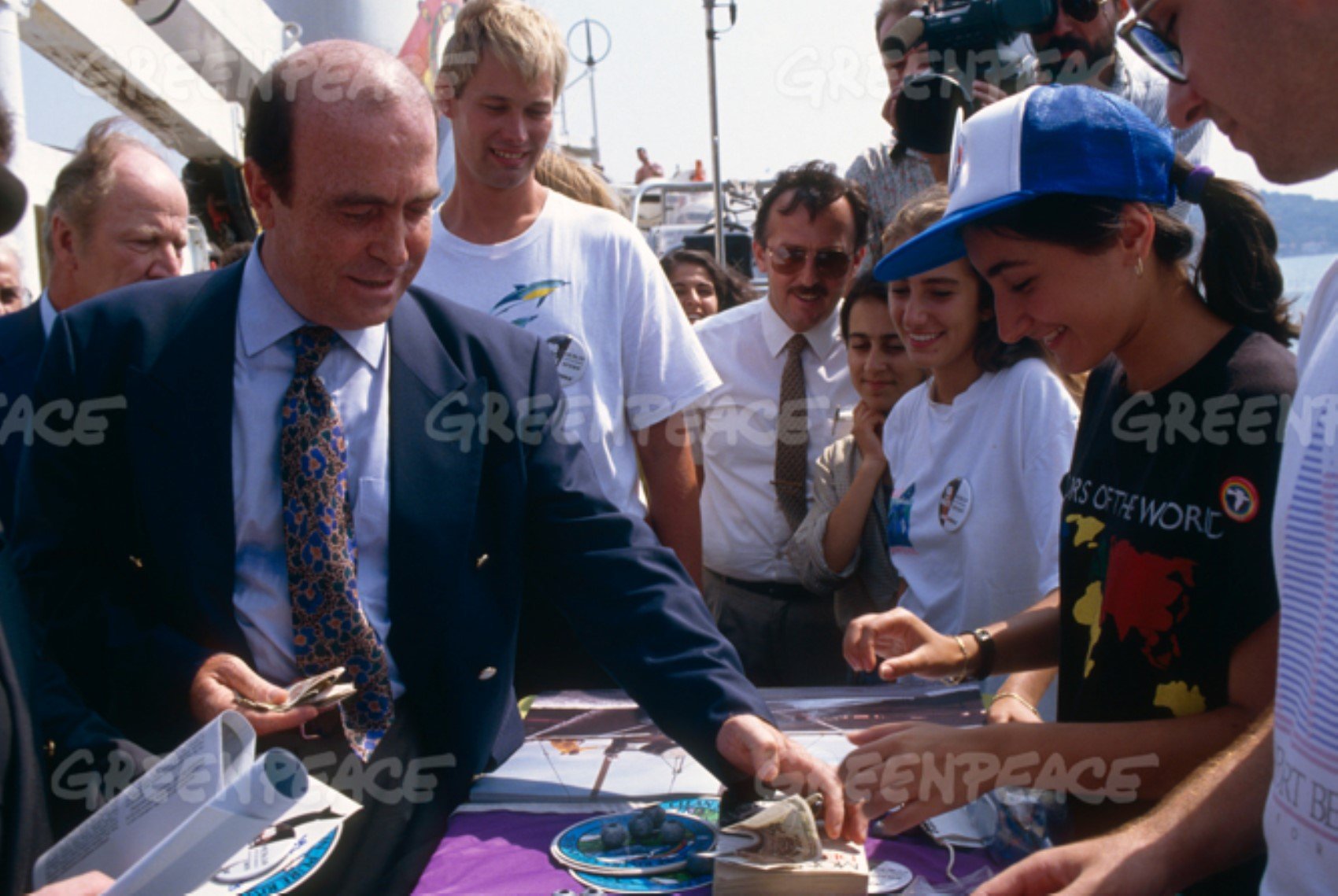
(The SHP Tourism Minister of that period, 1992, Abdülkadir Ateş, is making a donation to Greenpeace in Istanbul)
They had come to ask for help from the world-famous environmentalist group Greenpeace to protect their lives, but the very people responsible for an operation that could poison them had been welcomed onto the Sirius ship, had apparently met with Greenpeace representatives, and were now leaving.
What was this? What did it mean?
The people of Bergama were invited to a cabin/ship room and, with the help of friends among them who knew foreign languages, they explained their grievances. They requested information and documents from them regarding such operations around the world.
Greenpeace representatives listened to the guests with respect and stated that they were only interested in nuclear power plants, and that cyanide gold mines were not on their agenda.
The meeting was over!
As the guests were leaving the ship, thinking they had received no help, a Greenpeace representative—an Australian female environmentalist—said she understood their problem, that such mines were causing immense damage to the environment in other parts of the world as well, and that if they provided an address, a non-governmental organization in London, England, called "Minewatch" could send them documents.
Around the world—in the USA, Canada, England, and even India—there were social "grassroots" movements, which literally mean "grass roots."
The issue of toxic mining was wreaking havoc on the environment everywhere in the world!

(An announcement made by local environmentalists regarding discussions on toxic mines in the states of Idaho in the western US and Maryland in the east. "Say no now!")
Non-governmental organizations that warned societies and reported on the scandals caused specifically by cyanide gold mines were called "Minewatch".
The people of Bergama left Greenpeace's Sirius ship with a bitter feeling.
They had not found the "environmental protection solidarity" they had hoped for.
What were the toxic-polluting executives of Eurogold doing alongside Greenpeace, on their ship!
These famous environmentalists had not acted warmly toward the villagers at all.
Except for a young Australian girl!
Let's see if she would keep her word.
The villagers needed information to protect their lives against the claims of the cyanide-using Eurogold company, which propagated that cyanide mines were as sweet as honey and sherbet and caused no harm to the environment.
They returned to their homes.
Some time later, a sack full of documents arrived in the mail one day. It had truly come from London.
The female representative from Greenpeace had kept her word.
The sack was filled with newspaper reports collected from all over the world and reports from scientific organizations.
It described the pollution and deaths caused by cyanide around the world.
Documents detailing the disasters caused by cyanide poisoners in many places such as "Ok Tedi," "Guyana," "Papua New Guinea," and "Nevada" were laid bare, complete with pictures.
These were the harbingers of potential environmental destruction in Anatolia.
If only the public officials and politicians who granted operating permits to these companies—those who turned a blind eye to the deaths at the Erzincan İliç gold mine, those who ignored the arsenic-laden waste in the streams of Ordu, and those who attempted to destroy the deep green forests of Cerrattepe in Artvin—had read and examined these documents!
If only they had told the public the truth! And what would befall them!
***
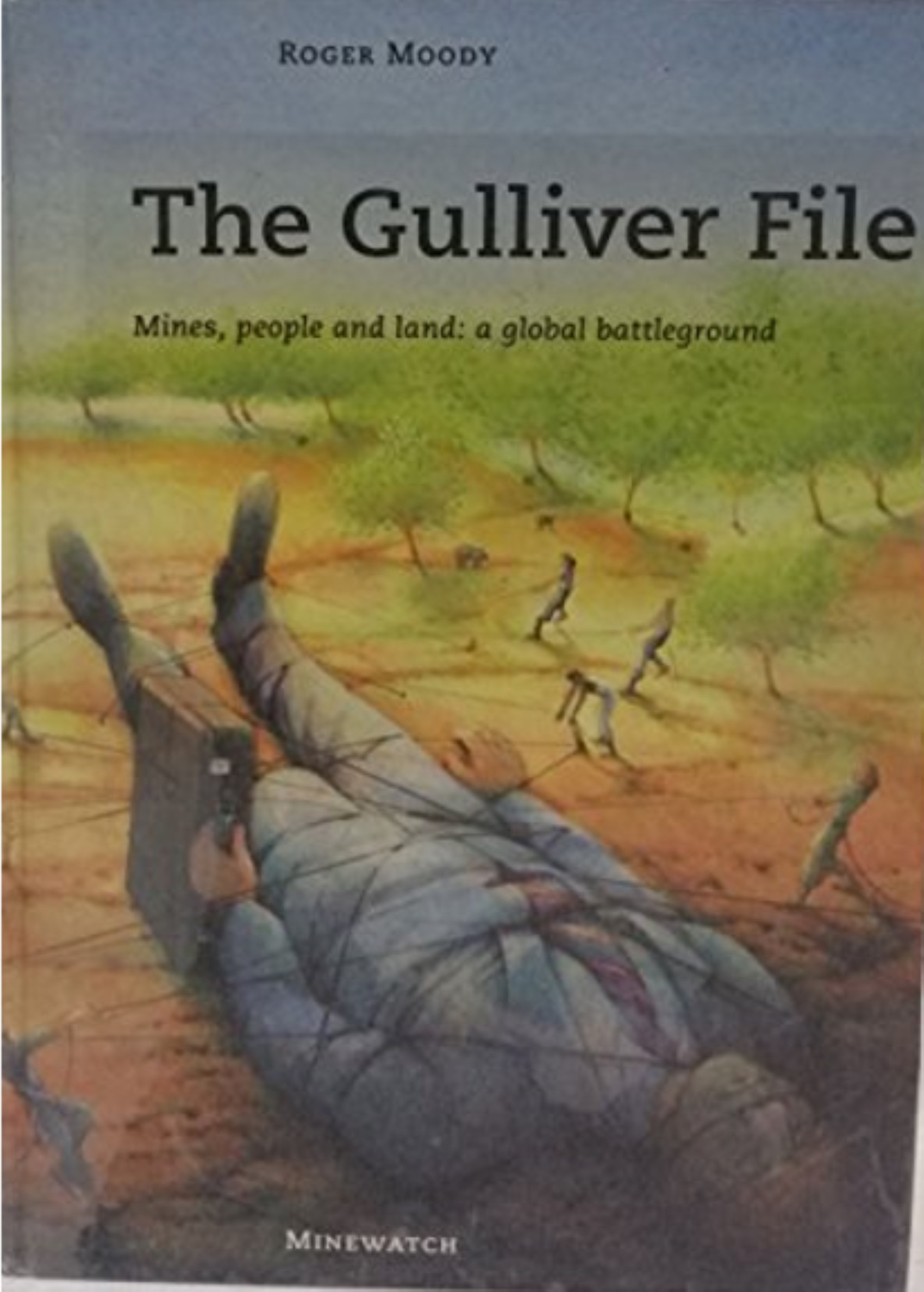
(A book by mine observer Roger Moody, in which he exposes the true face of cyanide-using companies)
And then a book emerged from among the documents!
Its name was: “Gulliver File: Mines, People & Land: A Global Battleground”.
"The Gulliver File: Mines, People and Land: A Global Battleground".
Its author was the British researcher Roger Moody, an opponent of toxic mining.
He was exposing the secrets of the "Cyanide Octopus," the companies causing environmental disasters around the world.
The things they had done!
The title he gave his book was also interesting!
What did the adventures of "Gulliver," known even to children, have to do with "cyanide gold mines"?
"Gulliver" is by the Irish author Jonathan Swift written by, and first published in 1726 "Gulliver's Travels" was the protagonist of the book titled novel character. This book was one of the most widely read books in the world.
The story was fantastic:
"Gulliver, an adventurous ship captain, took refuge on an island after his ship sank. The people living on this island, who were 15 cm tall and called themselves Lilliputians, were afraid that Gulliver, who was as big as a giant to them, might cause harm, so they laid him on the ground and tied him up with ropes."
After various events he experienced, Gulliver returned to his homeland.
In fact, Jonathan Swift was making social satires with a sarcastic tone in this book he wrote 300 years ago.
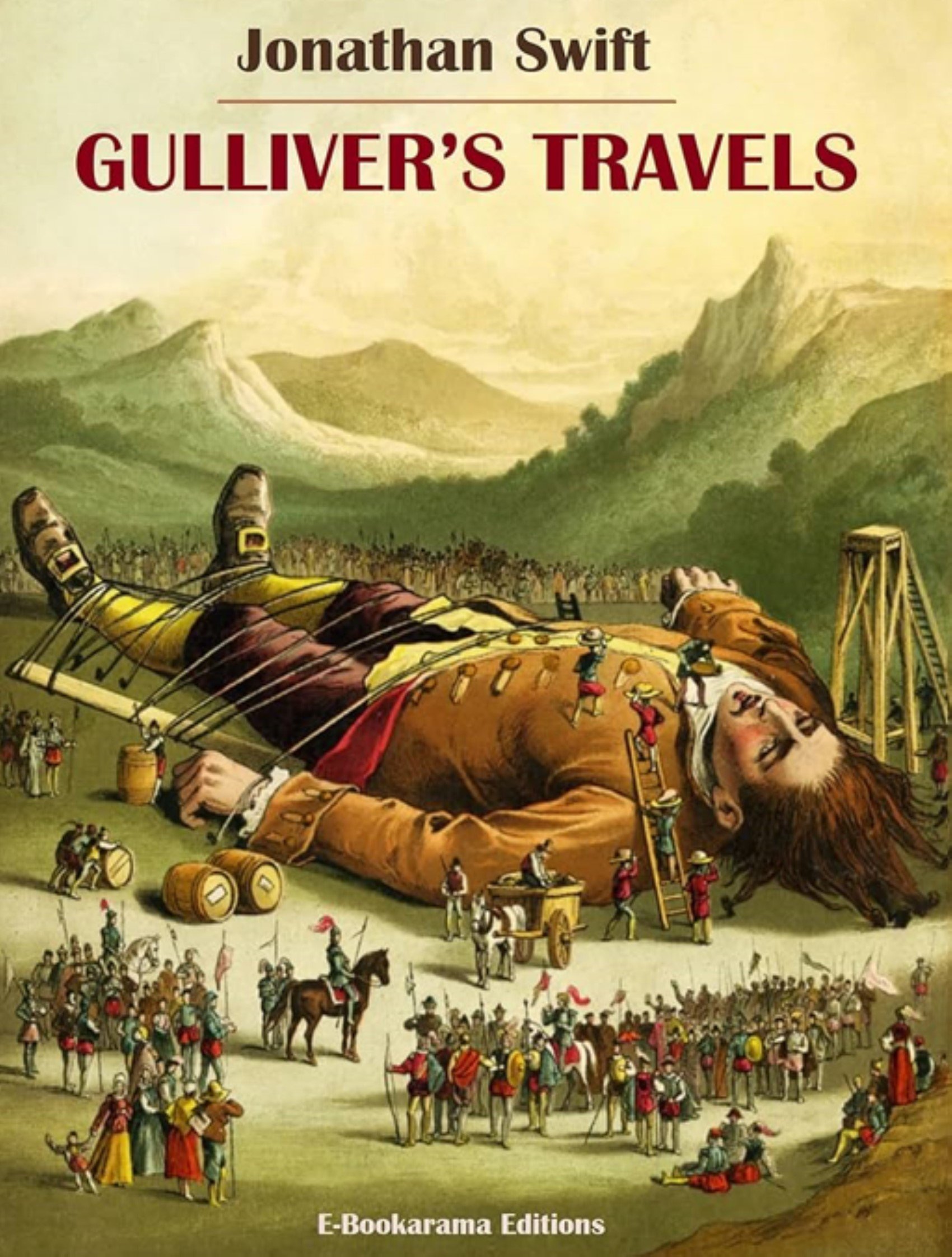
(Jonathan Swift's book Gulliver's Travels)
Roger Moody, who collectively exposed and documented the inner workings of dirty mining on Earth, especially the dirty business of cyanide gold miners, was displaying the shamelessness of the 'gold-worshipping' Savage Capitalism in this book.
Of course, the cyanide problem in Turkey existed everywhere in the world long before.
Cyanide companies had wrapped their arms around all countries.
In addition to the documents he published, Roger Moody must have been trying to explain or suggest something through the book's title and metaphor!
'Gulliver likely represented humanity and was tied firmly to the ground by poisonous companies so that he could not move. He was not wanted to move!'.
Or, 'Gulliver was a poisonous company with very few numbers, and the people, described as Lilliputians, were rendering the giant poisonous companies inactive through public actions, just as the small Lilliputians did. The small could resist the big and win!'.
With the many documents she sent and this book, the young Australian environmentalist showed her solidarity with the villagers of Bergama who were seeking a remedy to save their lives.
****
As the documents were read and learned about, everyone's astonishment grew.
What things they had done, and how much they had put our world in such a difficult position, these greedy gold miners!
These poisoners were not innocent at all!
Quite the contrary!
Why were public officials, whose duty it is to ensure the 'safety of life and property of the public' under Article 56 of the Constitution, not coming to explain these things to the people?
On the contrary, it was becoming apparent that they had begun to take a stance in favor of this poisoning company.
Volunteer environmentalists and Bergama Municipality officials shared these documents and the information they contained with public officials and the press.
Should eyes have been opened, or closed?
Had a stroke of good luck landed on the country, or was it a great misfortune?
Before long, respected scientists from all over Turkey would rush to the aid of the Bergama villagers.
***
Humans are not alone on the blue planet we live on.
There are many people around the world who take ownership of such issues and stand by those who oppose them.
Ants have brothers!
(Source: https://www.greenpeace.org /// https://www.minewatchnc.org /// Roger Moody: Gulliver File: Mines, People & Land: A Global Battleground)
Sefa Taşkın
09.02.2025
Karşıyaka/Izmir
Most Read

Striking picture for Özgür Özel's 'New Party'
Özgür Özel gives a dated response regarding the number of resignations

The PKK opening and Özgür Özel’s path!..
Forest fire in Antalya brought under control

How did the newspapers view Özgür Özel's farewell to the CHP?

He killed his wife by slitting her throat: Their children witnessed the moments

What did the CHP do?

Özel’s new party move in the world press

The New CHP, against CEHAPE

Fire at TUSAŞ engine factory in Eskişehir under control