



Even if the public does not always make choices in line with universal social development, the most correct decision in state or city administration is to act in accordance with the public's demands or to persuade them of the decisions to be made.
The most realistic method for this is "Direct Democracy".
In the most delicate general matters, in determining the representatives who will implement policies, and in identifying decision-makers, the choices made by the public are the healthiest from an administrative perspective.
The argument that "If you leave it to the public, they will elect Hitler or Trump" exists because those who oppose these individuals, their thoughts, and their actions have failed to persuade the public of their own positions.
***
In Direct Democracy practices, people with the right to vote can make advanced democratic decisions through meetings called "People's Assemblies" or "Councils".
If those who make the choices have made a mistake, they learn from the experience and try not to repeat it.
Once bitten, twice shy!
Today, this method is used in our country in associations and cooperatives in a sense.
This was the case in Pericles' Athenian Democracy 2500 years ago.
Everyone except women and foreigners was equal and could aspire to State/City administration and vote in elections.
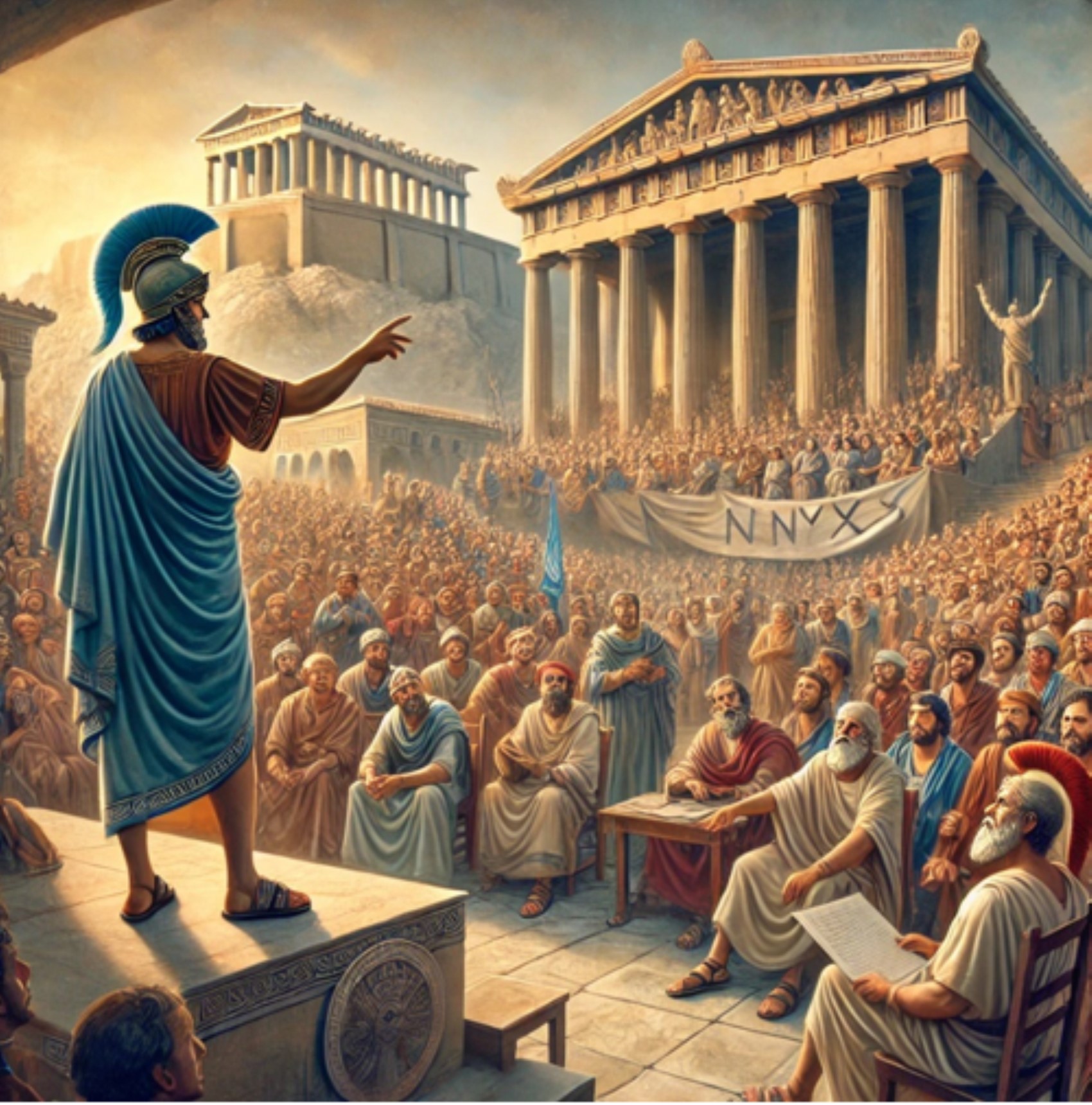
(Pericles and Athenian Democracy-Representative image- AI)
***
Over time, the concentration of decision-making authority and power in the hands of a single person or a group through methods such as "Tyranny", "One-Man Rule", "Despotism", "Absolutism", and "Oligarchy" ignored the public's will and desire.
Of course, the public sometimes reacted very violently to this when their demands were ignored.
Some circles from the same social class as the "One-Man" rulers, who did not want to share their power, also opposed them.
In 1215, other Feudal Lords/Barons/Large landowners who rebelled against the oppressive rule of King John in England forced the King to sign a document called the "Magna Carta" or "Great Charter", which reduced his powers and limited his absolute authority over society.
When King John and his son Henry III did not comply with these limitations, the barons and large landowners who rebelled under the leadership of the French-born Simon de Montfort started a major uprising by taking the public along with them.
As a result of this rebellion, a parliament, an assembly that included public representatives for the first time in England and world history, was formed in 1265 under the leadership of Simon de Montfort.
This was the first legislative body that included not only nobles but also bourgeois from cities, wealthy urbanites, and representatives elected from rural areas.
This institution is considered one of the cornerstones of today's Parliamentary system.
The parliament that operates continuously with elections in the modern sense is the Parliament of the United Kingdom (UK), formed by the union of England and Scotland in 1707.
***
The word Parliament comes from the French word "parler=to speak".
It is the place where problems are discussed and social and political decisions are made.
The act of sharing power with the public, which began in England in the 13th century by kings and those with absolute sovereignty, stemmed from a necessity and the public's desire to participate in decisions made about themselves.
One-Man Rule meant arbitrariness and oppression.
However, land ownership, weapons, and the judiciary were still in the hands and under the control of Kings and Feudal Lords.
The development of productive forces and means of production enabled the bourgeoisie/wealthy urbanites, who grew stronger with cities, to increase their influence.
This caused them to enter into conflicts of interest with Kings and Feudal Lords.
Later, the bourgeoisie, taking the newly developing working class and peasants with them, tore down the kings.
So, how would the wealthy urbanites/bourgeoisie who seized political power govern the state?
There was a parliament experience in England, first in 1265 and later from 1707 onwards, in which different segments of the public participated.
In France, the wealthy urbanites/bourgeoisie, who also took the poor segments of society with them, had dealt a definitive defeat to the monarchy/absolutism with the 1789 Revolution and established a "National Assembly". This assembly included representatives from every social segment.
The assembly, which consisted mostly of bourgeoisie and public representatives and also included representatives from the clergy and nobility, crushed the Feudal System as a result of fierce struggles.
The Kingdoms whose powers were taken away had only symbolic authority.
The revolution, which set out with the slogan "Liberty, equality, fraternity", was crowned with the adoption of the "Declaration of the Rights of Man and of the Citizen" in the 1791 French Constitution.
This is a great step forward for all humanity!
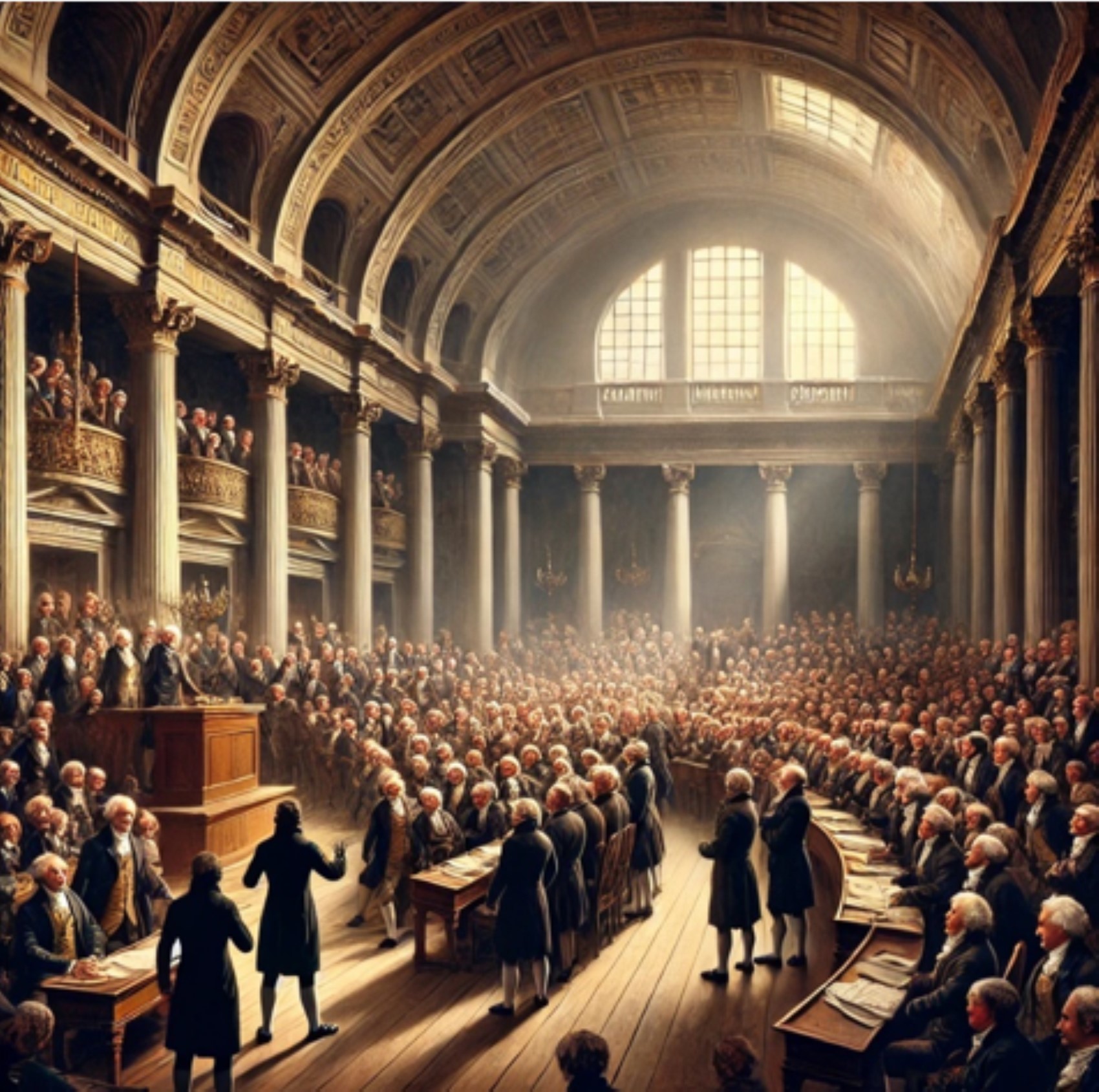
(People's Assembly and debates during the 1789 French Revolution-Representative Image-AI)
***
However, the bourgeoisie that seized the State would, after a while, take full control of the reins in the country, suppress the uprisings of the oppressed classes excluded from the revolution, such as the 1830 Paris Commune, with blood, but would not give up on the parliamentary system, which is a form of "Representative Democracy".
"Democracy", which humanity found and implemented in ancient times as a result of social necessity and by visionary leaders, had been remembered again as a method.
Undoubtedly, this democracy was a style of governance used by the ruling class, the bourgeoisie, for its own interests.
It both ensured reconciliation between various bourgeois groups and legitimized its power and authority.
The limited number of dissidents who could enter could also make their voices heard to some extent.
Representatives gathered in Parliament, discussed problems, and made decisions.
Among themselves, they shared state power on behalf of the upper class to which they belonged.
The newly enriched class, the bourgeoisie, protected its interests in this way through the state apparatus. It sometimes forced the public to agree to the decisions it made.
With its weapons, sticks, judiciary, and laws, the state was necessary for the ruling social classes.
During this process, Capitalism was developing, and the concentration of industry and capital in certain hands was accelerating.
States frequently engaged in fights to expand markets and went to war with each other.
In these clashes, the borders of countries were changing, and Representative Democracy continued to function during this process.
However, the working class that emerged with the existence of capitalism, the peasants who had been oppressed since time immemorial, tradesmen, and artisans wanted to have a say in governance to have better living conditions and to be freer.
But this was not the interest and intention of the bourgeoisie. It was concerned with protecting and growing its existence. It did not care much about the democratic demands of the public.
Thus, new democracy struggles began in countries.
New understandings of democracy emerged.
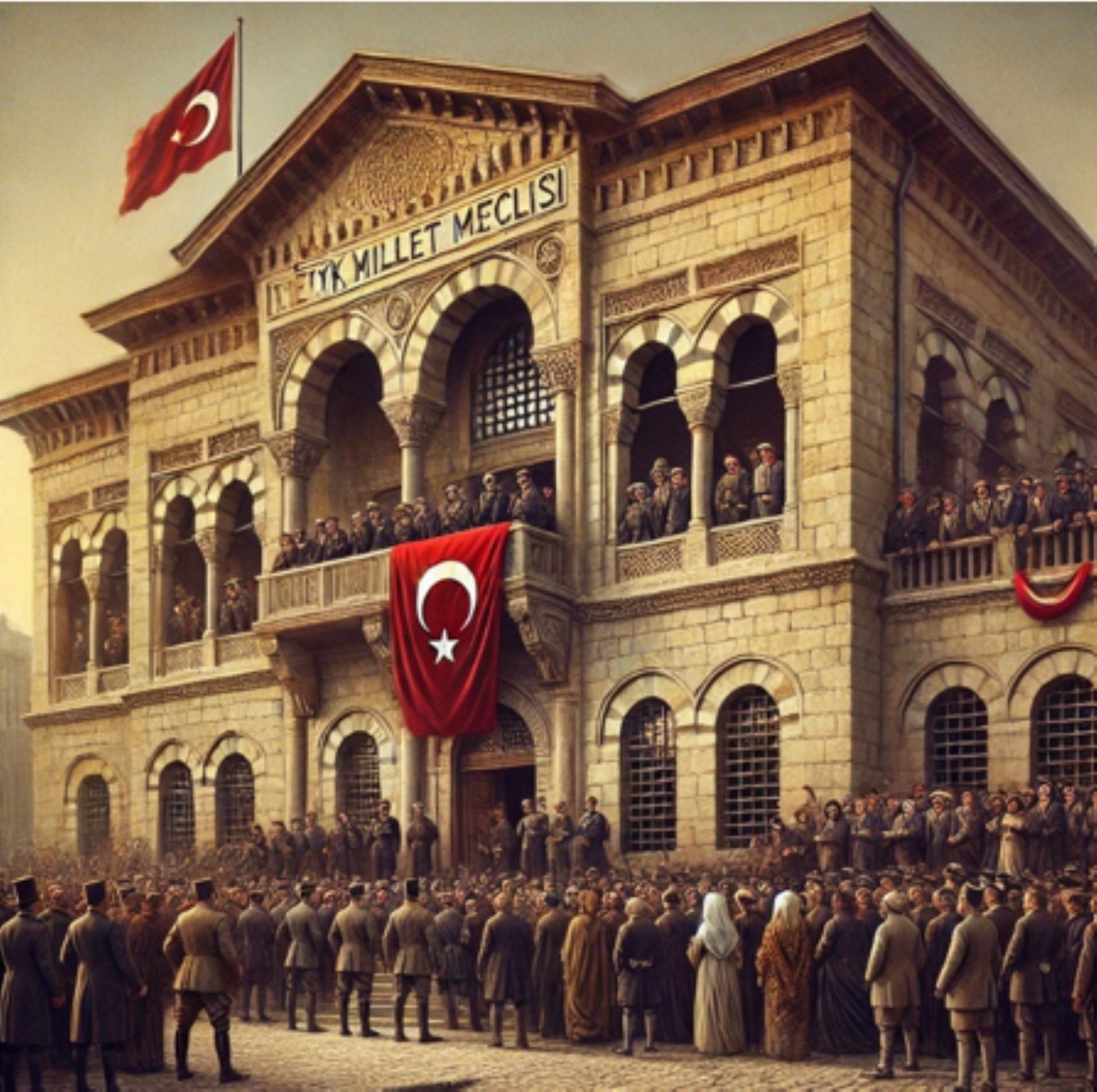
(Grand National Assembly of Turkey-Ankara-1920-Representative Image-AI)
***
In this context, the Capitalist System had to develop "Representative Democracy".
While all kinds of manipulation were possible, the right to vote was granted to wider masses, and the authority to determine their own representatives was given.
Thus, while the lower classes defended their rights, which mostly did not find a response in parliaments, and stated their demands, the upper classes thought they were integrating them into the state administration they controlled themselves.
Of course, care was taken to ensure that most of these representatives who would join the environment of decision-makers were people who would act in accordance with the interests of the ruling classes.
In this environment, even if there was opposition in parliament, it could never overthrow the political power and could not become the government itself.
If this is a game, the ruling classes were playing it well.
When things got complicated, they did not hesitate to use the stick. They had plenty of resources. Sometimes their hand was soft, sometimes hard!
Even dissident politicians like Rosa Luxemburg could not escape being shot in the head and thrown into Berlin canals in the early 20th century.
***
Initially, women had no right to vote in elections at all.
Women gained this right in the USA in 1920, in England in 1928 (for those 21 and older), in France in 1944, and in Switzerland in 1971.
Despite 2500 years having passed, democracy was for men, just as it was in ancient times.
In Atatürk's Turkey, with the amendments made to the Constitution and the Election Law on December 5, 1934, women gained the right to vote and be elected as members of parliament.
This right was granted to women in Turkey years before the capitalist countries that consider themselves developed.
Women, who were under heavy pressure during the Ottoman period, were elected as members of parliament for the first time in the general elections held on February 8, 1935, following these legal changes. 17 female members of parliament entered the National Assembly.
***
Today, countries governed by the method called Parliamentary Democracy are managed by institutions known by names such as "National Assembly", "Senate", "Congress", and "People's Assembly".
This is realized through representatives elected by the public through direct voting via Political Parties (in Turkey, through Members of Parliament).
There are also independent candidates without parties, but their chances of being elected are very low!
In crowded societies, voters see political parties as a reference.
The Assembly/Parliament formed by the elected representatives performs the legislative duty and determines the executive body.
In some countries, in the system called the "Presidential System", the President of the State, who has great powers, is elected directly by the public.
It is seen that the People's Representatives/Members of Parliament in the resulting Assembly/Senate can only supervise this president to a certain extent.
Thus, the "Representative Democracy" method is applied in many countries with small differences.
Along with these, there are still "sultans" and "palaces" in the world!
Through general elections, "Representative Democracy" can lead to "One-Man Rule" and the concentration of power in a single hand.
***
It is clear that today, monopoly industrial and capital capitalism has become multinational and transnational by combining its forces, and the companies representing it have intertwined and even integrated with each other.
It is also clear that by using the technology revolution as a means of renewing itself and emerging from crises, and by giving the masses a larger share of the increasing production in this environment, it has silenced them by pushing them into a frenzy of consumption.
However, this period is slowly being left behind.
Developments in informatics and the fact that "Artificial Intelligence (AI)" has begun to affect human life in almost every field, almost replacing human labor, the great importance gained by virtual currency and precious metal mining, and the incredible spread of communication are signs of a brand new era.
Against these astonishing developments in productive forces, the ownership of the means of production does not change; it becomes even more centralized.
On the threshold of this era, universal wealth reaches immeasurable amounts in the hands of a narrow group.
One of the main rules of capitalism is to grow continuously, continuously.
In this context, protecting wealth and earning more (material or virtual) money is the nature of capitalism.
It doesn't even discuss this situation!
Relying on the state power it possesses, capitalism becomes a little more savage every day for its own interests.
As its power increases, it becomes more ruthless.
The environment, in a sense, resembles the "savagery" in the stories where Charles Dickens described life in the periods when English capitalism first developed, and Emile Zola described French capitalism.
The forced migration of people from their homes due to reasons such as climate change, hunger, security, and war is reaching incredible dimensions and causing great suffering.
The thousands of deaths resulting from Israeli attacks on Palestine are among the rare massacres seen in human history.
The "One-Man" of the USA, with the immense economic and military power he possesses, wants to stand up and openly seize the land of another country.
Informatics, communication, and pharmaceutical technology monopolies play with people's rights to communicate, obtain information, and be healthy as if they were playing with small change.
Savage capitalism is now attacking whatever will make money.
As if it will never be satisfied!
With the assumption that the capitalist lords at the very top fundamentally control the world economy and manage the world through vassals/sub-wealthy people and small states dependent on them, some also call this environment "technological new feudalism".
The concept of post-truth, which expresses a situation where emotions and personal beliefs shape reality in the context of politics, media, and social perceptions, is used by the masters of the world as a tool of manipulation in every field.
Reality can be easily distorted.
However, in the capitalist production relations experienced today, where mental and manual labor continue to produce surplus value, no veil can hide "the new savage face of capitalism".
In this context, society is confused.
So what should be done?
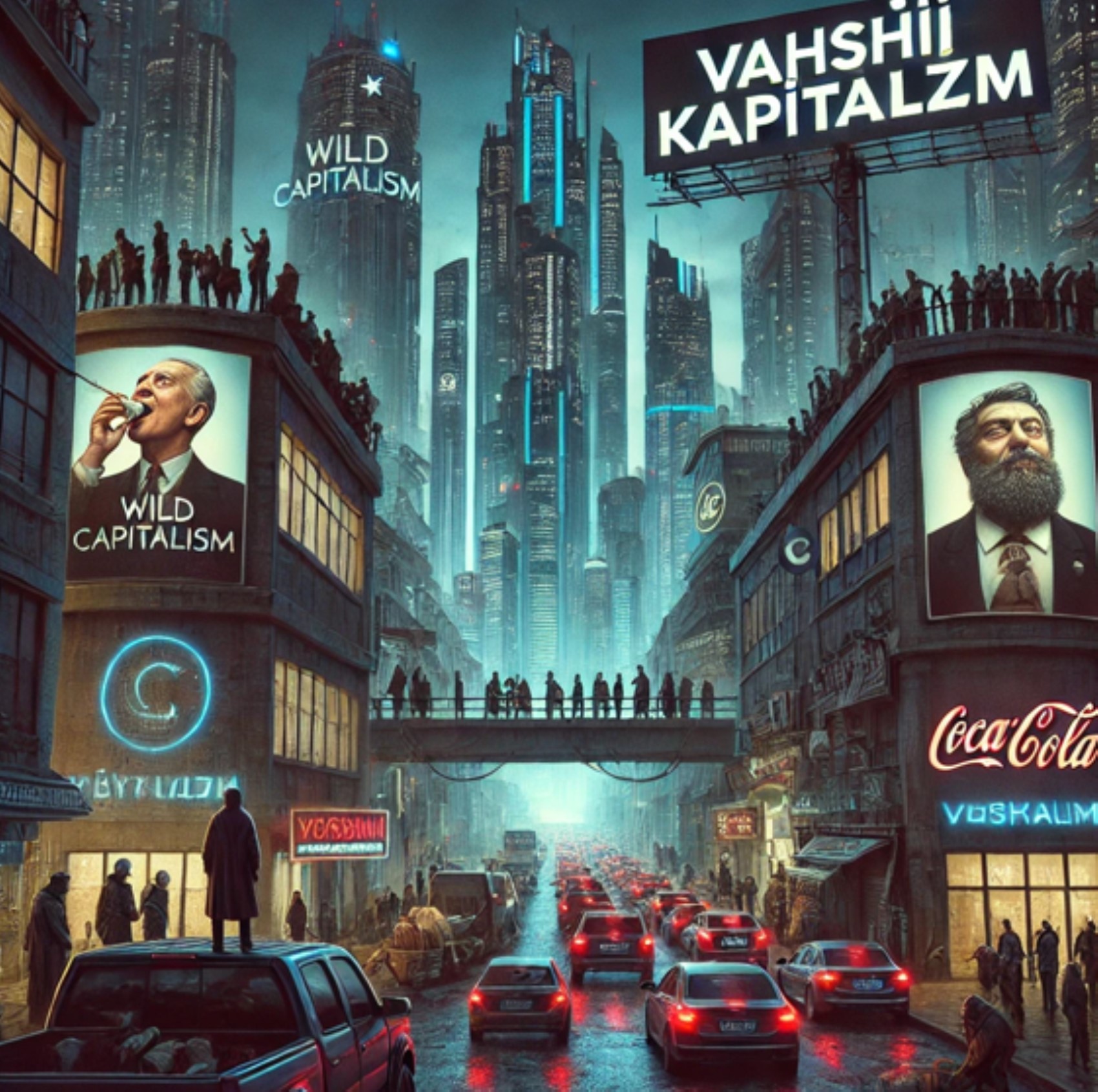
(A dystopian image representing Savage Capitalism-AI)
***
In today's world, although the governance of countries by seemingly elected representatives is mostly accepted in today's global environment, it is clear that the decisions made and practices implemented frequently face public objection.
The claim that political top management acts more in line with the private interests of ruling classes and individuals who own giant monopolies rather than the general interests of the country is not unfair.
Despite the full weight of this great power, social problems often arise, of course. The decisions made are questioned.
Unless issues are sufficiently discussed in public opinion, the public, who are forced to comply with the decisions made, is generally not persuaded by the perception that everything is going well by looking at their own living conditions and environment.
Unheard objections can rise in society.
Silencing and eliminating these objections is sometimes carried out with violence, as well as with large communication organizations.
The "Big Brother" who sees and controls everyone in the book "1984" by the English writer George Orwell has not yet fully appeared on the stage.
Maybe it's a little too early! Or it's almost time!
***
Against all kinds of negativity, societies have "democracy" that comes from thousands of years of human experience!
Therefore, the remedy for not being crushed under such great unpredictable money power is nothing other than implementing democracy in social life in its true sense, that is, as "real power filled with its people, not for show".
Without solving the problem of ownership over the means of production, how can this happen?
In today's conditions where Savage Capitalism is getting stronger every day, it does not seem possible to solve this problem in the near future.
In the capitalist world, how can the ruling powers, who control even knowledge and obtaining information along with productive forces in every field, allow the public's democracy?
The answer to this is for the public to demand democracy with all its might.
A very, very small minority cannot always control a very, very large majority.
***
Despite all this negative social trend that is felt to be getting worse every day, the public under suffocating pressure can show behaviors to catch their breath.
With the opportunities brought by the age we live in, in every suitable environment, under every condition, with sufficient scale and necessary information, the realization of "Direct Democracy" can be forced.
The public is not in a position to discuss the ownership of the means of production with the power possessed by the "new savage capitalism" intellectually and actionably.
But the demand for democracy, even if it is dangerous for the rulers, is always an innocent request for the public.
Democracy also includes the concept of freedom.
Freedom is one of the most fundamental reasons for the existence of humanity.
The determination that made Mehmet Akif Ersoy say, "Which madman will put chains on me? I wonder?", is a very important stance.
Another face of today's reality is that hundreds of thousands of protesters, who criticized the government's profit-oriented policies regarding the train accident that occurred in Greece on February 28, 2023, and caused the death of 57 people, and demanded that those responsible be brought to justice, carried banners saying "a child under the derailed train saying 'I have no oxygen, I can't breathe=den oksigeno', makes the state a murderer".
The public can show its determination and power under certain conditions by using its democratic rights.
Our ancestors implemented democracy, which provides people with significant freedom, especially "Direct Democracy", even in the most limited, oldest times.
Moreover, society is open to such a perception.
Today, referendums are an important tool of this method.
Existing decision-makers are, of course, wary of decisions made directly by the public.
They only appear to be supporters of such methods when it suits their own interests.
Sometimes they hold referendums where they can get the result they want.
They can influence the results with the great resources they have, and they can create organizations related to this.
Large social masses suffering from "new savage capitalism" and their political representatives should always keep this option available.
Direct Democracy can be demanded without fear of the manipulations of the ruling powers.
Ultimately, this is a matter of social struggle.
The struggle determines the result!
Against the objection that can be made to this method, "Would there be a referendum for every issue, for every decision?", it should not be forgotten that gains are permanent, and mistakes are sometimes gains.
***
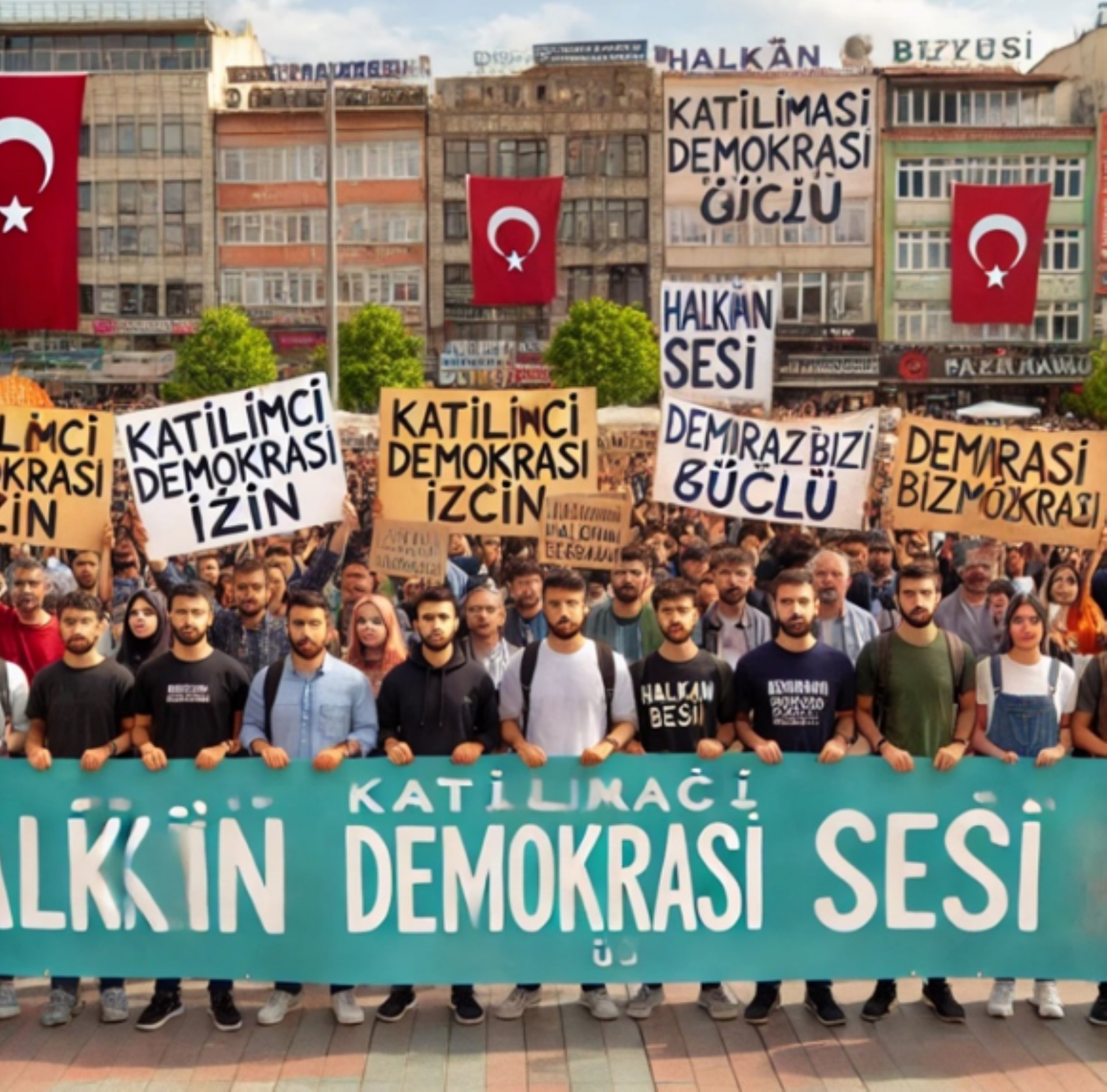
(Masses wanting Participatory Democracy-Representative Image-AI)
Another democratic method is the creation and experience of "Participatory Democracy" environments where the public can force the realization of their demands and raise their voices.
This method can be easily applied in social life.
Considering the developments brought by the age, such as increased awareness, easier access to information, and the rise in general culture and education levels, the participation of the public in the decisions and behaviors of general and local administrations can be ensured, and it must be ensured.
Such a democratic environment can be created with the participation of formations such as "Mukhtar Assemblies", "Neighborhood/Street Communities", "Union of Democratic Mass Organizations", "Professional Organizations", "Associations", etc., and practical mechanisms can be developed through various trials.
However, this practice should not be limited to the Governorates, District Governorates, and Municipalities bringing together the relevant institution officials and giving orders or listening to their troubles (which is also a positive step), as is done in many places in Turkey.
But what is really important is to involve the public in the decision-making process and implement the joint decisions made.
Some traces of this are being experienced today.
The reason for the failure of "City Councils", which were created and are wanted to be created with Article 76 of the Municipal Law No. 5393, is that this council has no sanctioning power.
According to the current understanding, the authorities where power is legally concentrated in one hand do not need support and advisory assistance from centers they do not approve of!
The "Environmental Impact Assessment" (EIA) Regulation, which was issued in 1993 to prevent the environment and people from being negatively affected by investments to be made, and the "Public Information Meetings" connected to it, were seen as very promising at the beginning.
However, unfortunately, this practice has been distorted from its true meaning by some ruthless employers with the backing of some official institutions and has become used in line with their own interests.
This situation is a great disgrace for our country's democracy.
***
In the context that forms the basis of these evaluations, it is mandatory for democracy to be developed and rooted for the public to live more comfortably and freely in our country.
It is clear from the social unrest experienced that One-Man administrations and the concentration of power in one hand generally accelerate the decision-making and implementation process, but also lead to wrong decisions being made.
Of course, society wants the country to develop rapidly, production to increase, and national income to be shared fairly.
However, it is clear that this rapid decision-making process and the mistakes made along with it cause social unhappiness.
This situation is directly related to the shaping of democratic life in the direction of one-man rule.
***.
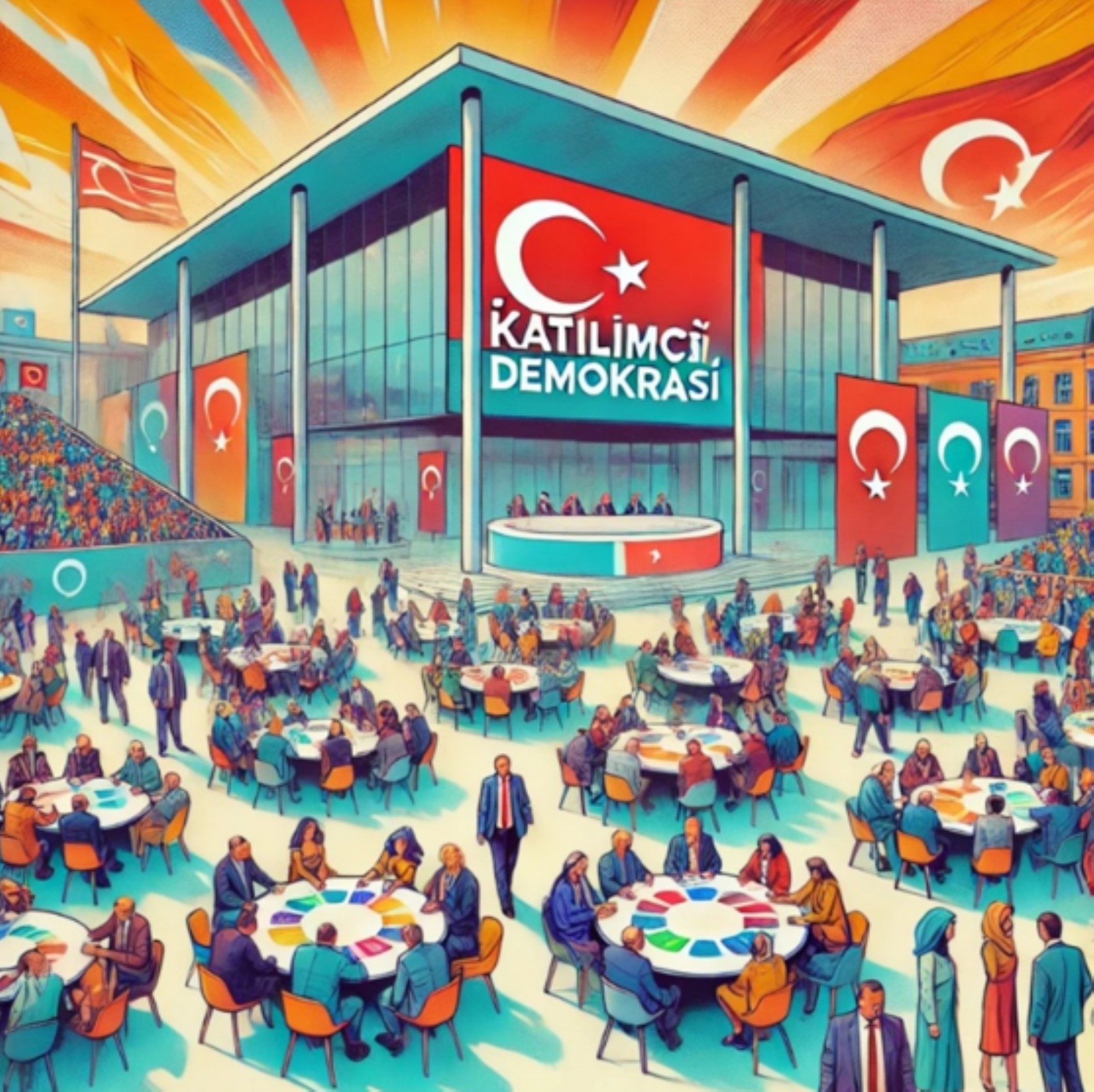
(A Participatory Democracy Environment-Representative Image-AI)
Along with these evaluations, the issue of "how representatives are determined" in our country, where Representative Democracy is applied, carries great importance.
In our country, parliamentary candidates are determined within the framework of Articles 37-41 of the Political Parties Law and the Parliamentary Election Law; mayoral candidates are determined within the framework of the Political Parties Law and the Local Administrations Election Law.
The laws have offered various options in this regard.
The most widely applied of these is the "Central Selection".
According to Article 38 of the Political Parties Law, the parties' candidates can be determined by their Headquarters.
In this method, the Party Headquarters directly selects the candidates who will be "Public Representatives".
AK Party, CHP, MHP, and other parties generally prefer this method.
The second way to determine Public Representative candidates is the "Organization Selection".
Party organizations make evaluations about the public representative candidate nominees, express their opinions, and submit them to the headquarters.
The final decision is made by the party headquarters.
According to Article 37 of the Political Parties Law, political parties can also determine public representative candidates (Members of Parliament, Mayors, Municipal Council members) through primary elections.
In this determination, all party members or delegates vote to select the candidates in accordance with the Headquarters decision (or party charter).
However, according to the law, "primary election is not mandatory"; parties use this method optionally.
In our country, CHP has implemented primary elections from time to time.
However, "primary election" is generally not on the agenda in major parties like AKP and MHP.
***
It is clear that none of these methods have anything to do with Direct Democracy or Participatory Democracy, or the public expressing its preference in the shortest way.
The public can only make a choice in the final stage from among the candidates determined by others (the General Chairman or Central administrators).
The public has no connection with the candidates chosen by the Headquarters unless they are a very well-known person.
Mostly, they do not know them.
The candidates also show no connection to the public when they are elected as Representatives (Members of Parliament).
If they do not carry ethical responsibility, they owe nothing to the people whose votes they received, because it was not the public who chose them, but their party's Headquarters.
They owe it to the Party Headquarters.
It was the Headquarters, not the public (or party members), that chose them.
Whatever the Headquarters says, that happens!
From time to time, correct and useful results can also emerge from these determinations made from the top.
When they become Public Representatives/Members of Parliament, these people, unfortunately, can only show their existence and are evaluated not by the cultural and intellectual abilities they possess, but only by the fingers they raise and lower.
The decision has been made above; it only remains for those below to approve!
Those who object to this situation are either put out the door, their privileges, if any, end, or they can never see that seat again in the next election.
Gradually, this very important duty, being a representative of the public, unfortunately turns into a job.
The job is done, a monthly salary is received, and a good retirement right is obtained!
Of course, there were many Public Representatives who did not fit this definition.
They tirelessly pursue the country's problems.
They are known for their dissenting identities.
They can be dismissed, tried, and even convicted.
Of course, this definition does not cover those who try to use the position they are in for their own personal interests.
The situation of Mayoralties is a bit different.
Their duty requires more face-to-face contact with the public and establishing good relationships with the public.
If they open the door, the public is in front of them.
This is a good thing! However, in the end, they are also subject to the One-Man or oligarchic decision-makers at the Headquarters.
The place where Mayors who do not strengthen their ties with the public will go is the place they came from.
***
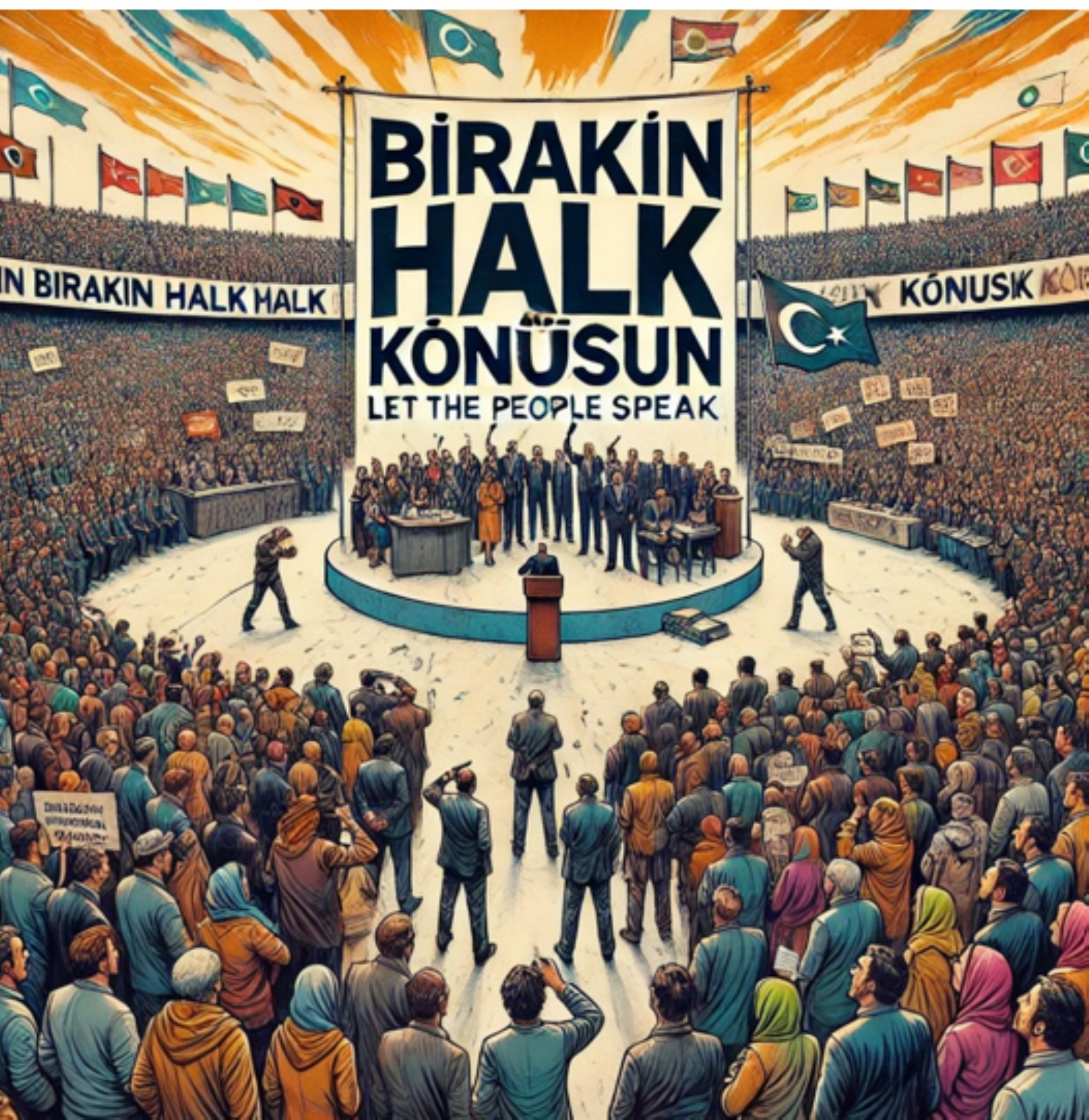
(An image representing a type of modern Direct Democracy-AI)
The fact that society consists of different interest groups and social classes deepens this inadequacy even further.
Such a Representative Democracy is far from meeting the basic human expectations of the public, such as living more comfortably and being free.
This system is even behind Pericles' Athenian Democracy of 500 years ago.
The determination of candidates by Headquarters according to their own criteria has turned into almost arbitrariness, and has even become a system that legitimizes this arbitrariness.
The closest democratic practice against this situation is to hold primary elections among candidates.
Representative Democracy cannot function healthily and produce correct decisions without primary elections.
The discussions, disagreements, and the presence of a large number of candidates that may occur in these determinations, based on mutual respect and in accordance with general morality, are not a sign of the system's unhealthiness; on the contrary, they are an extremely useful situation for making correct decisions.
With the saying "They don't give a bride to a house with fights", characterizing disagreements and discussion as a "fight" is a great fallacy.
The public loves mature discussions.
In this context, not holding primary elections with the arguments of "The party charter says so", "The General Assembly decided this way" is not only undemocratic but also not correct in terms of social interests.
This understanding does not contribute to the development of society, nor does it prevent the rooting of democracy.
Especially for CHP, which is a member of the "Socialist International", an international organization that brings together Social Democratic, Socialist, and Labor parties, this situation is not correct at all.
It is acceptable for a certain small percentage of candidates to be determined by the Headquarters to be evaluated on issues requiring expertise.
The benefit of having a small number of individuals with superior personal abilities in the Assembly who are not known by the public and have no chance of being elected by primary election cannot be denied.
However, of course, not the private doctors or lawyers of the General Chairmen!
***
Being a Representative of the Public does not mean being a member who carries out the decisions of a decision-making group at the Headquarters, nor does it mean being a person chasing individual interests.
This sacred duty is not a job to be done to exalt one's self/ego, nor to build a career.
The saying "Service to the public is service to the Truth (God)", attributed to Hz. Abu Bakr in some sources and Sheikh Edebali in others, has a deep meaning in Islamic and Turkish culture.
It points to the sublimity of working for the welfare of the public.
Such an understanding has an unattainable value.
The people who come and will come to these duties should be people who love and respect the public, and whose only concern is to serve the public.
The honor of being a Representative of the Public is above every expectation.
For those who know themselves, this honor is enough!
***
In this context, our country will face Presidential and Parliamentary, and perhaps Municipal elections four years later, or perhaps at an earlier date if one looks at the discussions on the agenda.
In fact, while there is time for regular elections, the never-ending shocking social and economic problems the country is in, the cost of living, high inflation, the threat of terrorism, and tensions in foreign relations can make such an early election mandatory.
It is seen that the political power governing the country is having difficulty maintaining its power due to serious mistakes it has made, alongside many positive services it has performed.
It is clear that the candidates for President, Members of Parliament, and Mayors of the current government will be names determined by their Headquarters.
This is in the nature of this political tradition!
Its worldview is like this!
The main opposition party, CHP, claims to be a "democratic" party that "aims for the power of the public".
With the participation of all its members or delegates, it can hold "primary elections" within the framework of the election law and "tendency polls" according to the party charter on candidate nominees.
It is democratic for CHP to ask its party members about the people who will represent the party and the public at the state level and who will govern the state.
However, the fact that primary elections/tendency polls have many candidate nominees shows the multiplicity of democratic options.
Options are a good thing!
The opposite situation means nothing other than a candidate predetermined from a center being approved without giving others a chance.
CHP and democratic parties should be sensitive to these situations.
How will they democratize the country without implementing democracy within themselves?
Developments will show the future.
***
One way or another, every democratic practice paves the way for social development.
However, instead of shaping democratic methods according to the person or conditions, it should be mandatory for democracy to be implemented continuously, without "ifs" or "buts", at every stage and in every environment.
Today, regardless of whether it is a legal obligation or not, primary election should be the basic condition of the candidate determination process not only in CHP but in all political parties. For this, the phrase "primary election can be held" in the election law should be changed to "primary election must definitely be held".
Political formations like CHP, which have ambitious views on "democratic society" and "development of democracy", should embed this certainty into their charters, party consciousness, and political practice.
Democratic practices should become permanent traditions.
If the goal is truly to do politics for the good of the public and the voter, one should not be afraid of the public and the voter.
Every step taken without taking the public's opinion by any method will remain incomplete or will go down the wrong path.
***
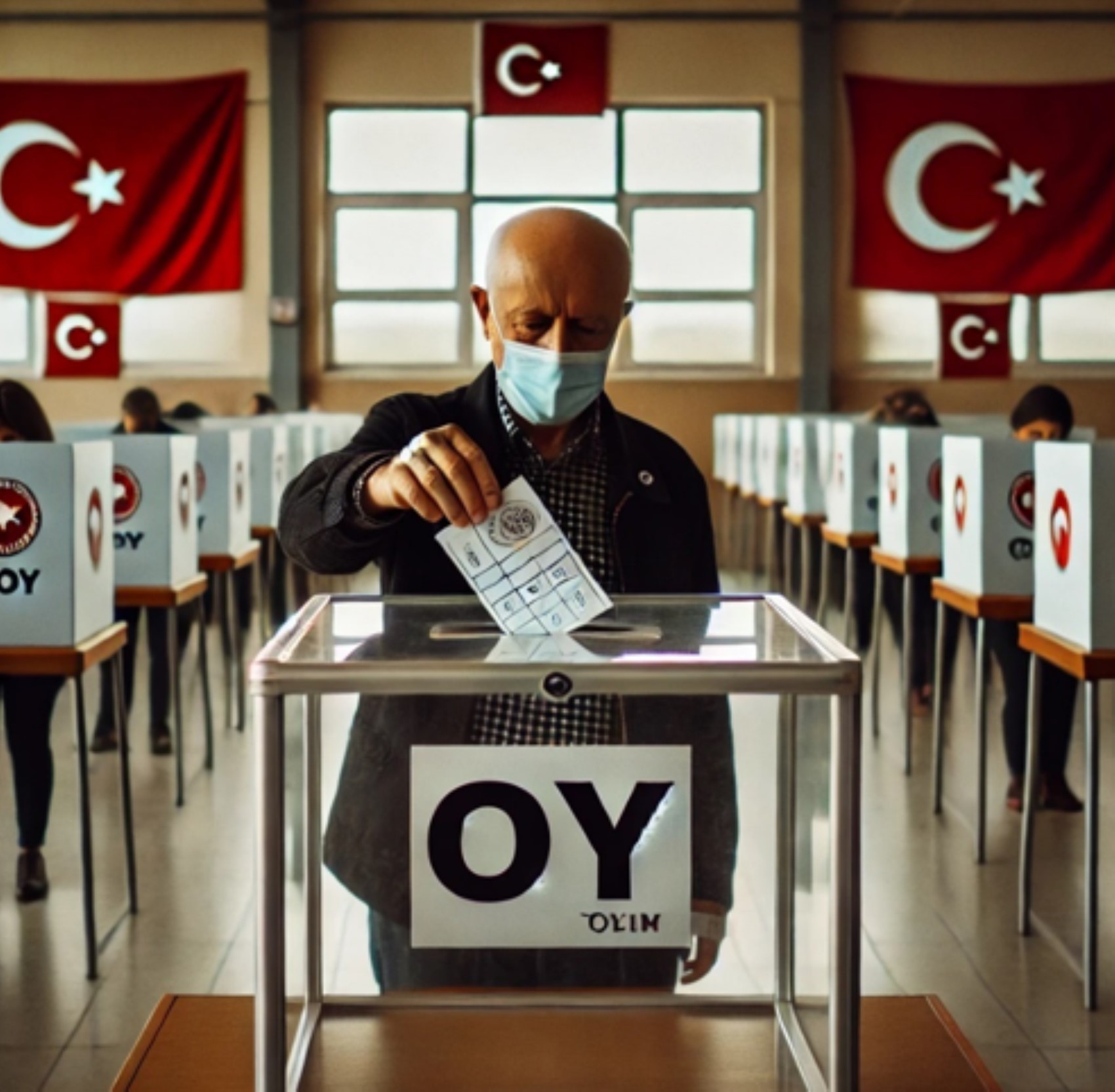
(The sacred of democracies-Vote-Representative Image-AI)
Technology now even offers the public the opportunity to vote from their homes, from where they sit.
Public opinion polls show that social trends can change every day.
Robots and Artificial Intelligence (AI) are slowly entering every field of life.
Those who cannot adapt to new conditions will remain stuck in the past and will eventually fail.
Or they will be dragged into an inevitable collapse with the wounds they have received.
Despite all kinds of evil, anti-democratic practices, and those who try to turn elections into a game of chess or backgammon, Representative Democracy is no longer enough for humanity.
Participatory Democracy, and even Direct Democracy, are pushing the boundaries and doors.
The clearest proof of this is that no one on the street likes anything and everyone has an opinion on every subject!
If the goal is social progress, the end of trying to govern the country and the state without considering the public's views and demands is disappointment.
In this context, expressions like "populism, following the tail of the public" are empty talk!
The ruling classes are striving with all their might to control and direct these developments.
But no matter what they do, history has an unstoppable flow.
***
The great 16th-century English poet William Shakespeare describes a scene at the beginning of his work titled "Timon of Athens":
The time is ancient times.
Timon is one of the richest people in Athens.
In the hall of his house, a poet, a painter, a jeweler, and a merchant among the guests are discussing how they can benefit from Timon's wealth.
The poet asks the painter: "How goes the world?"
The painter replies: "It wears as it grows."
Unless wealth is shared, our world wears out and tears!
***
Change and renewal are inevitable at every stage of life!
Perhaps the greatest wealth humanity possesses is the ability to change and develop!
This is true not only for individuals but also for societies and politics.
Ways of living and governance must also be renewed.
It was like this yesterday, it is like this today, and it will be like this tomorrow!
Otherwise, the reign of "One-men" will continue!
***
Primary elections to be held in future elections and in every election should pave the way for new democratic transformations and true democracy!
Participatory and Direct Democracies should become the fundamental way of life and culture of humanity!
In any case, the ultimate goal is a freer, more comfortable, and more honorable life.
Humanity should be covered with the shawl of democracy!
Sefa Taşkın
16.03.2025
Karşıyaka/İzmir
Most Read

Striking picture for Özgür Özel's 'New Party'

The PKK opening and Özgür Özel’s path!..

How did the newspapers view Özgür Özel's farewell to the CHP?

He killed his wife by slitting her throat: Their children witnessed the moments

What did the CHP do?

Özel’s new party move in the world press

The New CHP, against CEHAPE

Fire at TUSAŞ engine factory in Eskişehir under control

From self-efficacy to despair

Kılıçdaroğlu's first message on Özgür Özel's new party announcement