



What was there in the beginning?
This article is the first in a three-part series that tells the story of humanity in the context of the first traces of humans similar to us, recently discovered in İzmir. The continuation of the series will be published in the coming weeks in the 12 Punto online newspaper.
We say it often. We do not forget.
The owner of the property, the owner of the land, where is its first owner?
Not owning property feels like being left naked to us.
We have been conditioned this way from generation to generation.
But we cannot own the means of production.
They have very powerful owners.
New Imperialism is the owner of the world.
Techno-feudals are the owners of us, who are each a content creator.
Digi-capitalists are the owners of our labor.
Of course, this situation was not like this in the very, very distant past.
No one was the owner of anything.
Humans hunted and gathered only as much as they needed. They shared the excess or what they had gathered and hunted together.
Perhaps they wanted to accumulate to live safely, but they did not yet know how to make pots and pans to store things.
Over time, humans made tools, improved what they made, and established production relations that fit the productive forces they created.
They walked, walked, walked, and arrived at these days.

(Modern Human)
***
For many years, humanity did not know how it began this walk.
Who was human?
Why and how did they have a mind that many living things do not have?
Depending on the environment they lived in, they sought divine answers to these!
Over time, in the process we call evolution, they acquired the ability we call the mind.
By researching the very old and long dark times, by increasing the store of knowledge they called science, by connecting the inferences they made from what they learned and drawing conclusions, they began to know the unknown and to disperse the darkness.
Humans have known since Heraclitus of Ephesus, 2500 years ago, that change is the fundamental rule of the universe.
Scientists can now explain human existence and change through evolution, which has very strong foundations.
New findings in this direction open new horizons every day.
Today, we will talk about how the first humans who resembled us emerged, how they spread, and how they came to these lands, to Anatolia.
Inspired by the traces recently found around İzmir.
So who were these first humans of İzmir?
What was there at the very, very beginning?
Perhaps this will help us better understand ourselves, our environment, and our society!
***
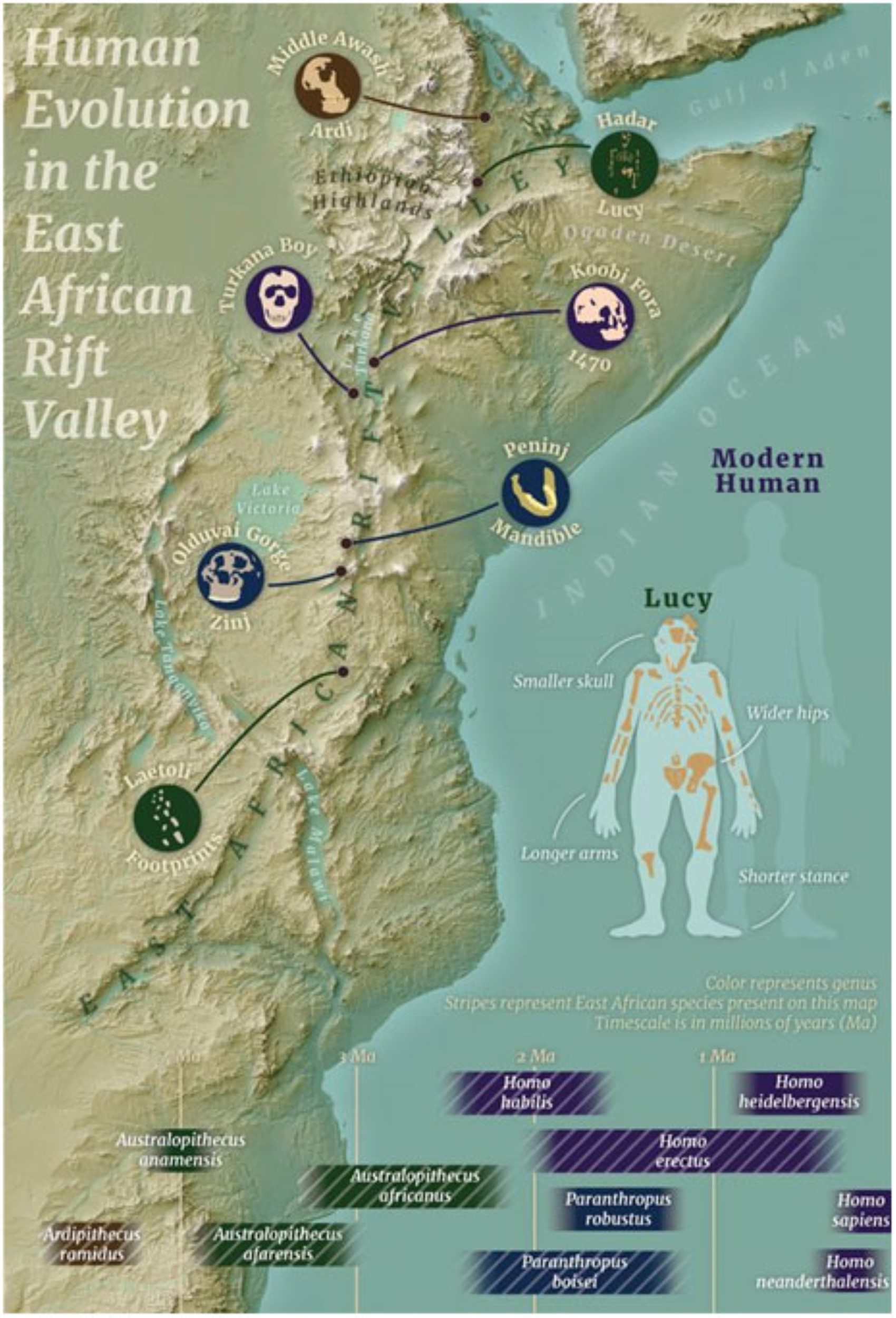
(The Rift Valley in East Africa and the first hominids)
Of course, there is no complete certainty on these subjects yet. Most of the information consists of rational hypotheses based on strong evidence produced to understand the truth.
The time is so distant, so dark!
According to the inferences made by today's scientists on the limited findings available, the adventure of humanity began approximately 7-5 million years ago in Central West Africa, in the lands we call Ethiopia today, formerly Abyssinia, and its surroundings.
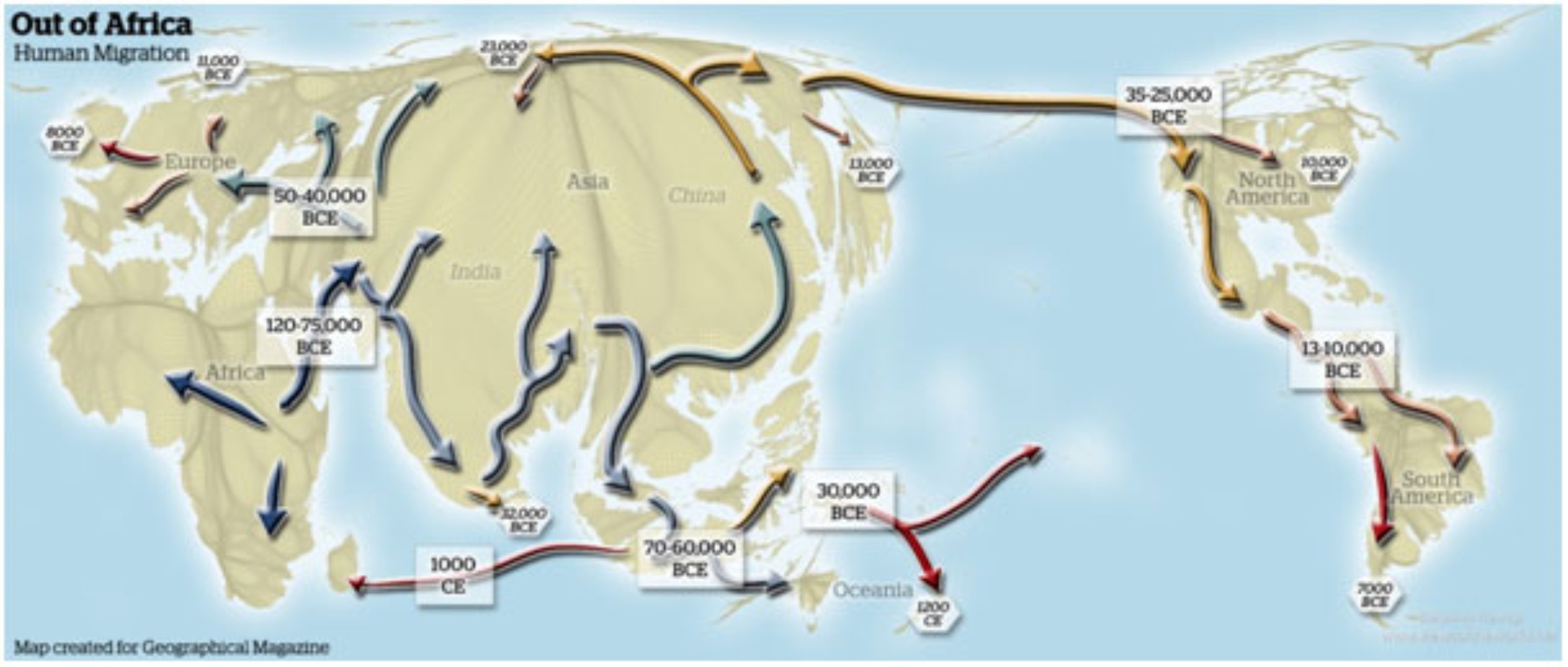
(The spread of humans/hominids to the world)
At that time, a being that was the common ancestor of chimpanzees and humans was living in vast forests along with its peers and many other living species. The forest was their home.
They were continuing their lives on their own, in their own environmental conditions.
In those years, a major climate change occurred in Africa.
The reason for this was the separation of two large land masses, West Africa and the Somali mass facing the Indian subcontinent; it was the result of this tectonic movement.
Scientists report that this separation continues very slowly today.
The high level of volcanic activity in the region, and the fact that the ashes spewing from volcanoes covered living or dead creatures, preventing them from disappearing completely, caused the remains we call fossils, the traces of the living things of that time, to remain from millions of years ago to the present day. There were many fossils in this region.
During the process of this separation and the emergence of the giant rift that formed, a valley called the Rift, 6000 km long from south to north, was formed 5-7 million years ago.
This new formation changed the climate of Africa in this vicinity.
West Africa turned into a rainforest, and East Africa turned into a dry savanna/steppe.
This climate change is seen as one of the main factors that brought our ancestors down from the trees to the ground. This was the being that was the common ancestor of chimpanzees and humans.
When the forests dried up in this jarring environment, areas with sparse trees called savannas expanded. The “common ancestor of humans and chimpanzees” living in the wooded area diverged.
While chimpanzees and their likes held on in the forest, the other branch had to adapt to this open terrain to survive.
Walking upright on the ground, seeing the horizon, freeing the hands; change was born from this pressure.
The other branch, the chimpanzee, was already successful in its own environment. The forest gave it everything. There was no evolutionary pressure. It did not have to change. It still lives there.
Those who remained in the open area, outside the protective environment of the forest, were forced to continue their lineage, and this compulsion opened the path leading to humanity.
We generally call this change and transformation “evolution.”
We understand evolution as the process by which living species undergo hereditary changes by adapting to the environment over generations, and through these changes, transform or diverge into new species over time.
We see evolution as the fundamental mechanism that allows living things to survive and reproduce in changing environmental conditions. If it didn't exist, all life would have remained in its first single-celled form.
In this context, while searching for the first humans of Anatolia in İzmir, we will carefully follow the evolution of humans.
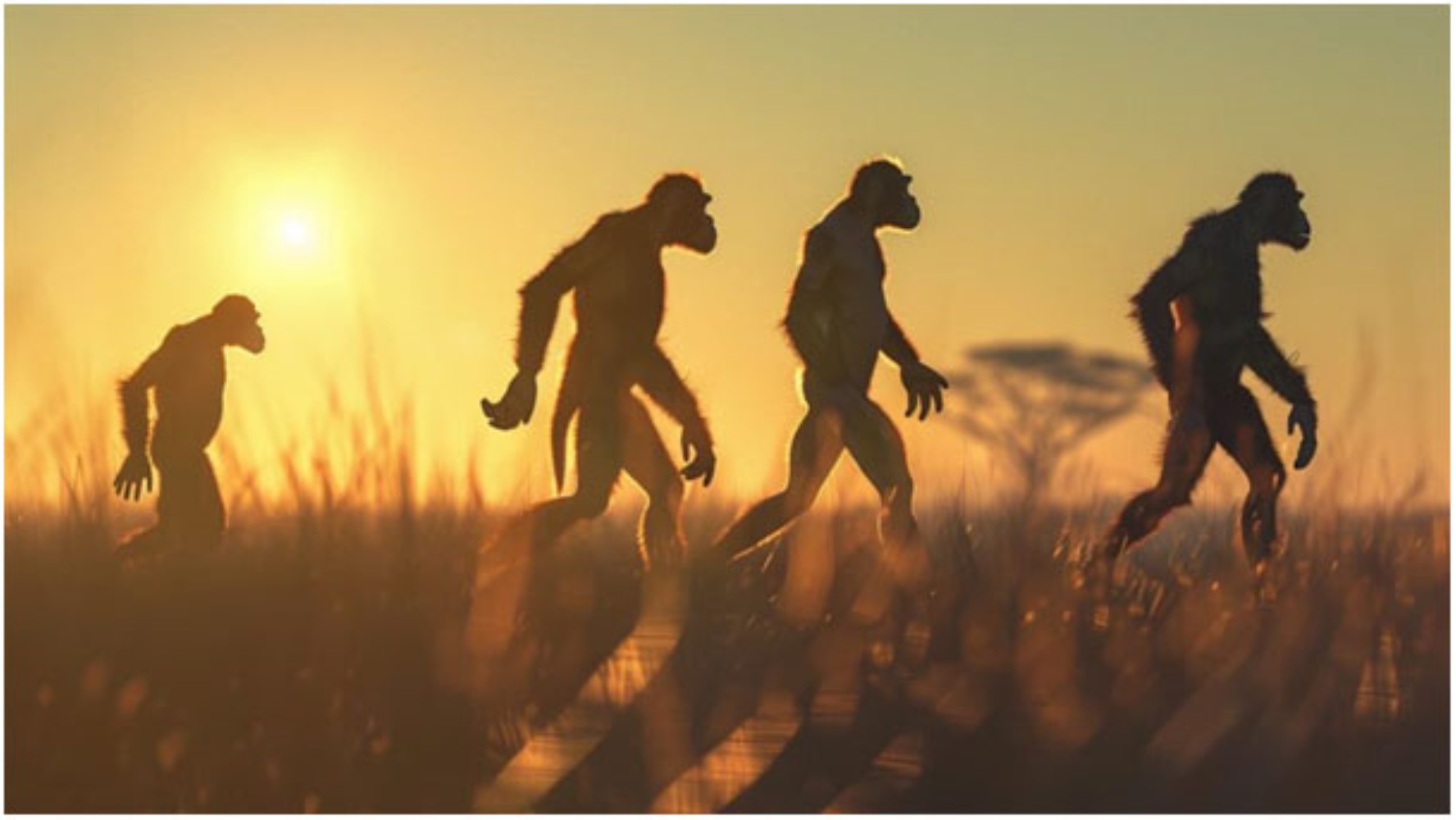
(Hominids on the migration route)
***
According to strong but controversial theories on this subject, when the “ancestor of humans” walked upright and their hands were freed, it became easier to make tools and gather food.
Less energy was spent while walking on two feet; when standing upright, less body surface was exposed to the sun, making it easier to survive in the heat of the open area. Distant distances could be observed, and danger in the open terrain could be detected in advance.
When the hands were freed, the brain grew: When the hands were freed by upright walking, tool making began. Tool making required complex thinking. Complex thinking grew the brain. The growing brain made more complex tools. Thus, a self-feeding cycle was formed.
The growing brain made social groups more complex. Complex social life developed communication. Communication gave birth to language. Language grew the brain even more.
Human evolution is not a story of superiority, but a story of necessity.
Our ancestors changed not because they were better, but because they had no other options left.
***
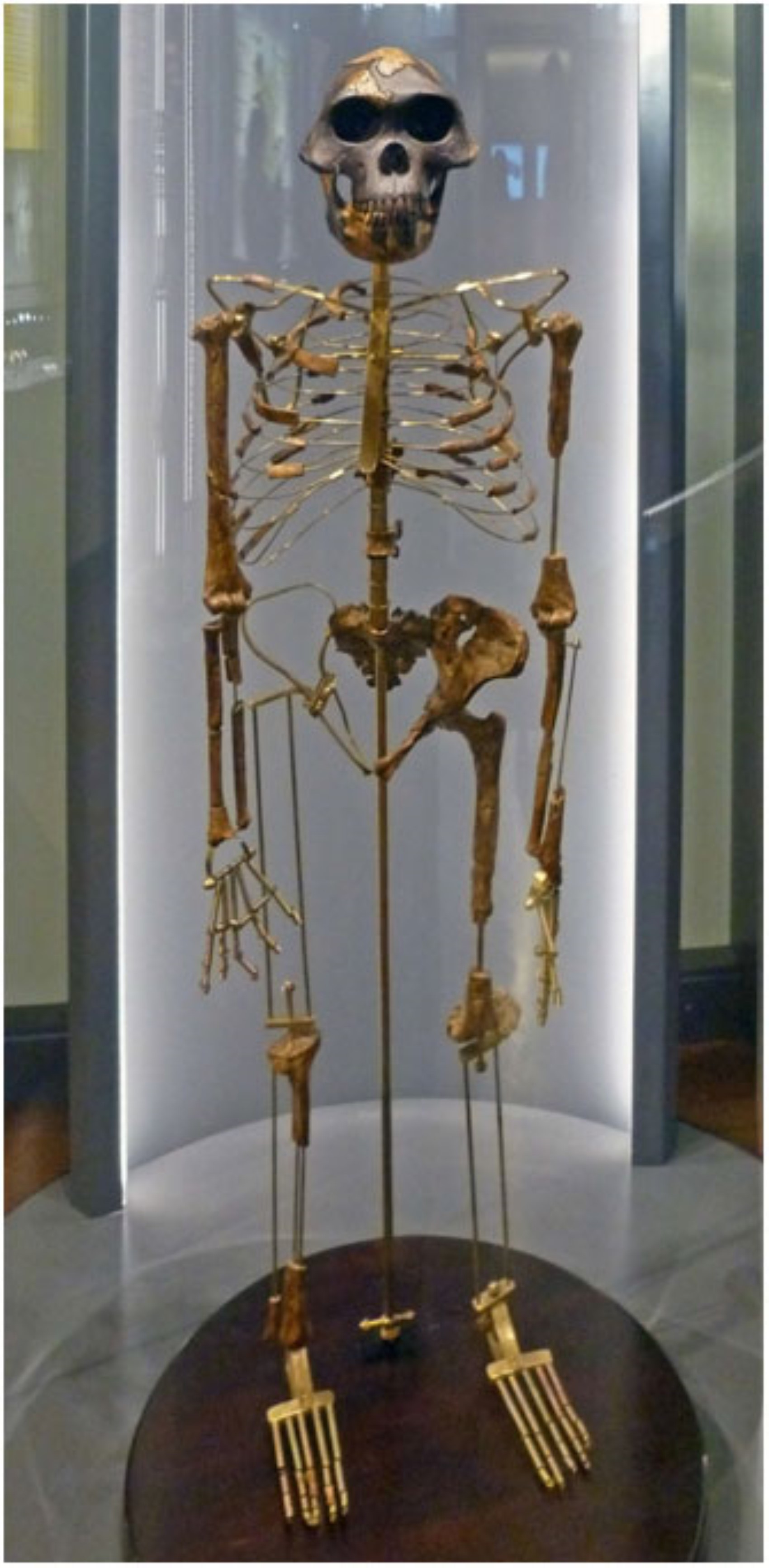
(Lucy's skeleton - National Museum in Addis Ababa, Ethiopia. The original is usually kept in storage. The one in the picture is the exhibited copy)
The first archaeological evidence of the evolution of humanity was found on November 30, 1974, in the Hadar valley in the Afar region of Ethiopia.
The remains of the creature extracted from the excavation were 40% of a skeleton.
It was dated to approximately 3.2 million years ago.
In the examinations, it was understood that the creature resembled a chimpanzee but walked upright. This was a very important difference.
It was determined that the brain volume was close to that of a chimpanzee, 400 cm3. A normal human's brain volume is 1350 cm3.
While archaeologists were celebrating their discovery at the excavation camps that night, the Beatles' song "Lucy in the Sky with Diamonds" was playing on the tape recorder. Because of this, they named the hominid found “Lucy.”
It is thought that Lucy, who is understood to have lived 4 million years ago, continued her existence until 2 million years ago.
Lucy's fossil is exhibited today at the National Museum in Addis Ababa, the capital of Ethiopia.
Scientists call Lucy “Australopithecus afarensis” (a hominid found in the south, in the Afar region).
Ethiopians are very honored that the first hominid, Lucy, lived in their own country.
Lucy's story did not end there. Evolution had not stopped. On the contrary, it continued to progress slowly but steadily for millions of years.
***
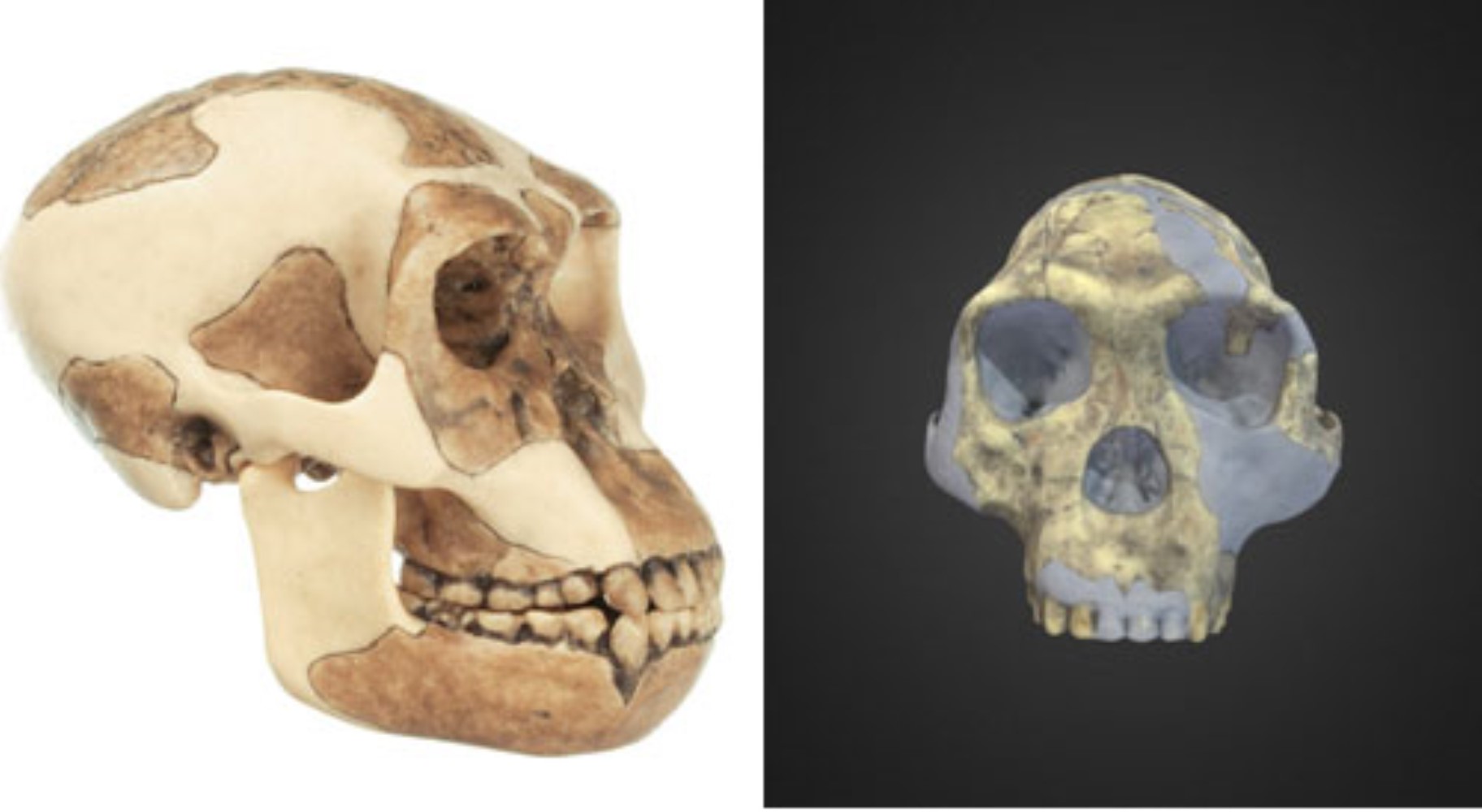
(Homo Habilis. The one on the left is a replica made with the SOMSO reconstruction method, the one on the right is the model called OH24/Twiggy, which was heavily damaged when found and then reassembled)
Very interesting information was also obtained from the fossil of another hominid discovered in 1960, again in Central Africa, in the Olduvai Gorge in Tanzania, even before Lucy. Its age was 2.4 million years ago.
Its age was closer to our time than Lucy's.
Chipped stone tools and animal bones were found next to the fossil.
So it was making tools and eating meat.
Scholars named this being “Homo Habilis.” “Homo” means human, “Habilis” means skillful, capable of doing work.
Its brain was larger than Lucy's, but although it was smaller than the brain of today's human, at 600 cm3, it could make tools.
Homo Habilis is the first living thing to make stone tools in a systematic way.
This hominid, which was more evolved than Lucy, never left Africa. It did not migrate anywhere else.
It is predicted that it continued its existence until 1.4 million years ago.
The ancestor of humans was evolving as “Lucy” -> “Homo Habilis = Skillful Human.”
Of course, other hominid, human-like species that could not maintain their existence during this long period of time may have emerged and gone extinct. Perhaps their traces can also be found over time.
***
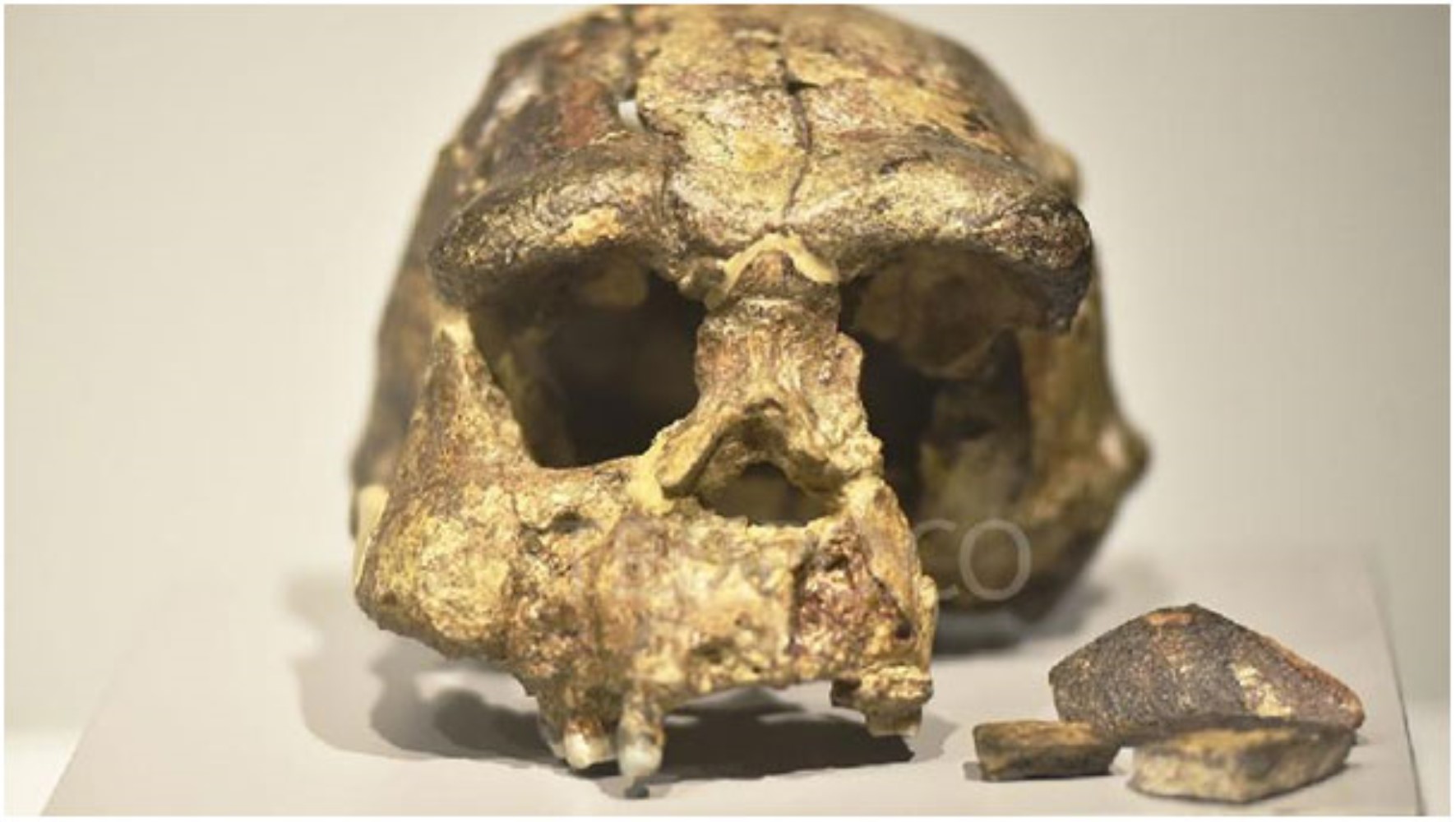
(Java man/Homo Erectus fossil skull. National Museum of Indonesia)
Evolution was continuing.
The real big leap on the path to humanity occurred 2-1.8 million years ago.
The upper part of a skull and a thigh bone of a hominid found in Indonesia in the Far East in 1891 opened a new window for research.
It was named “Pithecanthropus erectus.” This expression means “upright-standing hominid” in Greek.
The name comes from the most striking feature of this species: It was understood that this being walked completely upright and balanced.
This thigh bone found on the island of Indonesia/Java was very similar to that of modern humans. It showed that the owner of this bone walked like us, not like a chimpanzee.
There was upright walking in previous species too, but it was not complete. Lucy, for example, walked upright, but her body was still partially adapted to life in trees.
“Java man” was a fully bipedal being. That is why it was given the name “Homo Erectus,” “upright-standing human.”
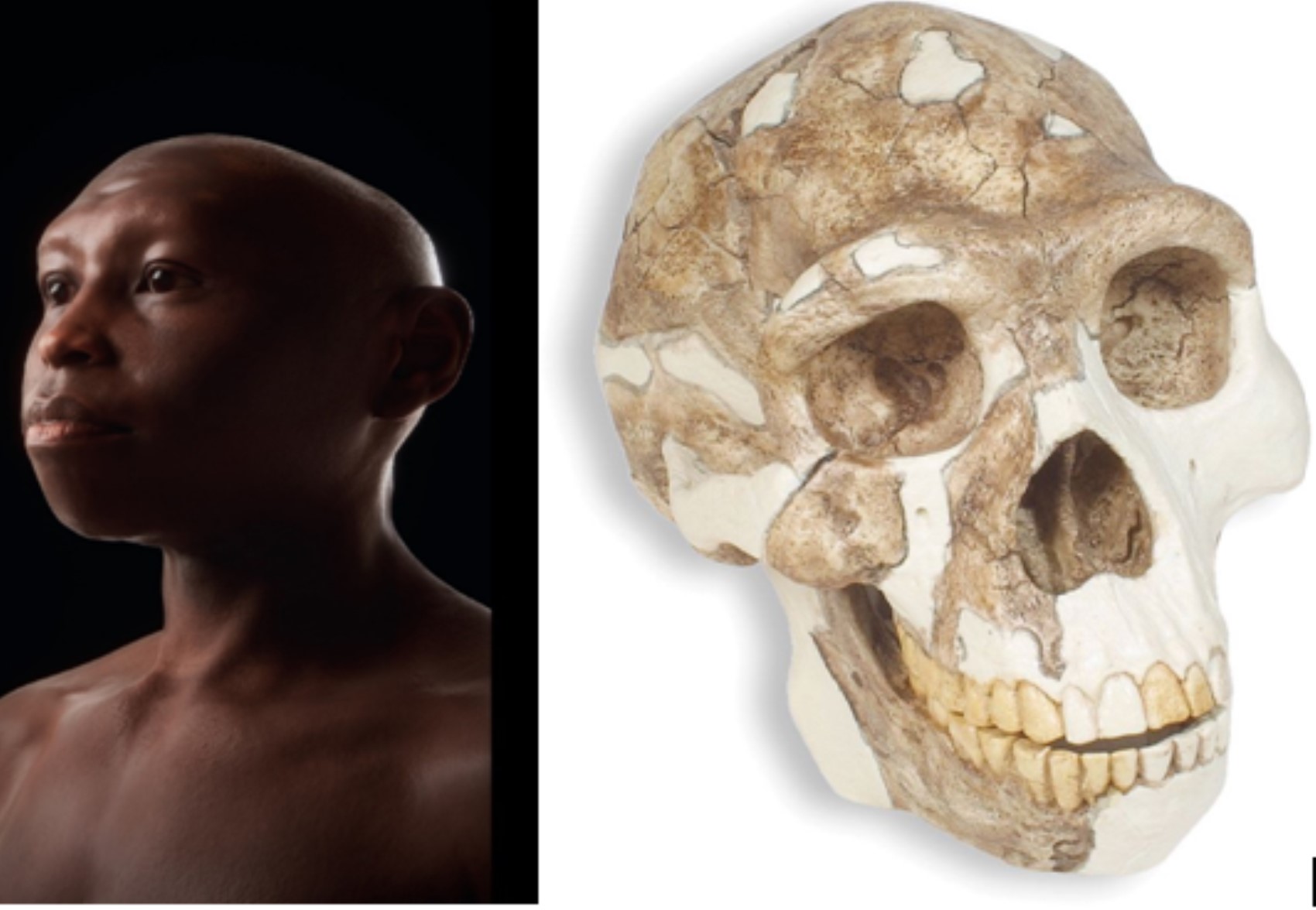
(Left: Homo Erectus/Female. Smithsonian Institution - "Reconstructed Faces" series — work by sculptor John Gurche. Reconstruction / Right: Homo Erectus-Peking man. Image source: Encyclopaedia Britannica)
Its brain volume was also larger than previous hominids, at 900 cm3. It was larger and had a bigger head.
This meant that its thinking capacity was greater.
Homo Erectus used fire and could produce hand axes from chipped stone.
In later years, Homo Erectus fossils were also found in Africa.
It was understood that the bone remains found in Java were from about 1 million years ago, and the oldest of those found in Africa were from about 2 million years ago.
So, first there was Homo Habilis, then Homo Erectus appeared. It evolved from it or its likes.
“Homo Habilis = Skillful Human,” a species less developed than Homo Erectus, never left Africa, but “Homo Erectus = Upright-Standing Human” spread to the whole world through migrations.
In its journey extending to Indonesia, it must have passed through the Levant and also sheltered in Anatolia.
Thanks to its more developed body structure and the tools it produced, Homo Erectus lived more easily than previous species, which allowed its population to increase. As a result, food sources in the places where it emerged in Africa became insufficient for their increasing numbers.
Due to the drying of Africa as a result of the climate changes that occurred, following the migrating herds of game animals also made new searches mandatory.
The tool technology they developed; making “bifacial hand axes” with the stones they chipped made long journeys possible.
This technical invention was a tremendous breakthrough for that time. They could cut everything easily. They could protect themselves more easily.
For such reasons, Homo Erectus left Africa approximately 1.85 million years ago. They were the first hominids to set out on a migration.
They left Africa and spread to the Caucasus, Asia, and Europe. They also reached Anatolia. Anatolia was the bridge of this journey.
Their fossils were found in China, Georgia, and Anatolia-Denizli.
Had they also come to the vicinity of İzmir, I wonder?
They had succeeded in spreading to the whole world.
Human evolution continued as “Lucy” -> “Homo Habilis = Skillful Human” -> “Homo Erectus = Upright-Standing Human.”
But Homo Erectus was not the end either. The transformation was continuing. This time, a much more complex being would appear on the stage.
According to archaeological data, it is reported that Homo Erectus maintained its existence until more recent times, 110 thousand years ago.
***
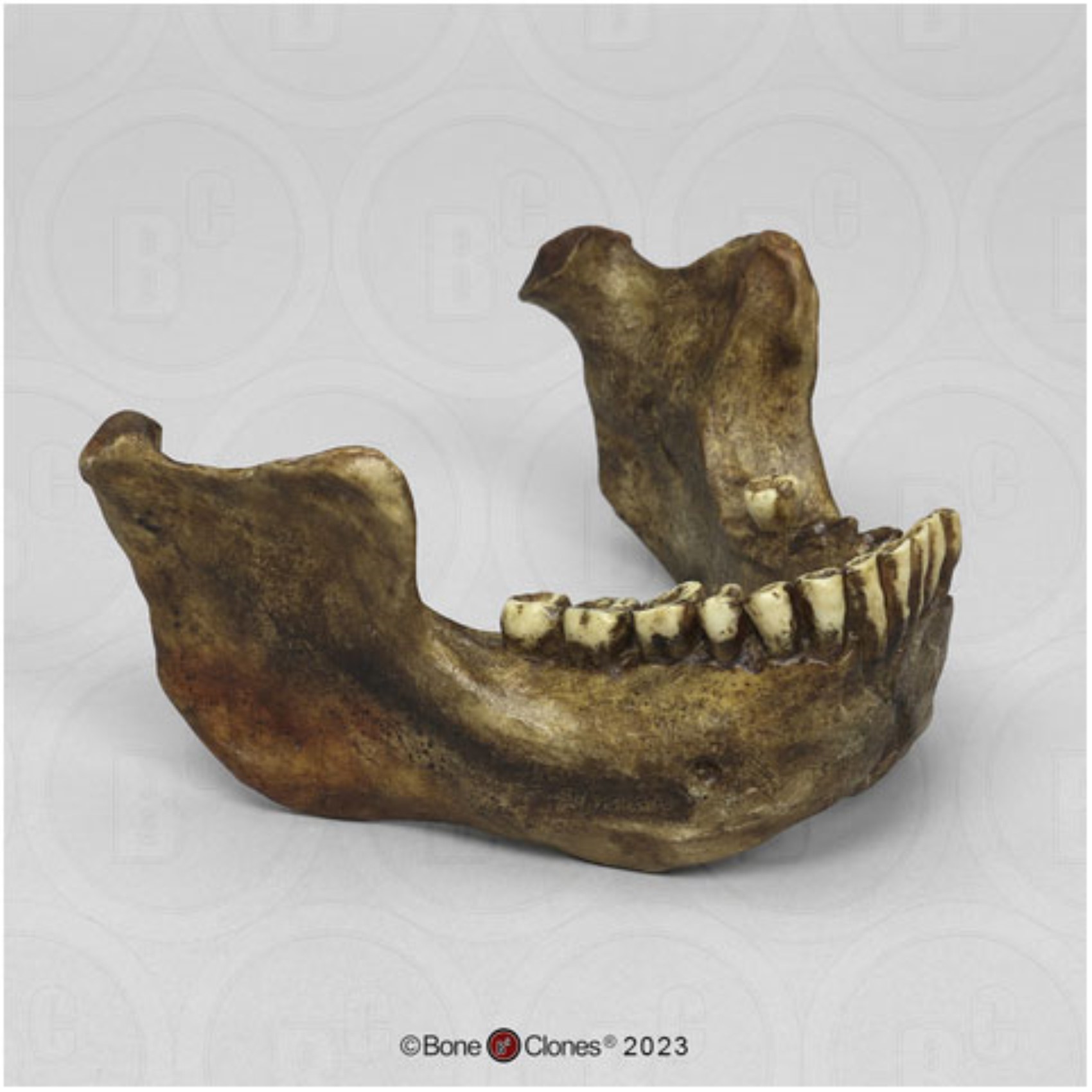
(Homo Heidelbergensis jawbone. Mauer mandible replica)
A fossil fragment discovered by chance by a sand pit worker in the village of Mauer, near the city of Heidelberg in Germany, in 1907, allowed for the completion of a very important link in the evolution of humanity.
The fossil, which was understood to be a part of a hominid, was dated to approximately 600 thousand years ago. It was determined that the brain volume of the being was 1,200 cm3.
Change continues; physical structure develops, the brain grows, and thus abstraction increases.
Scientists called this species “Homo Heidelbergensis,” referring to the place where it was found.
It is predicted that it began to diverge and transform from Homo Erectus, the developed hominid species before it, approximately 700 thousand years ago.
In other words, while Homo Erectus was maintaining its existence, one branch had transformed into Homo Heidelbergensis.
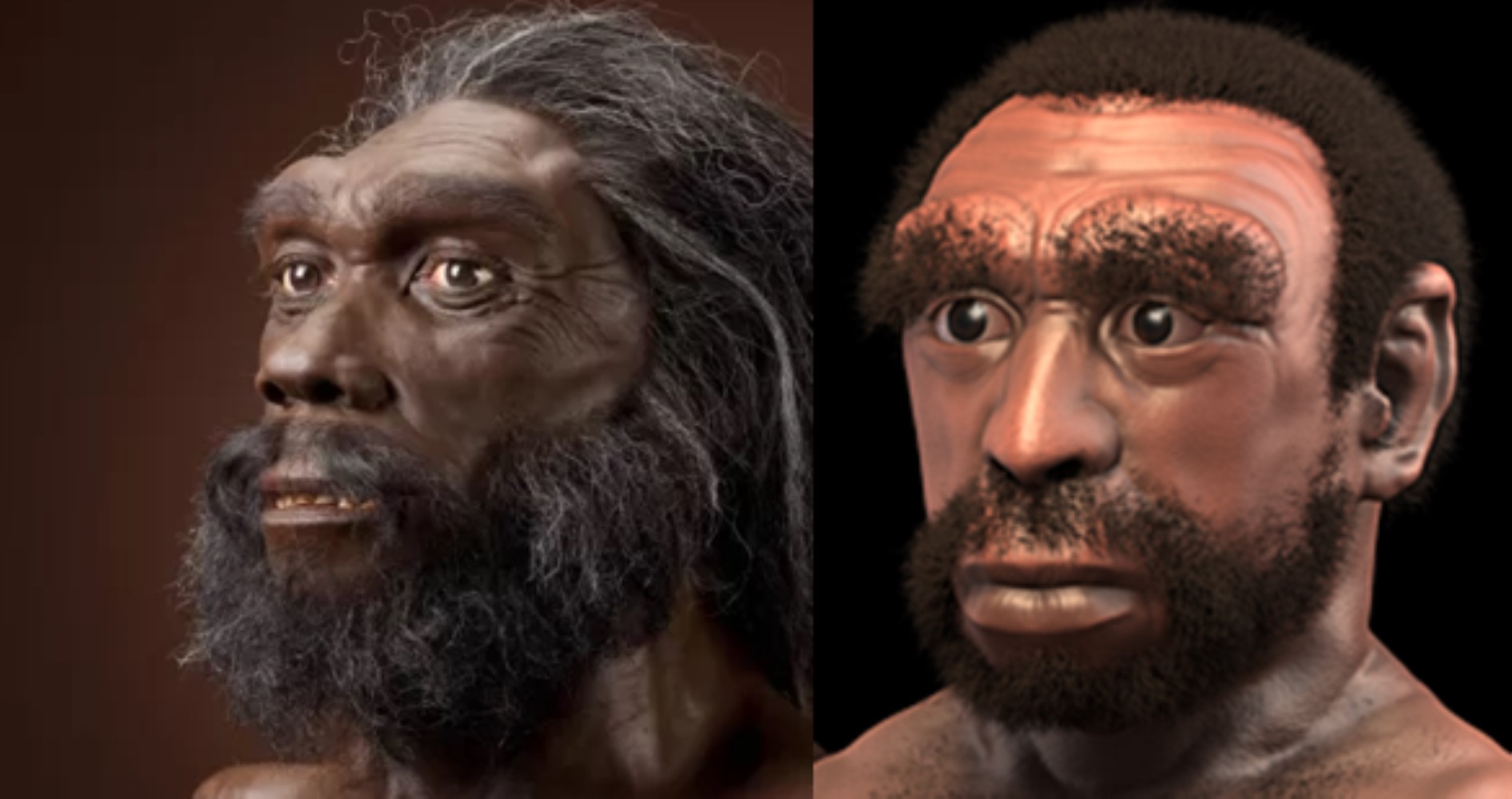
(Left: Homo Heidelbergensis - Smithsonian Institution / Right: Homo Heidelbergensis. Common Wikipedia)
The one found in Germany was only a “lower jawbone” of this new species, but it was extremely well-preserved and told scientists very important things.
The tooth structure of this jawbone was close to modern humans, but much larger and stronger. The underside of the jaw was flat, and there was no prominent protrusion as in modern humans.
The species indicated by the jawbone fossil carried features of both Homo Erectus and Homo Sapiens (today's human).
Scientists evaluated this species as a transition form towards today's human.
In later years, a jaw found in Germany with the same features, a skull in France, a skull in Africa-Zambia, and the remains of 28 individuals in Spain strengthened this view.
From the traces found in Atapuerca in northern Spain, it was understood that this species left their dead in a special cave. This was one of the oldest known examples of this ceremonial behavior.
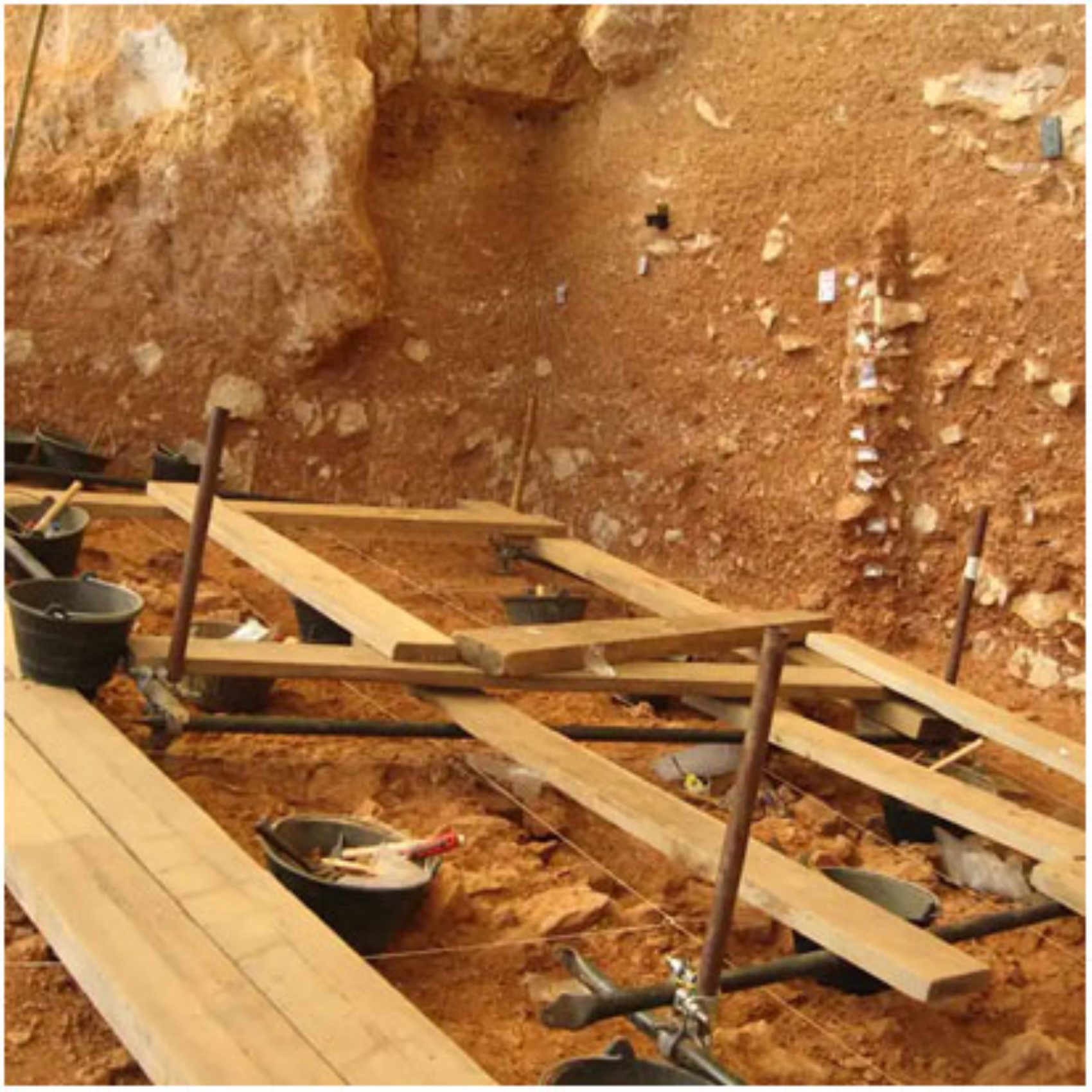
(Excavation site in Atapuerca, Spain)
Traces of Heidelbergensis, which evolved from Erectus, were seen in both Africa and Europe.
Heidelbergensis communities that emerged in Africa migrated north. There were also Erectus in the places they went.
There was constant coming and going and mixing with Homo Erectus. This spread occurred 700-400 thousand years ago.
According to strong hypotheses; in addition to factors such as population growth and following game animals, climate cycles/change were the cause of these migrations.
During this process, the Earth began to experience climatic change again. It entered a major glacial period 700 thousand years ago.
When the glaciers moved south, northern Africa dried up, and southern Europe became temperate.
Homo Heidelbergensis managed to adapt to these oscillations and progressed.
In this environment, they were able to make spears. These tools made long-distance hunting and therefore spreading to distant geographies possible.
With sticks to which they attached sharp and piercing chipped stones at the tip, they could both strike the prey without getting too close and keep wild animals away, protecting themselves more easily.
An example of this; wooden spears with chipped stone tips dating back 400 thousand years were found in Germany.
It is stated that Homo Heidelbergensis disappeared 200 thousand years ago.
The reason and how are unknown.
Had the feet of these hominids touched the soil of İzmir in Anatolia by those days, I wonder?
Had they bathed in the warm waters of the gulf?
The seeds of Heidelbergensis gave different fruits in different climates.
However, a completely different human was being born in the glacial cold of Europe.
***
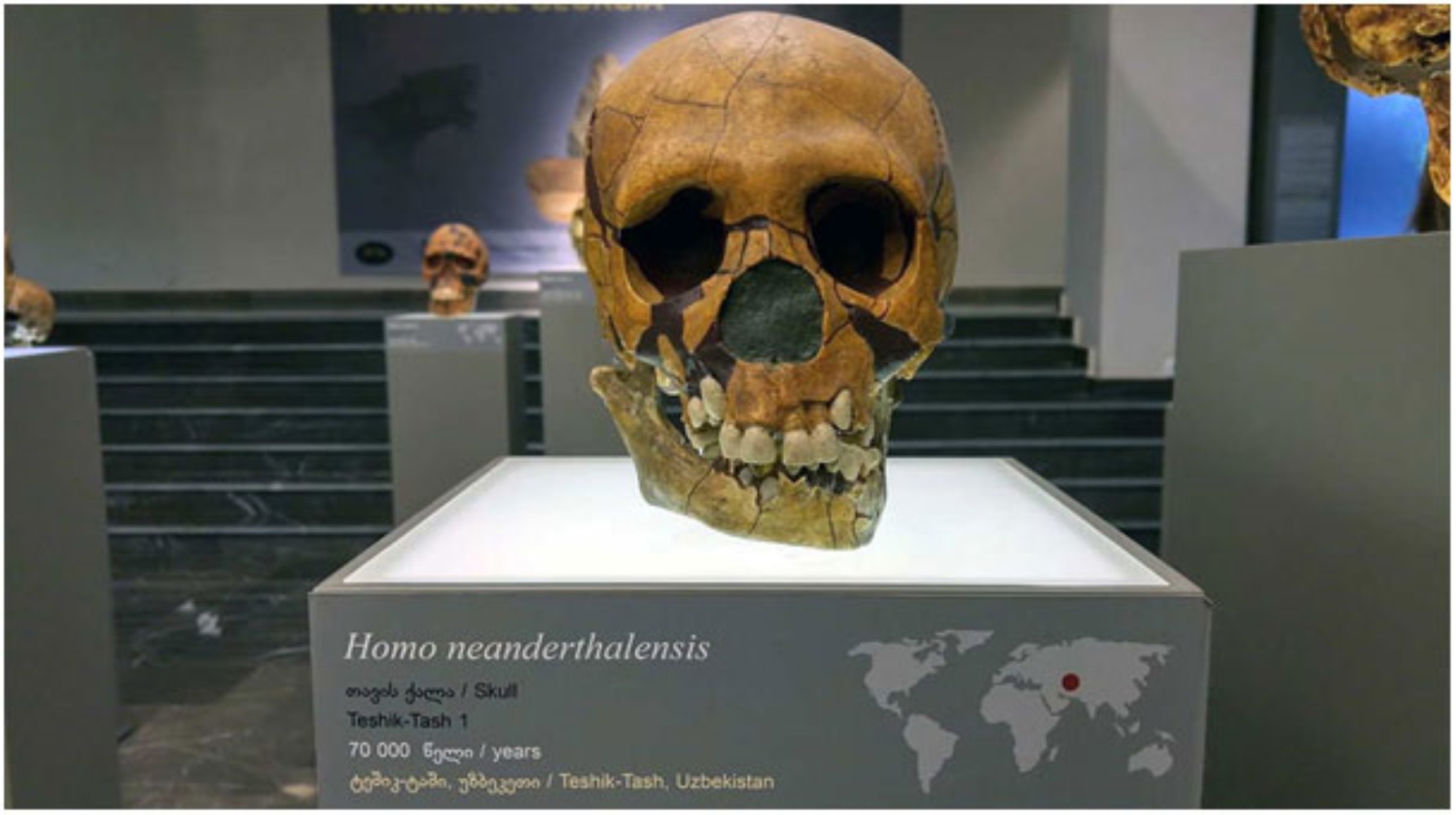
(Homo Neanderthalensis. The collector.com)
In 1856, in the Neander Valley near the city of Düsseldorf in Germany, a fossil different from those found before appeared in a limestone cave, the Feldhofer Cave.
Quarry workers had encountered some bones while cleaning the cave. At first, they thought they belonged to a cave bear and threw some of them away. Fortunately, a teacher in the region understood that these were different objects, collected the remaining bones, and took them to an expert.
The findings were the upper part of a skull and a few bones. The brow ridges of the skull were very prominent, and the forehead was retracted. It was clearly different from modern humans.
Similar fossils had been found in Gibraltar, Spain, and Belgium before the one found in Neander, but the idea of evolution was still very controversial at that time.
Charles Darwin's book “On the Origin of Species,” which would place the subject of evolution into a scientific framework, would be published in 1859.
(Charles Darwin 1812-1870)
Actually, this fossil was not the first Neanderthal found, but it would be the one that defined the species.
What these fossils belonged to was debated among scholars for many years.
It was clearly understood that these did not belong to modern humans.
The examinations indicated that the findings belonged to a body whose brow ridges were abnormally large and prominent, whose forehead was retracted and flat, whose skull was long and low compared to the round and high skull of modern humans, whose bones were very thick and heavy, and whose muscle traces were extremely strong.
The discovery of more than 800 Neanderthal bones belonging to dozens of individuals in the Krapina cave in Croatia in the Balkans in 1899 effectively ended this debate. There was a population spread over a wide geography with clearly definable, consistent anatomical features.
In the genetic examination conducted in 2010, it was definitively determined that these fossils belonged to a separate hominid.
They were called “Homo Neanderthalensis.”
It is predicted that Neanderthals began to diverge from Heidelbergensis 700 thousand years ago, and their full emergence was approximately 400 thousand years ago. But this was not a sudden emergence; it was the result of a long evolutionary process.
In other words, Homo Heidelbergensis had evolved from Homo Erectus, and it had transformed into Homo Neanderthalensis from Homo Heidelbergensis.
Human evolution continued as “Lucy” (Australopithecus afarensis) -> Homo Habilis (Skillful Human) -> “Homo Erectus (Upright-Standing Human) -> Homo Heidelbergensis -> Homo Neanderthalensis.
The evolution of Neanderthals from Homo Heidelbergensis occurred in both Europe and Western Asia. In other words, the Neanderthal was not of African origin.
So it did not migrate from Africa; it evolved in Europe, adapting to the cold climate, from the Heidelbergensis that came from Africa.
After Homo Heidelbergensis took root in Europe, the continent entered glacial periods.
These communities, which were exposed to severe cold for hundreds of thousands of years, changed over time.
Their bodies evolved into having a wide nose to warm the cold air, a short, stocky body to reduce heat loss, large eye sockets to increase vision in low light at northern latitudes, and a strong jaw structure and teeth to digest hard food.
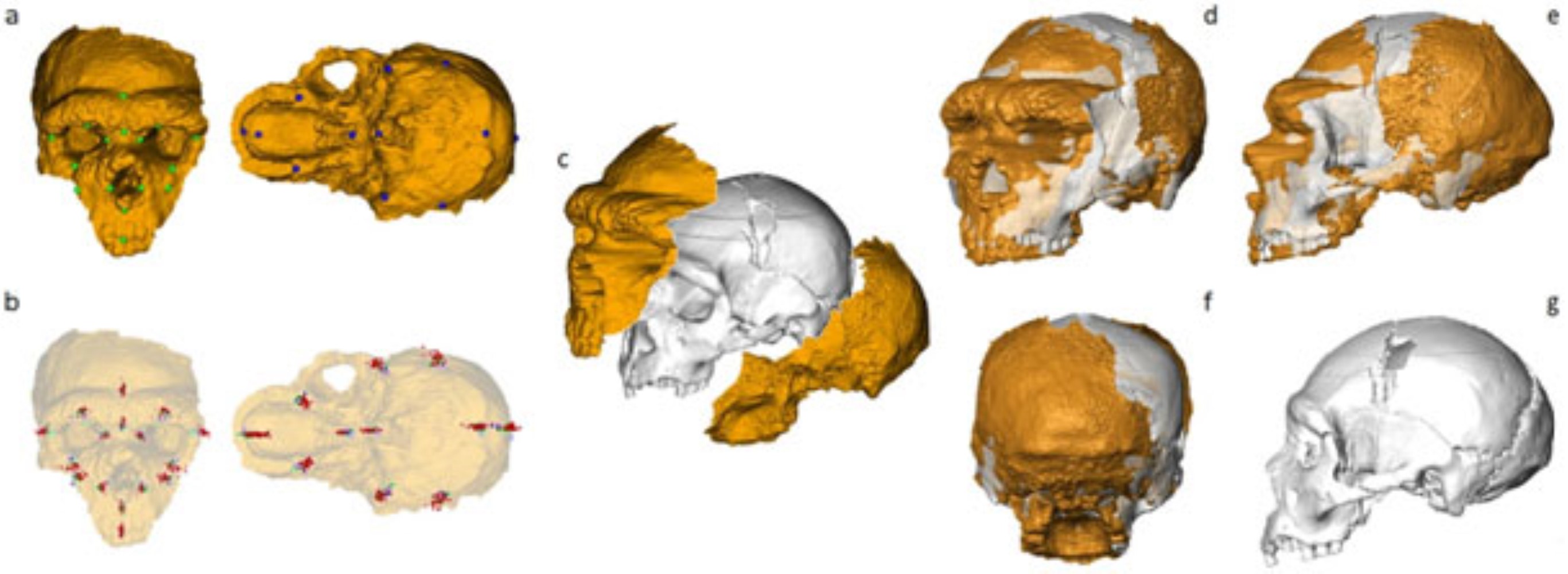
(Homo Neanderthalensis skulls. Animalia-life.club)
Their brain volume was 1400-1500 cm3. Their heads were slightly larger than modern humans.
These were all structural reflections of adaptation to the cold climate.
Neanderthals reached their most mature state approximately 130 – 40 thousand years ago. They possessed a certain degree of mind and intellect.
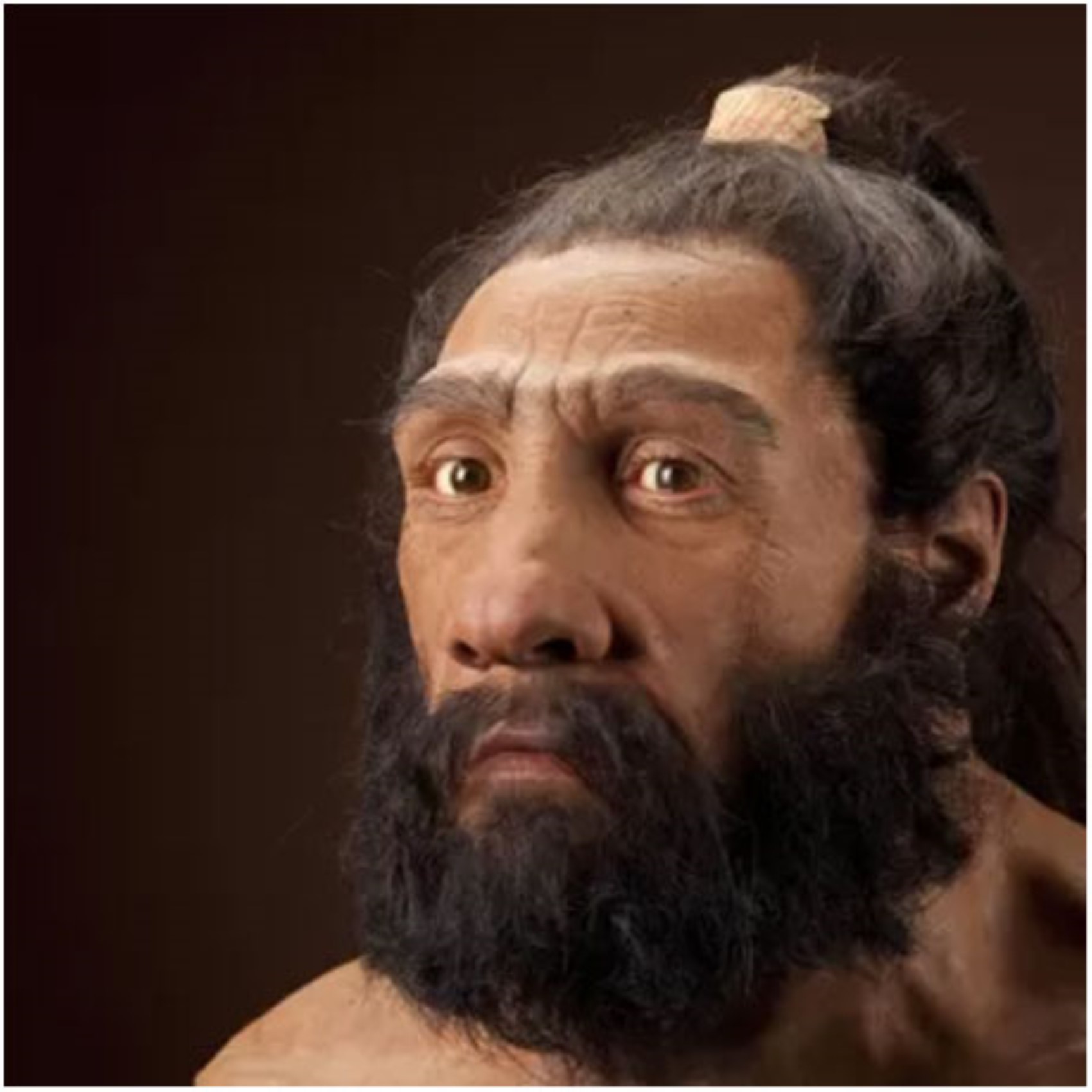
(Homo Neanderthalensis. Smithsonian Institution)
It was seen that they developed a new and more advanced culture. In this period: they buried their dead, put flowers in their graves, used paint, made jewelry, developed complex hunting methods, and took care of their sick and elderly.
These were emotions, thoughts, and actions similar to the behaviors of today's humans.
One day came, and they too withdrew from the world stage.
It is not known for certain why Neanderthals went extinct, but there are very strong hypotheses on this subject:
Competition for food resources with the arrival of Homo Sapiens (today's human), which evolved from Homo Heidelbergensis, in Europe; diseases caused by new microbes they brought; the hardening of the last ice age; and their genetic melting by mixing with Sapiens (modern human) are accepted as strong reasons.
Most likely, a combination of all of these was effective in the extinction of Neanderthals.
They disappeared 40 thousand years ago.
They disappeared, but before that, Homo Sapiens (today's human) and Neanderthals lived together for many years.
There is 1–4% Neanderthal gene in the DNA of today's humans (Homo Sapiens), Europeans, and Asians.
In other words, Neanderthals did not disappear completely biologically; they live partially within us.
***
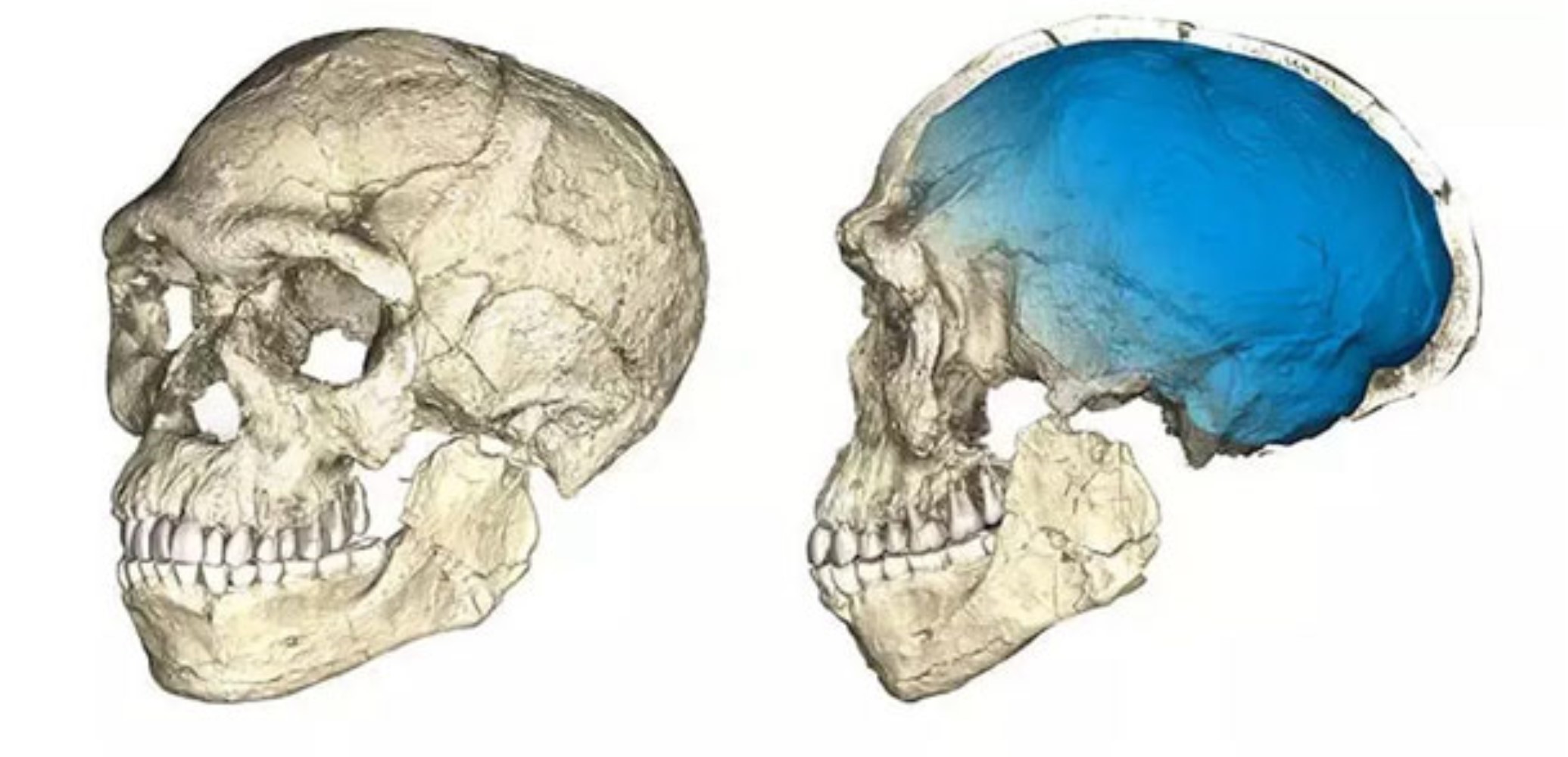
(Homo Sapiens fossil found in Jebel Irhoud, Morocco)
“Homo Sapiens,” which we call modern human, began to emerge as a different species 700-500 thousand years ago.
The dictionary meaning of “Homo Sapiens” is “Wise Human.”
They evolved from Homo Heidelbergensis along with Neanderthals.
In other words, while a branch of Homo Heidelbergensis that spread to Europe and Western Asia transformed into Neanderthals, some of those who remained in Africa diverged into Homo Sapiens.
So, the branch of Heidelbergensis that left Africa and went to Europe evolved into Neanderthals, and the branch that remained in Africa evolved into Homo Sapiens.
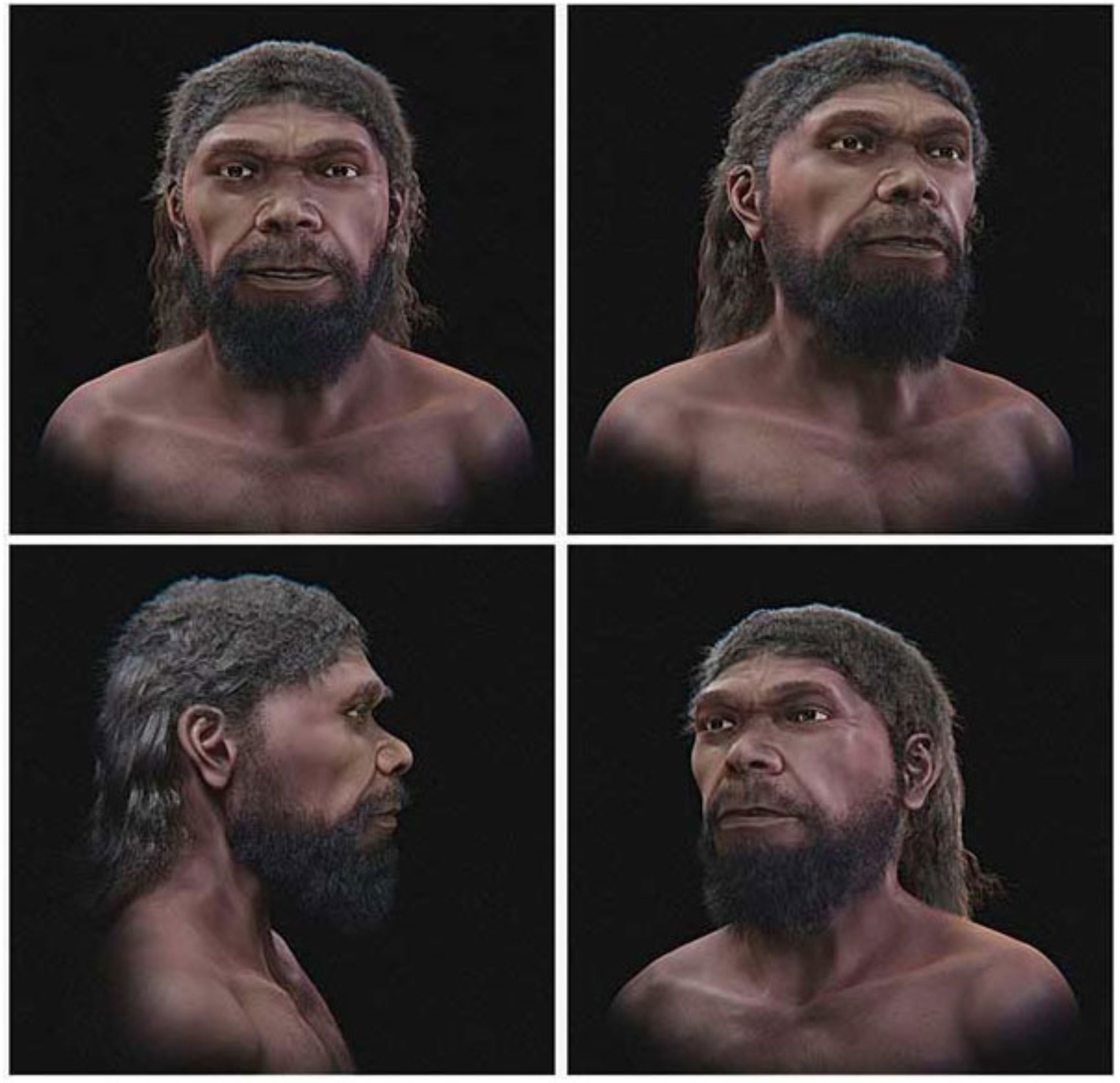
(Jebel Irhoud Homo Sapiens. Greenme.com.br)
Of course, this divergence was not a sudden formation. It was based on a long time and happened slowly.
While Neanderthals acquired their classic features 400 thousand years ago, Homo Sapiens became fully distinct 300 thousand years ago.
In other words, the Neanderthal became anatomically clear earlier, and Homo Sapiens later.
One was shaped in the cold in the north, the other in the heat in the south. Both took about the same amount of time to develop, but different results emerged.
The reason for this was most likely that Europe's severe glacial climate exerted a faster and stronger selection pressure on the Neanderthal.
It is one of the most important laws of evolution.
Those who do not adapt to the conditions go, they disappear. Those who adapt are selected.
We call the first Homo Sapiens today's modern human, but they were a little different.
It was a transition form between Heidelbergensis and our exact current state.
The skull was not as round as it is today, it was a bit longer and lower. The brow ridges were still prominent but not as much as the Neanderthal. The forehead had begun to straighten but was not complete. The brain volume was very close to modern, it was approximately 1,350 cm3.
Its face was a bit larger and more prominent than today's, it had a chin but it was not fully distinct, and its nose and cheekbones were stronger.

(First Homo Sapiens. Biolecta.com)
Its body was long-legged and slender, adapted to the African heat.
Compared to the Neanderthal, it was much thinner-boned, and its height was around 165–170 cm on average.
The fossils found in Jebel Irhoud in Morocco, in the north-west of Africa, in 2017 are dated to 315 thousand years ago and belong to the oldest Homo Sapiens known at the moment.
So, 315 thousand years ago, there were “Wise Humans = Homo Sapiens” in the world who resembled us but were not exactly us.
The facial structure of these individuals was very close to modern, but the back of the skull was still a bit long and primitive.
Scientists call them “early Homo Sapiens” or “archaic Homo Sapiens.”
In terms of behavior, Sapiens was also much cruder than we think: It spoke, but its language was probably not as complex as it is today.
They were making tools, but symbolic thinking was still limited. Art and ornaments were very rare, not systematic. They were living as nomads in small groups.
***
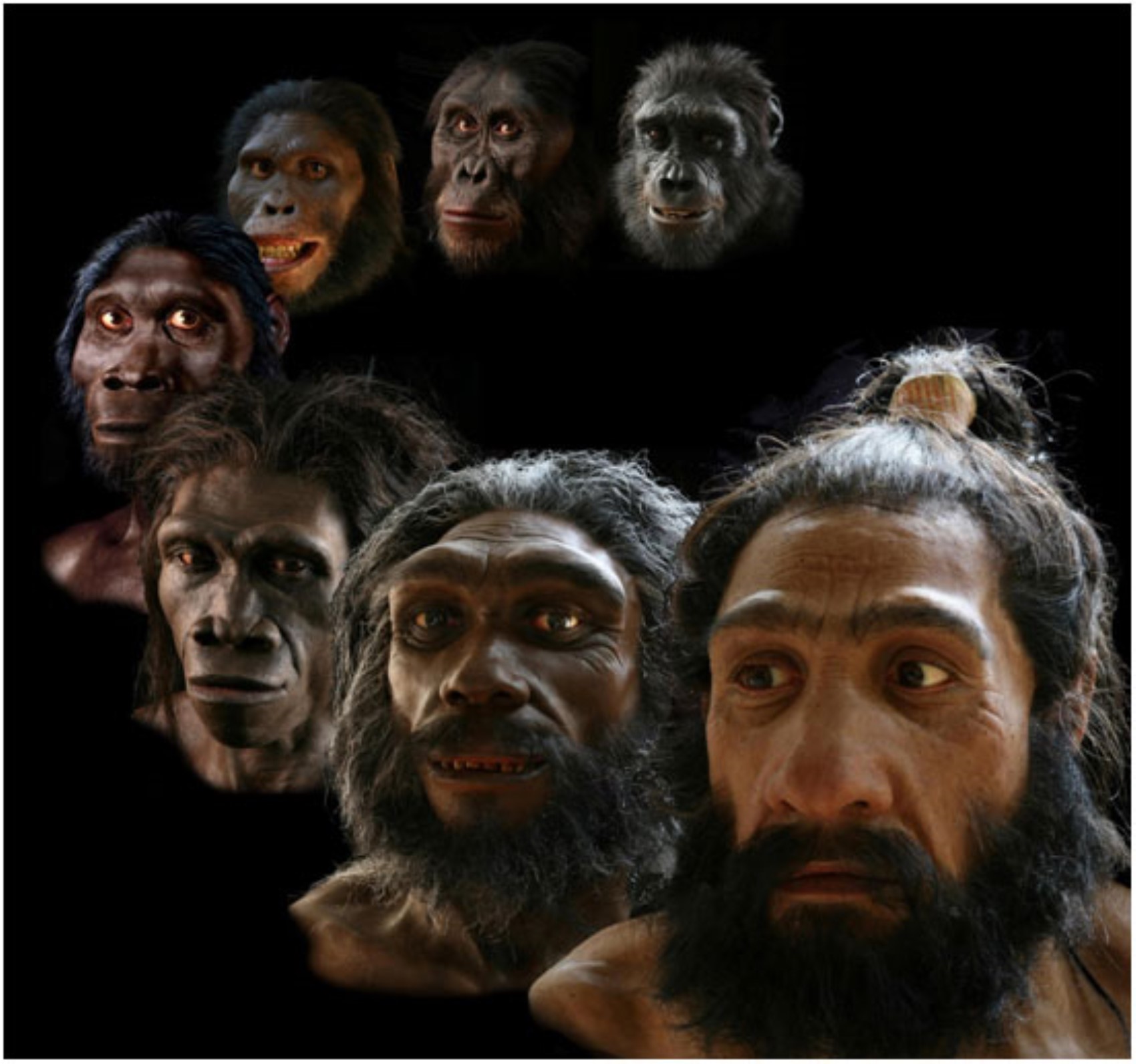
(Evolution of hominids)
The real big behavioral leap in Homo Sapiens occurred 50–70 thousand years ago. At that point, art, jewelry, complex tools, and long-distance trade exploded.
Their appearance was very close to today's African hunter-gatherers.
This leap was important. Because a mind that can make art and produce symbols could one day also erect a stone monument. It didn't know yet, though.
Evolution had darkened their skin to protect against the African sun. This darkness (blackness) changed, increased, or decreased depending on the place where they lived, where the effect of the sun was strong.
Their hair was curly for heat dissipation. They had wide nostrils suitable for hot and humid air. Their bodies were thin and long to resist the heat.
As a result, you could recognize Homo Sapiens if you saw them on the street today.
But if you looked closely, you would feel that something was not quite right: Their face is a bit cruder, their head is a bit longer, their behavior is much simpler.
We are their grandchildren, but the 300 thousand years in between deeply shaped both us and our culture.
So, did this long journey extend to İzmir in Anatolia?
Did it touch the flowers on the mountains of İzmir?
The evidence we have reveals a surprising picture.
Note: The information above has been obtained from various written, visual, and electronic data.
Sefa Taşkın
12.07.2026
Dikili/İzmir
Most Read

Striking picture for Özgür Özel's 'New Party'

Özgür Özel gives a dated response regarding the number of resignations

Forest fire in Antalya brought under control

The PKK opening and Özgür Özel’s path!..

How did the newspapers view Özgür Özel's farewell to the CHP?

What did the CHP do?

Houthis strike Saudi-owned tanker

Özel’s new party move in the world press

The New CHP, against CEHAPE

From self-efficacy to despair